The Wright Brothers and the First Powered Flight
On December 17, 1903, the Wright brothers flew 852 feet at Kitty Hawk. The secret was not power but control — three-axis steering they invented themselves.
Key takeaways
- On December 17, 1903, the Wright Flyer made four powered flights at Kill Devil Hills near Kitty Hawk; the longest covered 852 feet in 59 seconds.
- The breakthrough was three-axis control — elevator, wing-warping, and rudder — the same control scheme every airplane uses today.
- After their 1901 glider underperformed, the brothers built a wind tunnel and tested about 200 wing shapes, discovering the accepted aerodynamic data was wrong.
- Famous rivals chased engine power first; the Wrights treated flight as a piloting problem and solved control before anything else.
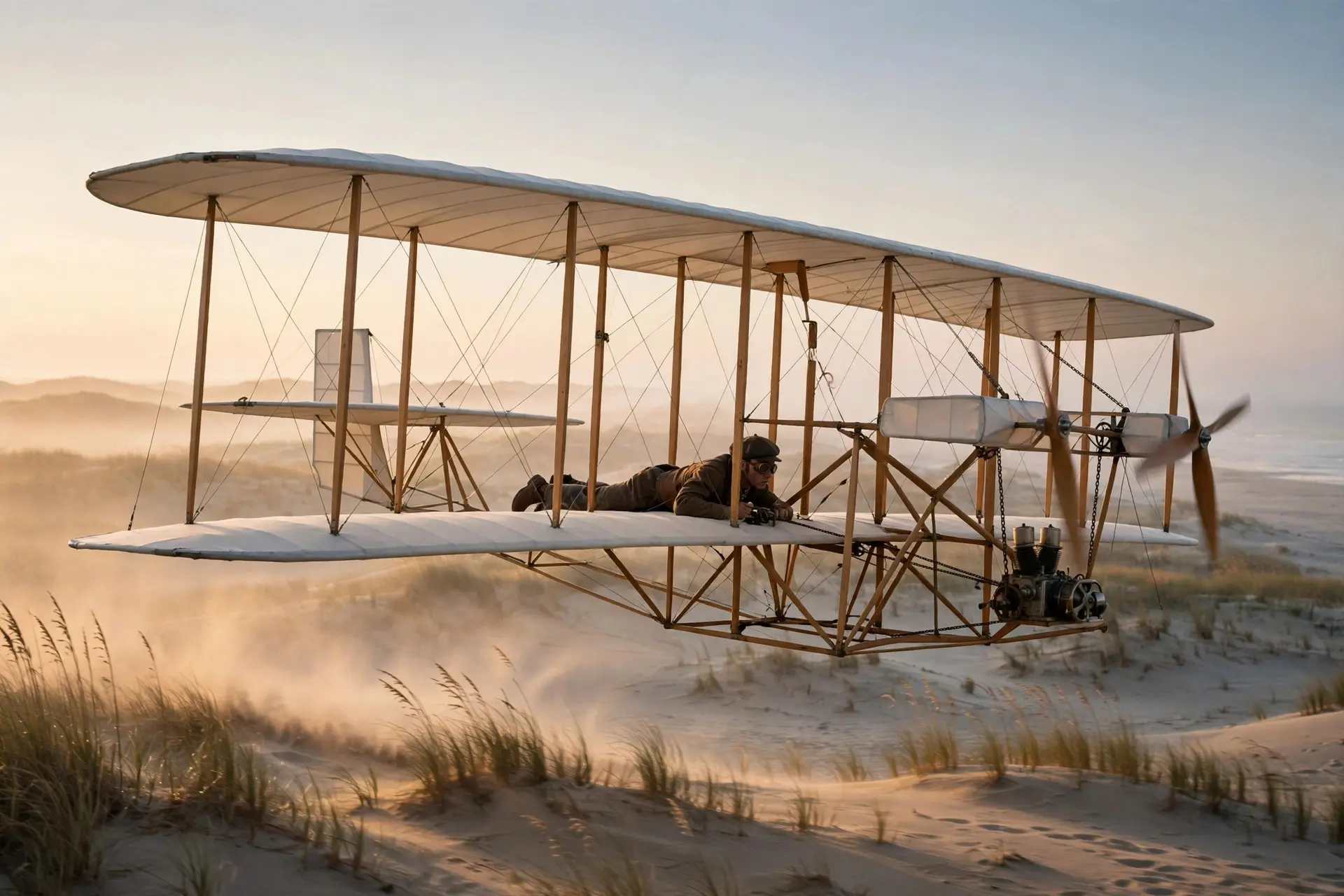
On December 17, 1903, at Kill Devil Hills near Kitty Hawk, North Carolina, two bicycle mechanics from Dayton, Ohio, made four powered flights in the history of controlled, heavier-than-air flight. The longest covered 852 feet in 59 seconds. The machine that flew weighed just over 700 pounds and carried an engine of about 12 horsepower — less power than a modern riding lawnmower. What made it work was not the engine. The Wright brothers succeeded because they treated flying as a piloting problem. While well-funded rivals chased horsepower, Wilbur and Orville Wright solved the one thing nobody else had cracked: how to steer an airplane. Power gets you off the ground; control lets you stay in the air and come back down alive.
What actually happened on December 17, 1903?
The brothers arrived with the Flyer and launched it from a 60-foot track laid on level ground, into headwinds of 22 to 27 miles per hour. Orville won the coin toss and flew first at 10:35 a.m.: 120 feet in 12 seconds, at a ground speed of just 6.8 mph against a 21-mph headwind. Wilbur flew second at 11:20 a.m. — about 175 feet in about 12 seconds. Orville took the third flight at 11:40 a.m., covering about 200 feet in 15 seconds, and a side gust mid-flight forced him to warp the wings to recover lateral balance — the first real test of their control system under power. Wilbur's final flight at noon lasted 59 seconds and covered 852 feet, the longest of the day. Then the day's success destroyed the machine. A gust caught the Flyer on the ground and flipped it end over end, wrecking it beyond repair. The airplane that changed the world never flew again. The brothers' telegram to their father reported "Success four flights… started from level with engine power alone… longest 57 seconds" — the 57 seconds was a transmission error (it was 59), and Orville's name came out misspelled as "Orevelle."
What was the three-axis control breakthrough?
NASA credits the Wrights' decisive invention as three-axis control: a front elevator to pitch the nose up and down, wing-warping to roll the wings left and right, and a rear rudder to swing the nose sideways. The same three controls guide every airplane flying today. The core insight — wing-warping — came to Wilbur in 1899, tested first on a box kite: twist the wingtips in opposite directions to bank the aircraft, the way a bird twists its feathers. They coupled a movable rudder to the warping wires so the pilot could correct the sideways drag the twist created. Their 1902 glider became the first aircraft with full three-axis control, and that control system was the heart of their famous 1906 patent. Critics sometimes note that earlier experimenters also flew gliders. The Wrights' answer was a complete system: a pilot who could command the aircraft in all three dimensions, powered or not.
How did a wind tunnel and propellers make the difference?
After their 1901 glider underperformed, the brothers refused to accept the blame the way others might have. Instead they built a wind tunnel in their Dayton bicycle shop and tested about 200 wing shapes between late October and early November 1901. The tests revealed that the accepted aerodynamic coefficient — Smeaton's coefficient, trusted for decades — was wrong. They redesigned their wings with a shallow, parabolic camber, and the 1902 glider flew beautifully. Then came the propellers. Realizing, as they put it, that "a propeller was simply an airplane wing that turned on a spiral course," they designed two 8.5-foot spruce propellers that spun in opposite directions to cancel each other's torque. Their propellers achieved about 66 percent efficiency — against 40 to 50 percent for 19th-century European propellers and 52 percent for Samuel Langley's much better-funded machine. No manufacturer could supply an engine under 180 pounds producing 8 horsepower, so with mechanic Charlie Taylor they built their own four-cylinder engine.
Every number was earned, not assumed. That discipline is the real contrast with rivals: Langley had Smithsonian backing and a government grant; the Wrights had a bicycle shop, a homemade wind tunnel, and better data.
How did the brothers build an engine when nobody sold one?
Every part of the Flyer was a custom solution. No manufacturer in America could supply an engine weighing under 180 pounds while producing 8 horsepower — the lightest engines on the market were built for automobiles and far too heavy. So the brothers designed their own with their bicycle-shop mechanic, Charlie Taylor: a simple four-cylinder engine that produced about 12 horsepower. The loaded Flyer weighed just over 700 pounds. That engine-to-weight ratio would have been useless without the rest of the system. The wings came from the wind-tunnel data. The propellers — two 8.5-foot spruce blades turning in opposite directions to cancel torque — came from the insight that a propeller was just a wing traveling in a spiral. The control system came from the 1902 glider. The Flyer was not a lucky prototype; it was the integration of four separate solved problems.
Why is the first flight still contested?
The brothers kept quiet for years, partly to protect their patents, and that secrecy fed skeptics. Competing claims — Brazil's Alberto Santos-Dumont, France's Clément Ader — persist in some countries' national histories. But the historical record, including contemporary witnesses and documentation, credits sustained, controlled, powered flight to Kitty Hawk on December 17, 1903. The legacy traveled far beyond North Carolina. A scrap of fabric from the 1903 Flyer later flew to the Moon with Apollo 11, and a postage-stamp-sized piece flew on Mars aboard the Ingenuity helicopter in 2021. The first airplane's material has now flown on three worlds — Earth, the Moon, and Mars. Like the Concorde's later leaps in speed, the Wrights' leap was about refusing to accept the limits everyone else had measured — and measuring better.
Frequently asked questions
How far was the first powered flight?
The first flight on December 17, 1903 lasted 12 seconds and covered 120 feet. The fourth and longest flight that day covered 852 feet in 59 seconds.
Why did the Wright brothers succeed where others failed?
They treated flying as a control problem, not a power problem. Their three-axis control system — elevator, wing-warping, and rudder — let a pilot steer a heavier-than-air craft, which rivals like Langley's team had never solved.
Who was the pilot of the first flight?
Orville Wright flew the first flight at 10:35 a.m.; he and his brother Wilbur alternated, making two flights each that day.
What happened to the 1903 Wright Flyer?
A gust of wind flipped it end-over-end on the ground after the fourth flight, wrecking it beyond repair. It never flew again.