How Did the Assyrians Move Colossal Lamassu Statues?
Assyrian crews hauled 30-ton winged bulls on sledges and rafts to palace gates, and 19th-century diggers faced the same struggle moving them to museums.
Key takeaways
- Lamassu were carved from single stone blocks, some over four metres tall and weighing up to 30 tonnes.
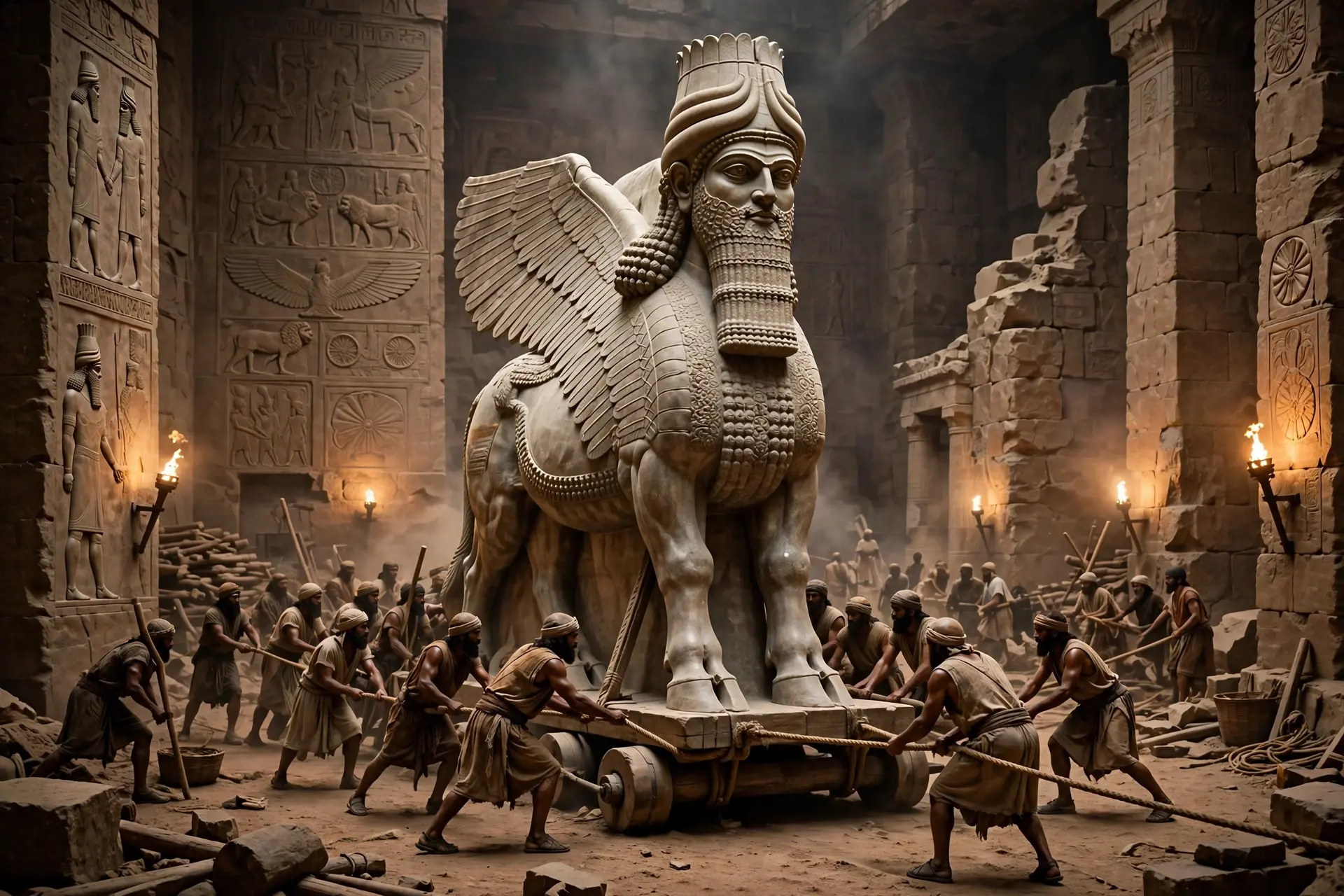
- Assyrian reliefs show the bulls hauled on sledges by dozens of men, with levers and a horn signal controlling the work.
- An official's letter to King Sargon reports boats loaded with bull colossi sinking and having to be hauled up again.
- Layard kept his Nimrud winged lions whole, while the Khorsabad bulls bound for the Louvre were sawn into sections.
- The Chicago lamassu stands over 16 feet tall and weighs about 40 tons, and took three years to reach its museum.
The Assyrians moved their colossal lamassu the hard way: on wooden sledges dragged by gangs of men, then on rafts down rivers, with ropes, levers and a great deal of patience. We know this not from guesswork but from two kinds of evidence the Assyrians left behind: stone reliefs that show the haul in progress, and letters from royal officials complaining about how often it went wrong.
What were the Assyrians actually moving?
A lamassu was a guardian spirit in stone, set in pairs at the entrances and passageways of palaces to turn evil away from the king. The French Ministry of Culture's Khorsabad project describes them as colossal winged human-headed bulls, also called shedu, that stood guard at gateways and helped support the brick vaulting of the passageways above them. They were not decoration added after construction; they were part of the building, and a long cuneiform inscription carved between their hooves recorded the king's titles and the building of his palace. Other ancient builders pursued the same tight, load-bearing fit in stone, as seen in Inca masonry fitted without mortar. Their design is famously clever. The Oriental Institute's factsheet on its Khorsabad bull explains that the figure has five legs rather than four: seen from the side, the bull appears to stride forward, while from the front it appears to stand still. The head is human, wearing a horned crown that marks the figure as divine, and the body carries the mass of a bull with the wings of a bird. Each figure was carved from a single block of stone. The French project puts each bull at more than four metres high and weighing up to 30 tonnes, while the Oriental Institute's example, which guarded the throne room of Sargon II at Khorsabad, stands over sixteen feet tall and weighs approximately forty tons. Moving one of these was not a matter of hiring a bigger cart. It was a state project in its own right.
How did sledges and levers move 30 tonnes?
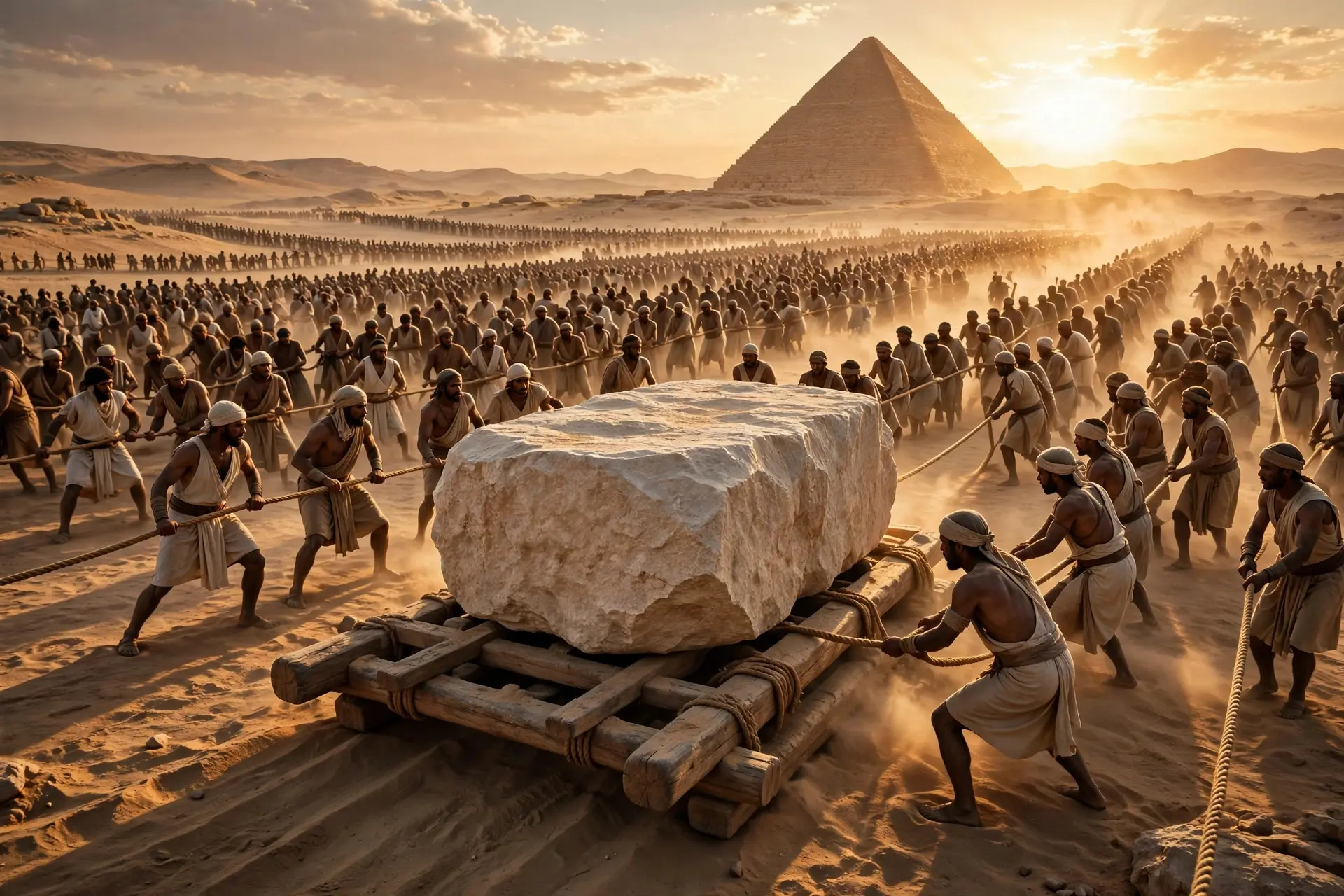
The Assyrians left us a picture of the operation. Stone reliefs from the palace of Sennacherib, son and successor of Sargon II, show the stages of producing a colossus: hewing the monolith from bedrock, removing it from the quarry, and hauling it across country to the city. The Oriental Institute describes one scene in detail: foreign workers hauling a winged bull on a sledge out of the quarry and across a stream, some clearing rocks from the track while others insert a long lever underneath the sledge, the whole operation controlled by a man with a horn who stands on the colossus itself, watched over by the king from his chariot. The French Khorsabad project summarises the method the same way: the bulls were quarried and cut before being pulled on sledges by dozens of men and loaded onto rafts. The sledge spread the load and let the gang drag the stone over prepared ground; the levers broke it free whenever it stuck; the horn signals kept dozens of pullers moving together, because a 30-tonne load punishes any uneven effort instantly. On flat ground, muscle and coordination were the engine. On water, the river did the heavy lifting, and the rafts carried the bulls toward the capital. This was not a technique unique to Assyria. Moving huge stone by sledge, rope and river was the standard heavy haulage of the ancient world, and Egypt's pyramid builders used the same family of methods to shift multi-ton blocks across sand and water. What makes the Assyrian case special is that the Assyrians documented the failures as well as the method.
What went wrong on the way to the palace?
Quite a lot, according to the king's own correspondence. The Oriental Institute factsheet quotes letters written to Sargon II by his officials about the difficulties of transporting the colossi. In one, an official reports that a colleague loaded the bull colossi onto boats, but the boats could not carry the load and sank, and that only with great trouble were the stones hauled up again. The letter is a small masterpiece of bureaucratic understatement: a royal commission, a sunken cargo, and a salvage operation, all in a few lines. The lesson is that the Assyrians were working at the edge of what their technology could manage. A single block that heavy, loaded onto a river boat built of timber and reeds, was always one miscalculation from disaster. The king's personal interest, shown in the reliefs with Sennacherib watching the haul from his chariot, tells the same story: these were prestige objects whose safe arrival mattered enough for the monarch to supervise it. The bulls announced the king's power at his gates, but getting them there tested that power first.
Why did 19th-century diggers saw some bulls apart?
When European excavators reached Assyria in the 1840s, they faced exactly the same problem, with the added difficulty of getting the statues to London or Paris. The French Ministry of Culture notes that the first excavators at Khorsabad and Nineveh resigned themselves to sawing the bulls and other reliefs into sections in order to transport them to museums. The New York University Institute for the Study of the Ancient World draws the contrast sharply: the Khorsabad lamassu bound for the Louvre were cut into smaller sections, while Austen Henry Layard, digging at Nimrud from 1845, insisted on keeping his two colossal winged lions whole, moving them much as they had originally been transported to Nimrud in antiquity. Layard's lions reached London and became a sensation. Smarthistory describes the arrival of a lamassu at the British Museum in 1852, carted into the grand portico before crowds who had never seen anything like it, an event newsworthy enough for illustrated newspapers to engrave. Layard and his protégé Hormuzd Rassam had transported the sculptures from Iraq to the British Museum, and the discovery sparked a wave of Assyrian-inspired art, jewellery and architecture in Victorian Britain. The statues that had guarded an Assyrian king's gates now guarded a museum's entrance, and the public came to stare at them just as ancient visitors once had. The Chicago bull's journey shows how little had changed even in the 20th century. The Oriental Institute's bull had broken into more than a dozen pieces in antiquity, and even in fragments the move was an ordeal. The largest pieces weighed approximately twenty, seven and five tons each. It took fifteen days to travel twelve miles to the Tigris, the only available truck repeatedly breaking down, until it collapsed about three hundred metres from the river and had to be dragged by steel cables the rest of the way. Three days went into manoeuvring one crate onto a boat. Three years after its discovery, the reassembled bull was finally installed in Chicago. That is the real answer to how the Assyrians moved their lamassu. They did it with sledges, levers, gangs of coordinated haulers, river rafts, and a tolerance for failure that modern excavators, with trucks and steel cables, found they still needed. The statues were designed to look effortless and eternal at the palace gates. Everything about getting them there was the opposite: slow, heavy, and one sunk boat away from ruin. The five-legged illusion, striding and standing at once, is a fitting emblem for the whole enterprise, a monument to power that only arrived through stubborn, muscular patience.
Frequently asked questions
What exactly was a lamassu?
A lamassu was a protective guardian figure with a human head, the body and ears of a bull, and a bird's wings, placed in pairs at palace and city gateways. The Oriental Institute notes that the five-legged design makes the bull look striding from the side and standing still from the front.
How heavy were the lamassu statues?
The French Ministry of Culture's Khorsabad project puts each bull at more than four metres high and up to 30 tonnes. The Oriental Institute's Khorsabad bull is larger still, standing over 16 feet tall and weighing approximately 40 tons.
Did the Assyrians really move these statues on sledges?
Yes. Reliefs from Sennacherib's palace, described by the Oriental Institute, show a winged bull being hauled on a sledge out of the quarry and across a stream, with workers clearing rocks and inserting levers beneath the sledge while a man with a horn directs the operation.
Why were some lamassu cut into pieces?
Because moving them whole was so difficult. The French excavators at Khorsabad and Nineveh sawed bulls and reliefs into sections for transport to museums, while Layard at Nimrud insisted on keeping his winged lions intact.
Sources
- Human-Headed Winged Bull from Khorsabad, Oriental Institute, University of Chicago
- Winged bulls | Khorsabad, French Ministry of Culture
- Austen Henry Layard and the early exploration of Nimrud, Institute for the Study of the Ancient World, New York University
- Assyrian Lamassus in Victorian Britain, Smarthistory