How Apollo 11 Landed on the Moon: Inside the Descent
Apollo 11's landing rode on hand-woven computer memory, five program alarms and a fuel gauge that read low. Here is how Eagle reached the Moon on 20 July 1969.
Key takeaways
- Apollo 11 left Earth on 16 July 1969 atop a 111-metre Saturn V, and the lunar module Eagle touched down in the Sea of Tranquility at 20:17 UTC on 20 July.
- Eagle's guidance computer had 2,048 words of erasable memory and 36,864 words of fixed memory, woven by hand from fine wire threaded through or around tiny magnetic rings.
- Four 1202 alarms and one 1201 flashed during the descent because rendezvous-radar signals were eating roughly 13 to 15 percent of the computer's time.
- Controllers believed Eagle landed with well under half a minute of fuel; post-flight analysis found about 45 seconds, because sloshing propellant made the gauge read low.
Apollo 11 reached the lunar surface through a relay of machines and people. A Saturn V rocket threw the spacecraft toward the Moon, a 32-kilogram computer flew the lunar module Eagle most of the way down, and Neil Armstrong took the last stretch partly by hand to steer past a crater ringed with boulders. Eagle settled into the Sea of Tranquility at 20:17 UTC on 20 July 1969, after five computer alarms and a low-fuel warning that turned out to have sounded early. The journey had begun four days before, at 9:32 a.m. local time on 16 July, from Launch Pad 39A at the Kennedy Space Center. The rocket stood 111 metres (363 ft) tall, and the five F-1 engines of its first stage produced about 34 meganewtons (7.6 million pounds) of thrust at liftoff. Three men rode on top: Armstrong, the commander; Edwin "Buzz" Aldrin, who would fly down with him; and Michael Collins, who would stay behind in lunar orbit aboard the command module Columbia.
What computer flew Apollo 11's lunar module?
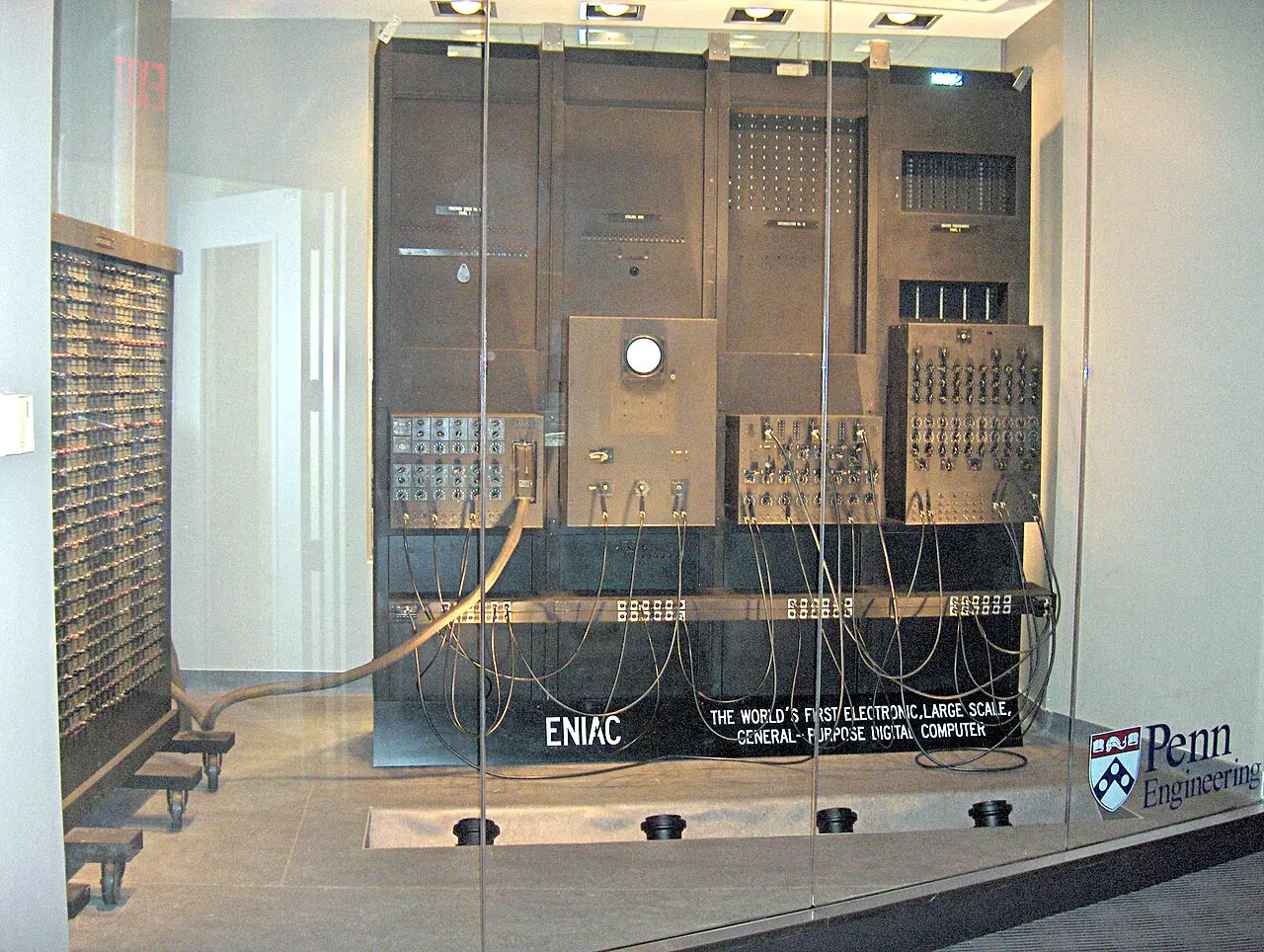
Eagle's brain was the Apollo Guidance Computer, designed at MIT's Instrumentation Laboratory. By modern standards it was minute. It held 2,048 words of erasable memory for working data and 36,864 words of fixed memory for its programs, roughly 4 and 72 kilobytes, in a box weighing about 32 kilograms (70 lb). Less than a quarter of a century earlier, ENIAC had filled an entire room with vacuum tubes. The fixed memory was not stored the way a chip stores code today. It was woven. At Raytheon's plant in Waltham, Massachusetts, workers threaded fine wire through or around rows of tiny magnetic rings, a craft for which the company hired heavily from the local textile trade and the Waltham Watch Company. A wire that passed through a ring read as a 1; a wire that went around it read as a 0. Each module took about eight weeks to make, so the code had to be frozen months before launch. Nobody could patch a woven program the night before. The software came from the team that Margaret Hamilton led at the Instrumentation Lab. Hamilton, who died on 30 September 2026 at the age of 90, oversaw code built around priorities: if the computer ran out of time, it could abandon background chores and keep only the jobs that mattered for flying. Over the next 12 minutes, that idea would be tested for real.
What happened during Eagle's final descent?
Eagle fired its descent engine at about 20:05 UTC. Five minutes later Armstrong called a program alarm and read out the code: 1202. The crew had never met that alarm in training, Armstrong asked Houston for a reading on it, and the decision fell to Steve Bales, the guidance officer. Bales had help that most people at the time never heard about. After a training simulation had caught the team out, flight director Gene Kranz told Bales to write down every alarm the computer could possibly raise. Bales passed the job to Jack Garman, a 24-year-old guidance software specialist, who kept the answers handwritten under a sheet of plastic. A 1202 meant the computer had more work than time and was shedding tasks. As Garman later recalled the moment, the rule was simple: "if it doesn't reoccur too often, we're fine." Bales called go, and Capcom Charlie Duke passed it to the crew. The overload came from Eagle's rendezvous radar, a sensor needed only for the trip back to Columbia. A switch setting let it pour a stream of meaningless signals into the computer. Don Eyles, one of the MIT programmers, later wrote that the problem stole about 13 percent of the machine's time, peaking near 15 percent, on a processor that had little to spare. The software did what it was built to do. It restarted, dropped the low-priority jobs and kept guiding the lander. Four 1202 alarms and one 1201 appeared during the descent, and each time Houston said go. Then the landing site went wrong. Eagle was coming in long, several kilometres past its target, and the computer was steering it toward a large, rugged crater littered with boulders 1.5 to 3 metres (5 to 10 ft) across and larger. Armstrong took partial manual control and flew Eagle on over the rocks, looking for flat ground. That search burned fuel. About 30 metres (100 ft) up, Aldrin reported the low-fuel light, which started a countdown in Mission Control to "bingo", the point at which the crew would have to land immediately or abort. Duke called 60 seconds, then 30. Aldrin said "contact light", the engine stopped, and Armstrong gave the spot its new name, Tranquility Base, before the words Houston had been waiting for: "The Eagle has landed."
Was Eagle really seconds from running dry?
The legend says yes, and in the room it certainly felt that way. Controllers believed the reserve was down to well under half a minute; the Lunar and Planetary Institute gives their figure at touchdown as 17 seconds. Post-flight analysis told a calmer story. NASA's statistical history of Apollo, citing the official mission report, puts the fuel remaining at touchdown at about 45 seconds. The gap came from physics, not luck. As Armstrong tilted and slid Eagle across the boulder field, propellant sloshed inside the tanks and fooled the gauge. A 1971 study at NASA's Langley Research Center found that slosh had made the low-fuel warning come on 30 to 45 seconds early on both Apollo 11 and Apollo 12. Engineers designed a baffle and a modified gauge tube that cut the false warning to under 5 seconds, and flight data from Apollo 14 suggested the fix worked. None of this shrinks the achievement. No one in the cockpit or in Houston knew the reading was off, so every decision was made on the worst-case numbers in front of them. The real margins had been built in advance: software that could triage itself, an alarm list written before anyone needed it, and a commander trained to fly the final stretch himself.
What happened after the landing?
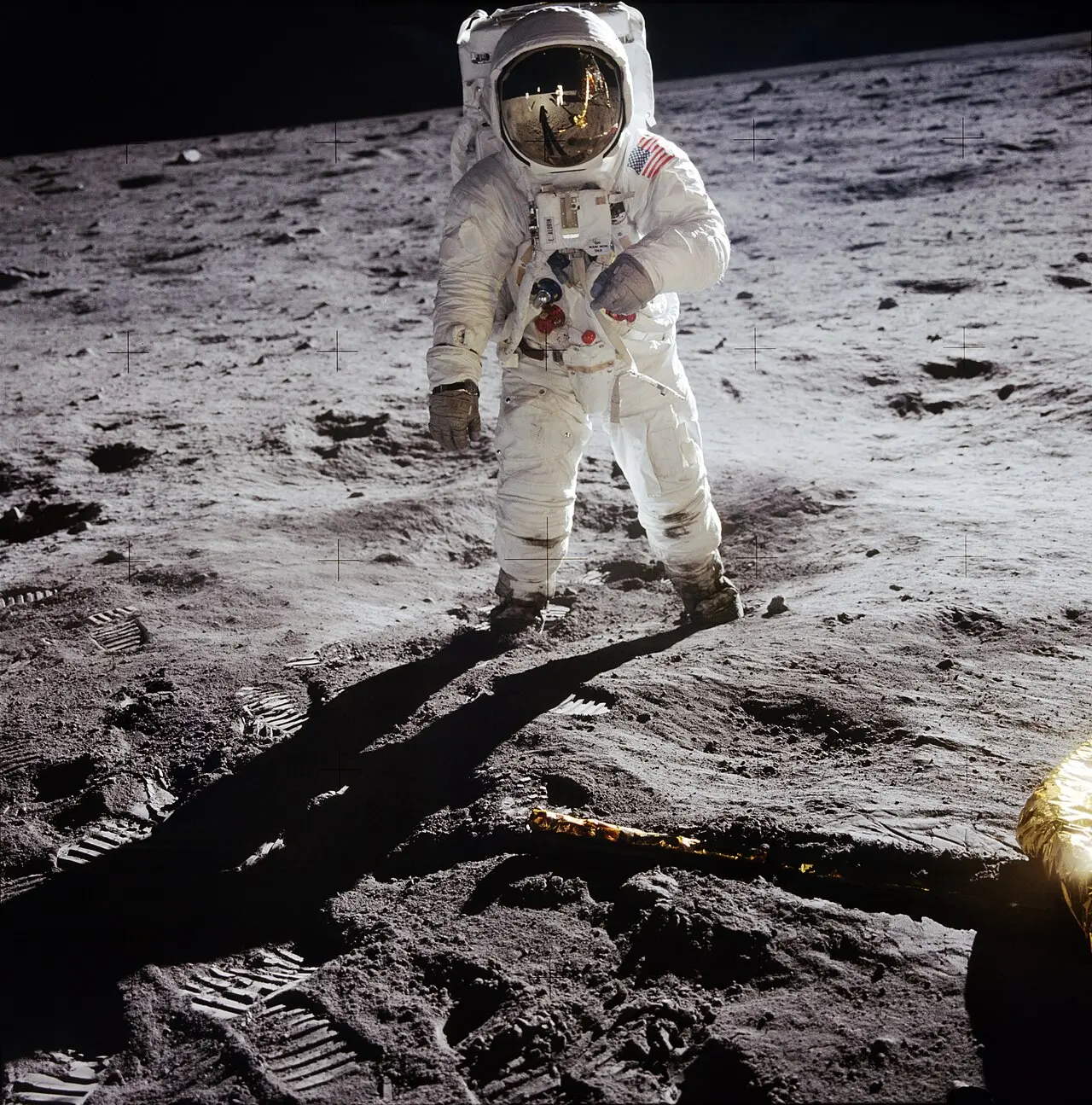
Armstrong and Aldrin spent about two and a half hours working outside, collected roughly 22 kilograms of rock and soil, and lifted off after some 21 hours on the surface. Above them, Collins had spent about 27 hours circling the Moon alone in Columbia, falling around it the way every satellite falls around Earth. The two craft met again in lunar orbit for the trip home. On 24 July the command module splashed down in the Pacific, about 24 kilometres (13 nautical miles) from the recovery ship USS Hornet, ending a flight of a little over 195 hours. The crew went straight into a sealed quarantine facility on board, the start of three weeks of isolation in case they had carried lunar microbes home. The line the world remembers came from Armstrong as he stepped off Eagle's footpad. As the recording is usually heard, he said: "That's one small step for man, one giant leap for mankind." He long maintained that he had said "a man", and a 2016 study of his speech concluded that the audio alone cannot settle it. Apollo 11 is usually told as a story of nerve, and it was one. But the final 12 minutes were also a stress test of engineering choices made years earlier, by people who assumed something would go wrong. The computer's memory was woven by hand, the alarm list was written out on paper, and the fuel gauge was lying. Eagle landed anyway, because the system around the astronauts had been designed to fail gracefully.
Frequently asked questions
What were the 1202 alarms on Apollo 11?
They were overload warnings from Eagle's guidance computer. A rendezvous radar glitch was flooding it with useless signals, so the software restarted, dropped low-priority jobs and kept flying the landing.
How much fuel did Apollo 11 have left when it landed?
Controllers believed the reserve was well under half a minute; the Lunar and Planetary Institute gives their figure as 17 seconds. Post-flight analysis found about 45 seconds, because propellant slosh had triggered the low-fuel warning early.
Who decided Apollo 11 could keep landing despite the alarms?
Guidance officer Steve Bales made the go call in Mission Control. He was backed by Jack Garman, a 24-year-old software specialist who kept a handwritten list of every alarm the computer could raise.