How the Taj Mahal Was Built: Grief, Marble and Symmetry
Shah Jahan began the Taj Mahal after Mumtaz Mahal died in 1631. Here is how 20,000 workers, Makrana marble and optical tricks produced its famous symmetry.
Key takeaways
- Shah Jahan ordered the Taj Mahal after Mumtaz Mahal died in childbirth in 1631, delivering the couple's 14th child; the tomb was finished by 1648 and the complex by 1653.
- About 20,000 workers and some 1,000 elephants built it, wrapping a brick core in white marble from Makrana in Rajasthan.
- Court historian Abdul Hamid Lahori records that wells filled with stone were sunk along the riverbank to carry the foundations.
- Inscriptions are lettered larger higher up so they look even from the ground, and the minarets lean slightly outward so a falling tower would miss the tomb.
- Shah Jahan's cenotaph, added beside Mumtaz Mahal's after his death in 1666, is the only asymmetrical element in the composition.
The Taj Mahal exists because the Mughal emperor Shah Jahan lost his wife: Mumtaz Mahal died in childbirth in 1631, delivering the couple's 14th child. He answered with a tomb designed as a vision of her home in paradise, raised over about two decades by some 20,000 workers in white marble from Makrana in Rajasthan. Its famous perfection is part engineering and part optical design, arranged to look flawless from where the visitor stands. The love story is real, but it is not the whole story. The tomb also displayed the power of an emperor at the height of Mughal prosperity, and almost everything about it, from the foundations to the size of the lettering, was calculated.
Why did Shah Jahan build the Taj Mahal?
Mumtaz Mahal, born Arjumand Banu Begum, married the prince who would become Shah Jahan in 1612 and travelled with him across the empire, even on military campaigns. When she died, the chroniclers of his reign recorded his grief in unusual detail. Like most Mughal tombs, the monument he ordered was meant to be paradise brought down to earth, in this case a picture of the house Mumtaz would occupy in heaven. Its Qur'anic inscriptions dwell on the Day of Judgement and on the paradise promised to believers. It was also a statement. Shah Jahan ruled from 1628 to 1658, and his court historian Muhammad Amin Qazwini promised that the building would be "a masterpiece for ages to come". The complex is almost a kilometre long, and the scholar Ebba Koch, who spent a decade measuring it, has called it "the biggest mausoleum if not in the world, at least in Asia." Some historians read it as political theatre too. In 1979 Wayne Begley argued that the complex evoked the throne of God on the Day of Judgement, borrowing that authority to glorify Shah Jahan's reign. Koch rejects the reading, partly because the Qur'an's Throne verse is missing from the inscriptions.
How was the Taj Mahal actually built?
Work began within months of her death, in 1631 or 1632 depending on the source. The riverfront terrace came first, a red sandstone platform about 300 metres long that still forms the complex's face toward the Yamuna. Building on a riverbank demanded deep support. According to the court historian Abdul Hamid Lahori, the builders sank a row of wells beside the river and packed them with stone to bear the weight above. As at Machu Picchu, some of the most important work is buried out of sight. The tomb that rose on that base is not solid marble. Its core is lakhauri, a traditional earthen brick, sheathed in white Makrana marble, while the gateway, mosque and other buildings use red sandstone quarried around Sikri and Dholpur. About 20,000 workers took part, with some 1,000 elephants hauling materials. The workforce is traditionally said to have drawn on specialists from far beyond Agra — sculptors from Bukhara, calligraphers from Syria and Persia, inlay workers from southern India and stonecutters from Baluchistan. The decoration is pietra dura, known in India as parchin kari, in which semi-precious stones such as jasper, jade, lapis lazuli and turquoise are cut to shape and set flush into the marble to form flowers and vines. The official site counts 28 different gems and decorative stones in the scheme. The main tomb was finished by 1648, and the gardens and outlying buildings by 1653. Who designed it is less certain than you might expect. Custom at the time credited a building to the ruler who paid for it, not to the people who drew it. The name most often given is Ustad Ahmad Lahori, later credited with Delhi's Red Fort, but contemporary sources mention the design team only in passing.
What tricks make the symmetry look perfect?
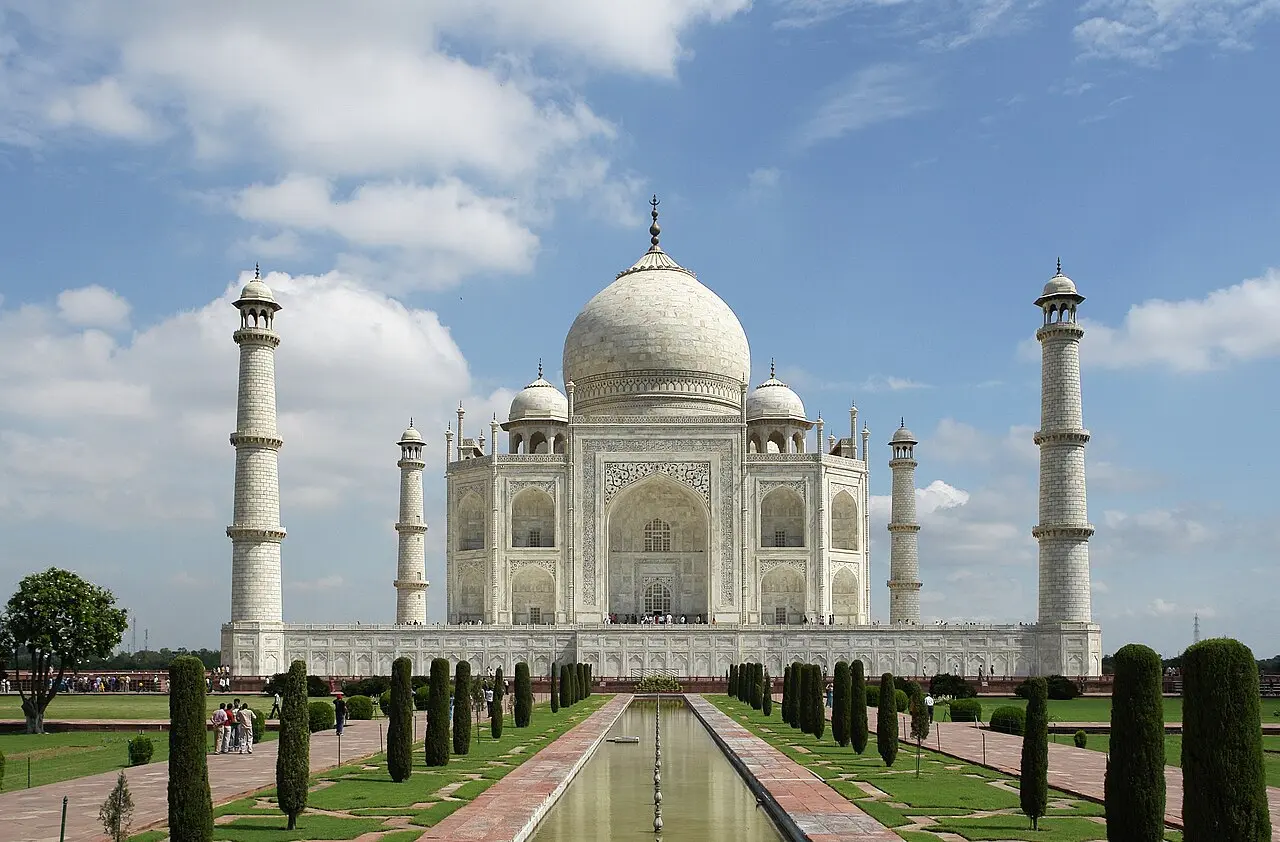
The plan follows a principle the Mughals called qarina: strict mirror symmetry along a central axis, typically with two matching buildings framing a dominant one. At the Taj Mahal the rule outranked function. West of the tomb stands a mosque. East of it stands a near-identical building, the jawab, or "answer", built above all to balance the mosque — though it may have housed visitors who came to observe the anniversaries of Mumtaz's death. Its pool, mirroring the mosque's ablution tank, has no known function.
The builders also corrected for the human eye. The Qur'anic inscriptions framing the great arches, laid out by the calligrapher Amanat Khan, who signed his work inside the dome, use slightly larger letters on the higher panels, so the text does not seem to shrink as it rises. The four minarets, each about 40 metres tall, stand at the corners of the marble platform and lean very slightly outward, so that if one ever collapsed it would fall away from the tomb. And the dome is double: the ceiling visitors see from inside, about 24 metres up, sits far below the outer shell that dominates the skyline. There is one famous break in the symmetry, and it belongs to the emperor himself. Mumtaz Mahal's cenotaph is the focus of the central chamber. Shah Jahan's, added beside hers after his death in 1666, is the only asymmetrical element in the whole composition.
Which stories about the Taj Mahal are true?
Visitors are often told that Shah Jahan planned a black-marble twin for himself on the far bank. Whatever he may once have intended, it was never built. What excavators found directly opposite, at the Mehtab Bagh, was a garden: a square about 300 metres on each side, laid out in line with the Taj, with a large octagonal pool. The emperor's sad final years, on the other hand, are history. In 1658 his son Aurangzeb deposed him and kept him under house arrest in the fort at Agra, where he could look across at the tomb until his death in 1666. He was buried beside Mumtaz. The detail that he gazed at it through a diamond set in the wall at just the right angle is, even on the official tourism website, presented as legend. The monument's later scars are real too. During the 1857 uprising, British soldiers and officials prised precious stones and lapis lazuli out of its walls; like the iron clamps dug from the Colosseum, they were worth more loose than in place. Repair came under Lord Curzon, viceroy of India from 1899, whose restoration ran until 1908 and also laid out the English-style lawns that visitors cross today. A UNESCO World Heritage Site since 1983, the Taj now faces a quieter threat. Air pollution from factories and traffic endangers the marble, and India's Supreme Court has ordered protective measures, including closing some factories and keeping vehicles away from the monument. The Taj Mahal's serenity is the product of hard calculation. A grieving emperor supplied the motive and the money, but the effect depends on stone-filled wells, a brick core in a marble skin, lettering scaled to the human eye and a plan that put symmetry ahead of use. Nearly four centuries on, the hardest part of keeping it perfect is protecting that marble from the city that has grown up around it.
Frequently asked questions
Why was the Taj Mahal built?
Shah Jahan built it as a tomb for Mumtaz Mahal, who died in childbirth in 1631 while delivering the couple's 14th child. It was designed as an earthly vision of her home in paradise, and also as a statement of Mughal power.
How long did it take to build the Taj Mahal?
Work began in 1631 or 1632. The main tomb was finished by 1648, and the gardens and outlying buildings by 1653, so the whole complex took a little over two decades.
Was there a plan for a Black Taj Mahal?
The black-marble twin across the river was never built. Excavation of the Mehtab Bagh on the opposite bank revealed a square garden aligned with the Taj, with a large octagonal pool.
Sources
- History of The Taj Mahal, Taj Mahal Official Website
- Taj Mahal - UNESCO World Heritage Centre, UNESCO World Heritage Centre
- Shah Jahan | Facts, Mughal Dynsaty, Emperor, Taj Mahal, India, & Family | Britannica, Encyclopaedia Britannica
- The Taj Mahal Story, Taj Mahal Official Website
- The Myth of the Taj Mahal and a New Theory of Its Symbolic Meaning, Wayne E. Begley, The Art Bulletin
- Mehtab Bagh | Welcome to UP Tourism-Official Website of Department of Tourism, Government of Uttar Pradesh, India, UP Tourism
- Overview, Taj Mahal Official Website