How Did Imhotep Build Egypt's First Stone Pyramid?
Imhotep turned a flat royal tomb into Egypt's first pyramid by stacking stone mastabas and copying perishable buildings in limestone, built to last eternity.
Key takeaways
- Imhotep enlarged a flat mastaba tomb in stages until it became a six-stepped pyramid about 61 metres tall.
- The Saqqara complex translated earlier mud-brick, wood and reed architecture into permanent stone.
- The walled complex measured 277 by 544 metres and held courtyards, shrines and dummy buildings for royal ritual.
- Beneath the pyramid lay burial chambers for Djoser and 11 members of his family, reached by subterranean corridors.
- Imhotep, Djoser's vizier, was later deified, one of only two Egyptian commoners to receive that honour.
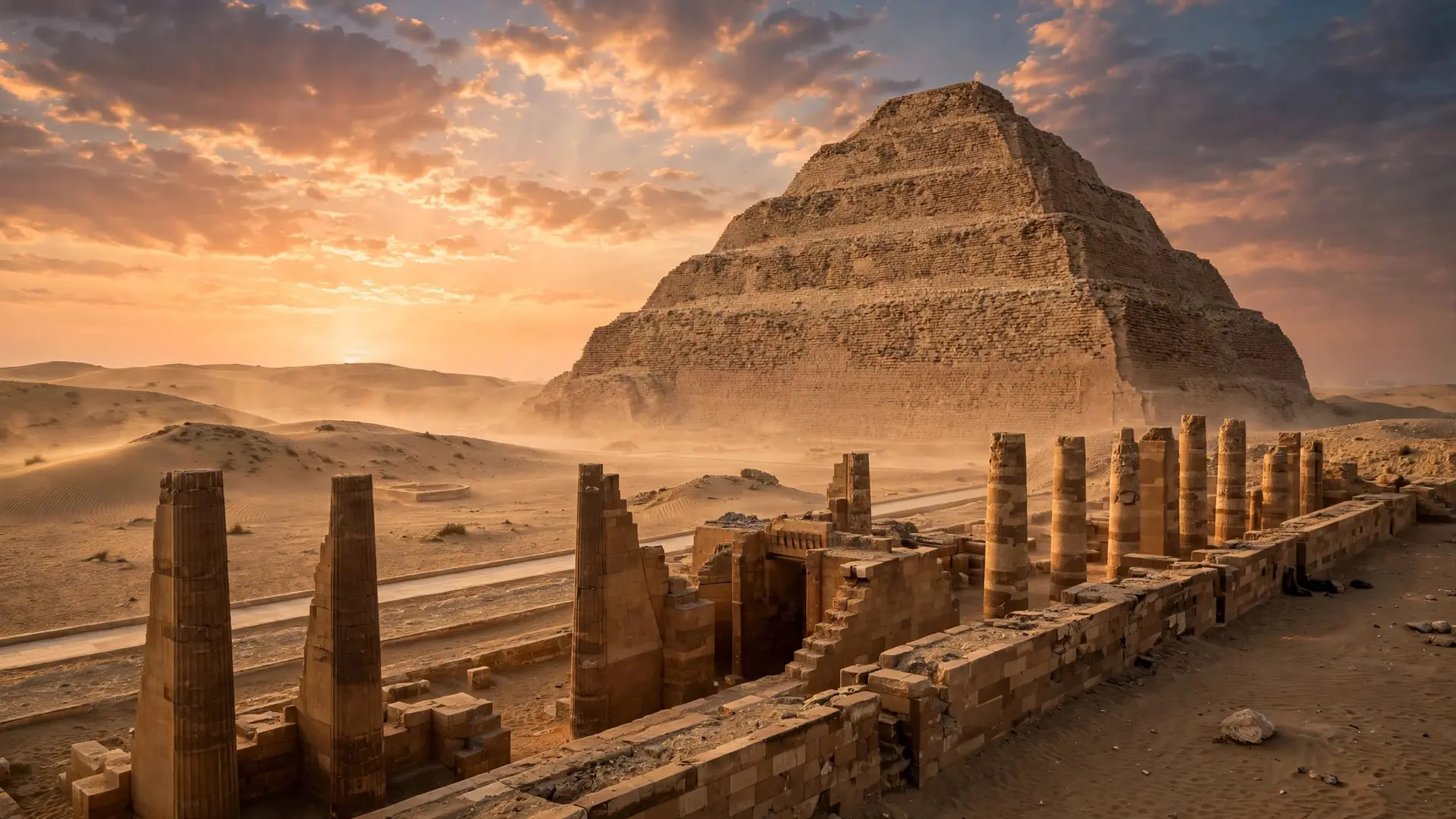
Imhotep did not begin with a pyramid. He began with a flat-topped rectangular tomb, the mastaba, and then did something no builder before him had dared: he enlarged it upward, step by step, until a tomb became a mountain of stone. The Step Pyramid at Saqqara was not drawn up whole and then executed. It grew, in stone, as its architect's ambition grew with it.
How did a flat tomb become a pyramid?
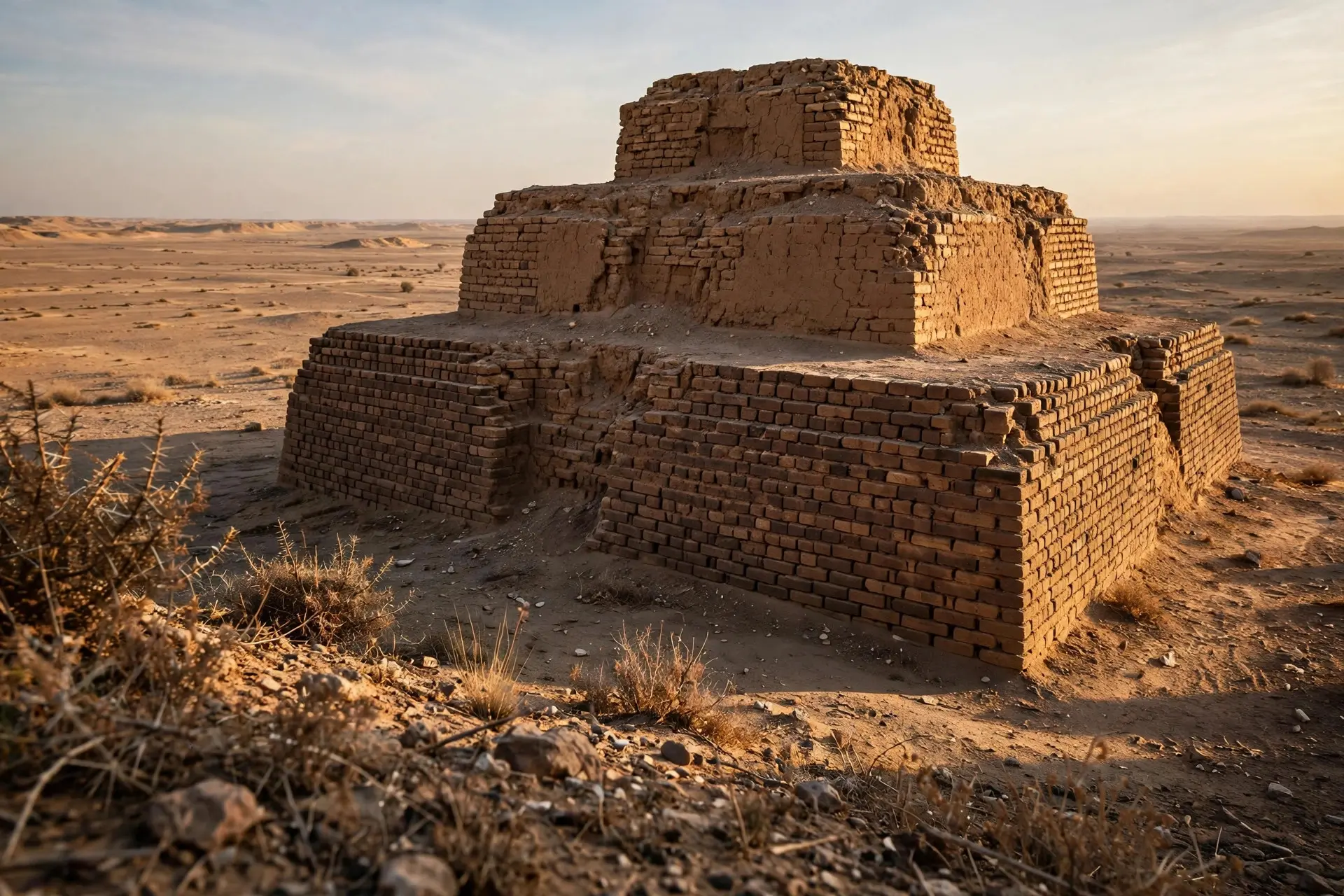
Before Djoser, Egyptian royal tombs were mastabas: low, bench-shaped structures of mud brick or small stone raised over a burial shaft. The Global Egyptian Museum records that Djoser's tomb was originally conceived as a huge mastaba, then gradually enlarged into a six-stepped structure rising to about 60 metres at the centre of the complex. Each enlargement stacked a smaller mastaba-like tier on top of the last, so the finished monument reads as a staircase climbing toward the sky. Britannica puts the final height at about 200 feet, or 61 metres, with six diminishing tiers originally covered in gleaming white limestone. The four faces of the base were generally oriented to the cardinal points, and the whole mass stood in the desert outside Memphis, Djoser's capital, where it dominated the skyline. The trick was not height alone. A mastaba is a solid, stable shape, and stacking smaller versions of it kept the structure stable as it rose. Imhotep's genius was to see that a familiar form, repeated and reduced, could become something entirely new.
Why build the whole complex in stone?
The pyramid is only the centrepiece. Around it Imhotep laid out an entire ceremonial city for the dead king, and he built all of it in stone. The Global Egyptian Museum gives the enclosure as 277 by 544 metres, ringed by a high wall with one real door and fourteen false ones. Britannica measures the wall at more than a mile long and originally 34 feet high, and describes the site as a vast city of the dead.
Here is where the design turns strange and brilliant. Much of the complex was not functional architecture at all. It held courtyards connected with Djoser's Sed Festival, the jubilee rite in which a king renewed his power; a southern tomb; shrines interpreted as representations of Upper and Lower Egypt; a serdab, a sealed chamber holding a statue of the king; and rows of chapels and colonnades. Britannica notes that the pyramid was a translation of earlier Egyptian architecture into stone, and many of these buildings reproduce in limestone the wood, reed and mud-brick forms of ordinary Egyptian construction, right down to details that serve no structural purpose in stone. They were, in effect, stage sets for eternity: buildings the king's spirit would use forever, made of a material that would not rot, burn or wash away. That choice is the real revolution. Earlier monuments used stone sparingly. Imhotep committed an entire royal complex to it, betting that a workforce trained in mud brick could learn to quarry, cut and lay stone at monumental scale. The gamble worked, and it set the template for everything that followed, from the smooth-sided pyramids of the 4th dynasty to the stone temples of later centuries. The same leap from perishable to permanent thinking runs through other ancient building traditions, though none made it as early or as completely as Saqqara; compare, for instance, how later engineers learned to raise stone monuments upright rather than merely pile them high.
What lies beneath the pyramid?
A pyramid that is only a pile of stone would be impressive enough. What makes Saqqara extraordinary is what runs underneath it. Britannica describes an underground structure of unprecedented size and complexity, with galleries and some 400 rooms. The Global Egyptian Museum adds that both the pyramid and the southern tomb have subterranean corridors, some decorated with blue faience tiles bearing reliefs of the king performing rituals during his royal jubilee. Beneath the pyramid itself were the burial chambers of the king and 11 members of his family. This was not a single royal grave but a family necropolis, dug into the rock before the stone tiers rose above it. The scale of the underground work helps explain why the project took so long and why it mattered so much: the pyramid was the visible crown of a hidden world, a palace below ground to match the ceremonial city above. Later pyramid builders would simplify the underground arrangements, but none would match Saqqara's labyrinthine ambition.
The logistics behind all this are the least documented part of the story, and honesty requires saying so. No construction plan from Imhotep's workshop survives, and no text explains how his crews organised the quarrying or the lifting. What survives is the building itself, and the enlargement sequence archaeologists read in its masonry. That evidence supports a picture of a project that learned as it went: each tier a larger experiment, each stage proof that the previous one had held. The contrast with later pyramid building is instructive. By the time crews were hauling multi-ton blocks to Giza, they were working from a century of accumulated stone-working experience that began at Saqqara.
Who was Imhotep, and why do we still know his name?
Imhotep was Djoser's vizier and chief minister, and Britannica credits him as the architect of the Step Pyramid. His standing at court is confirmed by an inscription bearing his name on a statue of Djoser found at Saqqara, listing titles including chief of the sculptors and chief of the seers. No contemporary account describes him as a practising physician, but Britannica notes that the pharaoh's chief magician frequently also served as chief physician, and his later reputation strongly suggests medical skill. That reputation outlived him by millennia. Not until the Persian conquest of Egypt in 525 BCE, Britannica records, was Imhotep elevated to a full deity, joining the great triad of Memphis. He was one of only two Egyptian commoners ever fully deified, and in Greece he was identified with Asclepius, god of medicine. His temples at Memphis and Philae drew sufferers who slept there hoping the god would reveal remedies in their dreams. A builder became a god of healing: the strangest afterlife of any architect in history, and a measure of how completely his contemporaries understood that something unprecedented had happened at Saqqara. The Step Pyramid still stands because Imhotep's central insight was right. Buildings made of perishable materials serve the living; buildings made of stone serve the dead forever. He did not invent the pyramid in a single stroke. He enlarged a tomb, copied a wooden world in limestone, dug a palace beneath it, and walled the whole thing in as a city for one man's eternity. Every stone monument that followed in Egypt, and much of the stone architecture of the ancient world beyond it, descends from that first staircase in the desert.
Frequently asked questions
Was the Step Pyramid planned as a pyramid from the start?
No. According to the Global Egyptian Museum, the tomb was originally conceived as a huge mastaba and was gradually enlarged to a six-stepped structure, so the pyramid grew in stages rather than from a single fixed blueprint.
Why is Imhotep called the first named architect?
Britannica describes him as the world's first named architect and credits him with designing the Step Pyramid for Djoser, first king of the 3rd dynasty. An inscription bearing his name on a statue of Djoser found at Saqqara lists titles including chief of the sculptors.
What else is inside the Saqqara complex besides the pyramid?
The walled enclosure held open courtyards connected with Djoser's Sed Festival, a southern tomb, shrines representing Upper and Lower Egypt, a serdab holding a statue of the king, and many other buildings, all built in stone.
How tall is the Step Pyramid?
Britannica gives its height as about 200 feet, or 61 metres, in six diminishing tiers, originally covered in gleaming white limestone.
Sources
- Step Pyramid of Djoser, Encyclopaedia Britannica
- Imhotep, Encyclopaedia Britannica
- Step Pyramid, The Global Egyptian Museum