Solar System: A Tour of Our Cosmic Neighborhood
Born 4.6 billion years ago from a collapsing cloud, the Solar System stretches far beyond Pluto. Get a real sense of its scale, its birth story and its moons.
Key takeaways
- Roughly 4.6 billion years ago a collapsing cloud of gas and dust gave birth to the Solar System, and the Sun still holds about 99.8% of its mass.
- Shrink the Sun to a 1-meter ball and Earth becomes a 9 mm bead 107 m away, Neptune sits 3.2 km off, and the Oort Cloud's outer edge lies about 10,700 km out.
- Voyager 1 left the heliosphere in 2012 and is due to reach one light-day from Earth on 18 November 2026.
- NASA's counts, updated in September 2026, give Jupiter 115 moons, Saturn 293, Uranus 29 and Neptune 16, for 456 moons around the eight planets.
- Models such as the Nice model and the Grand Tack suggest the giant planets migrated after forming, reshaping the young Solar System.
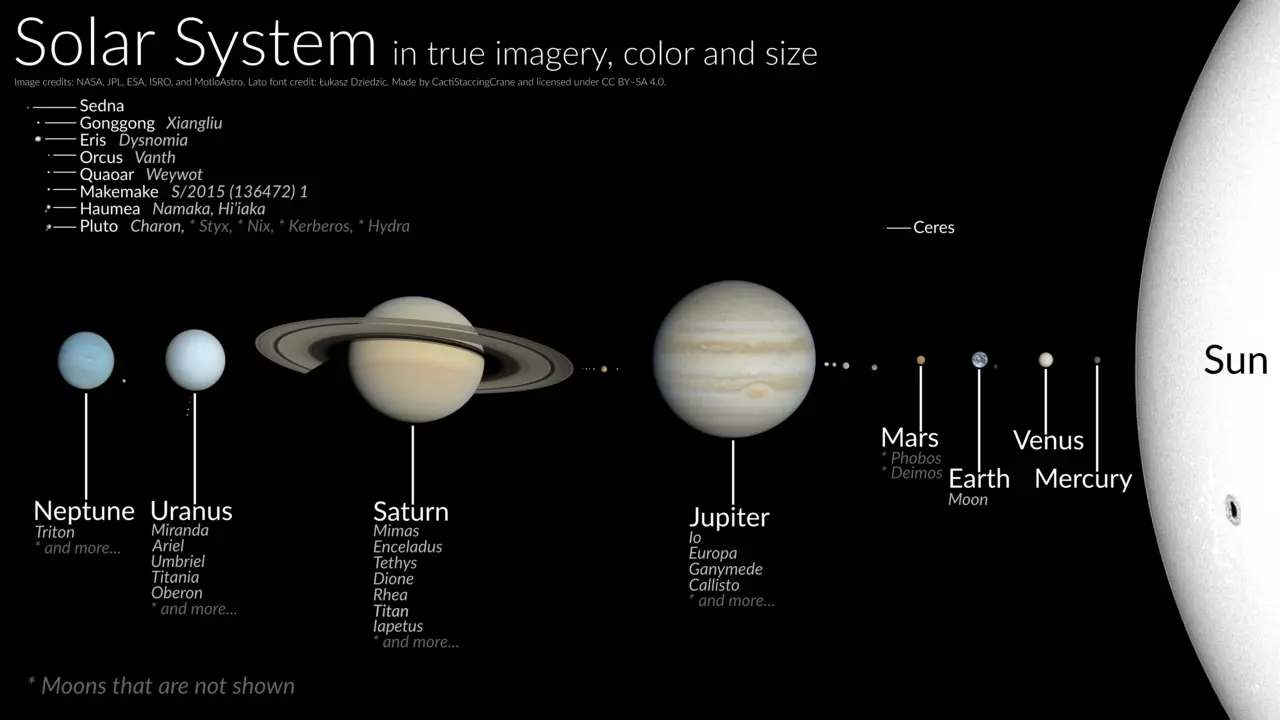
The Solar System is the Sun and everything its gravity holds: eight planets, five officially recognized dwarf planets, hundreds of moons and countless asteroids and comets. Its story began with a cold cloud of gas and dust that fell in on itself some 4.6 billion years ago. It is also far bigger than the tidy diagrams in textbooks suggest, with its outermost icy fringe thought to lie more than a light-year from the Sun.
How did the Solar System form?
The raw material was a wispy cloud inside a larger nebula. At some point it collapsed, possibly squeezed by the shockwave of a nearby exploding star, according to NASA. As it fell inward its spin quickened and it spread into a flat disk, with most of the material piling up at the center. Pressure and heat there grew until hydrogen began fusing into helium, and the Sun switched on. The Sun swallowed almost everything. It still holds about 99.8% of the Solar System's mass, and its volume could hold 1.3 million Earths. The planets formed from the scraps left over in the disk, as dust grains stuck together, grew into boulders and then into bodies that collided and merged. Temperature decided what kind of planets each region could build. Close to the young Sun, ices and gases could not survive the heat, so only rock and metal were available, and the result was four small rocky worlds: Mercury, Venus, Earth and Mars. Farther out, beyond a boundary astronomers call the frost line, water and other compounds froze into solid ice. With far more raw material on hand, planets there grew big enough to pull in vast envelopes of gas, becoming the gas giants, Jupiter and Saturn, and farther out the ice giants, Uranus and Neptune. The giants were quick. Computer models suggest Jupiter and Saturn formed within a few million years, while the rocky planets kept growing for tens of millions of years. Everything that survived has been circling the Sun ever since for the same reason a satellite stays up: each world is falling sideways fast enough to keep missing.
How big is the Solar System, really?
Most pictures of the Solar System lie about distance, because a true-scale drawing would be almost entirely empty. Try a model instead. Shrink the Sun to a ball 1 meter across. Earth becomes a bead about 9 millimeters wide, orbiting 107 meters away, roughly the length of a soccer field. Jupiter sits about 560 meters out. Neptune, the outermost planet, is 3.2 kilometers away. Light offers another yardstick. Sunlight takes about 8 minutes and 20 seconds to reach Earth, around 43 minutes to reach Jupiter and more than four hours to reach Neptune. NASA's Voyager 1, launched in 1977 and still sending data, is now so far away that its radio signals are approaching a full day in transit. NASA expects the probe to reach one light-day from Earth, about 25.9 billion kilometers, on 18 November 2026. In the 1-meter model, that is about 18.6 kilometers from the Sun. And the planets are only the inner neighborhood.
What lies beyond the planets?
Between Mars and Jupiter orbits the main asteroid belt, made of leftover building blocks that never came together into a planet. It is far emptier than science fiction suggests: all its asteroids combined weigh less than Earth's Moon. Past Neptune lies the Kuiper Belt, a ring of icy bodies that includes Pluto and most of the other dwarf planets found so far. Pluto's place there is why it lost its planetary status. In 2006, the International Astronomical Union decided that a planet must orbit the Sun, be massive enough for its gravity to pull it round, and have cleared the neighborhood around its orbit. Pluto passes the first two tests but shares its zone with many other Kuiper Belt objects, so it became a dwarf planet. That did not make it dull: NASA's New Horizons flew past in July 2015, then visited the distant Kuiper Belt object Arrokoth on 1 January 2019. The Sun's influence reaches farther still. Its solar wind blows a vast bubble called the heliosphere. Somewhere between 80 and 100 astronomical units out (one astronomical unit, or AU, is the Earth-Sun distance of about 150 million kilometers), that wind slows sharply as it runs into interstellar gas. Beyond it lies the heliopause, where the hot, thin solar wind finally meets the cold, denser material between the stars. Voyager 1 crossed into interstellar space in 2012, and its twin, Voyager 2, followed on 5 November 2018.
Yet the Sun's gravity has not run out. NASA describes the Oort Cloud as a thick shell of icy, comet-like objects stretching from about 5,000 to 100,000 AU, perhaps as far as 1.6 light-years away. Nobody has ever seen it directly; its existence is inferred from comets and computer models. In the 1-meter model, its outer edge would be some 10,700 kilometers from the Sun, not far short of the real Earth's 12,700-kilometer width.
How many moons are there?
The answer keeps changing. When Galileo turned an early telescope on Jupiter in 1610, he found four large moons, a discovery that helped dethrone Earth as the center of everything. Mercury and Venus have none, Earth has one and Mars has two. The giants are another matter. NASA's moon pages, updated in September 2026, list 115 officially recognized moons for Jupiter, 293 confirmed moons for Saturn as of August 2026, 29 for Uranus and 16 for Neptune. That makes 456 moons around the eight planets. Saturn's count has climbed rapidly in recent years as survey teams pick out ever fainter objects, so any figure printed today should be read with a date attached. Pluto has five moons of its own, and moons also circle some asteroids and other distant icy bodies.
Is the Solar System's birth story settled?
Not quite. The tidy picture of planets forming where they orbit today has been challenged by computer simulations suggesting that the giant planets moved after they were born. In 2005, a team of four astronomers, Tsiganis, Gomes, Morbidelli and Levison, published three linked papers in Nature describing what became known as the Nice model. In it, the giant planets stayed stable for a long stretch and then rapidly migrated, a shake-up that could explain the shapes of their orbits, the swarms of Trojan asteroids sharing Jupiter's path and a possible spike in impacts on the Moon about 700 million years after the planets formed. In 2011, Kevin Walsh and colleagues proposed the Grand Tack in the same journal. In their simulations, Jupiter drifted inward through the gas disk to about 1.5 AU, roughly where Mars orbits today, then reversed course along with Saturn. That excursion would have cut off the disk of rocky material at about 1 AU, which could explain why Mars ended up so small, and it would have scattered and then refilled the asteroid belt. Neither scenario is final, and new data on asteroids, comets and distant planetary systems keep testing them. The Solar System is a 4.6-billion-year-old survivor of a collapsing cloud, dominated by one star that holds nearly all its mass. Its planets crowd into a small central zone, while its icy outskirts may stretch 1.6 light-years into space. We are still counting its moons and still rewriting the story of how it was built.
Frequently asked questions
How old is the Solar System?
About 4.6 billion years. It formed when a cloud of gas and dust collapsed, possibly squeezed by the shockwave of a nearby exploding star, into a spinning disk with the young Sun at its center.
Why are the inner planets rocky and the outer planets giants?
Close to the young Sun it was too hot for ice and gas to survive, so only rock and metal could build planets. Farther out, ices froze solid, giving growing planets enough material to sweep up huge envelopes of gas.
Where does the Solar System end?
It depends on the definition. The Sun's wind gives way to interstellar space at the heliopause, which the Voyager probes crossed in 2012 and 2018, but the Sun's gravity holds the hypothesized Oort Cloud as far as 1.6 light-years away.
How many moons are in the Solar System?
The eight planets have 456 known moons according to NASA's counts as of September 2026, led by Saturn with 293 and Jupiter with 115. Dwarf planets and asteroids have more, and the totals keep rising.