The Telescope: How We Learned to See the Universe
In 1608 a Dutch spectacle-maker sought a patent for a simple tube with two lenses. Within two years, it would dethrone Earth from the center of the universe.
Key takeaways
- In October 1608, Dutch spectacle-maker Hans Lipperhey filed the first documented patent application for a two-lens spyglass — and was refused, because the design was judged too easy to copy.
- Galileo heard rumors of the device in June 1609 and, within months, built versions magnifying roughly 20 to 30 times — far beyond Lipperhey's 3x original.
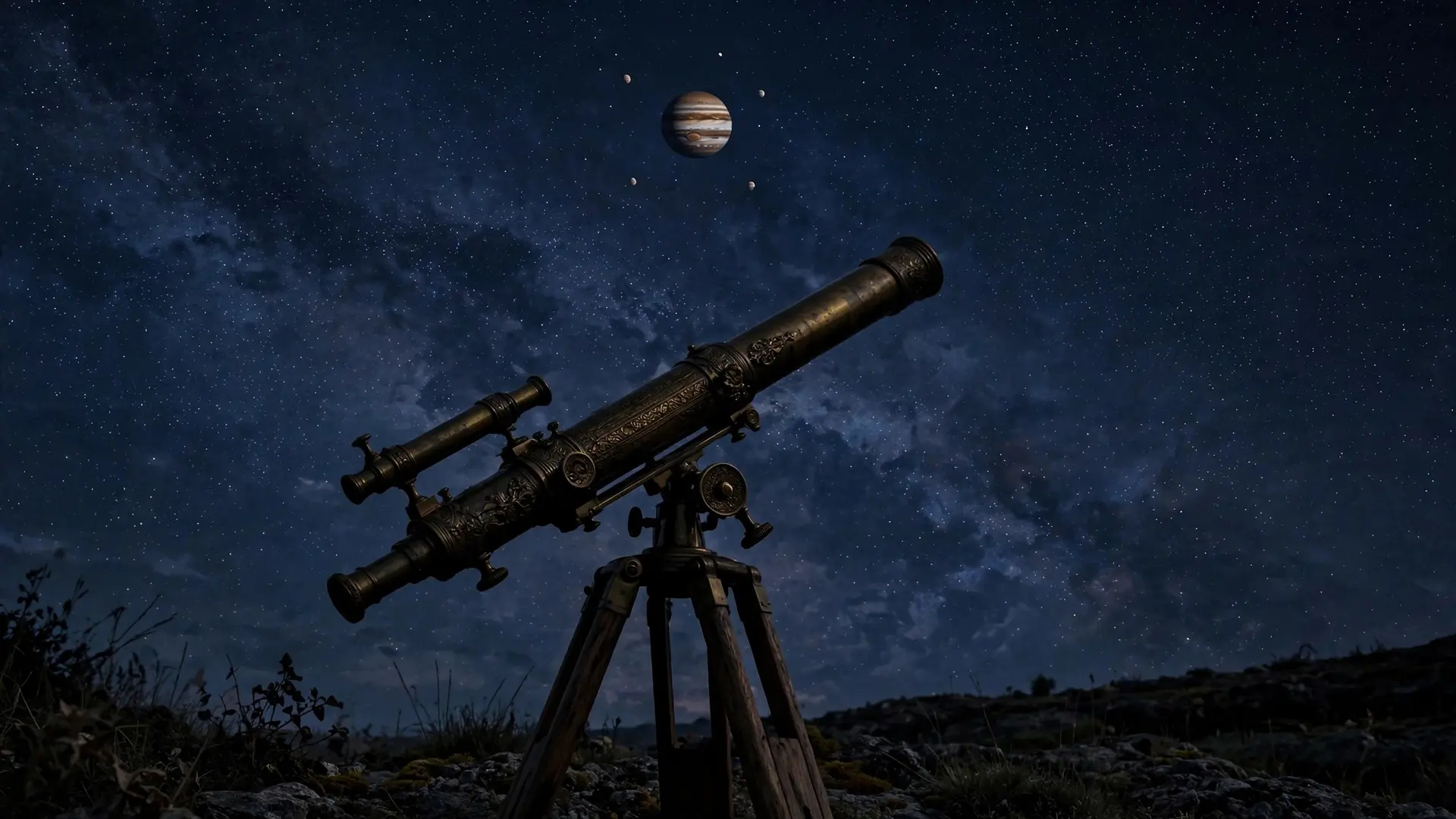
- In January 1610 Galileo spotted four moons orbiting Jupiter — the first direct proof that not everything in the heavens revolves around Earth.
- Galileo published his findings in March 1610 in 'Sidereus Nuncius' (The Starry Messenger), a pamphlet that rewired European astronomy in a single season.
- The word 'telescope' was coined in 1611 by Greek scholar Giovanni Demisiani from tele ('far') and skopein ('to look or see') at a banquet of the Accademia dei Lincei.
The telescope was not invented by the man who made it famous. In October 1608, a Dutch spectacle-maker named Hans Lipperhey filed the first documented patent application for a two-lens "spyglass" — and the authorities turned him down. The man who got the glory, Galileo Galilei, never invented the telescope at all: he simply had the genius to point it at the sky.
Who really invented the telescope?
Lipperhey was a German-born lens grinder working in Middelburg, in the Netherlands, when he asked the States General for an exclusive patent on his "instrument for seeing things far away as if they were nearby." The device was elegantly simple: a convex lens and a concave lens mounted in a tube, magnifying distant objects about three times while keeping the image upright — ideal for spotting ships and enemy troops long before they reached shore. The patent was refused. Rival spectacle-makers, including Zacharias Janssen and Jacob Metius, claimed to have built similar devices, and the Dutch authorities judged the design too easy to copy for any monopoly to be fair. Lipperhey never grew rich from his invention. But the idea escaped anyway: before the summer of 1608 the device appears in no record at all, and within a year simple telescopes were being sold all across Europe, according to a comprehensive 1977 study by Dutch science historian Albert van Helden. What Lipperhey built, though, was a military gadget of poor optical quality, not a scientific instrument. He probably aimed it at the Moon at least once, but spying on ships paid better than stargazing. The telescope needed someone who looked up — and that someone heard the rumors in the summer of 1609.
How did Galileo turn a spyglass into a scientific instrument?
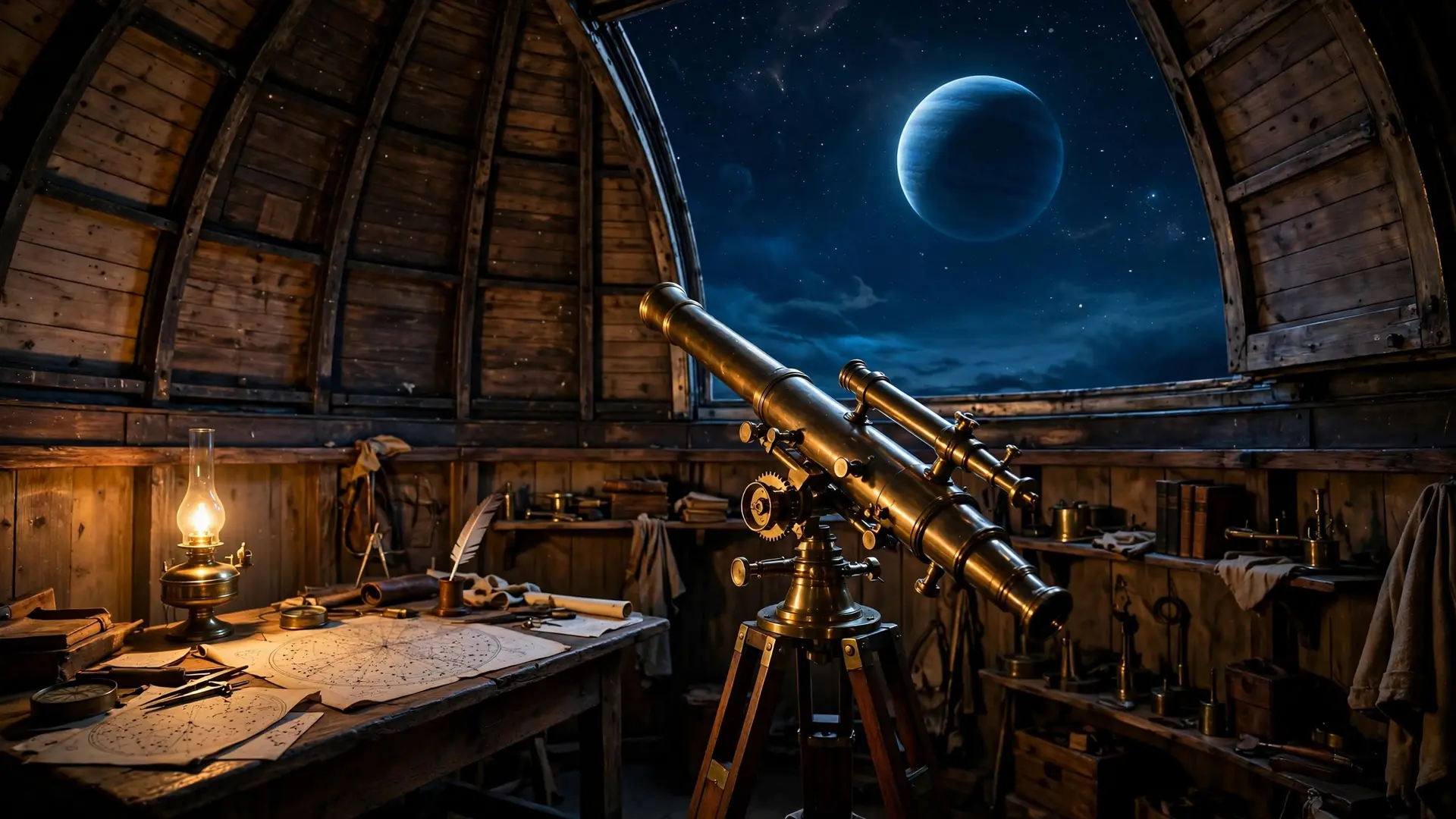
Galileo Galilei was a mathematics professor at the University of Padua when word of the Dutch "spyglass" reached him in Venice in June 1609. By his own account, he worked out the optics within a day and, once back in Padua, built his own from hand-ground Venetian glass: a leather-wrapped wooden tube, an eyepiece bead of glass smaller than a fingernail, focus set by sliding one section of tube inside another. Days later he demonstrated the instrument to the leaders of the Venetian Republic — who, impressed, awarded him a lifetime position at the university. Then Galileo did what no spectacle-maker had bothered to do: he kept improving it. His first version magnified three times, like Lipperhey's. His next reached eight. By the autumn he had pushed his design to roughly twenty to thirty times magnification — an amateur's build by modern standards, yet enough to open the outer solar system. One footnote matters for honesty: Galileo was probably not even the first person to aim a telescope at the Moon. The English astronomer Thomas Harriot made the first telescopic drawings of the Moon in the summer of 1609, months before Galileo's lunar sketches. Harriot simply never published them. Galileo published — and that made all the difference. He called his instrument a perspicillum, Italian for a seeing-glass; the word "telescope" would not exist for two more years.
What did the telescope reveal in 1610?
In January 1610 Galileo turned his finest telescope toward Jupiter and noticed three — then four — tiny points of light hugging the planet's edges. Night after night he sketched their positions, and within a week he understood what he was seeing: four moons orbiting Jupiter — Io, Europa, Ganymede and Callisto, as we name them today. It was the first direct evidence that not everything in the heavens circled the Earth. The geocentric model was not slightly wrong; it was broken at the foundation. The moons were only the beginning. The telescope showed him mountains and valleys on the Moon — a pitted, imperfect surface, not the flawless celestial sphere of Aristotle. It revealed the phases of Venus, which could only happen if Venus circled the Sun. It exposed dark spots crawling across the Sun's face, proving the Sun rotated on its axis. And the hazy band of the Milky Way dissolved into millions upon millions of individual stars.
In March 1610 Galileo rushed these findings into print in a slim Latin pamphlet, Sidereus Nuncius — The Starry Messenger — a book that rewired European astronomy in a single season. Like Röntgen's accidental discovery of X-rays three centuries later, the telescope exposed a reality that had been hiding in plain sight all along: the universe was far larger, stranger, and less Earth-centered than anyone had dared to imagine.
Why don't we call it the Lipperheyscope?
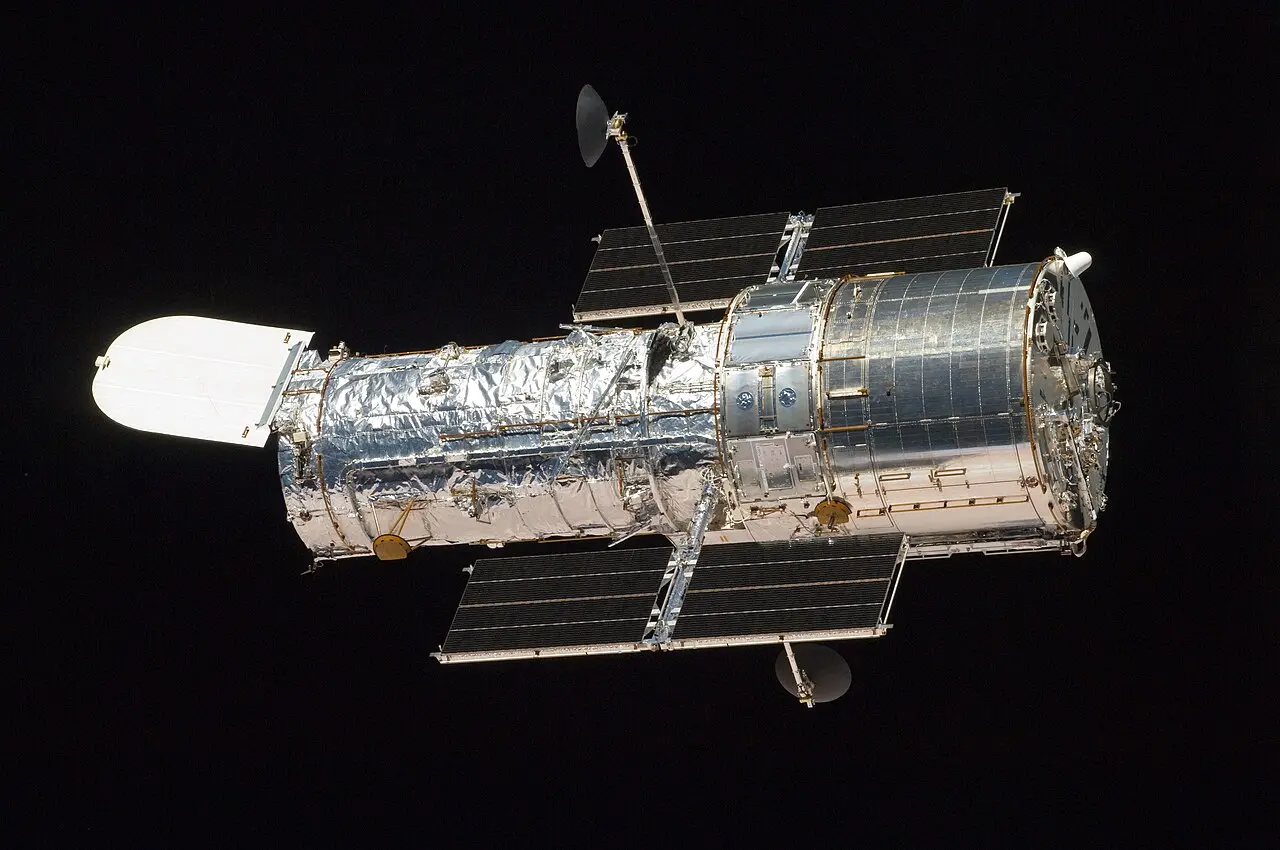
Because Galileo's discoveries eclipsed the inventor. The word "telescope" itself was coined by someone else entirely: the Greek scholar Giovanni Demisiani, who at a banquet of the Accademia dei Lincei in 1611 held to honor Galileo's induction proposed the name from the Greek tele, "far," and skopein, "to look or see" — the far-seeing instrument. The name stuck, becoming telescopium in Kepler's Latin and "telescope" in English. Meanwhile the instrument kept evolving. Johannes Kepler designed a version using two convex lenses, which inverted the image but allowed greater magnification. The lenses' prism-like tendency to smear false colors across the image — chromatic aberration — was only tamed more than a century later. Then came mirrors: Newton's reflectors, then the giant observatory telescopes, and eventually the Hubble Space Telescope, a reflector orbiting above Earth's blurring atmosphere, seeing things Lipperhey's little tube never could. So who invented the telescope? Lipperhey holds the first documented patent application, and historians give him the strongest claim. Galileo holds the glory, and he earned it — not by inventing the tube, but by being the first to aim it upward, write down what he saw, and change what humanity believed about its place in the universe. A denied patent application in October 1608 and a Latin pamphlet in March 1610: that is the whole span between the telescope's invention and the moment it dethroned the Earth. The instrument itself was just glass and leather — but in the right hands, at the right moment, it taught humanity to see beyond the known.
Frequently asked questions
Did Galileo invent the telescope?
No. Dutch spectacle-maker Hans Lipperhey filed the first documented patent application in October 1608, and it was refused. Galileo heard of the device in 1609, built far more powerful versions, and became the father of telescopic astronomy by being the first to publish his celestial observations.
What did Galileo discover with his telescope in 1610?
Four moons orbiting Jupiter, mountains and craters on the Moon, the phases of Venus, sunspots, and that the Milky Way is made of countless individual stars — all published in March 1610 in Sidereus Nuncius (The Starry Messenger).
Where did the word 'telescope' come from?
Greek scholar Giovanni Demisiani coined it in 1611 from tele ('far') and skopein ('to look or see') at a banquet of the Accademia dei Lincei held to honor Galileo. Before that, Galileo called his instrument a perspicillum — a seeing-glass.