Black Holes: Where Gravity Defeats Even Light
Nothing that crosses a black hole's event horizon gets out, not even light. See how a 1916 equation led to star orbits, gravitational waves and real photos.
Key takeaways
- A black hole's size depends mainly on its mass: the Sun would become one if squeezed to a radius of about 3 km, and Earth would need a radius of roughly 9 mm.
- Karl Schwarzschild published the first exact solution of Einstein's equations in 1916, and in 1965 Roger Penrose showed mathematically that black holes can actually form.
- Stars racing around Sagittarius A* reveal about 4 million solar masses packed into a space no bigger than our solar system, work that won Genzel and Ghez the 2020 Nobel Prize.
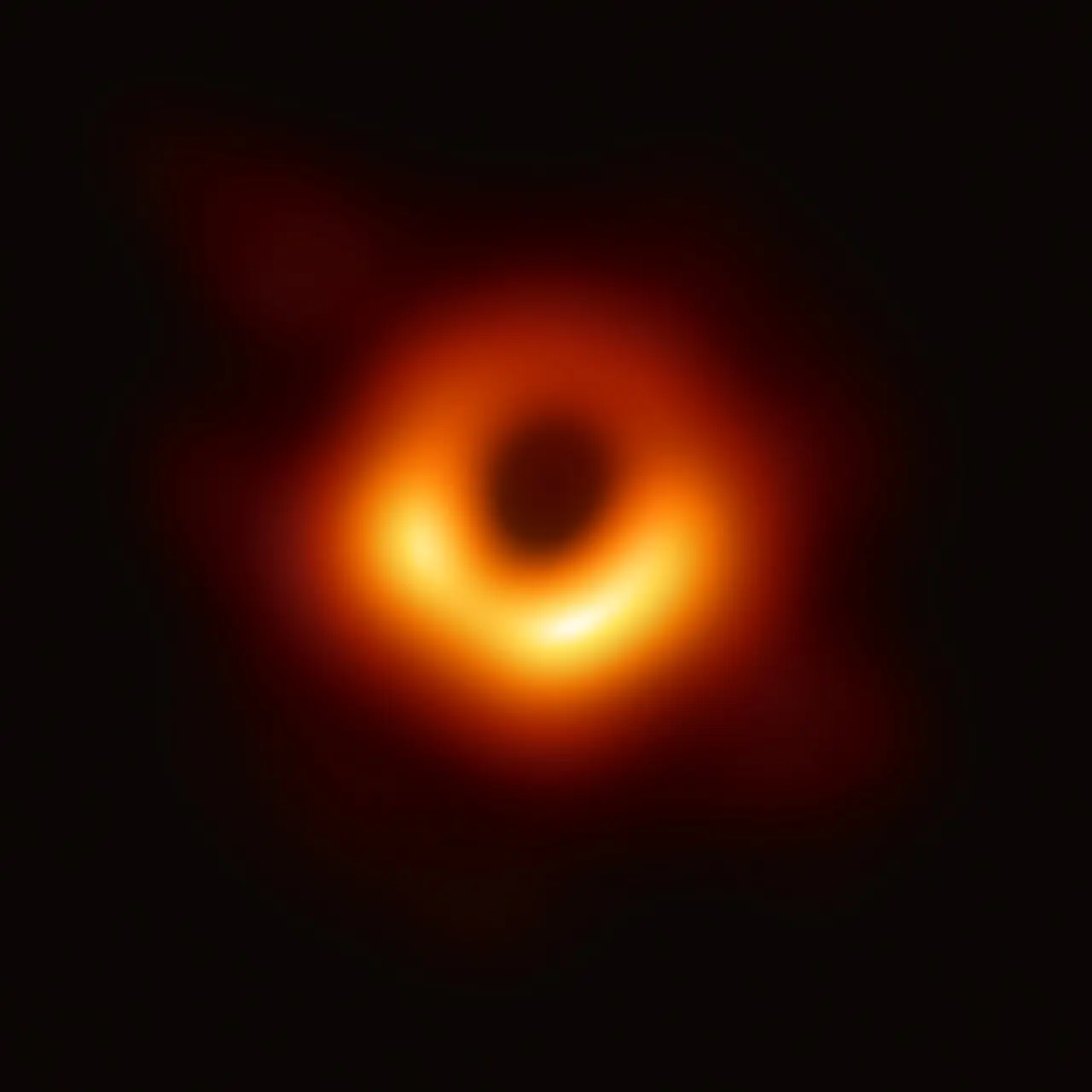
- LIGO first detected gravitational waves from two merging black holes on 14 September 2015, and the Event Horizon Telescope unveiled images of M87* in 2019 and Sagittarius A* in 2022.
- Hawking showed in 1974 that black holes should slowly radiate, but a Sun-mass black hole would glow at about 60 billionths of a degree, and the radiation has never been detected.
A black hole is a place where matter is packed so densely that the speed needed to escape it is greater than the speed of light. Anything that crosses its boundary, the event horizon, is gone for good, light included. For half a century black holes existed only on paper, as a strange answer to Einstein's equations; today astronomers weigh them by the stars they whip around, hear them collide and have even photographed their silhouettes.
What exactly is a black hole?
The event horizon is not a surface you could stand on. It is a boundary in space, marking the distance at which escape becomes impossible. How big that boundary is depends mainly on how much mass sits inside. Run the numbers with general relativity and the Sun would have to be crushed into a ball about 3 kilometers in radius to become a black hole. Earth would need to shrink to a radius of roughly 9 millimeters, about the size of a marble. Nature makes black holes in a few weight classes. Stellar-mass black holes, weighing anywhere from a few Suns to around a hundred, are what very large stars leave behind when they run out of fuel. According to NASA, a star of about 20 solar masses or more collapses in a supernova and leaves a black hole rather than a neutron star. A few dozen suspected or confirmed examples are known in the Milky Way, and NASA estimates the galaxy may hold as many as 100 million. Supermassive black holes, from hundreds of thousands to billions of solar masses, sit at the centers of galaxies. They are not cosmic vacuum cleaners, despite their reputation. From a distance, a black hole pulls exactly as hard as a star or planet of equal mass. Swap the Sun for an equally heavy black hole and the planets would carry on in their orbits, although the solar system would turn cold and dark.
How did a wartime equation become a real object?
In 1915, Albert Einstein published general relativity, which describes gravity as the curving of space and time. Within months Karl Schwarzschild, a German astronomer serving in the army on the Russian front, worked out the first exact solution of its equations, describing the field around a single point of mass. Einstein wrote back that he had not expected the problem could be solved so simply. The paper appeared in 1916, though it would be decades before physicists took such objects seriously. He died that May, after an illness he contracted at the front.
Einstein did not believe such objects could exist either. The turning point came in January 1965, when the British mathematician Roger Penrose proved that collapsing matter really can form black holes, with a singularity at their core where the known laws of physics break down. That work earned him half of the 2020 Nobel Prize in Physics. Astronomers, meanwhile, went hunting. One early suspect was Cygnus X-1, a bright source of X-rays locked in orbit with a massive blue star, from which it pulls gas. In 1974 Stephen Hawking wagered that Cygnus X-1 held no black hole at all. He lost.
How do we know black holes are really there?
The case now rests on three independent lines of evidence. The first is stars. Since the early 1990s, teams led by Reinhard Genzel and Andrea Ghez have tracked stars around Sagittarius A*, at the heart of the Milky Way. One star, S2, completes an orbit every 16 years; on its close pass observed in 2018 it came within 20 billion kilometers of the central object at more than 25 million kilometers per hour, almost 3% of the speed of light. The orbits demand about 4 million solar masses packed into a region no larger than our solar system, and a supermassive black hole is the only known explanation. Genzel and Ghez shared the other half of the 2020 Nobel Prize. The second is gravitational waves. On 14 September 2015, the twin LIGO detectors in Livingston, Louisiana, and Hanford, Washington, felt space itself stretch and squeeze as a ripple passed through, a distortion thousands of times smaller than the nucleus of an atom. The wave came from a pair of black holes of about 30 solar masses each, spiraling together 1.3 billion light-years away. The signal reached Livingston 7 milliseconds before Hanford. Rainer Weiss, Barry Barish and Kip Thorne received the 2017 Nobel Prize in Physics for the work. The third is pictures. The Event Horizon Telescope links radio dishes around the world into a single Earth-sized instrument observing at a wavelength of 1.3 millimeters. On 10 April 2019 it released the first image of a black hole, M87*, which holds 6.5 billion solar masses and lies 55 million light-years away. On 12 May 2022 came Sagittarius A*, about 27,000 light-years from us and more than a thousand times smaller in mass. Both show the same thing: a dark shadow inside a bright ring of hot gas whose light is bent by the black hole's gravity, the same lensing effect astronomers use on far larger scales to map dark matter.
What would happen if you fell into one?
Gravity pulls harder on the part of you nearest the black hole than on the part farthest away. Close in, that difference stretches you lengthwise and squeezes you sideways, a process astronomers really do call spaghettification. In a study published in 2020, astronomers using ESO telescopes watched it happen to a star, in an event named AT2019qiz, as a black hole about 215 million light-years away shredded it into thin streams of gas. Counterintuitively, a bigger black hole is kinder. Small ones have compact horizons and fierce tidal forces, so a stellar-mass black hole would tear you apart before you even reached the horizon. In a 2024 NASA simulation of a black hole with 4.3 million solar masses, a camera took about three hours to fall to the horizon, crossed it intact and was spaghettified 12.8 seconds later. "If you have the choice, you want to fall into a supermassive black hole," said Jeremy Schnittman, the NASA Goddard astrophysicist who created the simulation. A friend watching from a safe distance would see something else entirely. Time runs slower deep in a black hole's gravity, as Einstein's relativity predicts, so your image would seem to slow and freeze just outside the horizon. That illusion is why astronomers once called black holes "frozen stars."
What do we still not know about black holes?
Plenty. In 1974, Hawking showed that quantum effects should make every black hole glow faintly and slowly lose mass. For a black hole as heavy as the Sun, the temperature of that glow works out to about 60 billionths of a degree above absolute zero, and evaporating would take far longer than the age of the universe. Hawking radiation has never been detected, and if black holes do evaporate, physicists still argue over what becomes of the information about everything that fell in. The center is murkier still. General relativity predicts that matter there is crushed to infinite density, a sign that the theory has reached its limits. Astronomers still don't know whether the singularity is a physical object or merely a sign that the equations have hit their limits. Answering that probably requires a theory of quantum gravity that nobody has yet built. Then there is the question of growth. In 2023, NASA's Chandra X-ray Observatory and the James Webb Space Telescope spotted a black hole of an estimated 10 to 100 million solar masses in the galaxy UHZ1, seen just 470 million years after the Big Bang. Something that heavy so early suggests some black holes were born big, and it fits a wider pattern of galaxies maturing faster than models allowed. Black holes began as a mathematical oddity whose full meaning took decades to recognize. A century later they have been weighed by starlight, heard across 1.3 billion light-years and, in two cases, photographed. The edge of a black hole is now measured; what lies beyond it is the real unknown.
Frequently asked questions
What is a black hole?
It is a region where matter is packed so densely that the speed needed to escape exceeds the speed of light. The boundary of that region is the event horizon, and nothing that crosses it can return.
How do we know black holes exist if they give off no light?
Astronomers track stars orbiting an invisible mass at the Milky Way's center, detect gravitational waves from colliding black holes, and have photographed the shadows of two black holes against the glowing gas around them.
Would falling into a black hole kill you?
Eventually, yes. A stellar-mass black hole would stretch you apart before you reached its event horizon, while a supermassive one would let you cross the horizon intact before tidal forces tore you apart.
Would a black hole swallow Earth?
Not unless Earth fell into it. If the Sun were replaced by an equally heavy black hole, the planets would keep their orbits, although the solar system would grow cold and dark.
Sources
- Press release: The Nobel Prize in Physics 2020, NobelPrize.org (Royal Swedish Academy of Sciences)
- GW150914 Press Release, LIGO Laboratory, Caltech
- Astronomers Capture First Image of a Black Hole, ESO
- Plunge into a black hole in this new video, EarthSky (via NASA)
- Death by Spaghettification: ESO Telescopes Record Last Moments of Star Devoured by a Black Hole, ESO
- Press release: The 2017 Nobel Prize in Physics, NobelPrize.org (Royal Swedish Academy of Sciences)