How Satellites Stay in Orbit Without Falling Down
A satellite in orbit is falling toward Earth at 28,000 km/h — and never lands. Here is how gravity and speed keep it circling, and why drag pulls it down.
Key takeaways
- A satellite in orbit is continuously falling toward Earth — it stays up because it moves sideways at roughly 28,000 km/h, fast enough to keep missing the ground.
- Gravity at orbital altitudes is still strong; orbit is a balance between gravitational pull and forward speed, not an escape from gravity.
- In low Earth orbit, faint atmospheric drag slowly saps a satellite's speed, which is why the International Space Station needs periodic reboosts.
- Solar storms can heat the upper atmosphere and spike drag — in February 2022, a geomagnetic storm destroyed 38 of 49 newly launched Starlink satellites.
- Too fast and a satellite flies off into space; too slow and gravity drags it down. Orbital speed is the exact middle path.
They are falling right now. Every satellite circling the planet — the weather watchers, the GPS fleet, the International Space Station — is in a state of continuous free fall toward Earth. The only reason none of them has landed is that they are also hurtling sideways at roughly 28,000 kilometers per hour, fast enough that the ground keeps curving away beneath them. Orbit is not floating. Orbit is falling with style, aimed so precisely that you miss the planet forever.
Why is a satellite technically falling?
Picture throwing a ball as hard as you can. It arcs and lands. Now throw it harder: it lands farther away. Throw it hard enough — and Earth starts to curve away beneath it at the same rate it falls. That was Newton's cannonball thought experiment in the 1680s, and it is still the cleanest explanation of orbit ever written. A satellite is simply the cannonball thrown at the one speed where the fall never ends. Gravity at these altitudes is not gone. In low Earth orbit, a few hundred kilometers up, Earth's pull is only slightly weaker than what you feel standing on the ground. The astronauts aboard the ISS are not beyond gravity's reach; they are falling around the planet at the same rate as everything inside the station, which is why they float. The key insight: weightlessness is not the absence of gravity, it is the sensation of unending free fall.
How fast must a satellite go to keep missing the ground?
The magic number depends on altitude. The lower the orbit, the stronger gravity's grip, and the faster the satellite must travel to keep falling around the Earth instead of into it. At an altitude of about 150 miles (242 km), the required orbital velocity is approximately 17,000 mph (27,359 km/h); the familiar figure for typical low Earth orbit is around 28,000 km/h, or 17,500 mph.
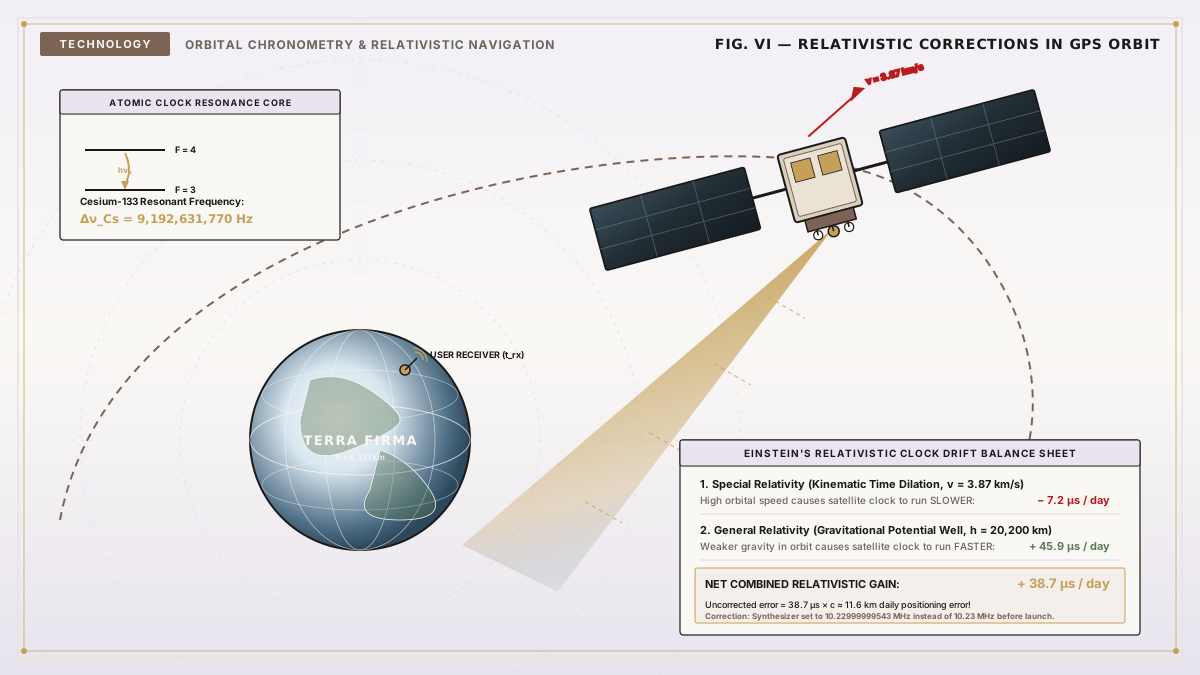
The relationship is governed by a simple physical law: orbital velocity equals the square root of the planet's gravitational parameter divided by the orbit's radius. That is why the Moon, far away, ambles along its month-long orbit while the ISS zips around Earth every 90 minutes. Go too fast at a given altitude and the satellite's inertia wins — it climbs into a higher orbit or escapes Earth's pull entirely (escape velocity is a steeper ~40,320 km/h). Go too slowly and gravity's pull wins, dragging it down. Satellites thread the exact middle path, and their launch trajectory is engineered so the rocket's final velocity delivers them to it. There is also a special address in the sky. At about 35,786 km above the equator, a satellite's orbital period exactly matches Earth's rotation, so it hangs motionless above one spot on the ground. This geostationary orbit is where communication and weather satellites — including the atomic-clock-carrying GPS fleet cousins in higher orbits — do their patient work, parked in the sky as surely as if nailed there.
What makes a satellite's orbit decay?
Here is the catch nobody told the cannonball: space is not perfectly empty. In low Earth orbit, the faint outer wisps of the atmosphere still reach up and brush against satellites at 28,000 km/h. Each collision with a stray gas molecule steals a whisper of speed. Over months and years, that tiny drag adds up — and it feeds on itself. Slower means a lower orbit; lower means thicker air; thicker air means more drag. Without intervention, the satellite spirals down, heats up from friction, and usually burns into glowing debris on reentry. The Sun is the puppet master here. Solar activity heats and expands the upper atmosphere, so during solar storms the thin air at satellite altitudes can suddenly thicken dramatically. In February 2022, SpaceX launched 49 Starlink satellites into a low initial orbit just as a geomagnetic storm hit — the atmosphere puffed up, drag spiked, and 38 of the 49 satellites reentered and burned up within days. It was a vivid reminder that low orbit is not a shelf in space; it is a treadmill that speeds up without warning. Altitude is the difference between a decade and a millennium. A satellite at 400 km fights constant drag and may last years. At 800 km, drag is a whisper and the satellite can linger for decades. Push above 1,000 km and dead hardware can circle for centuries — which is the dark side of the story, the growing graveyard of space junk that makes every decommissioned satellite a centuries-long hazard.
Why does the International Space Station need reboosts?
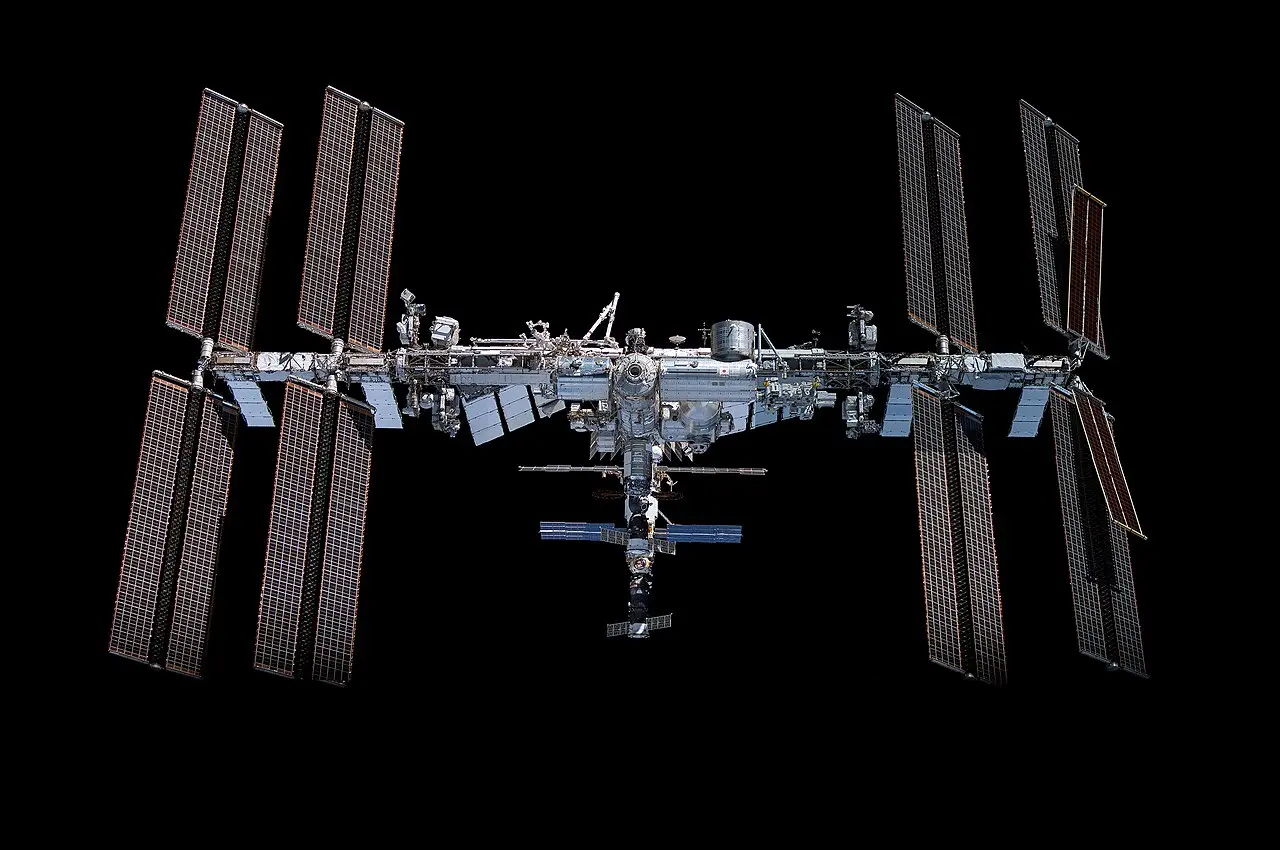
The ISS lives right in the drag zone, at roughly 415 km altitude. Even there, the faint atmosphere tugs at the station's huge solar wings and modules, bleeding off speed and altitude day after day. NASA estimates that without intervention, the station's orbit at that height would decay within roughly one to two years, depending on solar activity. So every so often, visiting cargo craft or the station's own thrusters fire for a few minutes — a maneuver called a reboost — nudging the ISS back up to altitude. Operators can even play drag like an instrument. NASA's CYGNSS constellation once adjusted the spacing between its eight spacecraft without burning a drop of propellant: engineers tilted one satellite to expose more surface area to the atmosphere, letting drag lower its orbit slightly. A lower orbit has a shorter period, so the satellite crept ahead of its companions — formation flying by aerodynamics. Drag is usually the enemy of orbit, but understood well enough, it becomes a tool.
What happens when satellites are finally left to fall?
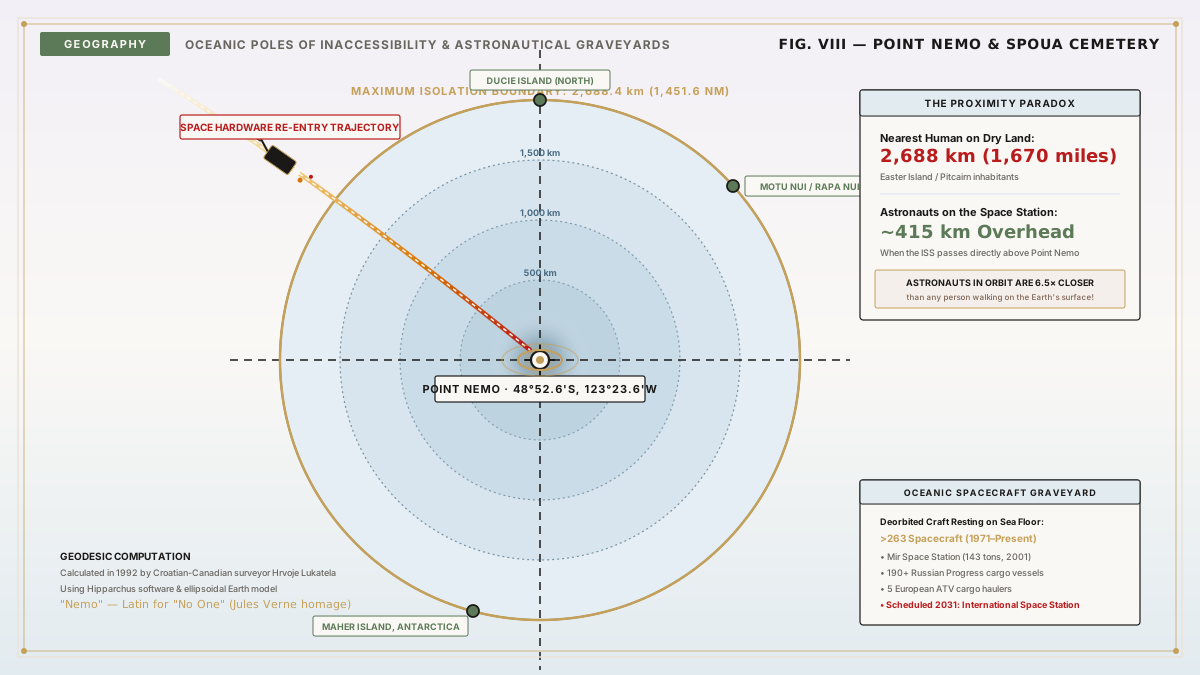
Some fall on purpose. When a satellite's mission ends, responsible operators spend its last fuel steering it into the atmosphere over the ocean to burn up — a controlled funeral that keeps orbits clean. Vanguard 1, launched in 1958, took the opposite path: it sits in a high, drag-free orbit where it has needed no reboost in nearly seventy years, the oldest human object still circling Earth, quietly circling long after its transmitters died. But most dead satellites simply drift. In the high orbits where drag cannot reach, retired hardware lingers for centuries — tens of thousands of tracked fragments and countless smaller shards, all moving at orbital speed. The very physics that makes orbit so graceful makes it unforgiving: anything that goes up and is not brought down stays, a hazard to everything launched after it. That is why modern operators now plan disposal orbits or deliberate reentry as part of the mission, not as an afterthought. So satellites stay up for the most poetic of reasons: they are falling perfectly. A satellite is an object that has been thrown so fast sideways that its fall toward Earth becomes a circle instead of a crash — held aloft not by engines, not by buoyancy, but by the sheer precision of its speed. The trick, as it turns out, was never to defeat gravity. It was to fall with such grace that you never hit the ground.
Frequently asked questions
Are satellites weightless in orbit?
No — gravity in low Earth orbit is nearly as strong as at the surface. Satellites and astronauts feel weightless only because they are in continuous free fall, falling around the planet at the same rate.
How fast does a satellite need to travel to stay in orbit?
In low Earth orbit, about 28,000 km/h (roughly 17,500 mph). Higher orbits require lower speeds, while geostationary satellites travel slower still, about 3 km/s.
Why does the International Space Station need reboosts?
Even 415 km up, faint atmospheric drag slowly robs the station of speed and altitude. NASA estimates that without periodic engine burns to raise its orbit, the ISS would reenter within one to two years.
Can a satellite stay in orbit forever?
Not always. High-orbit satellites can persist for centuries, but in low orbit atmospheric drag eventually wins unless the orbit is boosted — which is why defunct hardware either burns up or becomes space junk.