How Did Roman Surgeons Operate With Bronze and Iron Tools?
How did Roman surgeons operate? Their scalpels paired bronze handles with replaceable iron blades. CT scans of 2,000-year-old tools show how the system worked.
Key takeaways
- Roman surgeons never cut with bronze: scalpels paired a cast bronze handle with a detachable iron or steel blade.
- CT scans at 0.05 mm resolution show tiny scrolls on a 2,000-year-old bronze handle, carved to grip replaceable blades.
- Pompeii's House of the Surgeon held more than 40 instruments; standardized kits stretched from Britain to Syria.
- Romans performed trepanning, cataract couching, and amputations, but without sterilization, sepsis killed many patients.
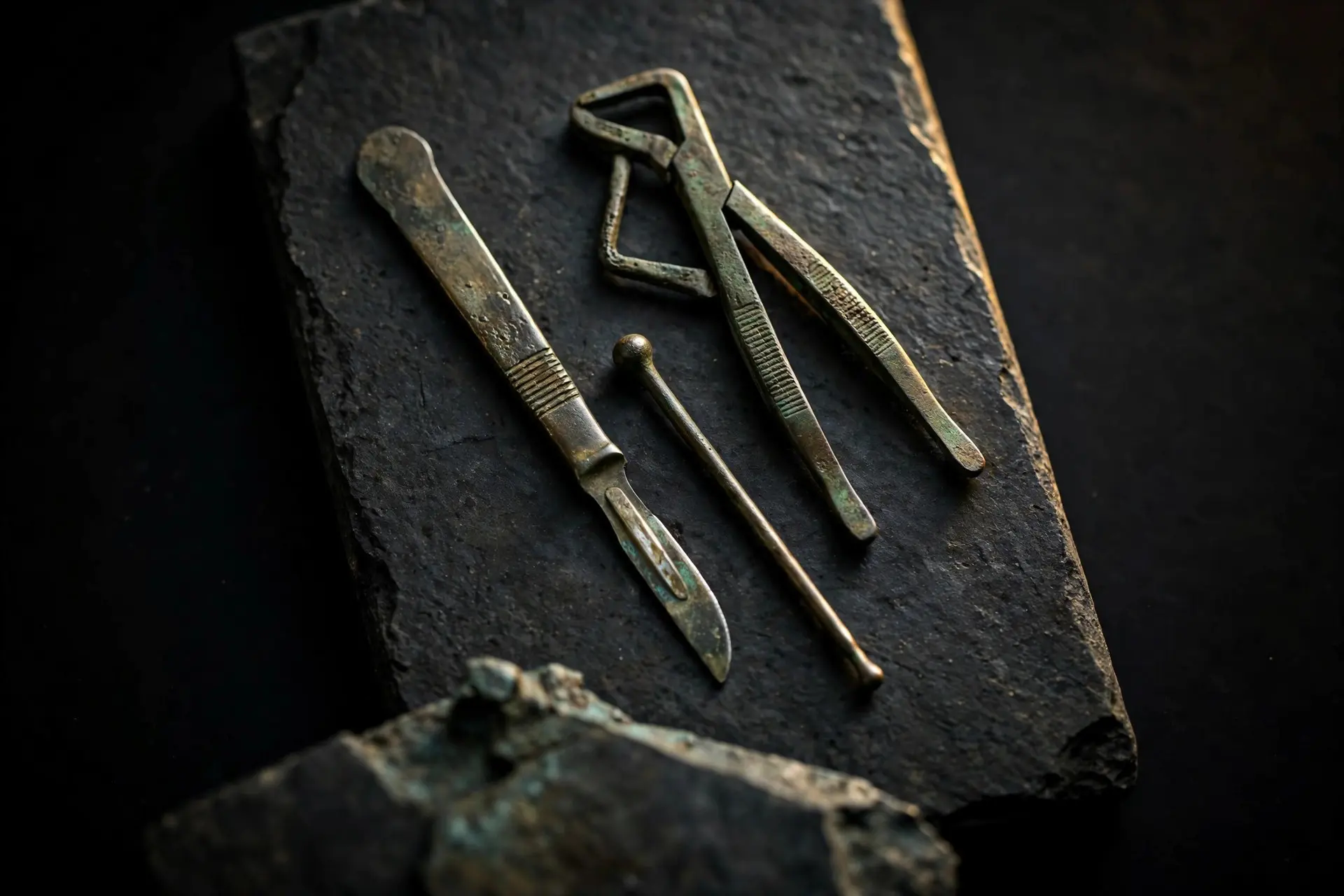
They never cut with bronze. Roman scalpels were composite tools: a cast bronze handle with a socket holding a detachable iron or steel blade. CT scans of 2,000-year-old instruments from Roman London reveal tiny decorative scrolls on the handle that were actually functional, giving the surgeon grip to swap worn blades. The sharp part was disposable; the bronze was the chassis.
- Pompeii's House of the Surgeon, excavated in 1770-1771, yielded more than 40 surgical instruments, including probes and scalpels, now in Naples' National Archaeological Museum. Pompeii Online
- Six implements from Roman London, a bronze scalpel handle, two probes, a spoon, and two needles, were CT-scanned at 0.05 mm resolution by the University of Exeter's SHArD 3D Lab in research led by Professor Rebecca Flemming. University of Exeter
- The scan shows a socket where the iron blade was inserted into the bronze handle, with small scrolls that made replacing worn blades easier over the instrument's lifetime. University of Exeter
- A first-century set near Jaszbereny, Hungary included three copper-alloy scalpels fitted with detachable steel blades and inlaid with silver in the Roman style. Our Health Needs
- Roman surgical instruments were standardized across the empire, with similar kits found from Britain to Syria. University of Exeter
- In March 2026, scans of a plaster-sealed case carried by a man fleeing Pompeii revealed about six small bronze objects inside, with a stone mixing palette 67 by 42 mm in a container roughly 12 cm long. Pompeii Online
What were Roman surgical instruments made of?
Bronze dominates museum displays, but that is partly a trick of preservation. Bronze survives two thousand years of burial; iron and steel corrode. The full toolkit was a mix: bronze handles, probes, forceps, needles, and bone levers, with blades of iron or steel set into the handles. A copper-alloy body with a steel cutting edge gave the best of both materials: a handle that never wore out and a blade sharp enough to hold an edge. The instruments were specialist-made. They had to meet fine tolerances for delicate work, and the Exeter scans show how much care went into tiny details. Professor Flemming notes that only the bronze survives today, alongside Greek and Roman medical texts describing the interventions the tools were used in.
How did the Roman scalpel actually work?
The London scalpel handle, held by the Devon and Exeter Medical Heritage Trust, is the clearest example. Its socket was crafted to receive the iron blade, and the small scrolls flanking the socket served as both decoration and a working grip for removing and reseating blades. A surgeon could keep one handle for a career and refresh the edge whenever it dulled. Roman surgeons used the scalpel for operations and therapeutic procedures including bloodletting. Probes did the exploratory work: sounding wounds, fistulas, and fractures before surgery, and even clearing wax from ears. The spoon mixed medicaments, while needles sewed bandages. The kit was compact and portable; the Pompeian found with a small case near the Amphitheatre in 1936 carried scalpels, forceps, needles, and probes plus a coticula, a small stone palette for grinding and mixing medicines. The Walbrook instruments themselves were unearthed around 125 years ago from London's Walbrook River, a waterlogged site that preserved Roman-era tools unusually well. Exeter's CT scans were made at 0.05 mm resolution, fine enough to peer beneath corroded surface layers at the original material. The resulting 3D models now let researchers print exact replicas for teaching, so students can handle a surgeon's toolkit that last saw use two thousand years ago.
What could Roman surgeons treat?
The range was wider than most people assume. Documented procedures include trepanning (opening the skull), cataract couching, amputation, mastectomy, hernia reduction, and operations through the body's orifices for polyps, inflamed tonsils, hemorrhoids, and fistulas. The Jaszbereny set even contained a bone lever for putting fractures back in place and what appears to be a drill handle for trepanning and extracting weaponry embedded in bone. There were real limits. With no knowledge of sterilization or germ theory, patients were likely to die of sepsis and shock. The encyclopedist Celsus, writing De Medicina in the first century, demanded a surgeon with "a strong and steady hand that never trembles," vision sharp and clear, undaunted yet empathetic, though also "unmoved by a patient's screams of pain." And the profession was open: as archaeologist Lawrence Bliquez puts it, "There were no licensing boards and no formal requirements for entrance to the profession. Anyone could call himself a doctor."
What do people get wrong about Roman surgery?
The biggest misconception is the primitive-bronze-saw image: a surgeon hacking with a soft metal blade. In reality the cutting edge was steel, the bronze was the handle, and the kits were specialized, portable, and standardized across continents. The subtler mistake is assuming the texts describe universal practice. Celsus and Galen describe many procedures, but finding instruments at Pompeii does not prove every operation in the literature happened there. The Archaeological Park of Pompeii stresses this caution: the tools confirm skilled practitioners with a sophisticated material culture, not a modern healthcare system, and there is no secure evidence Pompeii had public hospitals comparable to today's.
| Roman instrument | How it was built | Its modern counterpart |
|---|---|---|
| Scalpel | Bronze handle with socket for a detachable iron/steel blade | Scalpel with disposable blade |
| Forceps | Bronze, sometimes with ridged gripping handles | Tissue forceps |
| Probe | Bronze, with olive-shaped or hooked ends | Surgical probe |
| Bone lever | Heavy-duty bronze for prying bones into place | Periosteal elevator |
| Needles | Bronze, for sewing bandages | Suture needles |
| Roman engineering ran on the same standardized-knowledge model across the empire: roads built to one specification, baths heated by one system, water moved by one aqueduct technology. The surgeon's kit fit the same pattern. | ||
| How we made this article: FactSpire researched and drafted it with AI assistance and checked every fact against the sources listed above. |
Frequently asked questions
Why bronze if the blades were iron or steel?
Bronze was cast into ornate, durable handles that survived burial, while iron and steel blades corroded away. The bronze handle held a socket for a replaceable blade, so one handle served for years while dull blades were swapped out.
What surgeries could Roman doctors actually perform?
Archaeologists document trepanning, cataract couching, amputations, mastectomy, hernia reduction, and operations for polyps, fistulas, and hemorrhoids. Without germ theory or sterilization, though, infection and shock killed many patients.
Where have Roman surgical kits been found?
The most famous set came from Pompeii's House of the Surgeon, with over 40 instruments. Similar standardized kits appear from Britain to Syria, plus a first-century set near Jaszbereny, Hungary and a 1989 find in Rimini, Italy.
How do we know what the tools were used for?
CT scans reveal construction details, and ancient texts describe the procedures. But archaeologists warn the texts don't prove every operation happened everywhere: finding tools at Pompeii doesn't mean every procedure Celsus described was done there.
Sources
- Archaeological scanners offer 2,000-year window into the world of Roman medicine, University of Exeter
- Medicine in Pompeii: Between Science and Superstition, Pompeii Online (Archaeological Park of Pompeii)
- Scalpel, Forceps, Bone Drill: Modern Medicine in Ancient Rome, Our Health Needs