How Did Egyptians Drill Through Granite Without Steel?
The Egyptians drilled granite with hollow copper tubes and quartz sand, never steel. Here is how tubular drills and bow drills cut stone with abrasive grit.
Key takeaways
- The sand did the cutting: a hollow copper tube spun by a bow drill only carried quartz abrasive against the stone.
- A 2001 replication took 20 hours to drill a 6 cm core in granite, at a cutting rate of 5.2 cm3 per hour.
- Ancient drill cores range from 0.6 cm to about 70 cm across; no complete ancient copper tube drill survives.
- A Met Museum study found corundum abrasive inside an Amarna drill hole, suggesting harder grits were used too.
- The Aswan quarry marks people photograph are from dolerite pounders, not tube drills.
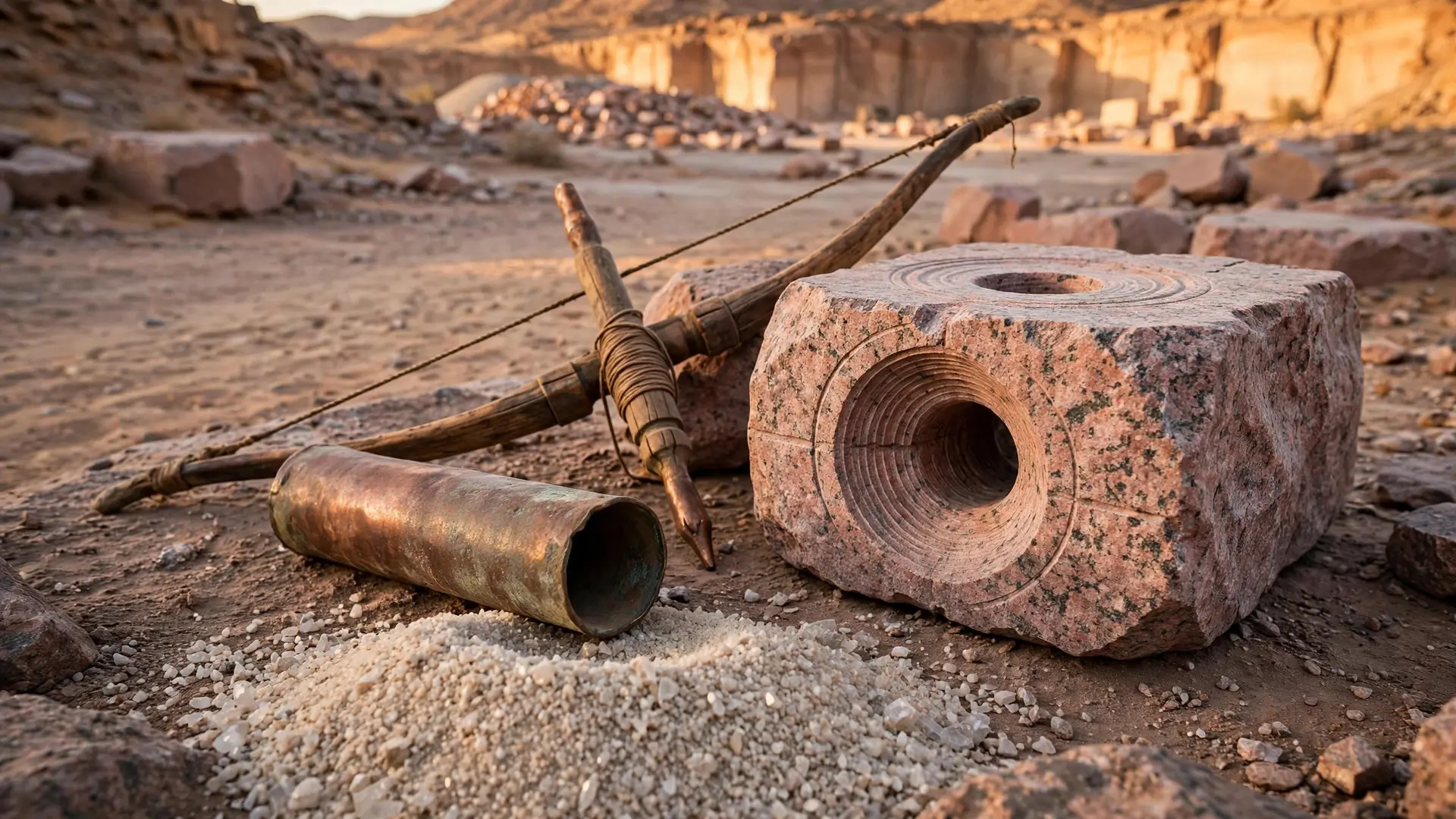
The secret was the sand, not the drill. The Egyptians spun a hollow copper tube with a bow and fed quartz sand under it. The soft copper only carried the abrasive, and the sand did the cutting. In a 2001 field test, drilling a hole 6 cm (2.4 in) deep into granite took 20 hours of work.
Key facts
- Copper and bronze are too soft to cut granite directly, so "a harder material than the metal itself is required as an abrasive"; loose quartz sand was the most likely abrasive for most of Egyptian history because worn grains were easy to replace (hallofmaat.com).
- Archaeologist Denys Stocks' 2001 Aswan test: a bow-driven copper tube with dry quartz sand produced a 6 cm (2.4 in) granite core in 20 hours, at 5.2 cm3 per hour; wet sand drilled more slowly (hallofmaat.com).
- Ancient cores and holes range from about 0.6 cm (0.24 in) to roughly 70 cm (27.6 in) across; W.M.F. Petrie recorded tubular drills from 1/4 inch to 5 inches in diameter (hallofmaat.com; Petrie).
- On Petrie's famous Giza Core 7, the spiral groove sinks 0.1 inch (2.54 mm) in 6 inches of circumference, a feed rate of 1 in 60 per revolution (Petrie).
- A Met Museum study of an Amarna temple fragment found angular corundum grains with corroded bronze drill fragments at the bottom of a 1 cm drill hole, suggesting harder abrasives were used alongside sand by around 1350 BCE (ResearchGate).
How did a copper tube cut through granite?
Picture a short length of copper pipe, open at both ends, held upright against the stone. A bow, like an archer's bow, wraps a cord around the tube, and a helper saws the bow back and forth so the tube spins. A second person feeds loose quartz sand and a little water into the groove. Each rotation drags fresh sand grains across the stone, and each grain gouges out a tiny amount of granite. The tube cuts an annulus, a ring-shaped groove, and eventually the untouched center breaks free as a cylindrical core. Bow drills are depicted in Egyptian tomb art from the 5th Dynasty, in the tomb of Ty at Saqqara, and surviving wooden bow drills from carpentry confirm the mechanism (hallofmaat.com). The great granite coffers of the pyramids were hollowed the same way: rows of tube holes were drilled close together until the cores could be broken out and the surface dressed flat (Petrie).
Sawing worked on the same principle. Straight saws of copper, some over 8 feet (2.4 m) long and as thin as 0.03 inch (0.76 mm), were drawn back and forth with sand under the blade, and Petrie identified bronze blades from the green copper staining left in the saw cuts (Petrie).
Why didn't they just use steel?
Steel did not exist for them. Egyptians began smelting copper around 3500 BC, used copper and arsenical bronze tools through the Old Kingdom, and made tin bronze the standard alloy in the New Kingdom. Hard stone was therefore worked with a full toolkit of non-steel methods: copper and bronze carriers with abrasives, dolerite pounders for rough shaping, and stone borers for finishing (hallofmaat.com). The physics is unforgiving. Granite's quartz grains rate 7 on the Mohs scale and its feldspar 6, while copper is far softer. Press a copper blade straight into granite and it simply deforms. But quartz sand, at Mohs 7, scratches everything softer than itself. The copper's job was never to cut; it was to grip and drag the sand. That is why the technique worked for centuries and why loose sand, constantly renewed as the grains broke down, beat a fixed point for most routine work (hallofmaat.com). Moving the stone afterward was a separate feat; see how the Egyptians moved pyramid stones.
What did the experiments show?
The debate over the abrasive ran for a century. Early Egyptologist Alfred Lucas argued for loose wet quartz sand; Petrie, looking at the precise spiral grooves on Core 7, suspected fixed cutting points of a harder mineral like emery or diamond. Two waves of replication settled most of it:
| Abrasive | Test | Result |
|---|---|---|
| Loose quartz sand (dry) | Stocks, Aswan 2001 | Cut granite; left concentric striations up to 2.5 mm (0.1 in) wide, similar to ancient artifacts |
| Loose beach sand, quartz, garnet (wet) | Gorelick & Gwinnett, lab 1983 | Drilled red granite at 1,000 RPM but left no concentric lines |
| Emery, corundum, diamond (loose) | Gorelick & Gwinnett, lab 1983 | Reproduced the concentric cutting lines seen on ancient cores |
| Water vs. no water | Stocks, Aswan 2001 | Wet sand drilled harder than dry; a mason's intuition that water helps was wrong |
The modern consensus is pragmatic: ordinary work used quartz sand, and for the finest cuts the Egyptians reached for harder grits. The Met Museum's Amarna find supports that. Conservators Nora Serotta and Federico Caro found abundant angular corundum grains and corroded bronze drill fragments at the bottom of a roughly 1 cm drill hole in a limestone fragment from the Great Aten Temple (Met 57.180.142), pointing to a bronze tubular drill with corundum-rich abrasive around 1350 BCE. It is one fragment, not proof of a whole industry, but it shows the technique was more varied than the old textbooks allowed (ResearchGate; Penn Museum). Concrete examples of the finished work survive in museums. An Old Kingdom sarcophagus lid of Dynasty IV in the Brooklyn Museum has a lid-peg drill hole 24 cm (9.4 in) deep, tapering from 5.3 cm (2.1 in) at the outside to 4.3 cm (1.7 in) inside (Penn Museum). At Karnak a drill hole about 8 inches (20 cm) wide pierces granite; at El Bersheh, grooves of about 18 inches (46 cm) diameter score limestone (Petrie).
What do people get wrong about Egyptian stone drilling?
| What people assume | What the evidence shows |
|---|---|
| The precise grooves prove power tools or lost technology | Replication with bow drills, copper tubes, and sand reproduces the marks; the grooves are what abrasive drilling looks like |
| The Aswan quarries show ancient drill holes | Aswan's documented marks are from dolerite pounders, trenches, and ochre guideline lines, as at the Unfinished Obelisk quarry; tube-drill cores come from Giza, Karnak, Saqqara, and El Bersheh |
| If it was possible, ancient drills would survive | No complete copper tube drill has ever been found; worn tubes were almost certainly recycled into new metal, and bronze would have been remelted |
| The "lost technology" claim usually starts with Petrie's Core 7 and its 1-in-60 spiral. Even Petrie doubted loose powder could cut so fast, and the groove became the founding exhibit for theories about lathes, lasers, and visitors from elsewhere. Stocks' answer, measured on actual Aswan granite with replicated tools, was patience: 20 hours for 6 cm, and a feed rate the sand-and-bow method explains without any mystery. Raising the finished stone was its own engineering problem; see how Egyptian obelisks were raised. | |
| Steel gets its own legends elsewhere. The legend of Damascus steel shows what happened when real steel-making finally appeared centuries later, and Inca stonework without mortar shows another culture solving the same hard-stone problem with different tools. | |
| The Egyptians drilled granite because they understood something counterintuitive: the tool does not have to be harder than the stone if the grit is. A soft tube, a bow, and a pile of sand were enough to cut the hardest stone they used, one revolution at a time. | |
| How we made this article: FactSpire researched and drafted it with AI assistance and checked every fact against the sources listed above. |
Frequently asked questions
How could copper, a soft metal, cut hard granite?
It could not do it alone. The copper tube was only the carrier: quartz sand fed under the spinning tube did the actual cutting, because quartz is harder than the metal and many of granite's minerals. Copper and bronze are too soft by indentation hardness to abrade granite on their own, so an abrasive harder than the metal was required.
How long did it take the Egyptians to drill granite?
In a 2001 field test at Aswan, archaeologist Denys Stocks used a bow-driven copper tube with dry quartz sand and needed 20 hours to produce a 6 cm (2.4 in) core in granite, a cutting rate of 5.2 cubic cm per hour. He estimated an experienced ancient crew could have roughly doubled that pace.
Did the Egyptians have steel tools?
No. They began smelting copper around 3500 BC, used arsenical bronze and copper tools in the Old Kingdom, and adopted tin bronze in the New Kingdom. Steel simply did not exist in their toolkit, so hard stone was worked with copper and bronze carriers, quartz abrasives, dolerite pounders, and stone borers.
Did any ancient Egyptian drill survive?
Not one. No complete ancient copper tube drill has ever been found, and archaeologists believe the worn tubes were recycled into new metal rather than discarded. The evidence that remains is the work itself: drill cores and holes in stone at Giza, Karnak, Saqqara, and El Bersheh.
Sources
- Ancient Egyptian Copper Coring Drills, hallofmaat.com
- Ancient Egyptian Stone-Drilling: An Experimental Perspective on a Scholarly Disagreement, Penn Museum
- Pyramids and Temples of Gizeh: Ch. 19, Mechanical Methods of the Pyramid Builders, W.M.F. Petrie
- Evidence for the use of corundum abrasive in Egypt from the Great Aten Temple at Amarna, ResearchGate