How Roman Roads Survived 2,000 Years of History
Roman roads outlasted the empire that built them thanks to four engineered layers, smart drainage, and precise surveying. Here's why they still survive today.
Key takeaways
- Top Roman roads had four structural layers — statumen, rudus, nucleus, and summum dorsum — so one failing layer never broke the road.
- At the empire's height Rome had laid roughly 250,000 miles of road, of which about 50,000 miles were stone-paved highways.
- Roads were built military-first, in straight surveyed lines through hills and marshes, with cambered surfaces and drainage ditches.
- The Via Appia, begun in 312 BC, was inscribed on UNESCO's World Heritage List in July 2024 — the first ancient road ever listed.
Roman roads have survived 2,000 years because the Romans never really built a "road" — they built a four-layer engineered structure designed to keep working even as parts of it failed. In a deep trench they set successive beds of packed stone, cement, and concrete, then crowned them with a surface of interlocking basalt slabs, the whole thing cambered so rain ran off into side ditches. Two millennia later, you can still walk on paving laid down before Rome was even an empire.
A Road Was a Machine, Not a Path
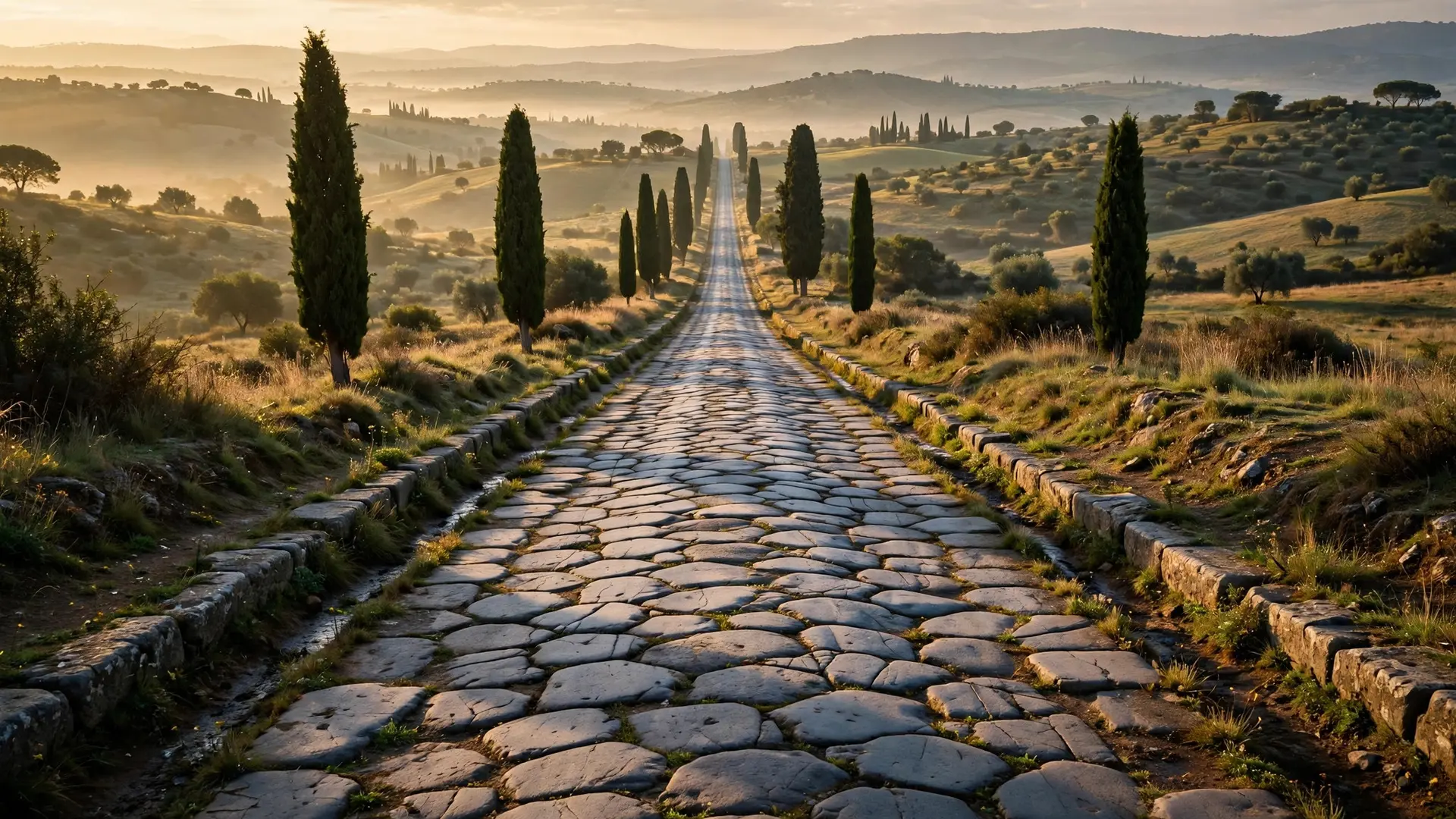
A first-class paved road — a via munita — was constructed from four named layers, and the same profile appears from Britain to Syria. First came the statumen, the foundation: after surveyors laid out the route, workers dug a trench three to six feet deep and lined it with large flat stones set in mortar. Over that went the rudus, a bed of broken stone and cement packed firm. Then the nucleus, finer gravel or concrete, smoothed flat and curved slightly upward at the center so water would drain to the sides. Finally the summum dorsum, the wearing surface: interlocking polygonal slabs of basalt, lava, or limestone fitted so tightly that the 6th-century historian Procopius, writing centuries after their construction, marveled that they "appeared to have grown together rather than been set by hand." The finished road was typically about 4.2 metres wide — enough for two carts to pass — flanked by raised stone curbs, gravel footpaths, and drainage ditches, with a camber of about one in sixty carrying rainwater off to the edges. At intervals, mounting blocks helped riders climb onto their horses. The layered structure was the point: if a slab cracked or a patch of gravel washed out, the road below still carried traffic. Modern asphalt, by contrast, is essentially one skin over a base — a single freeze-thaw cycle can split it open. The Romans built redundancy into every mile. Not every road got this treatment. Rome actually ran three grades: the via munita, fully paved, forming the 50,000-mile interstate system; the via glareata, gravel-surfaced with a stone or compacted base; and the via terrena, leveled and drained dirt. The dirt roads made up the bulk of the network's total of roughly 250,000 miles. What we picture as "a Roman road" is the top grade — and it was a deliberate overbuild.
Built for Legions, Not Tourists
The motive was military first. The Latin word via originally meant the way the army goes: new roads were laid right after new conquests, running in the most direct line possible from a legionary base back to Rome. Trade, mail, and travelers came later — because the roads were already there. Every Roman road descends from one: the Via Appia. In 312 BC, the censor Appius Claudius Caecus, in the middle of the Second Samnite War, simply built it — no Senate debate. It ran 132 Roman miles, about 195 kilometres, in a near-dead-straight line from Rome to Capua, a staging point for the southern campaigns. By 264 BC it reached the port of Brundisium, giving Rome a 360-mile stone artery to the heel of Italy and the sea routes to Greece. The poet Statius later called it regina viarum, the queen of roads, and the name stuck. One 90-kilometre stretch from Rome to Terracina was laid as a single ruler-straight section, and the road still holds Europe's longest straight stretch — 62 kilometres without a bend. The road set the template: straight lines wherever possible, layered paved construction built to last, state-funded and toll-free, with milestones, fountains, and way stations along the route. Rome industrialized road-building, turning one-off projects into state policy — a kind of infrastructure their engineers matched in the aqueducts that watered their cities.
Straight Lines and Drainage: The Two Real Secrets
Roman roads go through obstacles rather than around them. A hill in the way got a notch cut through it; a river got a bridge; a marsh got piles driven through the muck and a causeway built over them. The surveyors — the agrimensores — made this possible with instruments like the groma, a sighting tool with plumb lines for marking right angles, and the dioptra, an early theodolite. Where perfect straightness was impossible, they bored through: the Furlo Pass tunnel on the Via Flaminia, cut through 38 metres of solid limestone by Vespasian's engineers in AD 77, is still in use nearly 1,950 years later as part of the modern Italian highway system. Drainage was the other half of the secret, and arguably the more important one. Roads were raised slightly above the surrounding ground, cambered so rain ran off, and flanked by ditches and retaining walls; in wet country they ran on embankments to stay above floods. A road that never holds standing water never rots from beneath.
The roads were also a system, not just surfaces. Every Roman mile — about 1,479 metres — was marked by a milliarium, a stone column inscribed with distances and often the emperor who had ordered repairs; some 7,000 of them survive across the former empire. Augustus's Golden Milestone in the Forum marked distances to the empire's great cities — the origin of the saying that all roads lead to Rome. His cursus publicus, the imperial post, turned the network into a two-tier service: mutationes every eight to twelve miles where couriers changed horses, and mansiones every twenty to thirty miles offering stables, baths, kitchens, and beds. A military courier with an imperial travel pass could cover about 50 miles a day; Pliny the Elder records Tiberius covering 184 miles in 24 hours of chariot relays racing to his dying brother. Ordinary travelers in carts managed 15 to 20 miles a day — about the pace Napoleon's armies made on foot.
What We Get Wrong
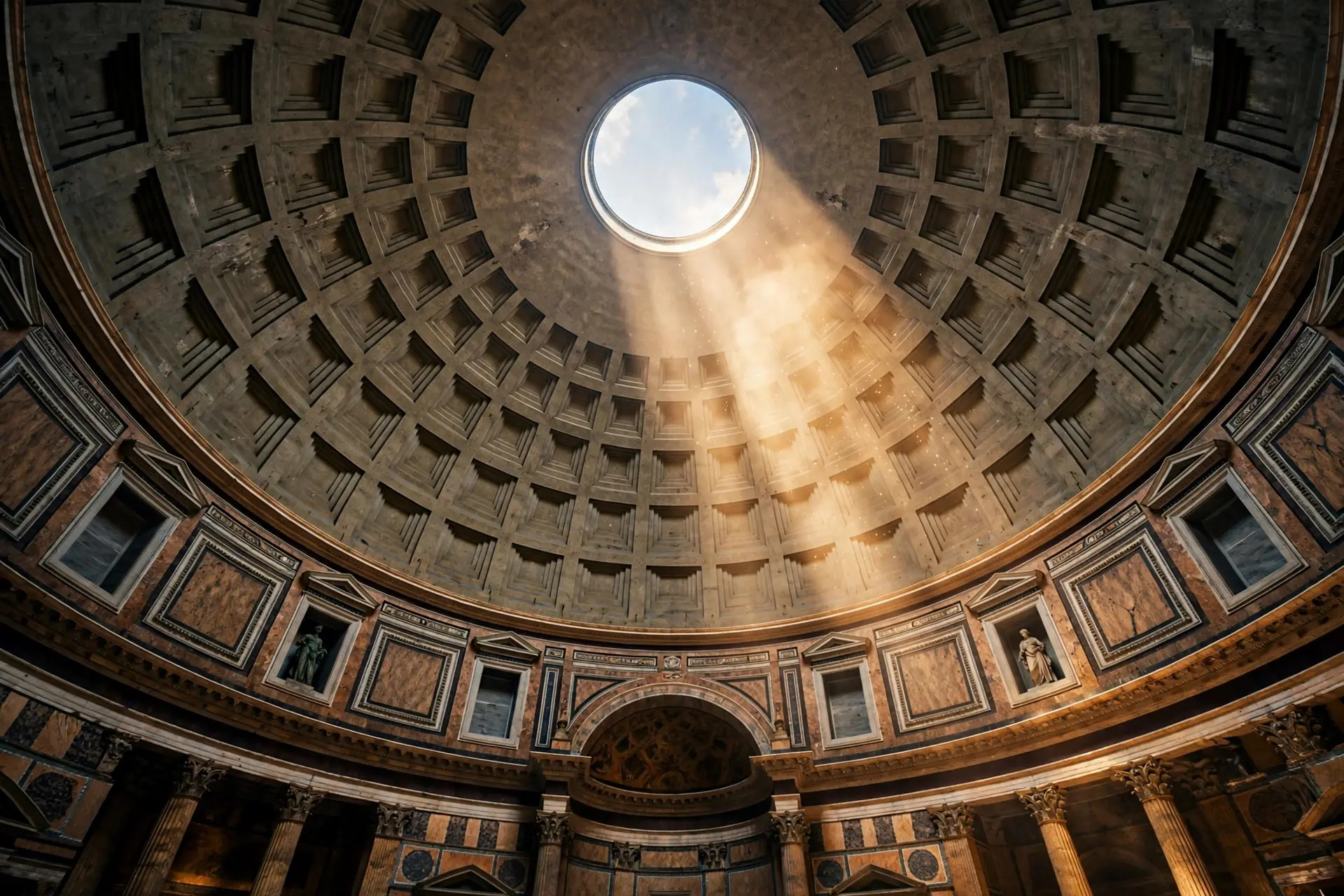
The biggest misconception is that every Roman road looked like the Appian Way. Most didn't — most of the 250,000-mile network was gravel or dirt. Only the great military highways got the four-layer treatment. What survived is a survivor's story: the best-built roads, carrying the heaviest traffic on the most strategic routes, with the strongest reasons for later generations to maintain them. Another is that the Romans were the end of the story. The Appian Way's recognition is still arriving: in July 2024 UNESCO inscribed the Via Appia on its World Heritage List — the first ancient road in the world so honored, and Italy's 60th property — praising it as a fully developed ensemble of engineering works showing the advanced technical skill of Roman engineers. At more than 800 kilometres of recognized route, it is not a monument but an entire landscape of roads, bridges, tunnels, tombs, and villas, and its first ten miles remain intact as a park in southern Rome. Roman roads endured because they were overbuilt on purpose: redundant layers, water shed away from the structure, and routes so straight that two thousand years of settlement grew up along them rather than rerouting them. Build every part to outlast itself, and the whole thing outlasts the civilization that made it — even the 1,900-year-old concrete of the Pantheon's dome follows the same Roman rule. Do not build for the decade; build for eternity.
Frequently asked questions
How many layers did a Roman road have?
The finest paved roads, called viae munitae, were built in four layers: the statumen foundation of large flat stones, the rudus of broken stone and cement, the nucleus of finer gravel or concrete, and the summum dorsum wearing surface of tightly fitted polygonal stone slabs. Lower-grade roads used gravel or dirt instead.
Why are Roman roads so straight?
Straightness was deliberate: a straight road is shorter, faster for marching armies, and quicker to build. Surveyors called agrimensores laid out routes with sighting tools like the groma and dioptra, cutting through hills and bridging rivers rather than going around them.
Can you still walk on Roman roads today?
Yes. Stretches of original paving survive across Europe and the Mediterranean — the first ten miles of the Via Appia survive as original paving inside Rome's Appia Antica park, and the Furlo Pass tunnel on the Via Flaminia, cut in AD 77, is still part of a modern Italian highway.
Sources
- Roman Roads | The Roman Empire, Roman-Empire.net
- Ancient Rome's Appian Way Is Now a UNESCO World Heritage Site, Smithsonian Magazine
- Italy's Ancient Roman Appian Way included in UNESCO World Heritage List, Associated Press
- Roman road system, EBSCO