How Did the Romans Raise the Colosseum's Velarium Awning?
How did the Colosseum awning work? Sailors from the Misenum fleet hauled linen sails over 240 masts to shade 50,000 spectators — see how the velarium worked.
Key takeaways
- The velarium was a retractable linen awning drawn across the Colosseum's seating by ropes, winches and about 240 wooden masts set into the top cornice.
- Sailors of the imperial fleet at Misenum, the classiarii, worked the rigging in coordinated teams because they understood wind and canvas.
- Mast sockets and stone corbels are still visible on the building's uppermost cornice, clearest from the upper tiers reopened in 2024.
- The arena floor stayed open to the sky; hot air escaping through the gap created a cooling breeze over the crowd.
- Rome was not first: Greek theaters and Pompeii's amphitheater (about 70 BC) had awnings long before the Colosseum's was built.
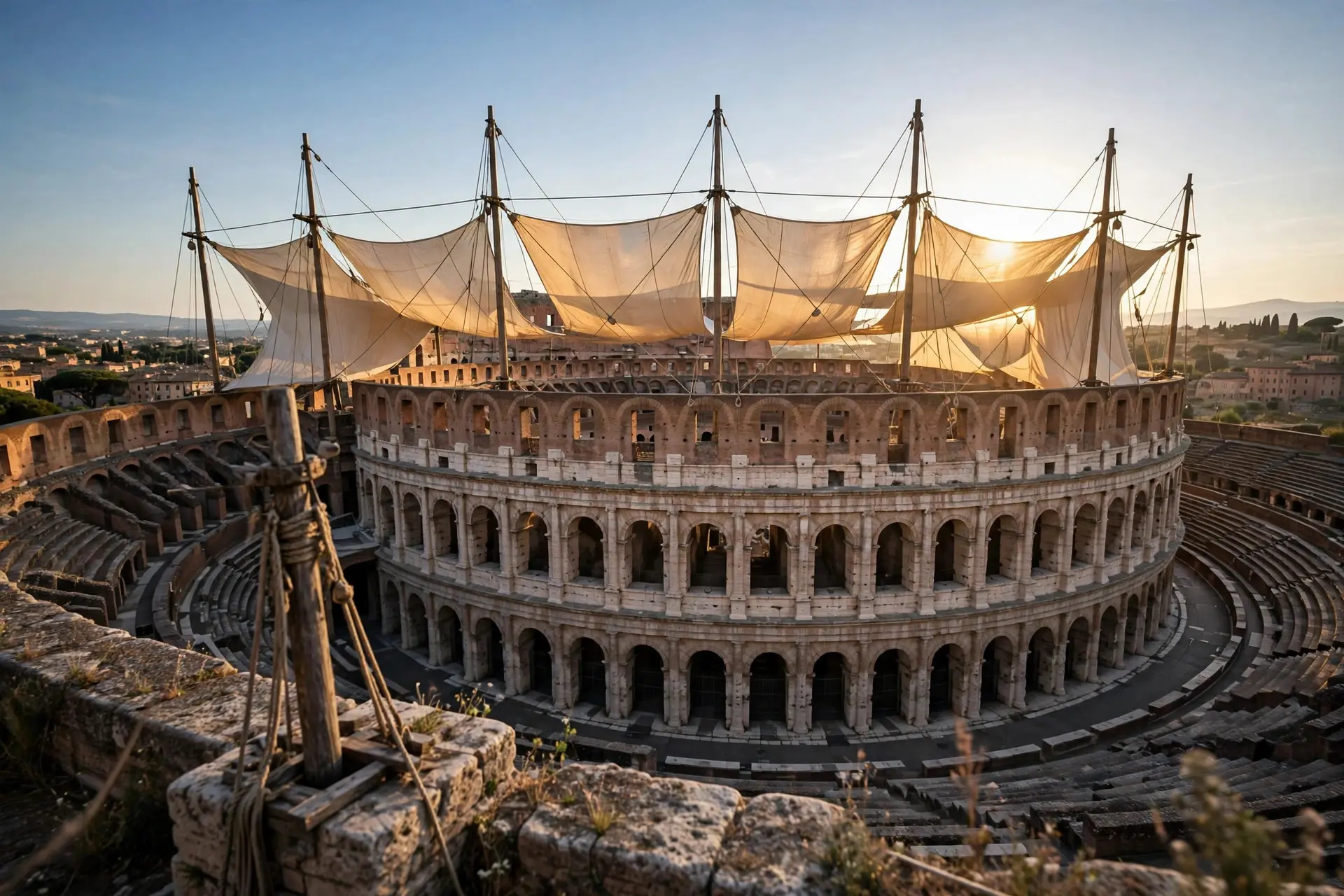
How did the Colosseum's awning work? The Romans raised it with rope, winch and sailor power: crews drew strips of linen across the seating from about 240 wooden masts slotted into sockets along the outer wall's top cornice. The arena stayed open, and hot air rushing up through the gap created a cooling breeze for the crowd below.
- About 240 wooden masts sat in sockets around the Colosseum's top cornice, each steadied by a projecting stone corbel that you can still see today (Encyclopaedia Romana).
- A naval detachment (vexillatio) from the imperial fleet at Misenum worked the ropes and winches, handling the linen panels the way sailors handle ship's sails (Encyclopaedia Romana, HISTORY).
- The awning used strips of linen (some accounts say wool) on ropes, drawn across the cavea, the tiered seating, while the arena stayed open to the sky (Encyclopaedia Romana, Through Eternity).
- The Colosseum was begun by Vespasian around AD 70 and opened by Titus in AD 80 with games lasting 100 days, designed from the start to carry the velarium (Encyclopaedia Romana, HISTORY).
- One estimate puts the fabric at up to 24 metric tons (about 26.5 US tons) on a building measuring about 188 m (617 ft) by 156 m (512 ft) (Through Eternity).
- Ancient authors confirm it: Pliny describes Nero's azure, star-spangled awning (Natural History XIX.24); Lucretius wrote that billowing theater canvas sounded like thunder (De Rerum Natura VI.110); Suetonius records Caligula ordering an awning drawn back in blazing heat (Caligula XXVI.5) (Encyclopaedia Romana).
How Did the Colosseum Awning Work?
The velarium was not one giant sheet of cloth. It was a kit of narrow linen panels that could be pulled out over the seating or drawn back again, like sliding curtains, except the track was rope and the motors were men. No surviving Roman manual explains the rigging, so modern understanding comes from the hardware still visible on the building and from reconstructions. Here is the sequence, step by step, from the wall to the center:
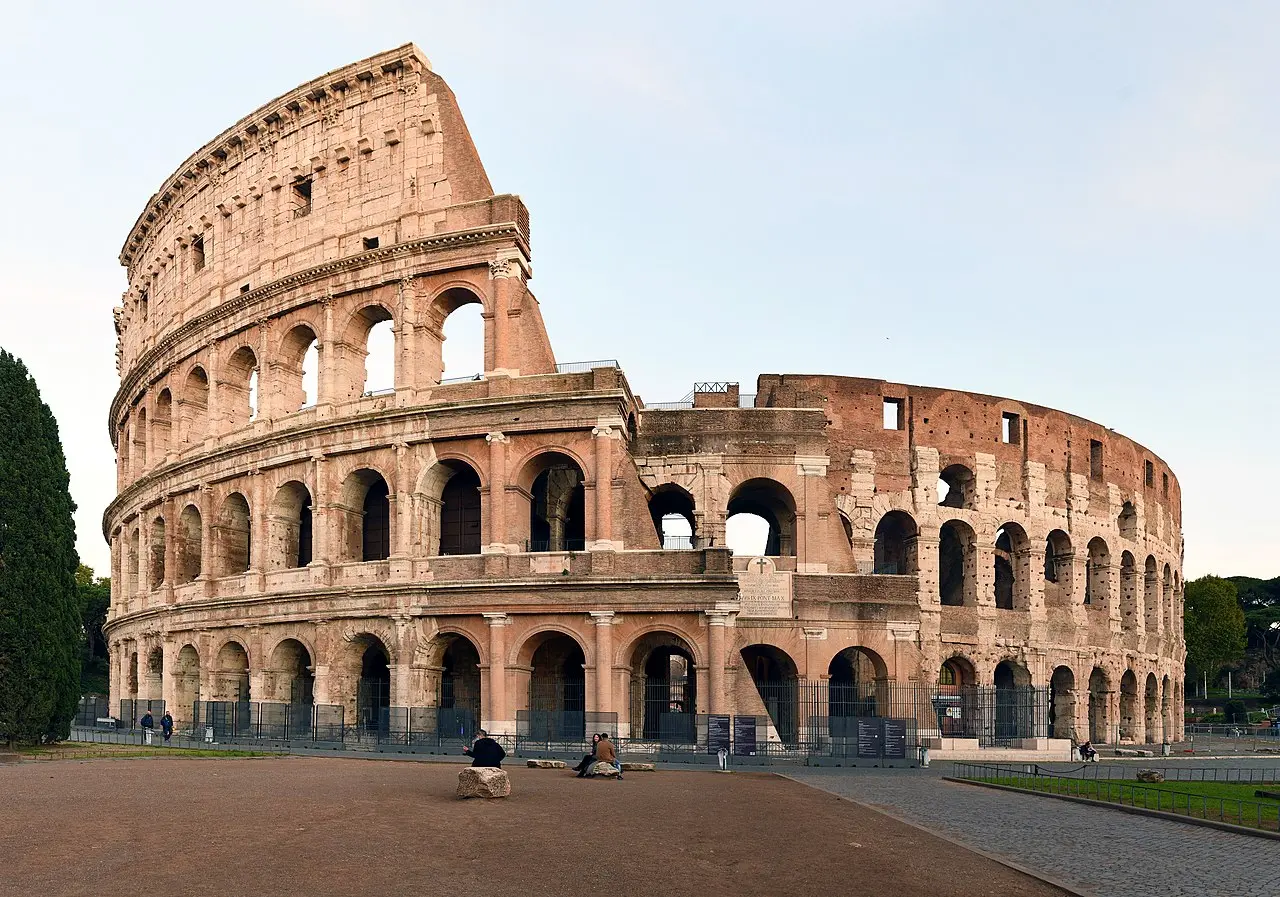
- Sockets. Roughly 240 sockets ring the top of the outer wall's attic story, each backed by a projecting stone corbel. The corbels and sockets survive and are still visible on the exterior.
- Masts. A tall wooden mast slotted into each socket, passing through the crowning entablature and braced against the wall.
- Ropes and panels. Ropes ran from the masts inward over the seating toward a central opening above the arena, and strips of woven linen, the same cloth Roman warships used for sails, were laced to them so each section could move on its own.
- Winches. Crews worked pulley tackles and winches on the upper story. Kristin Triff, an architectural historian at Trinity College, puts it this way in a HISTORY report from 2026: "They'd be up on the top story of the Colosseum working the masts. They'd have to work in sync, and it had to be coordinated."
- Pull, release, adjust. Hauling the ropes drew the linen panels out over the seats; easing them let the panels gather near the masts. Crews tuned the tension through the day as the sun moved and the wind shifted, and withdrew the awning entirely in bad weather. The word velarium comes from velum, the Latin word for sail, and the whole system behaved like one: a huge surface that caught the wind and had to be managed before it tore itself apart.
Who Worked the Velarium?
Sailors: a detachment (vexillatio) of marines from the imperial fleet at Misenum, near Naples, the men Romans called classiarii, fleet personnel. They were transferred to Rome and housed in barracks near the building known as the Castra Misenatium. Why sailors rather than soldiers? Edward Watts, a Roman history professor at UC San Diego, says they were brought in because they knew how to measure wind and understood how cloth behaves in it, which kept the apparatus from breaking apart. The velarium was, after all, ship's rigging turned sideways. How many hands did it take? No source gives a firm number: HISTORY speaks of "hundreds" of sailors at the winches, while other accounts describe crews of around a hundred. What is recorded is that the team had to be large, practiced and precisely coordinated, since one mistimed pull could jam a panel or rip a seam. The opening of the awning was part of the show: some emperors reportedly wanted everyone seated and the velarium unfurled before the games could begin. Lucretius even wrote about panels tearing and flapping between the poles with a sound like torn paper or a crack of thunder.
What Evidence for the Velarium Still Exists?
Evidence comes in three kinds: the building itself, the stones around it, and the ancient texts. Together they form a timeline.
| Date | Evidence |
|---|---|
| About 70 BC | Pompeii's amphitheater already had a velarium, anchored to the city walls instead of the building. |
| AD 37 to 41 | Suetonius says Caligula ordered an amphitheater's awning drawn back on a scorching day and forbade anyone to leave (Caligula XXVI.5), though he died decades before the Colosseum existed. |
| AD 70 to 80 | The Colosseum is built, designed from the start to carry a velarium. |
| AD 80 | Titus dedicates the Colosseum with 100 days of games. |
| About AD 77 | Pliny describes Nero's azure, star-spangled awning over his Campus Martius amphitheater (Natural History XIX.24): velaria could be decorated. |
| AD 217 | Lightning sets a fire that destroys the Colosseum's wooden upper levels, recorded by Cassius Dio. |
| Today | The 240 mast sockets and corbels remain visible on the uppermost cornice, clearest from the upper tiers reopened in 2024. |
The most contested evidence is a ring of travertine bollards, or cippi, around the building. Some suggest the ropes were secured to these stones, but the Encyclopaedia Romana page notes the foundations are too shallow to have held that tension, and the bollards sit on a different axis from the mast sockets. The likelier reading is that they carried chains cordoning off the piazza as a pedestrian zone: crowd control, not rigging. The full story of how the Colosseum was built covers the building itself, from Vespasian's first stone to the 100-day opening under Titus.
What Does Everyone Get Wrong About the Velarium?
A few misunderstandings turn up again and again:
| The claim | What the evidence says |
|---|---|
| It was a full roof. | It covered most of the seating but left the arena floor open. People seated closest to the action, including senators, were often left in the sun. |
| The Colosseum invented it. | Greek theaters used awnings first, and Romans copied the idea. Pompeii's amphitheater, built around 70 BC, had one anchored to the city walls. Velaria also appeared at Nimes, Arles and Pola. |
| The stone bollards outside anchored the ropes. | Possibly, but the shallow foundations and wrong alignment make crowd barriers the stronger explanation. |
| The awning was always up. | It was drawn back in bad weather, and Suetonius shows it could be withdrawn at an emperor's whim. |
| It was purely practical. | It was also propaganda. Nero painted heavens and stars on his velarium, and organizers advertised shaded seating on papyrus flyers and graffiti to pull in crowds. |
| Then there is the hot air. Because the arena stayed open, heated air rose through the middle of the velarium, and the rush escaping through the smaller opening "would create a breeze," as Triff puts it. She calls it "akin to Roman air-conditioning." The gap over the arena was not unfinished engineering. It was the engine. | |
| The Romans saw the parallel so clearly that they assigned the navy to run it, in the same spirit that raised the Pantheon's dome and built Rome's aqueducts: take a working technology, scale it up, and put it to work in public. |
Why Does the Velarium Still Matter?
The velarium matters because it was a system, not a structure: sockets, masts, ropes, linen, winches, sailors and weather reading all working together for one afternoon's shade, for 45,000 to 50,000 spectators in a building about 50 m (164 ft) tall. Reconstructing it forces engineers to think the way the Romans did, about load, wind and maintenance, the parts of building that rarely survive in stone. Honest limits remain. No source records the exact fabric weight or the precise crew size, and reconstructions of the central ring and rope pattern differ. What the evidence settles is the core: 240 masts in surviving sockets, linen panels on ropes, winches worked by Misenum sailors, a retractable awning that shaded the seats and left the sky open over the sand. How we made this article: FactSpire researched and drafted it with AI assistance and checked every fact against the sources listed above.
Frequently asked questions
How did the Colosseum's awning actually work?
Strips of linen were laced to ropes running from about 240 wooden masts set into sockets on the outer wall's top cornice. Sailors working winches and pulley tackles on the upper level hauled the panels outward over the seating, or pulled them back, adjusting tension through the day as the sun moved and the wind shifted.
Who operated the velarium?
A special detachment (vexillatio) of sailors from the imperial fleet at Misenum, near Naples, was stationed in nearby barracks called the Castra Misenatium. Roman leaders picked sailors rather than soldiers because they knew how wind behaves against cloth and how to keep heavy rigging from failing.
Did the velarium cover the whole Colosseum?
No. It shaded most of the seating tiers but left the arena floor open to the sky, which let hot air rise and escape through the gap and created a breeze for the crowd. People seated closest to the action, including senators, were often left in the sun.
Can you still see traces of the velarium today?
Yes. The sockets and projecting stone corbels that held the 240 masts remain on the Colosseum's uppermost cornice, clearest from an elevated viewpoint such as Colle Oppio park or the upper tiers reopened in 2024. Whether the travertine bollards around the building anchored the ropes is debated; many scholars read them as crowd barriers.
Sources
- Colosseum, Encyclopaedia Romana
- How Ancient Romans Kept the Colosseum Cool in Summer Heat, HISTORY
- Did the Colosseum Have a Roof? The Velarium, Through Eternity
- Colosseum « IMPERIUM ROMANUM, Imperium Romanum