How Did the Phoenicians Make Purple Dye Costlier Than Gold?
Phoenician Tyrian purple came from thousands of sea snails per gram of dye. Workshops at Aegina show how the 6,6-dibromoindigo color was made.
Key takeaways
- Tyrian purple was made from the mucus glands of predatory Mediterranean sea snails, chemically 6,6'-dibromoindigo.
- Thousands of snails went into a single ounce of dye; modern estimates put it around 10,000 snails per gram.
- The glands were simmered in saltwater in lead vats for about ten days, with sunlight turning the mixture purple.
- Archaeologists found a 3,600-year-old purple dye workshop on the Greek island of Aegina, published in PLOS ONE.
- The color was so exclusive that Roman emperors reserved it for themselves, and Byzantine law made imitating it punishable by death.
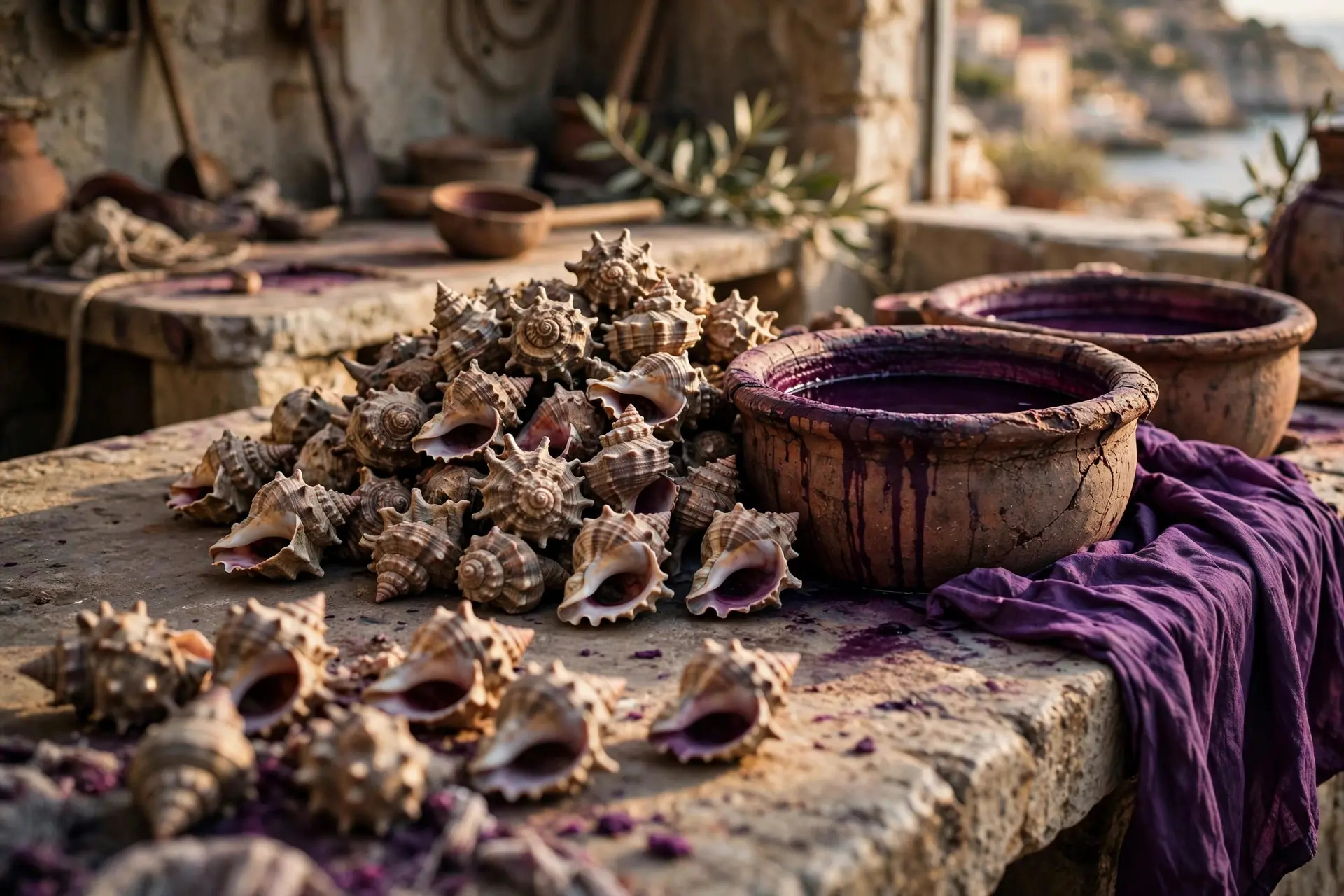
Tyrian purple was made from the mucus glands of predatory Mediterranean sea snails, simmered in saltwater in lead vats for about ten days. Thousands of snails went into a single ounce of dye, and sunlight turned the extract from green to blue to the deep purple-red that Roman emperors reserved for themselves.
- The raw material came from three snail species, mostly the banded dye-murex (Hexaplex trunculus), which accounts for up to 90% of shells at western Mediterranean production sites, plus the spiny dye-murex and the red-mouthed rock shell. (ScienceInsights)
- Each snail's mucus gland held only colorless chemical precursors; sunlight and air triggered the reactions that produced the vivid dye. (ScienceInsights)
- Workers cracked the shells, removed the tiny glands, and heated them slowly in saltwater brine for about ten days before straining the liquid and soaking textiles in it repeatedly. (ScienceInsights)
- Pliny the Elder wrote that thousands of snails were required to produce a single ounce of dye; modern estimates put it closer to 10,000 snails per gram. (Smithsonian Magazine, ScienceInsights)
- On the Greek island of Aegina, archaeologists found a 3,600-year-old dye workshop with pigmented ceramics, grinding tools, and heaps of crushed shells, published in the journal PLOS ONE. (Smithsonian Magazine)
- Julius Caesar named Tyrian purple his official color in the first century CE, and Byzantine emperors later made imitating purple dyeing punishable by death. (Smithsonian Magazine, ScienceInsights)
Which snails, and why were their glands special?
The snails were carnivores, not the garden kind. The banded dye-murex, the spiny dye-murex (Bolinus brandaris), and the red-mouthed rock shell (Stramonita haemastoma) all secrete a mucus from a small gland near the head, probably as a chemical defense and antibacterial shield for the animal and its egg masses. In the living snail, the secretion is not purple. It carries colorless precursors that only become dye through a sequence of reactions set off by sunlight and air, ending in the molecule 6,6'-dibromoindigo. Each species tinted the result slightly differently, so workshops could blend shades the way painters mix pigments. The chemistry also explains the dye's fame for durability: the two bromine atoms pull the molecules about 16% tighter together than ordinary indigo, making the dye far less soluble and resistant to breakdown. Ancient writers claimed the color improved with washing and sunlight instead of fading, the opposite of every other ancient dye.
How did the Phoenicians run a snail-dye industry?
The Phoenicians, based in the coastal city of Tyre in modern-day Lebanon, turned the process into a major industry, and the dye takes its name from their city. Harvesters gathered enormous quantities of snails along the coast, cracked the shells, and cut out the tiny mucus-producing glands. Those went into lead pots of saltwater brine and simmered for about ten days. Heat and salt broke down the organic matter and concentrated the dye compounds, the liquid was strained, and textiles were soaked repeatedly to build up the color. Sunlight did the final magic. An 18th-century observer watched the transformation unfold on fabric exposed to the sun: green to deep green, then sea green, blue, purplish red, and finally a deep purple-red, "beyond which the Sun can do no more." The full process needed hours of direct sun to reach the richest shade. The work was slow, smelly, and labor-intensive. Boiling vats of rotting snails reeked so badly that dye factories were pushed to the shoreline, and the discarded shells piled up into mounds that became permanent features of the coast from Lebanon to Spain. One reason purple production stayed put for centuries is that it needed the snails alive until their glands were harvested, as the Aegina workshop shows.
What did the Aegina workshop reveal?
In 2017, excavators working in the Bronze Age town of Kolonna on Aegina found two Mycenaean buildings dating to the 16th century BCE. The older one held pigmented ceramics, grinding tools, and heaps of broken mollusk shells: a purple dye factory some 3,600 years old. Analysis showed that only one snail species was used there, the banded dye-murex. The finds rewrite a small piece of economic history. Purple dye was being manufactured in a dense, fortified town, not just at isolated coastal sites, which means the color was already a traded urban product in the 1500s BCE, before it became the exclusive mark of royalty. The excavators also found the burnt bones of piglets and lambs, suggesting the workers sacrificed young animals to bless the dye's production. The pottery fragments still carry pigment of such quality that it could be extracted and used to dye cloth today, according to the study's co-author, archaeologist Lydia Berger of the University of Salzburg.
The arithmetic of an ounce of purple
How many snails make an ounce of the most expensive colorant in the ancient world? The ancient and modern figures disagree, but they converge on the same order of magnitude:
| Source | Snails per unit | Converted to per ounce (28.35 g) |
|---|---|---|
| Pliny the Elder (1st c. CE) | "thousands" per ounce | thousands per ounce |
| Modern estimate (ScienceInsights) | ~10,000 per gram | ~283,500 per ounce |
| Traditional account | ~250,000 per ounce | ~250,000 per ounce |
| Method: 10,000 snails per gram × 28.35 grams per ounce ≈ 283,500 snails per ounce. The modern estimate lands close to the traditional quarter-million figure, which suggests Pliny's "thousands" was either a loose figure or described a cruder, bulkier product. Either way, a single ounce of dye represented hundreds of thousands of individual animals, each processed by hand, one gland at a time. |
Why purple ruled the ancient wardrobe
Rarity made purple a natural status symbol, and the ancient world formalized it. The Phoenicians who pioneered it were traders, and purple paid. Roman senators wore togas with a purple stripe; generals celebrating a triumph wore solid purple; eventually the color belonged to the emperor himself. The Byzantine court turned the color into law. Sumptuary laws prohibited commoners from wearing purple, and Emperor Theodosius II issued an edict declaring that even attempting to imitate purple dyeing was punishable by death. The phrase "born to the purple" comes from the Byzantine court, where a purple-lined chamber was reserved for imperial births. Purple was not a fashion choice; it was a legal and political institution. Connoisseurs were picky: the most desirable shade had exactly the color of clotted blood, dark and nearly blackish to the sight but shining when held to the light, in Pliny's description. That is the same secretive craft that produced Damascus steel, another ancient luxury technology whose masters guarded their formulas to the grave, and the same era of organized industry that carved the lamassu statues of Assyria.
What do people get wrong about Tyrian purple?
First, that the snails are purple. They are not; the mucus is colorless until sunlight rewrites it. Second, that the recipe was lost because it was magic. It was lost because dye makers kept their formulas secret and the industry died out by the 15th century, when cheaper alternatives finally won. Third, that purple was expensive because of chemistry. Synthetic 6,6'-dibromoindigo costs under $4 for five grams today. The expense was pure biology: vanishingly small amounts of precursor, locked in thousands of animals, each opened by hand. How we made this article: FactSpire researched and drafted it with AI assistance and checked every fact against the sources listed above.
Frequently asked questions
How many snails did it take to make Tyrian purple?
Accounts vary, which is part of the story. Pliny the Elder wrote that thousands of snails went into a single ounce of dye. Modern estimates are steeper: roughly 10,000 snails to yield one gram of pure extract, which would mean on the order of 250,000 to 300,000 snails per ounce. Tunisian artisan Mohamed Ghassen Nouira processes about 45 kilograms of snails to get a single gram he sells for around $2,700.
What did Tyrian purple smell like?
Awful. The process meant crushing live snails, salting the glands, and simmering the mixture for days, which is why ancient dye workshops were banished to the shoreline, downwind of settlements. The stink was legendary: workers stank of it, and the mounds of crushed shells piled up into landscape features still visible in parts of the Mediterranean.
Why was purple the color of royalty?
Because only the richest could afford it. Roman senators wore togas with a purple stripe, generals in triumph wore solid purple, and Julius Caesar named it his official color in the first century CE. By the Byzantine era, sumptuary laws reserved purple for the emperor; Theodosius II made even imitating purple dyeing punishable by death.
Is Tyrian purple still made today?
Yes, by a handful of artisans using traditional methods. The molecule, 6,6'-dibromoindigo, is chemically identical whether made from snails or synthesized in a lab; synthetic versions cost under $4 for five grams. What made the ancient dye expensive was never the chemistry. It was the biological bottleneck of extracting dye from thousands of animals, one gland at a time.
Sources
- In This Ancient Workshop, Greeks Crushed Snail Glands to Make the Purple Dye Worn by Royalty, Smithsonian Magazine
- What Is Tyrian Purple? The Ancient Royal Dye, ScienceInsights
- Archaeologists find a Bronze Age purple dye workshop, HeritageDaily