What Made Damascus Steel So Legendary in Battle?
Damascus blades earned their fame from rippling patterns grown inside the steel itself. How wootz ingots, trace metals and lost ore supplies made them.
Key takeaways
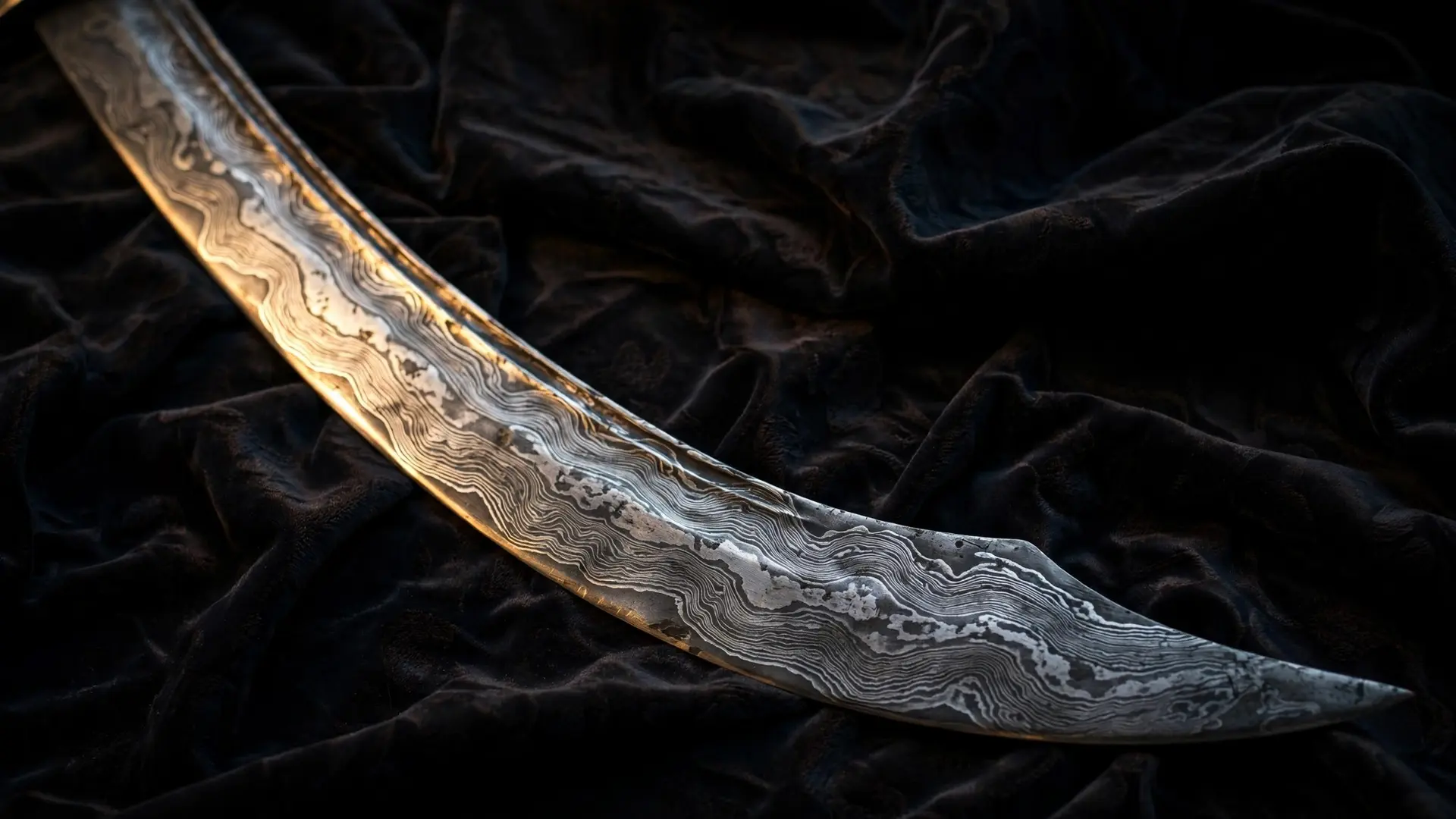
- The famous ripples on a wootz blade were bands of carbide particles inside the steel, revealed by polishing and etching, not decoration painted on the surface.
- Blades began as small crucible ingots of high-carbon steel, roughly 2.3 kilograms each, forged in the Near East from material produced in India.
- Trace amounts of metals such as vanadium, measured in tens of parts per million, helped the carbide bands form during careful low-temperature forging.
- The finest patterned blades belong mainly to the 16th and 17th centuries, and the best examples had probably stopped being made by around 1750.
- Modern layered pattern-welded steel looks similar but is made by a different method and is not the same material as historical wootz.
A Damascus blade earned its reputation not from a sharper edge alone but from the ripples that seemed to move across its surface like water. Those ripples were not painted, etched on as decoration, or folded in as visible layers. They grew out of the metal itself, from tiny clusters of a hard iron-carbon compound that lined up in bands while the blade was forged. That hidden structure, and the fragile chain of ore, heat and habit needed to produce it, is the real story behind the legend.
What was the pattern actually made of?
The starting material was wootz, a steel melted in a sealed clay crucible until it formed a small, dense cake. A research team led by J. D. Verhoeven at Iowa State University described typical ingots weighing about 2.3 kilograms and carrying roughly 1.5 percent carbon, a high share by the standards of hand-forged steel. When such a cake cooled, particles of cementite, the hard compound of iron and carbon, settled unevenly through the metal. Forging then stretched and aligned those uneven regions into bands lying close to the plane of the blade. Polishing and a mild acid etch made the difference visible. The bands, rich in cementite particles, caught the light, while the steel between them etched darker. Change the angle at which the blade surface met the bands and the pattern shifted, which is why a single blade could show waves, ladders and rosettes in different places. The celebrated ladder pattern, for instance, appears to have come from shallow grooves cut or forged across a nearly finished blade, which bent the bands as the metal flowed back into shape. The smith was not drawing on steel. He was steering geology that had already happened inside the ingot. This also explains why two blades from the same workshop could look so different. Verhoeven and his colleagues found that it was far easier to forge a wootz ingot into a plain, grainy blade than into one with bold bands. The bands demanded three things at once: the right trace chemistry in the ingot, the right heating and cooling rhythm, and a finishing grind that removed a dulled outer skin to expose the pattern beneath. Miss one, and the blade still cut, but it did not shimmer.
How did a southern Indian ingot become a Near Eastern sword?
The name Damascus steel is a map of trade, not of manufacture. The steel was produced in India, and also in centres such as Sri Lanka and Khorasan in Persia, then shipped as ingots to blade workshops across the Near East. The Museum of Fine Arts, Boston, places the main period of this hand-wrought steel roughly between 900 and 1600 CE, and notes that blades were prized for holding a sharp, resilient edge without shattering easily. Damascus itself mattered because it was a great market and finishing centre, where imported ingots were forged, sold and admired, and the city gave its name to the whole family of blades. Surviving examples show how far the material travelled and how highly courts valued it. The Wallace Collection in London holds a late 18th- or early 19th-century sword from Awadh, in northern India, whose blade is forged from wootz steel. Its wave-like pattern is exceptionally well preserved, and the museum notes that only the most skilled smiths could achieve such a result. The hilt, carved from walrus ivory and mounted with gold, tells the other half of the story: a wootz blade was a prestige object, carried by rulers and given as a gift, not merely a soldier's tool. Trade also explains the confusion that still surrounds the name. Alongside wootz blades, smiths made pattern-welded blades by forge-welding alternating sheets of high- and low-carbon steel, folding the stack again and again. Both kinds show patterns, and both were sold under glamorous names. Yet their insides are different. One pattern comes from bands that formed during solidification and forging; the other comes from layers the smith deliberately stacked. Calling both Damascus steel hides exactly the distinction that made wootz special.
Why did the finest blades stop appearing?
The best patterned blades cluster in the 16th and 17th centuries, and Verhoeven's team judged that the highest-quality examples had probably ceased to be made by around 1750, with lesser patterned work continuing into the early 1800s. No workshop diary records a final day of production, and no single explanation has been proven. The strongest current theory, however, turns on something the smiths could not see: trace impurities in the ore.
Experiments showed that vanadium at levels as low as 40 parts per million by weight could trigger the clustering of cementite particles into bands, with manganese able to play a similar role at higher levels. Chemical analyses of genuine old blades found vanadium in that range in nearly every case. The theory runs like this: for generations, ingots arrived from ore deposits that happened to carry the right traces, and smiths learned, by trial and error, the heating cycles that coaxed bands out of them. If that ore ran out or the trade route carrying it broke down, the same workshop routine would suddenly stop producing patterns. A smith could not tell a good ingot from a poor one by looking at it, and a secret that no longer worked would not be worth teaching to an apprentice. Within a generation or two, the knowledge could fade even while the workshops themselves survived. Other pressures may have helped. Long-distance trade could be interrupted, and political change could close a mine or a port. But the impurity theory has a particular elegance: it explains why the loss looks gradual rather than sudden, why some late blades show weak patterns, and why modern researchers could recover the metallurgy in the laboratory long before anyone could explain why the old workshops had lost it. The craft did not vanish in a single catastrophe. It unravelled, one missing ingredient at a time.
What should we stop believing about these blades?
The legends deserve scepticism, even when they flatter the material. Stories of blades slicing a falling silk scarf or cutting through an iron bar without dulling the edge belong to folklore and to the sales talk of dealers, not to measured evidence. Laboratory examination of a genuine blade found its strength comparable to good hot-rolled steel of similar carbon content, impressive for its age, but not supernatural. The blades were also not uniformly excellent. Many surviving wootz blades show only faint or grainy patterns, and at least one famous museum sword in the Verhoeven study turned out, on analysis, not to be true wootz at all, its pattern coming from a different kind of banding in the metal. The modern market adds a second layer of myth. A knife sold today as Damascus steel is almost always pattern-welded, and it may be excellent, but it is not a rediscovered wootz blade. That distinction matters for collectors, for museums, and for anyone who wants the legend to mean something precise. The historical achievement was narrower and stranger than the marketing: a small number of workshops, working with a particular ore, learned to coax an invisible internal structure to the surface of a sword. The same lesson runs through other lost crafts. Like the lost cities of the Silk Road, which thrived only while their water and trade routes held, Damascus steel depended on a network that stretched from Indian mines to Near Eastern markets. And like Greek fire, the Byzantine secret weapon, its power lay partly in secrecy, in knowledge held by few hands and lost when those hands stopped teaching. A blade's ripples were beautiful, but they were also a warning: the most admired technologies are often the most fragile, because they rest on conditions their makers cannot fully see or control.
Frequently asked questions
Was Damascus steel actually made in Damascus?
The name points to the city where such blades were traded and forged, but the steel itself was produced elsewhere, notably in India. Ingots travelled to workshops across the Near East, where smiths turned them into blades.
Why did the craft disappear?
No single cause is proven. Researchers argue that the pattern depended on trace metals from particular ores, on exact forging temperatures, and on skills passed from master to apprentice. If the right ore stopped arriving, the pattern would stop appearing even when the smiths did everything else right.
Is modern Damascus steel the real thing?
Usually not. Most modern Damascus steel is pattern-welded, built by folding and welding layers of different steels together. That produces a striking surface, but its internal structure differs from historical crucible wootz.
Were these blades magically sharp?
They were well made and could hold a fine edge, but tales of cutting silk in mid-air or slicing through iron bars are legends, not workshop records. Laboratory tests place their strength in the range of good high-carbon steel, not beyond physics.
Sources
- The Key Role of Impurities in Ancient Damascus Steel Blades, JOM, The Minerals, Metals & Materials Society
- Damascus steel - CAMEO, Museum of Fine Arts, Boston
- Sword associated with Maharaja Ranjit Singh, The Wallace Collection