Greek Fire: The Byzantine Empire's Secret Weapon
Greek fire was Byzantium's secret naval weapon — liquid flame that burned on water and couldn't be put out. How did it work, and why did its recipe stay hidden?
Key takeaways
- Greek fire was a liquid incendiary weapon whose recipe stayed a Byzantine state secret for over seven centuries.
- Its inventor is credited as Kallinikos of Heliopolis, a Greek architect who fled Muslim-held Syria for Constantinople in 668 CE.
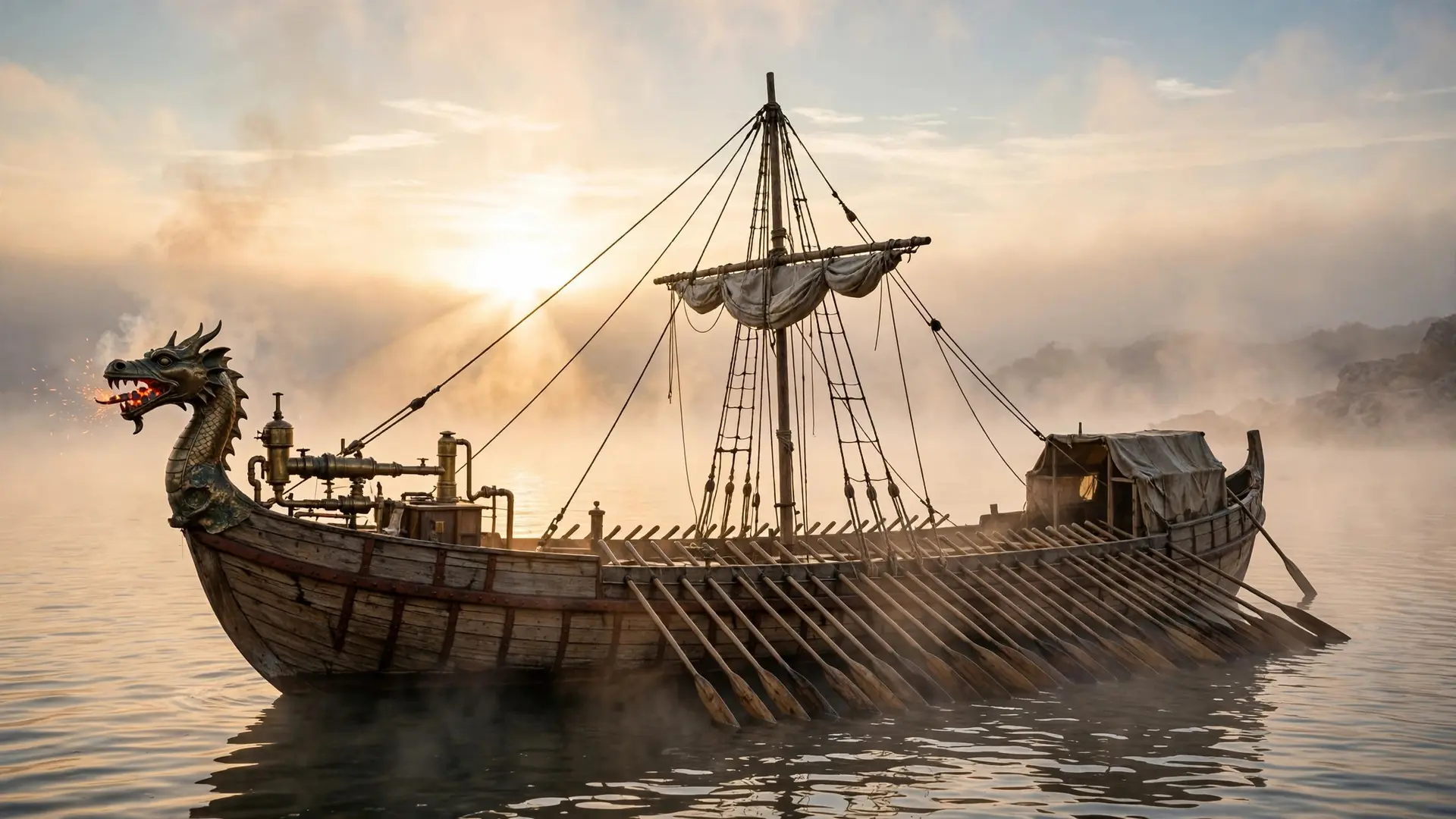
- Bronze siphons on dromon warships sprayed the burning liquid under pressure; water could not put it out — it burned on top of it.
- It broke the Arab sieges of Constantinople in 678 and 718 CE and became the empire's most famous weapon.
Greek fire was the Byzantine Empire's most feared naval weapon: a burning liquid, fired from bronze siphons mounted on warships, that clung to wooden hulls and kept burning on top of water instead of going out. Its exact recipe was guarded as a state secret for more than seven centuries — and it remains unknown to this day. No other weapon of the Middle Ages inspired quite the same dread. Medieval chroniclers called it the most devastating weapon of Christendom, and modern chemists still argue about what it contained. The story of Greek fire is really two stories at once: a remarkable piece of medieval engineering, and one of the most successful campaigns of secrecy in human history.
What exactly was Greek fire?
At its core, Greek fire was an incendiary liquid — sticky, volatile, and astonishingly hard to fight. Contemporary accounts agree on its strangest property: water would not extinguish it. Ships splashed with the liquid burned while surrounded by the sea, and sailors who leapt overboard to escape the flames sometimes found the fire burning on the water around them. The effect on morale was as decisive as the physical damage. Rigging, sails, deck timbers and hulls all caught at once, producing thick black smoke and a roaring blaze that spread across a fleet in minutes. The historian J. J. Norwich later wrote, "It is impossible to exaggerate the importance of Greek Fire in Byzantine history." Enemies who had never faced it learned quickly: an Italian chronicler, Liutprand of Cremona, recorded that during a 941 battle "the Greeks began to fling their fire all around; and the Rusii seeing the flames threw themselves in haste from their ships, preferring to be drowned in the water rather than burned alive in the fire."
How did the siphon weapon actually work?
The delivery system was as clever as the liquid itself. The main launcher was the siphon: a bronze tube mounted on the prow of a dromon, the fast oar-and-sail warship that formed the backbone of the Byzantine navy. The liquid was stored in heated, pressurized containers and forced through the tube by a siphon pump, so that a jet of flame could be aimed at an enemy vessel through a swivelling nozzle — essentially the world's first flamethrower, built a thousand years before the modern kind.
The Byzantines refined the system over time. Portable versions could be fired from fortifications, and for longer ranges the liquid was poured into clay grenades or soaked into bales of cloth and catapulted into enemy ranks. The technology demanded serious infrastructure: distilling the petroleum element required advanced techniques for the period, and preparing the mixture was so dangerous that only a tiny circle of specialists ever handled it. Remarkably, the engineering checks out. In 2006, historian John Haldon assembled a life-sized working copy from rebuilt components and Crimean petroleum, and it threw flames 10 to 15 metres — easily far enough to set an enemy ship ablaze in seconds.
Why did no one else crack the secret?
The invention is credited to Kallinikos of Heliopolis, a Greek architect who escaped from Muslim-held Syria to Constantinople in 668 CE. But the weapon survived for 700 years because of something Kallinikos could not have built alone: ruthless compartmentalization. The recipe was known only to the emperor and a handful of makers, and each emperor passed the secret directly to his successor. Emperor Romanos II, who ruled from 959 to 963, is said to have named three things that must never be given to foreigners: the imperial regalia, a royal princess, and Greek fire. The first two were, on occasion, bestowed on foreign rulers. The third never was. Secrecy worked even under pressure. On at least one occasion, enemy forces captured both the firing apparatus and the liquid fuel — and could not manage to use them. The machinery was too complex, the mixture too unforgiving, and the firing crews too specialized. Where other empires would have seen the weapon copied within a generation, Byzantium kept its monopoly until the technology itself faded.
Which battles did Greek fire decide?
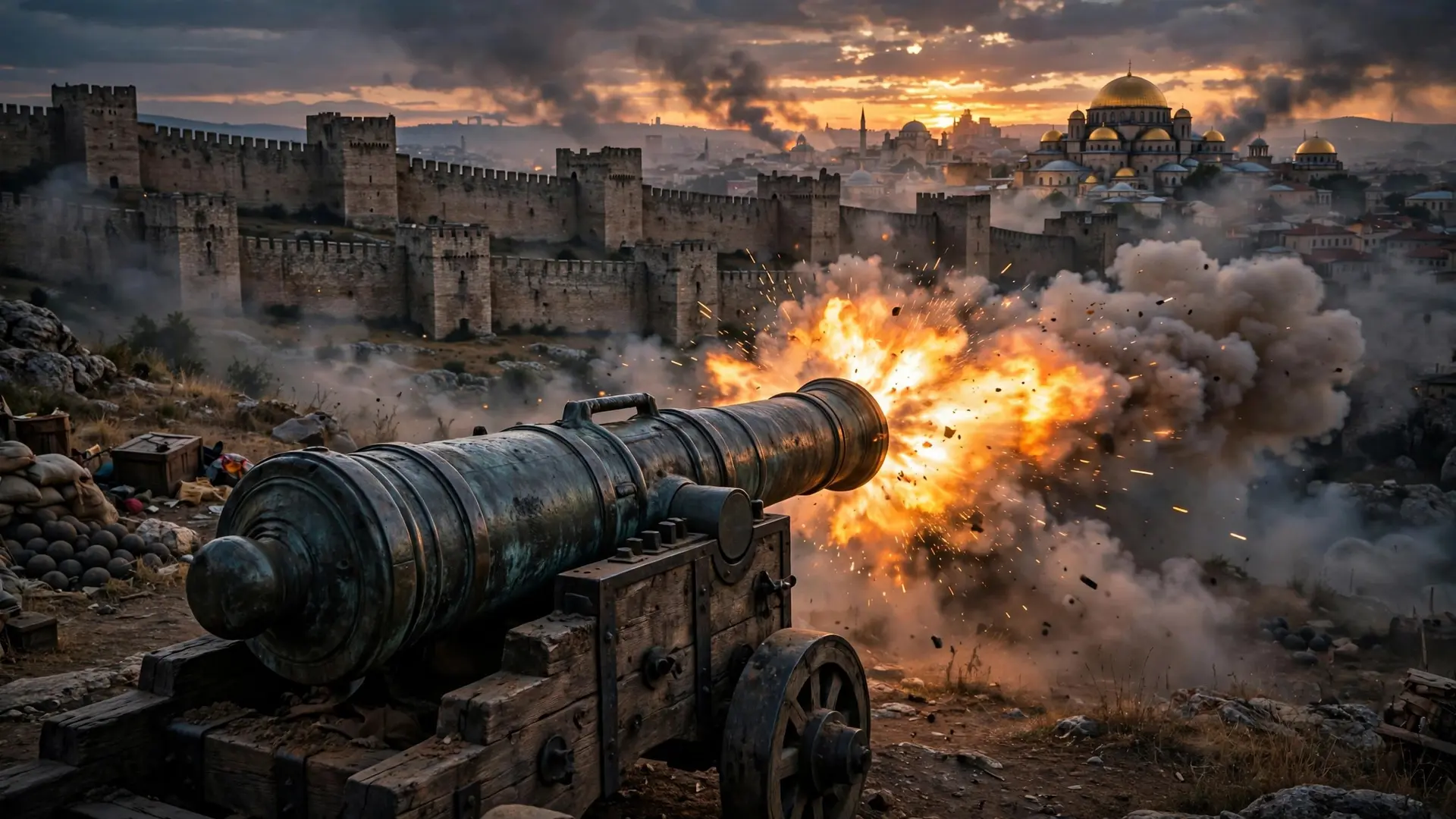
Greek fire arrived exactly when Constantinople needed it most. In the late 670s, Arab fleets had settled in to besiege the capital for four long years. Byzantine warships sailed out with their siphons spouting flame and routed the fleet — a victory that broke the siege. The trick was repeated a few decades later: after enduring a year-long blockade in 718, the Byzantines again destroyed the attacking Arab fleet with the burning liquid.
The victories kept coming. Romanos I used Greek fire against attacking Russian fleets in 941, and Constantine IX did the same a century later. John I Tzimiskes deployed it on land in 972 to force his way into Preslav, the Bulgar capital, and Basil II combined it with his Varangian Guard troops in 988–989 to crush the rebellion of Bardas Phokas. A 12th-century illuminated manuscript, the Madrid Skylitzes, even shows one of Michael II's ships firing the liquid at a rebel vessel during the siege of Constantinople in 821–822 — proof that the weapon was famous enough to be painted. For all of this, Greek fire was a weapon of the sea. Used against the 1258 siege of Baghdad style of land campaign it would have been far less decisive; its home was the narrow waters around the Byzantine capital, where a handful of flame-spouting dromons could turn a battle.
Why did Greek fire finally vanish?
Here is the common misconception: that the recipe was simply "lost," as if someone mislaid a scroll. The truth is more gradual. For reasons historians still debate, the use of Greek fire is unrecorded after the Fourth Crusade of 1202–1204, which sacked Constantinople itself and shattered the empire that had maintained the weapon's specialists, workshops and supply chains. Gunpowder was also beginning to transform warfare, offering range and power that no siphon could match. A secret kept by only a few people does not survive the collapse of the state that kept it. Yet the legend outlived the liquid. When Constantinople faced its last siege and the fall of Constantinople in 1453 finally ended the empire, Greek fire had been gone for two and a half centuries — but its reputation as the empire's invincible weapon lived on in every chronicle of its golden age. The weapon that once made the city look untouchable became, fittingly, one of history's great lost technologies: a reminder that the most powerful ideas are the ones you can keep secret. Like Venice's rise as a maritime empire centuries later, Byzantium's dominance at sea rested on a technology its rivals could see but never steal. Greek fire was not magic — it was chemistry, engineering and statecraft, blended as carefully as the liquid itself.
Frequently asked questions
What was Greek fire made of?
The exact formula is lost. Historians believe naphtha or light petroleum — possibly sourced from Crimea — was the vital ingredient, mixed with quicklime, sulphur, resin and saltpetre. The blend was extremely volatile and dangerous to manufacture.
How was Greek fire used in battle?
It was sprayed under pressure through bronze siphon tubes mounted on the prows of dromon warships, like a medieval flamethrower. It was also loaded into clay grenades and catapulted at enemy ships and fortifications.
Why is Greek fire's recipe still unknown?
It was a state secret known only to the emperor and a handful of makers, and Emperor Romanos II forbade it from ever reaching foreign hands. When the weapon stopped being used after the 1200s, the recipe died with its makers.