How Were the Moai Moved? The Case for Walking Statues
Rapa Nui tradition says the moai walked. Statue shapes, old roads and rope trials now support it, and recast the story of the island's supposed collapse.
Key takeaways
- About 95 percent of Rapa Nui's monolithic statues were carved from volcanic tuff at the Rano Raraku crater, and about 500 moai were moved beyond the quarry.
- Rapa Nui oral tradition says the moai walked, and Terry Hunt and Carl Lipo's team walked a 4.35-tonne replica 100 metres in 40 minutes using 18 people and ropes.
- Statues abandoned at the quarry or along the old roads lean forward, a shape that suits walking; carvers seem to have reshaped them upright only on arrival.
- The moai represent deified chiefly ancestors and were set on stone platforms called ahu, facing inland over the communities that built them.
- Ancient DNA from 15 islanders shows no 17th-century population crash; the real catastrophe followed Peruvian slave raids and smallpox in the 1860s.
The Rapa Nui most likely walked their moai. Teams hauling on ropes rocked each statue from side to side so that it shuffled forward upright, just as the island's oral traditions always said, and the statues themselves appear to have been shaped for the trip. They were carved as the living faces of deified ancestors, raised on stone platforms to watch over the people who made them.
Why did the Rapa Nui carve the moai?
Like Hawaii and other volcanic islands, Rapa Nui was built by eruptions rising from the seafloor, and three extinct volcanoes give it a triangular outline. A smaller volcanic crater, Rano Raraku, supplied the stone. According to the Easter Island Statue Project, about 95 percent of the island's monolithic statues were cut from the consolidated volcanic tuff of its crater, using basalt picks called toki. Counts range from about 900 to around 1,000 statues, depending on how fragments and unfinished pieces are tallied. A typical moai stands about 4 metres tall and weighs 10 to 12 tonnes, while an unfinished giant still joined to the bedrock at the quarry measures around 21 metres. Some wear pukao, cylinders of red stone quarried separately at Puna Pau, which may represent a headdress or hairstyle. The statues portray people, not gods: chiefly ancestors believed to descend from the gods and to protect the living with their supernatural power. The Rapa Nui phrase aringa ora, "living faces", captures the idea. Set on stone platforms called ahu, most of them near the coast, the moai faced inland, looking over their communities rather than out to sea. Eye sockets were carved, and eyes of white coral and dark stone inlaid, only once a statue stood on its platform. Polynesian voyagers had settled the island by around 1200 CE, perhaps earlier. Statue-making continued for centuries and was already in decline when the Dutch explorer Jacob Roggeveen sighted the island on Easter Sunday 1722.
How did the Rapa Nui move statues weighing many tonnes?
Islanders' traditions say the moai walked from the quarry to their platforms. For a long time outsiders filed that under myth. Experiments suggest it was closer to engineering.
In 1986 Pavel Pavel and Thor Heyerdahl's team showed that 16 people working ropes could rock a 9-tonne statue forward while keeping it upright. Archaeologists Terry Hunt and Carl Lipo later built that insight into a full research programme, setting out their case in a 2013 paper and drawing the evidence together in a 2025 review. In their best-known demonstration, 18 people walked a 4.35-tonne replica moai 100 metres in 40 minutes. Teams on ropes at either side tilt the statue alternately left and right, and with each rock it pivots and edges forward. It is the same shuffle anyone uses to move a heavy wardrobe without lifting it. The statues themselves supply the strongest evidence. Moai left at the quarry or lying beside the island's ancient roads lean markedly forward, a profile that makes walking easier and that platform statues lack. Hunt and Lipo argue that carvers reworked each moai into its final upright form only after it had arrived. On this account, the statues were designed for the journey as much as for the platform. The roads that run out from Rano Raraku look, in their reading, less like a planned network than the worn tracks of individual journeys. About 500 moai left the quarry this way. Hundreds more never did.
Why were sledges and rollers the standard explanation for so long?
The puzzle is an old one. In 1722 Roggeveen wrote that he could not understand how people with no heavy timber and no strong rope had managed to set up such figures. For most of the 20th century, researchers assumed the answer involved timber after all: statues travelling lying down, dragged on wooden sledges or rolled over logs. In Thor Heyerdahl's experiments of 1955 and 1956, 180 islanders hauled a medium-sized statue across the ground. In 1998 the Easter Island Statue Project, led by Jo Anne Van Tilburg, moved a replica for a NOVA documentary on an A-frame sledge modelled on the ladder of a Polynesian canoe. Raising a statue onto its platform was a separate feat. In those same 1950s trials, 12 islanders tipped a medium-sized statue, roughly 20 to 30 tons, upright on an ahu in 18 days, levering it with two wooden poles and packing stones underneath, a little at a time, until it rose on a mound of rubble.
Sledges are a proven technology: Egyptian crews used them to shift multi-tonne pyramid blocks. On Rapa Nui, though, they carried an awkward implication. Horizontal sledge-and-roller reconstructions implied large pulling crews and a steady appetite for rope and timber. That resource bill helped cast the statues as the villains of the island's best-known story.
Did building the moai destroy Easter Island?
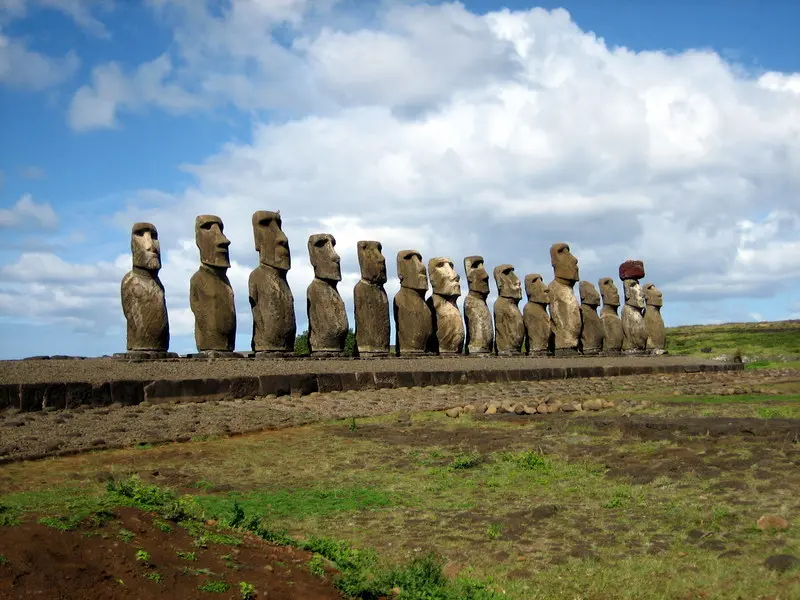
That story is ecocide. Popularised by Jared Diamond in his 2005 book Collapse, it holds that the islanders stripped their forests, partly to move statues, and that starvation, violence and a population crash followed. The island really was deforested, and its native palm is extinct. Recent research, however, points to different culprits and a different timeline. Polynesian rats, brought by the first settlers, feasted on palm nuts. Their bones crowd the earliest archaeological layers, and many surviving nuts carry gnaw marks. Because the palms could take 70 years to fruit, the forest had little chance to recover. Farmers adapted by building rock gardens, scattering stones across their fields so that minerals leached into the thin soil and moisture stayed put. A 2024 satellite survey of those gardens concluded they could have fed only a few thousand people, with a ceiling of about 3,900, far fewer than collapse scenarios assume, although some archaeologists question its methods. The same year, a study of ancient genomes from 15 islanders found no sign of a 17th-century population crash: the population had grown steadily until the 1860s. Archaeologists have also found no fortifications or mass graves. The disaster, when it came, arrived by sea. In 1862 and 1863 Peruvian slave raiders seized about a third of the population, and smallpox followed; by one estimate only around 110 Rapa Nui survived. The statues had been coming down for decades. Captain James Cook's party saw toppled moai in 1774, and by the 1860s none was left standing. The moai were not the cause of Rapa Nui's downfall but a record of what its people could do with stone, rope and cooperation. Carved to walk and raised to watch over their makers, they are the work of a small society that understood its island far better than its later visitors assumed. The greatest threat to them now is the ocean: a 2025 modelling study warns that rising seas could eventually push waves up to Ahu Tongariki, where 15 moai stand in a row on the island's biggest ceremonial platform.
Frequently asked questions
How were the Easter Island statues moved?
Most likely by walking them upright. Teams pulling ropes from either side rocked each statue so it shuffled forward, and experiments show 18 people can move a 4.35-tonne replica 100 metres in 40 minutes.
Why were the moai built?
They represent deified chiefly ancestors whose power was believed to protect the living. They stood on stone platforms called ahu, facing inland to watch over their communities.
Did building the moai cause Easter Island's collapse?
Recent evidence says no. Ancient DNA shows the population grew steadily until the 1860s, when Peruvian slave raids and smallpox devastated it.
Sources
- The 'walking' megalithic statues (moai) of Easter Island, Journal of Archaeological Science
- Megaliths and Mariners: Experimental Archaeology on Easter Island, Easter Island Statue Project
- Engineers of Easter Island, Archaeology Magazine
- Were the Moai, weighing tonnes, swung into place?, Galaxus / Spektrum der Wissenschaft