Why Is Mount Thor the Steepest Cliff on Earth?
Mount Thor on Baffin Island drops 1,250 metres straight down, leaning 15 degrees past vertical. Glaciers carved it, and climbers took 33 days to scale the face.
Key takeaways
- Mount Thor's west face drops about 1,250 metres in a single sheer fall, the greatest purely vertical drop on Earth.
- The face averages 105 degrees, leaning 15 degrees past vertical, so a falling object clears the rock all the way down.
- Glaciers carved the cliff between about 18,000 and 1,500 years ago, cutting a U-shaped valley through granite up to 3.5 billion years old.
- The west face resisted climbers until 1985, when a four-person team took 33 days to reach the summit.
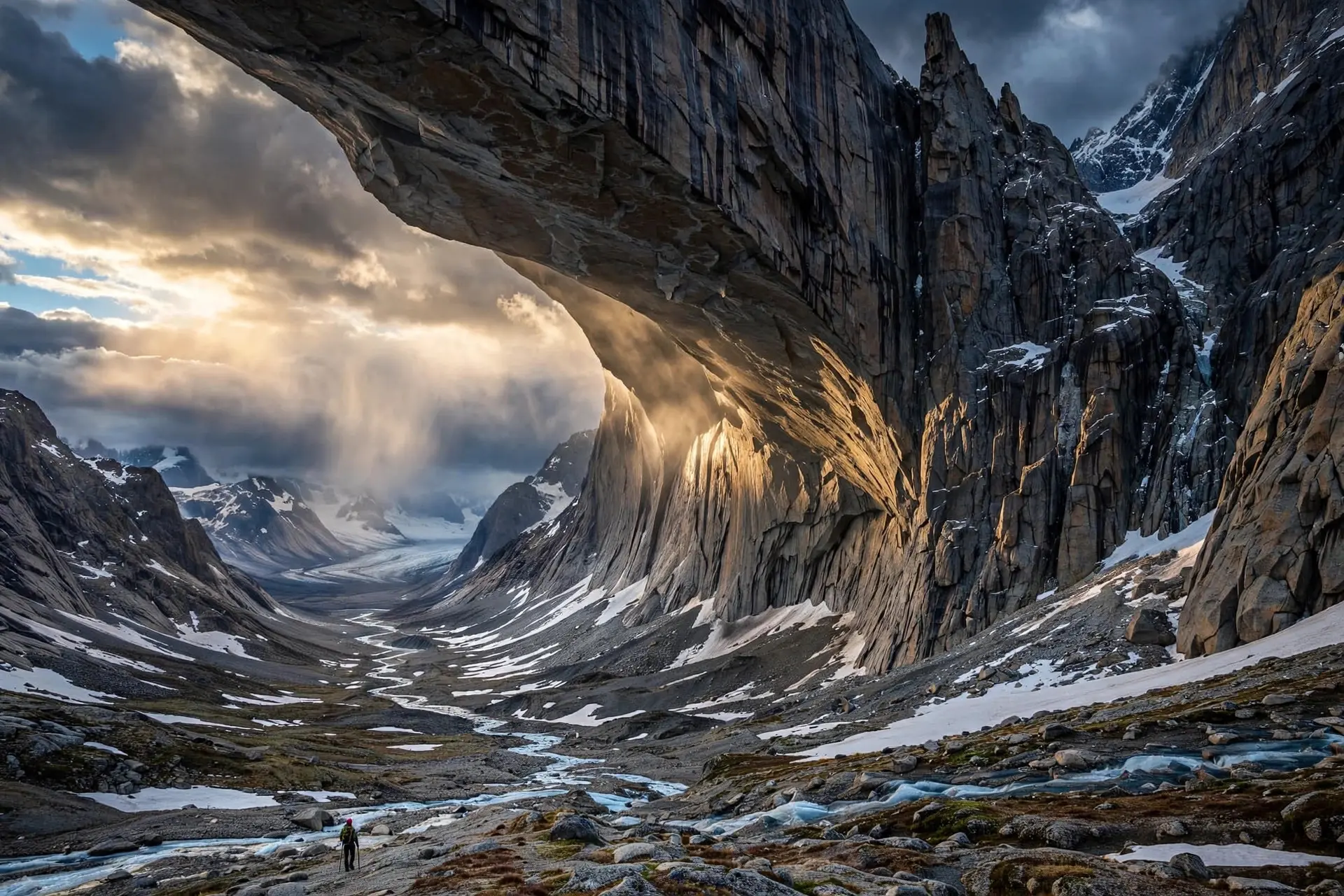
Mount Thor is not a particularly tall mountain. At 1,675 metres above sea level, it would barely register in the Himalayas or even the Rockies. But walk up the Akshayuk Pass on Baffin Island, in Canada's far north, and you will look up at something no other mountain on Earth can offer: a single rock face that drops about 1,250 metres — four Eiffel Towers stacked end to end — and leans outward as it rises, at an average angle of 105 degrees. That is 15 degrees past vertical. It is the greatest purely vertical drop on the planet, and it makes Thor the steepest cliff on Earth. Thor, officially gazetted as Thor Peak, stands in Auyuittuq National Park on Baffin Island, Nunavut, about 46 kilometres north-east of the Inuit community of Pangnirtung. Its Inuktitut names are Qaisualuk and Kigutinnguaq, and the English name honours Thor, the Norse god of thunder. The mountain belongs to the Baffin Mountains, part of the Arctic Cordillera, a chain that runs from Ellesmere Island to Labrador. Despite its remoteness — no roads reach the park, and visitors arrive by boat or snowmobile — the cliff has become one of the most famous walls in world climbing.
What exactly is the record?
The record is about verticality, not height, and the distinction matters. Plenty of cliffs are taller if you measure along a slope. Thor's claim is narrower and stricter: the longest drop that is vertical all the way down. Its west face is so steep that it curves back on itself, forming a shallow C-shape. Drop a stone from the summit and it falls clear of the rock for the whole 1,250 metres, with nothing to hit until the valley floor. That unbroken verticality is what sets Thor apart from taller but gentler walls. It also explains why "steepest cliff" needs a qualifier. The Trango Towers in Pakistan, for example, hold taller near-vertical faces, but their walls lean back rather than jutting outward. Thor's face does the opposite: at 105 degrees on average, it overhangs. A climber on the upper wall hangs out over empty air, and the only way up is to climb rock that leans toward you. In practical terms, most of a climb on Thor's west face is spent on an overhang, hauling gear up a wall that wants to push you off it.
How did glaciers carve a cliff past vertical?
Thor is made of solid granite, part of the Canadian Shield, the ancient core of the North American continent. The rock itself formed between 3.5 billion and 570 million years ago, making it among the oldest stone on Earth, and it sits on the eastern edge of a shield whose rocks are at least a billion years old. Old, hard rock is part of the story: softer stone would have crumbled under the forces that shaped Thor. The carving was done by ice. Over thousands of years, glaciers repeatedly advanced and retreated through what is now the Akshayuk Pass, most recently between about 18,000 and 1,500 years ago. A glacier moving down a valley acts like a slow, grinding saw, and a valley carved by ice has a distinctive U-shaped cross-section: a flat floor with steep, straight sides. Thor sits on the rim of just such a valley, and the ice planed its western flank into a sheer wall while the valley floor dropped away beneath it. The C-shaped overhang is the finished result — the profile left when a glacier undercuts a mountainside and the rock above is left jutting out over the void. The same glacial machinery shaped the whole landscape around Thor. The Akshayuk Pass is a 97-kilometre natural corridor following the Weasel and Owl river valleys between two fiords, and its walls are lined with granite towers: Overlord, Odin, Asgard and Thor, all rising from the same ice-carved trough. Auyuittuq itself means "the land that never melts" in Inuktitut, a name earned by its glaciers and the Penny Ice Cap that still feeds them. The park's scenery is, in effect, a single glacial workshop seen from the inside.
Why did the face resist climbers for so long?
Thor's summit was first reached in 1965, when the American astrophysicist Lyman Spitzer and Donald Morton climbed the mountain by an easier route during an Alpine Club of Canada expedition led by Pat Baird. The west face resisted climbers for two more decades before a four-person American team — Earl Redfern, John Bagley, Eric Brand and Tom Bepler — finally climbed it in 1985, taking 33 days on the wall. That is more than a month spent hauling hundreds of kilograms of gear, food and water up an overhanging face in Arctic summer, sleeping in portaledges bolted to the rock while storms rolled in from Davis Strait.
The difficulties stack up beyond the angle. On a face that steep, water is almost impossible to find, so climbers must carry all they need. The granite is generally sound, but the sheer length of the route grinds climbers down mentally as much as physically. Later milestones underline the point: a solo ascent of the west face followed in 1998, and the first free climb of the neighbouring Southwest Buttress came in 2012. Thor rewards siege tactics, not speed. The mountain has also claimed lives in other pursuits. On 23 July 2006, an American team set the world record for the longest rappel on Thor, descending the full face on ropes. A young Canadian park warden, Philip Robinson, rappelled with them, but his equipment failed and he fell to his death at the base. The record stands, and so does the warning.
Is "steepest cliff on Earth" really true?
With one careful qualification, yes. If "steepest" means the longest drop that is vertical or beyond vertical, Thor wins outright: 1,250 metres at an average of 105 degrees, with no ledge or slope breaking the fall. If it means the tallest rock wall of any angle, the answer changes — taller near-vertical walls exist elsewhere. And if it means the tallest mountain, Thor is nowhere near the conversation. The claim is precise, and the precision is the point: Thor is not the biggest mountain, but it is the most vertical large cliff on the planet. That precision also explains why Thor draws people who will never climb it. Hikers on the Akshayuk Pass walk beneath the face for a day or more, and photographers travel thousands of kilometres for a single viewpoint. The mountain offers something no photograph quite captures: the sight of rock leaning out over your head, higher than any building ever built, carved by ice from stone older than complex life on Earth. It is a cliff that should, by ordinary intuition, fall over. That it stands at all — and has stood since the glaciers left — is the real marvel. The Andes may run farther than any other range on land, and fjords show the same glacial carving at sea level. But no other cliff leans as far past vertical for as long a fall as Mount Thor. On a planet covered in mountains, that one superlative is enough.
Frequently asked questions
How tall is Mount Thor?
The summit stands 1,675 metres above sea level, which is modest by world standards. Its fame comes from the cliff, not the height: about 1,250 metres of that elevation is a single vertical face.
What does it mean for a cliff to be steeper than vertical?
Thor's west face averages 105 degrees, so the rock leans outward as it rises. Anything dropped from the top falls clear of the wall instead of bouncing down it, which is why the drop counts as purely vertical.
Can ordinary hikers see Mount Thor?
Yes, from the Akshayuk Pass, a roughly 97-kilometre valley route through Auyuittuq National Park. Reaching the base takes several days of backpacking from either end, with unbridged river crossings and no marked trail.
Sources
- Mount Thor: The mountain with Earth's longest vertical drop, Live Science
- Rock Climbing in Mount Thor, Nunavut, Mountain Project
- AKSHUYAK PASS – Auyuittuq National Park, Ron Perrier