How and Why Was Stonehenge Built? The Latest Evidence
Stonehenge's stones came from Wiltshire, west Wales and north-east Scotland. Quarries, chemistry and feasting debris now reveal how and why it was built.
Key takeaways
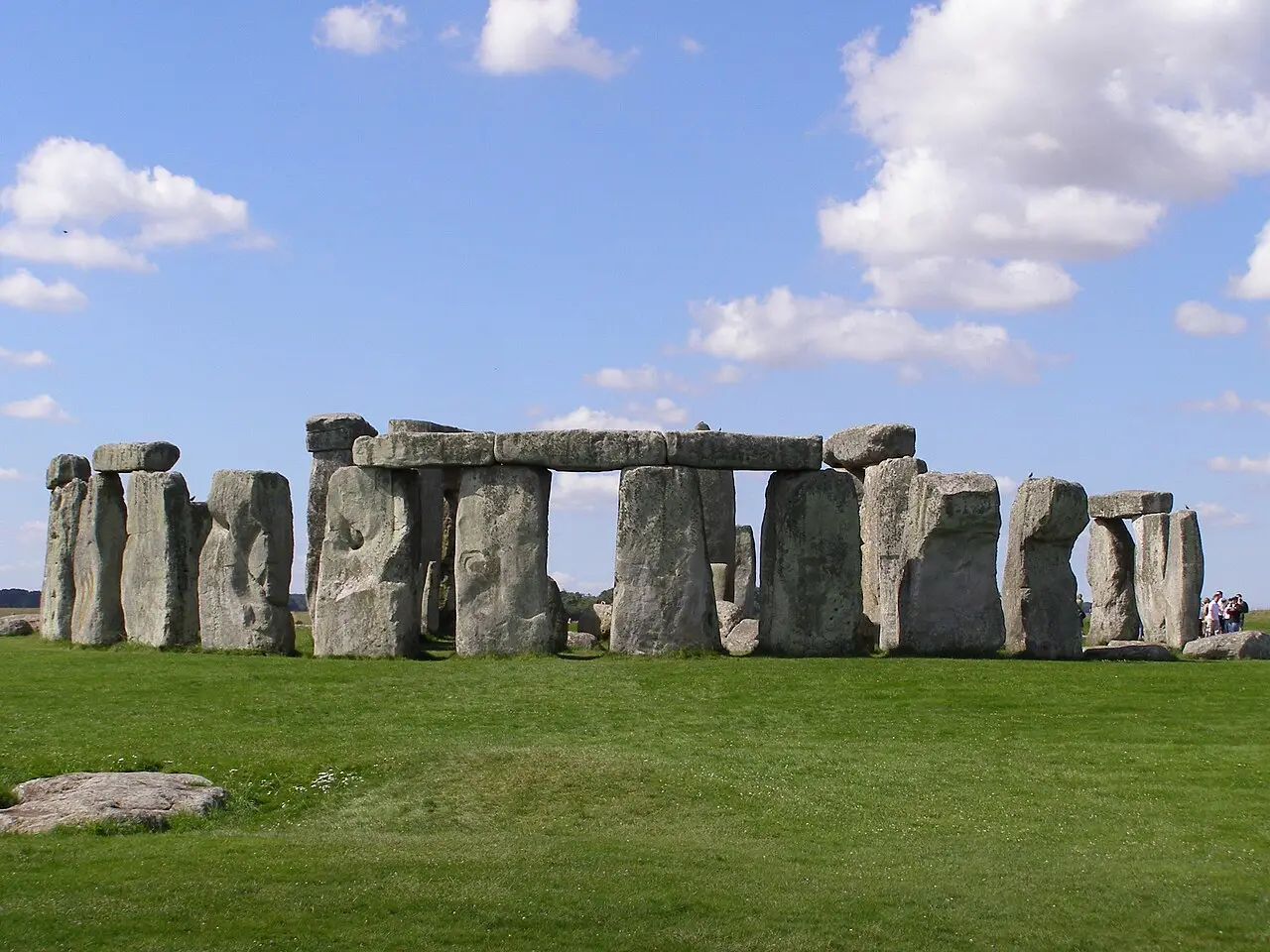
- Stonehenge was built and remodelled in stages from about 3000 BC, when its circular earthwork was dug, to about 1500 BC; the great sarsen settings date to around 2500 BC.
- Its bluestones came from the Preseli Hills of west Wales, about 230 km away, where quarries at Carn Goedog and Craig Rhos-y-felin were worked around 3000 BC.
- A 2020 study found that 50 of the 52 surviving sarsens share one chemistry, pointing to West Woods, about 25 km north of the monument.
- In 2024 mineral dating traced the 6-tonne Altar Stone to the Orcadian Basin in north-east Scotland, at least 750 km away.
- Pig bones at nearby Durrington Walls show animals slaughtered around midwinter, some raised as far away as north-east Scotland and west Wales.
Stonehenge was built in stages over about 1,500 years, from roughly 3000 BC to 1500 BC, by Neolithic and Bronze Age communities who brought its stones from as near as 25 kilometres away and as far as north-east Scotland. They aligned it on the midsummer sunrise and the midwinter sunset, buried their dead in it and feasted nearby on an enormous scale. Over the past decade or so, geochemistry, excavation and isotope analysis have turned much of that from educated guesswork into evidence.
When was Stonehenge built, and in what stages?
The monument began as an earthwork. Around 3000 BC its builders dug a circular ditch, about 100 metres across with banks on either side and two entrances, and set inside it a ring of 56 pits now called the Aubrey Holes. Those pits held timber posts or stones, quite possibly the first bluestones. The stone monument most visitors picture came roughly five centuries later. Around 2500 BC (radiocarbon dates put this phase at about 2620 to 2480 BC) the great sarsens went up: an outer circle of uprights capped with lintels and, inside it, a horseshoe of five trilithons, each a pair of uprights carrying a single lintel. The smaller bluestones stood in a double arc between them and were rearranged several times over the following centuries. An avenue was later laid out to link the monument with the River Avon. Activity continued well into the Bronze Age. Between about 1800 and 1500 BC, two rings of pits, the Y and Z Holes, were dug around the stones, perhaps for a rearrangement that was never completed. Over a similar period someone carved axe-heads and a few daggers into the faces of four sarsens.
Where did Stonehenge's stones come from?
Three very different sources have now been identified, and the most recent is the most surprising. The bluestones, 43 surviving pillars weighing between 2 and 5 tons each, came from the Preseli Hills of west Wales, about 230 kilometres away. Geologists matched several of them to individual outcrops, and excavations led by archaeologist Mike Parker Pearson at two of those, Carn Goedog and Craig Rhos-y-felin, revealed megalith quarrying around 3000 BC, the very period of Stonehenge's first stage. The researchers argue that this rules out the old idea that ice-age glaciers carried the stones to Salisbury Plain, though a minority of geologists still make the case for ice. Nearby at Waun Mawn, empty stoneholes show that at least six pillars were removed from a circle there, a hint that some bluestones may have stood in Wales before making the journey east.
The sarsens had been credited, since at least the 16th century, to the Marlborough Downs roughly 30 km to the north, but no one had rigorously tested the claim. In 2020 a team led by David Nash showed that 50 of the 52 sarsens still at the site share a consistent chemistry and so probably came from a single area. The key to locating it was a core drilled out of Stone 58 during restoration work in 1958. Robert Phillips, who had worked on site during the drilling, returned it to Britain from the United States in 2018, and its chemistry pointed to West Woods, near Marlborough, about 25 km north of the monument. Of an original 80 or so sarsens, only those 52 survive; a typical upright weighs around 20 tonnes. Then, in 2024, the Altar Stone changed country. This pale green sandstone slab, 4.9 metres long and weighing about 6 tonnes, lies flat at the heart of the monument, pinned beneath fallen stones of the Great Trilithon. It had long been assigned to south Wales. By dating tiny zircon, apatite and rutile grains inside fragments of it, a team publishing in Nature traced it instead to the Orcadian Basin of north-east Scotland, a region of Old Red Sandstone, at least 750 km away. The researchers argue that a load that size probably travelled by sea.
How did Neolithic builders shape and raise the stones?
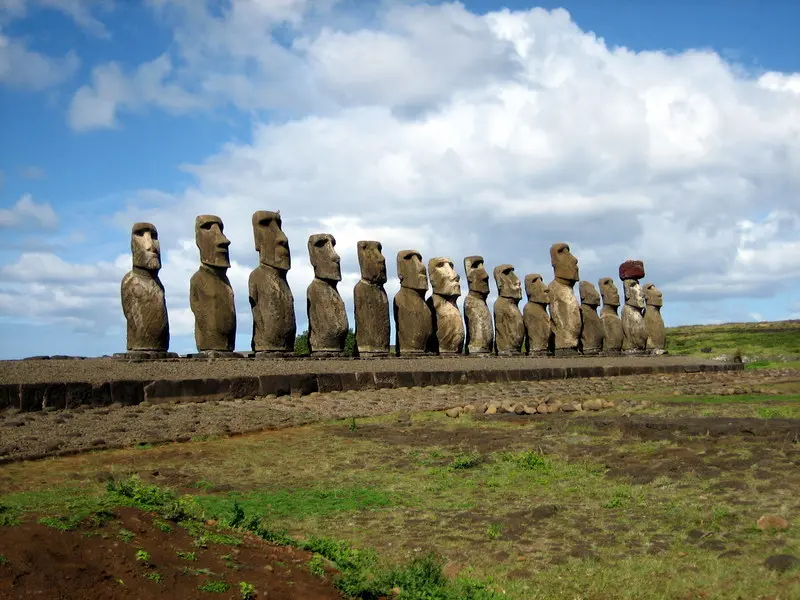
Transport routes are still debated, but the scale of effort is not in doubt: moving a 20-tonne sarsen 25 km, or a bluestone some 230 km from Pembrokeshire, demanded organised labour on a large scale. Other megalith builders met the same challenge in their own ways. Egyptian crews dragged sledges over wetted sand to shift pyramid blocks, while on Rapa Nui islanders walked their moai upright with ropes. The shaping is better understood. Masons used hammerstones of sarsen and flint, large ones to rough out a block and small ones to smooth it. Each lintel was locked onto its uprights with mortise-and-tenon joints, and the lintels of the outer circle were joined to one another with tongue-and-groove joints, a carpenter's toolkit translated into stone. Raising an upright probably began with a pit cut with one ramped side and faced with timber stakes. Crews then hauled the stone vertical on ropes of plant fibre, perhaps using a wooden A-frame for leverage and weights to help tip it. Timber platforms most likely lifted the lintels into place.
What was Stonehenge used for?
Its builders cared about the sun. From the centre of the circle on midsummer morning, the sun rises just left of the Heel Stone, an outlier to the north-east. At midwinter it originally set between the uprights of the tallest trilithon, over the Altar Stone, although half of that trilithon has since fallen. The final stretch of the avenue follows the same solstice axis, and a laser survey found that the stones framing it were the most carefully finished in the monument. English Heritage suggests midwinter may have been the more important of the two moments. Stonehenge was also a cemetery. About 64 cremation burials have been found in the ditch, the bank and the Aubrey Holes, most dating to between about 3000 and 2800 BC, and perhaps 150 people were originally buried there, making it the largest late Neolithic cemetery in the British Isles. A 2018 strontium-isotope study of 25 of those cremated individuals found that at least 10 had not lived on the local chalk. Their most plausible home was west Wales, the source of the bluestones. And it was a place of gathering. At Durrington Walls, about 3 km (2 miles) away, archaeologists found houses contemporary with the main stone phase and about 38,000 discarded animal bones, most of them pigs. Many pigs were killed at about nine months old; born in spring, they were slaughtered around midwinter. Isotopes in their bones and teeth show that some were raised in west Wales, some in northern England and some in north-east Scotland, then brought across Britain, on the hoof or perhaps by boat, to be eaten.
Why is there no single answer to why Stonehenge was built?
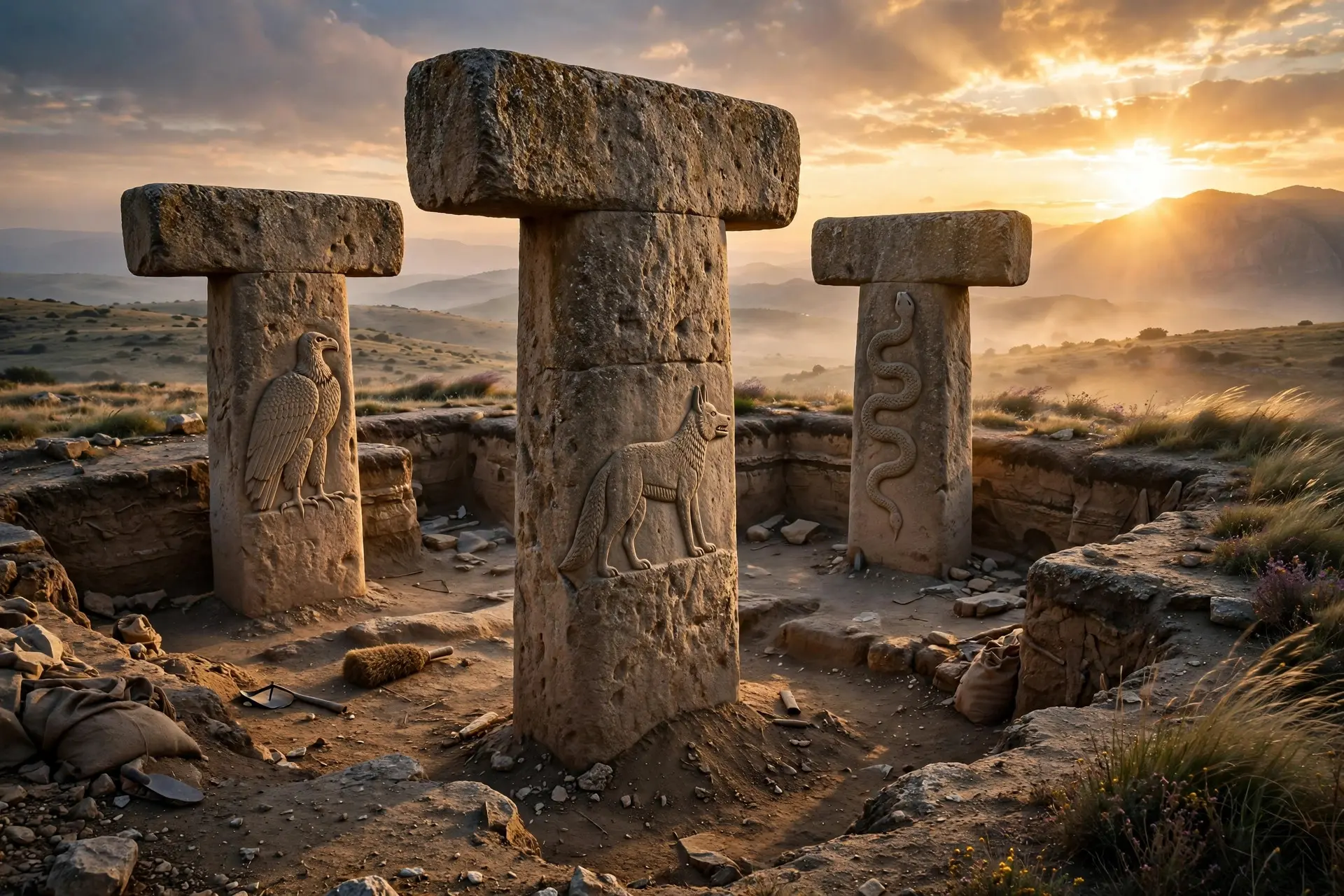
Because Stonehenge was never one thing. A monument used and rebuilt for 1,500 years could be a burial ground in one century, a solar monument and feasting destination in another and a place of carved weapons and unfinished plans in a third. Asking what Stonehenge was for is a little like asking what a cathedral is for across a thousand years of history. Earlier answers were simpler and wrong. Geoffrey of Monmouth credited the wizard Merlin in 1136, an explanation that was widely accepted until the 16th century. Nor was Stonehenge the first monument of its kind: hunter-gatherers raised the carved pillars of Göbekli Tepe in south-east Anatolia between about 9600 and 8200 BC, more than five thousand years earlier. The stones themselves have turned out to be the best witnesses. Their chemistry traces a network running from Pembrokeshire to north-east Scotland, and the bones at Durrington Walls show people and animals making journeys just as long. Stonehenge was the work of communities that could organise labour across Britain, and that aimed their greatest monument at the turning points of the solar year.
Frequently asked questions
Where did the stones of Stonehenge come from?
The large sarsens came mostly from West Woods in Wiltshire, about 25 km north. The smaller bluestones came from the Preseli Hills of west Wales, about 230 km away, and the Altar Stone came from north-east Scotland.
When was Stonehenge built?
Work began around 3000 BC with a circular earthwork and continued in stages until about 1500 BC. The great sarsen circle and trilithons were raised around 2500 BC.
What was Stonehenge used for?
It was aligned on the midsummer sunrise and the midwinter sunset, it was used as a cemetery for cremation burials, and it was the focus of large midwinter gatherings and feasts at nearby Durrington Walls.
Sources
- New research reveals origin of Stonehenge's great sarsen stones, English Heritage
- How researchers determined that Stonehenge's giant Altar Stone came all the way from northeast Scotland, The Conversation
- Quarrying of Stonehenge 'bluestones' dated to 3000 BC, EurekAlert!
- Building Stonehenge, English Heritage
- Understanding Stonehenge, English Heritage
- History of Stonehenge, English Heritage
- Cremated remains provide clues into who built Stonehenge, Earth.com
- Stone Age Britons Feasted While Building Stonehenge, Smithsonian Magazine
- Evidence of prehistoric large-scale celebrations found near Stonehenge, Earth.com