How Volcanic Islands Are Born: The Hawaii Story
Hawaii began as bubbles of lava rising from a mantle plume. Trace the hotspot engine, the five stages of an island's life, and the volcanoes growing today.
Key takeaways
- Hawaii was built by a hotspot: a mantle plume fixed in place while the Pacific Plate drifts northwest above it, running for 80+ million years.
- Roughly 95 percent of a volcano's volume is emplaced during the shield stage, mostly within about 500,000 years.
- From seafloor base to summit, Mauna Kea stands about 10,210 meters — Earth's tallest mountain by base-to-summit height.
- The Hawaiian–Emperor chain stretches over 5,800 kilometers with 80+ volcanoes; the oldest, Detroit Seamount, is about 81 million years old.
- Kamaʻhuakanaloa, 35 kilometers southeast of the Big Island, is growing on the seafloor right now in the preshield stage.
Hawaii is the most isolated major island chain on Earth, thousands of kilometers from any continent — and that is exactly the mystery. No tectonic plate boundary runs through it. So what force could build islands, one after another in a perfect line, in the middle of an ocean? The answer is a hot spot: a plume of hot rock rising from deep within Earth's mantle, essentially fixed in place while the Pacific Plate drifts northwest above it, a few centimeters per year. As the plate creeps along, each section takes its turn over the plume, and a new volcano begins to grow. The Hawaiian Islands are, in the U.S. Geological Survey's phrase, "the subaerial expression of volcanism above the relatively fixed Hawaiian hot spot" — the small above-water fraction of a mountain chain that starts on the deep seafloor. Hawaii is not a one-off; it is the latest and most famous product of an engine that has been running for more than 80 million years.
From seamount to shield: how an island grows
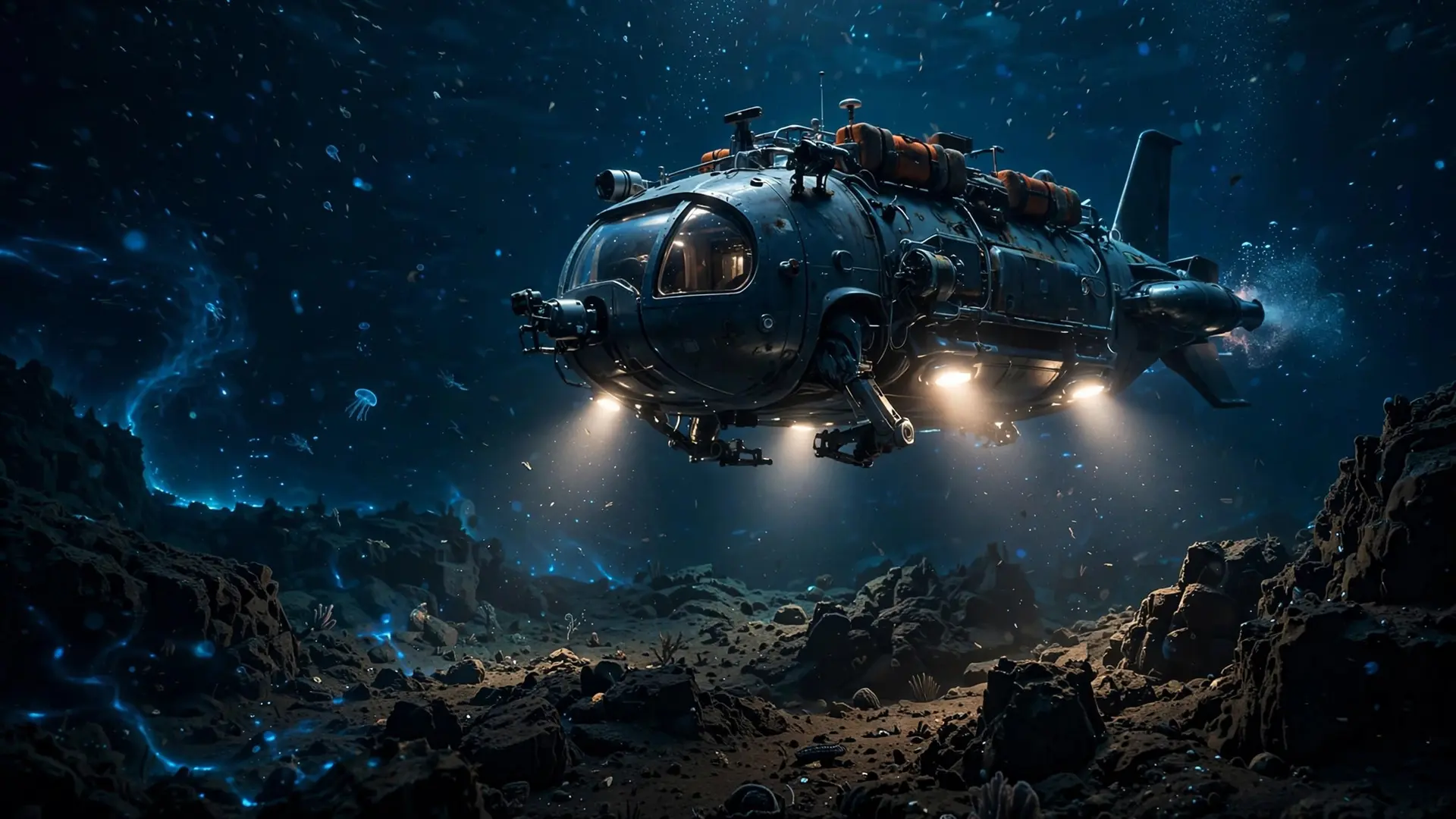
Every Hawaiian island followed the same volcanic blueprint. It starts underwater, as a seamount in the submarine preshield stage. Here, cold seawater pressure prevents explosive eruptions; lava oozes out and freezes into bulbous pillow lavas, slowly building a steep-sided underwater edifice. This stage can last around 200,000 years yet produce only a small fraction of the volcano's final volume. The youngest member of the chain, Kamaʻehuakanaloa (formerly known as Lōʻihi), is in this stage right now, growing on the seafloor about 35 kilometers southeast of the Big Island.
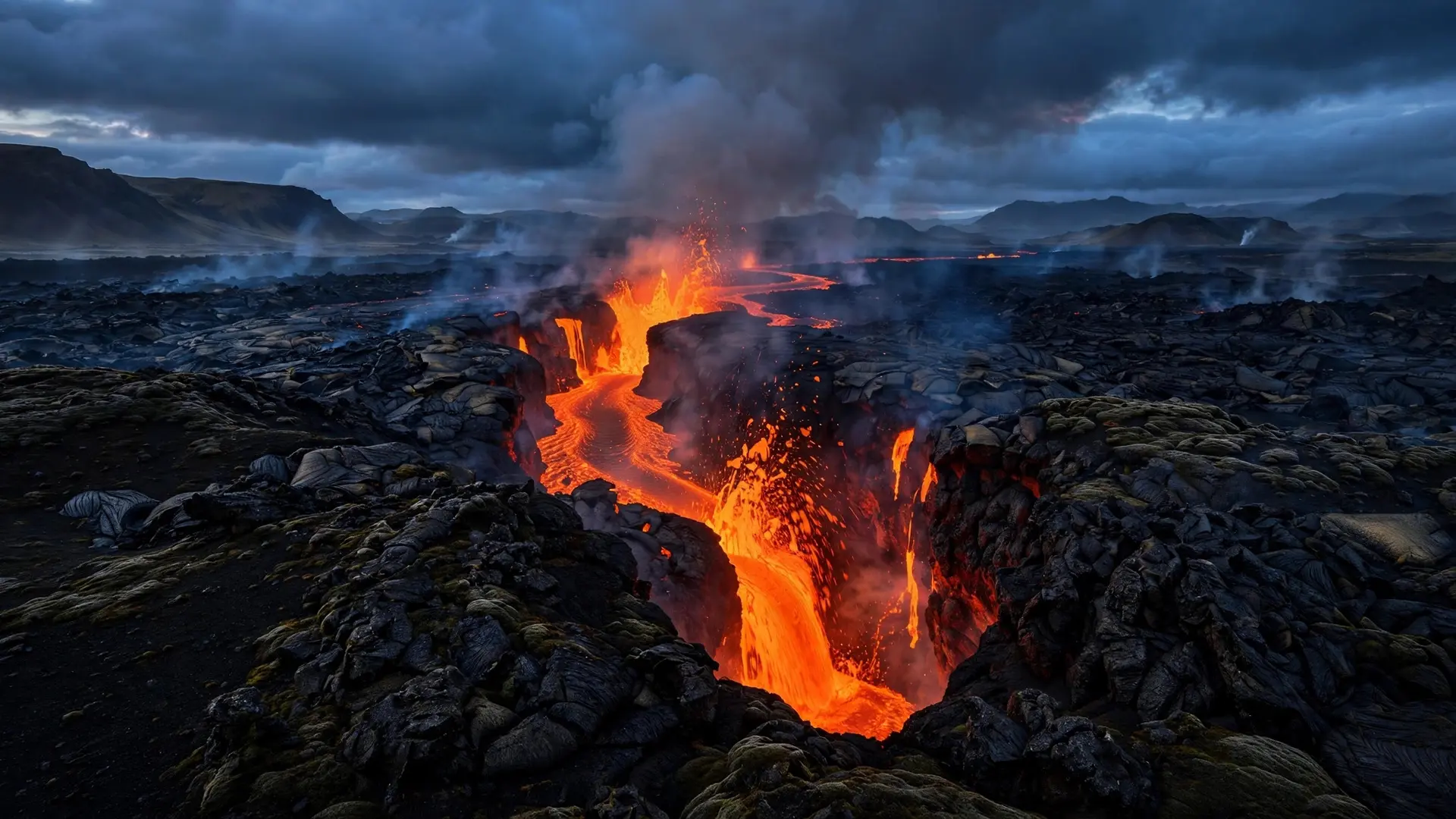
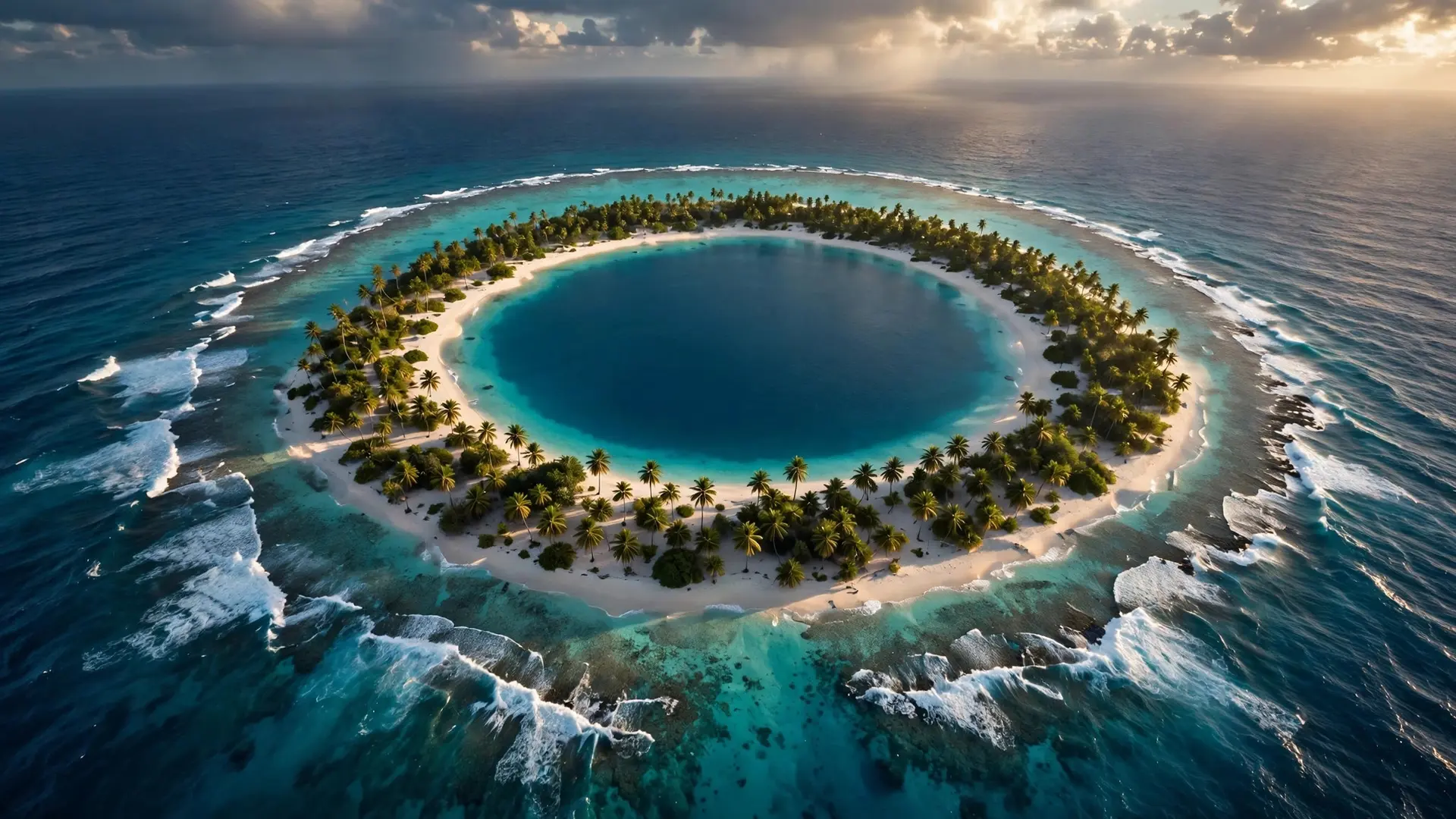
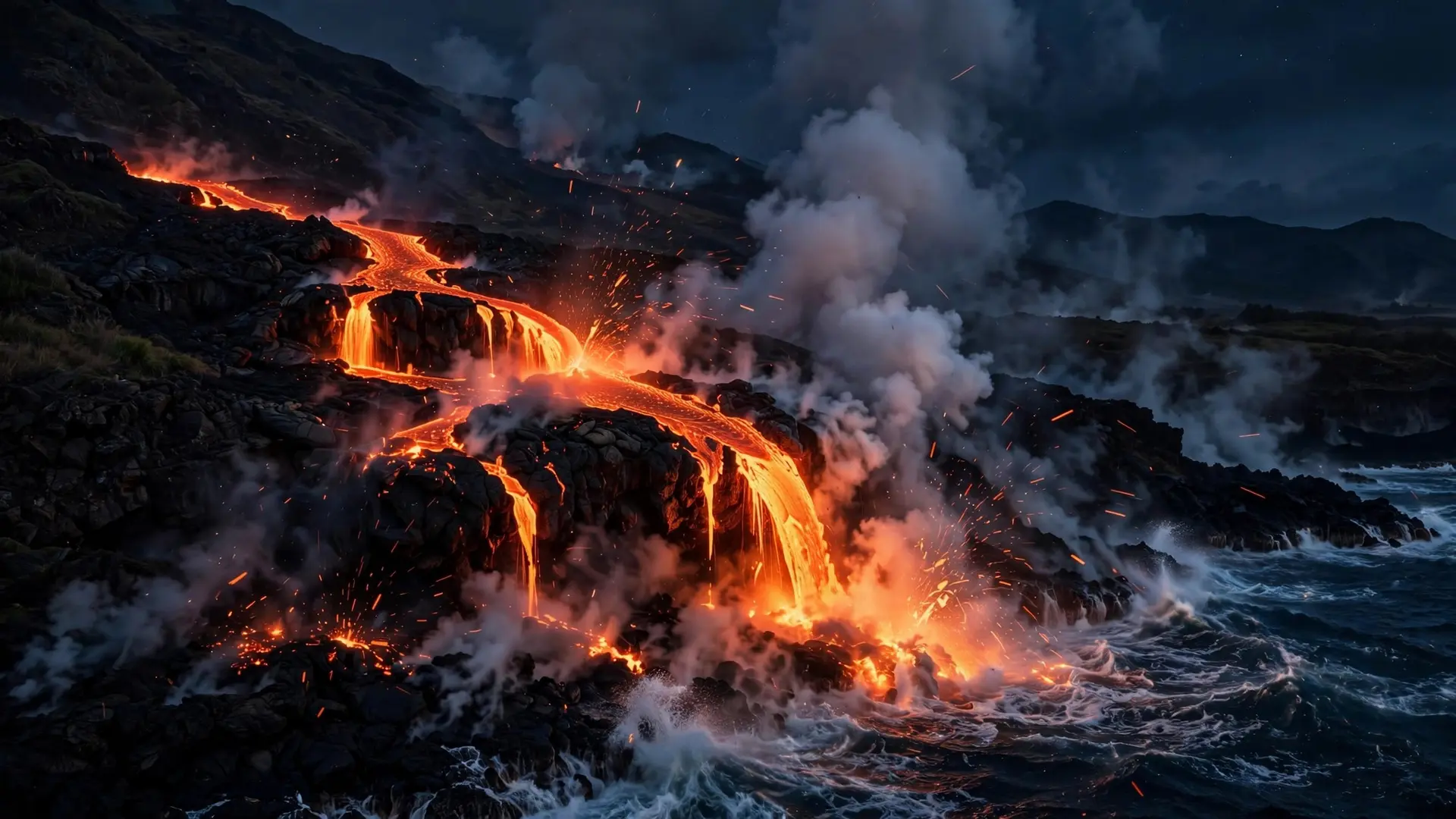
As the seamount grows, it enters the shield stage — the volcano's productive youth. When the summit reaches shallow water, lava and seawater mix in explosive eruptions that build ash cones, but once the volcano rises clear of the ocean, the fireworks calm into the steady, low-viscosity lava flows Hawaii is famous for: smooth ropy pāhoehoe and jagged blocky ʻaʻā. The lava stacks up in layer after layer of gently sloping rock, giving each volcano its broad, low profile — shaped, literally, like a warrior's shield laid flat. This is when roughly 95 percent of the volcano's total volume is emplaced, mostly within about 500,000 years, the period of highest eruption rates. Kīlauea and Mauna Loa are in this subaerial shield phase today. The final act is long and quiet. Once the island drifts away from the hotspot, eruptions dwindle through post-shield and occasional rejuvenated stages, and erosion takes over. Wind, rain, and landslides carve canyons into the basalt while the island slowly sinks — the immense weight of a shield volcano depresses the ocean crust beneath it, forming what geologists call the Hawaiian Moat, and today's Big Island coast is subsiding at 2–3 millimeters per year. As the volcano founders, coral reefs can grow upward around its flanks, eventually forming an atoll — a ring of coral with no island left at the center — before the whole structure disappears beneath the waves as a flat-topped seamount, a guyot.
The chain that maps the plate's movement
Because each island ages as it rides the plate away from the plume, the archipelago is a timeline written in geography. The Big Island is youngest, still under construction less than a million years old; Maui is about 1.3 million; Oʻahu around 3 to 4 million; Kauaʻi roughly 5 million; Niʻihau about 6 million. Walk northwest and you walk backward in time, watching islands grow older, more eroded, and lower as you go. Hawaii is only the southeastern tip of something far larger. The Hawaiian–Emperor seamount chain stretches more than 5,800 kilometers across the Pacific — over 80 identified volcanoes running northwest toward the Kuril–Kamchatka Trench, where the oldest ones are being swallowed back into the Earth at a subduction zone. Detroit Seamount, the oldest reliably dated, is about 81 million years old, and geologists suspect one seamount even older lies beyond it. The chain bends sharply about halfway along — a V-shaped kink that geologist J. Tuzo Wilson, in his landmark 1963 hotspot hypothesis, interpreted as a change in the Pacific Plate's direction of motion some 47 million years ago. Modern research suggests the plume itself may have drifted too, but the chain remains the clearest natural record of how tectonic plates wander over deep time. Meanwhile the northwest end keeps growing: at least 750,000 cubic kilometers of lava have been erupted over the chain's lifetime.
A mountain taller than Everest
The scale of what the hotspot builds is hard to absorb. Mauna Kea, the dormant volcano on the Big Island, rises only 4,207 meters above sea level — modest beside Mount Everest. But the volcano doesn't begin at the shoreline. Measured from its base on the Pacific seafloor to its summit, Mauna Kea stands about 10,210 meters tall, making it the tallest mountain on Earth by base-to-summit height — more than a kilometer taller than Everest above sea level. Most of the mountain is hidden underwater, built up by hundreds of thousands of years of eruptions before it ever broke the surface. The Big Island itself is a merger of seven volcanoes — Mahukona, Kohala, Mauna Kea, Hualālai, Mauna Loa, Kīlauea, and Kamaʻehuakanaloa — stacked and overlapping into a single landmass. Mauna Loa and Kīlauea remain active, and the hotspot is still feeding the chain: the volcanoes are growing as you read this, in eruptions that add new land grain by grain, occasionally — as in Kīlauea's dramatic 2018 eruption — in spectacular acre-at-a-time leaps.
The quiet truth about island volcanoes
The common misconception is that volcanoes need plate boundaries — collisions and rifts — to exist. Hawaii proves otherwise. A hot spot can operate mid-plate, independent of all that violence, steadily printing islands from deep-mantle heat while the crust slides over it like paper over a candle. That is why the chain is linear, age-progressive, and self-destructing by design: each island is born, peaks, erodes, and sinks, and the hotspot simply starts over. The coral atolls of the northwestern chain — islands turned to reefs like Midway — are as much volcanic landforms as the erupting peaks of the southeast; they are just older. That is the real story of Hawaii: not a fixed place but a moving assembly line, one of the clearest demonstrations on Earth that the ground beneath us is in motion. The next island in the sequence is already rising underwater southeast of the Big Island. Given a few hundred thousand years, Kamaʻehuakanaloa will break the surface and begin its own long arc from eruption to great coral reef-ringed atoll to sunken seamount — exactly as its older siblings did before it.
Frequently asked questions
What is a volcanic hotspot?
A plume of hot rock rising from deep in the mantle, fixed in place while the plate above drifts — each section of crust takes its turn over the plume and grows a volcano.
Why is Mauna Kea taller than Everest?
Measured from its base on the Pacific seafloor to its summit, Mauna Kea is about 10,210 meters — over a kilometer taller than Everest's height above sea level.
What are the life stages of a volcanic island?
Submarine preshield, shield stage, post-shield and rejuvenated stages, then erosion, sinking, atoll formation, and finally a submerged flat-topped guyot.