What Was the Minoan Bull-Leaping Ritual? The Real Story
What was the Minoan bull-leaping ritual? The Knossos fresco, the debate over how the leap really worked, and a French sport that shows it was possible.
Key takeaways
- The Minoan bull-leaping ritual was a Bronze Age performance in which athletes vaulted over a charging bull, shown in the Knossos Bull-Leaping Fresco of about 1450-1400 BC.
- Scholars disagree on whether the fresco records a real technique or an artistic composite; some argue the depicted leap could not have worked in real life.
- France's living course landaise tradition, where athletes vault over charging cows, suggests the ritual was real and survivable.
- The ritual was probably sport, religion, and palace politics at once, with Knossos using it to assert cultural dominance over Crete.
- Women took part too: the fresco paints two athletes white, the Minoan convention for women, and the leaper brown, for a man.
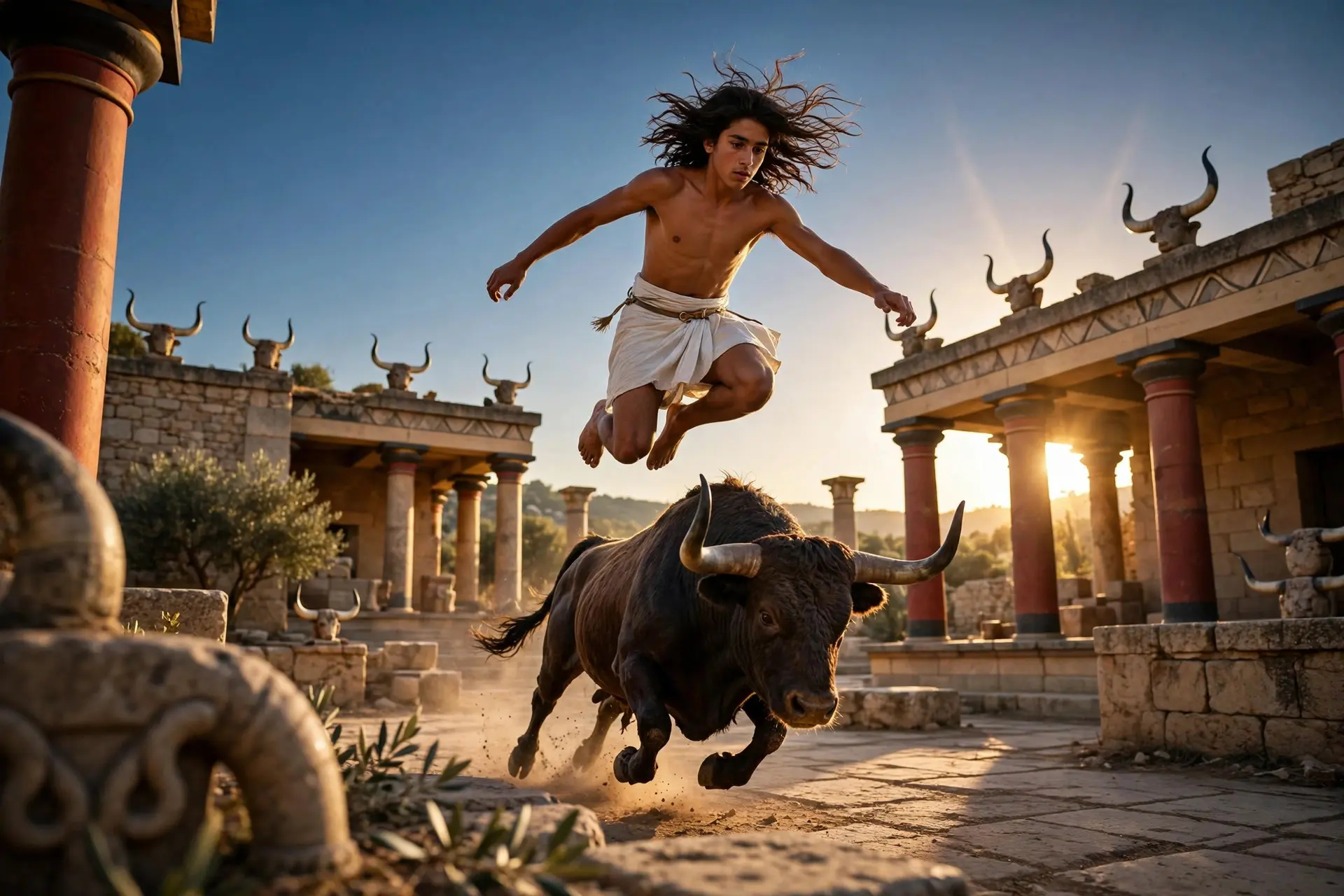
The Minoan bull-leaping ritual was a Bronze Age performance in which athletes vaulted over a charging bull in Crete's palace courts. The famous Knossos fresco shows three athletes mid-routine, yet some scholars argue the depicted leap could not have worked in real life. The real technique may have looked more like the bull-jumping sport still practiced in southwest France today. The people behind it were the Minoans, Europe's first civilization. But what exactly are we looking at: a sport, a religious rite, or a piece of palace propaganda? Archaeologists have argued about that for a century, and the argument is the interesting part. Key facts
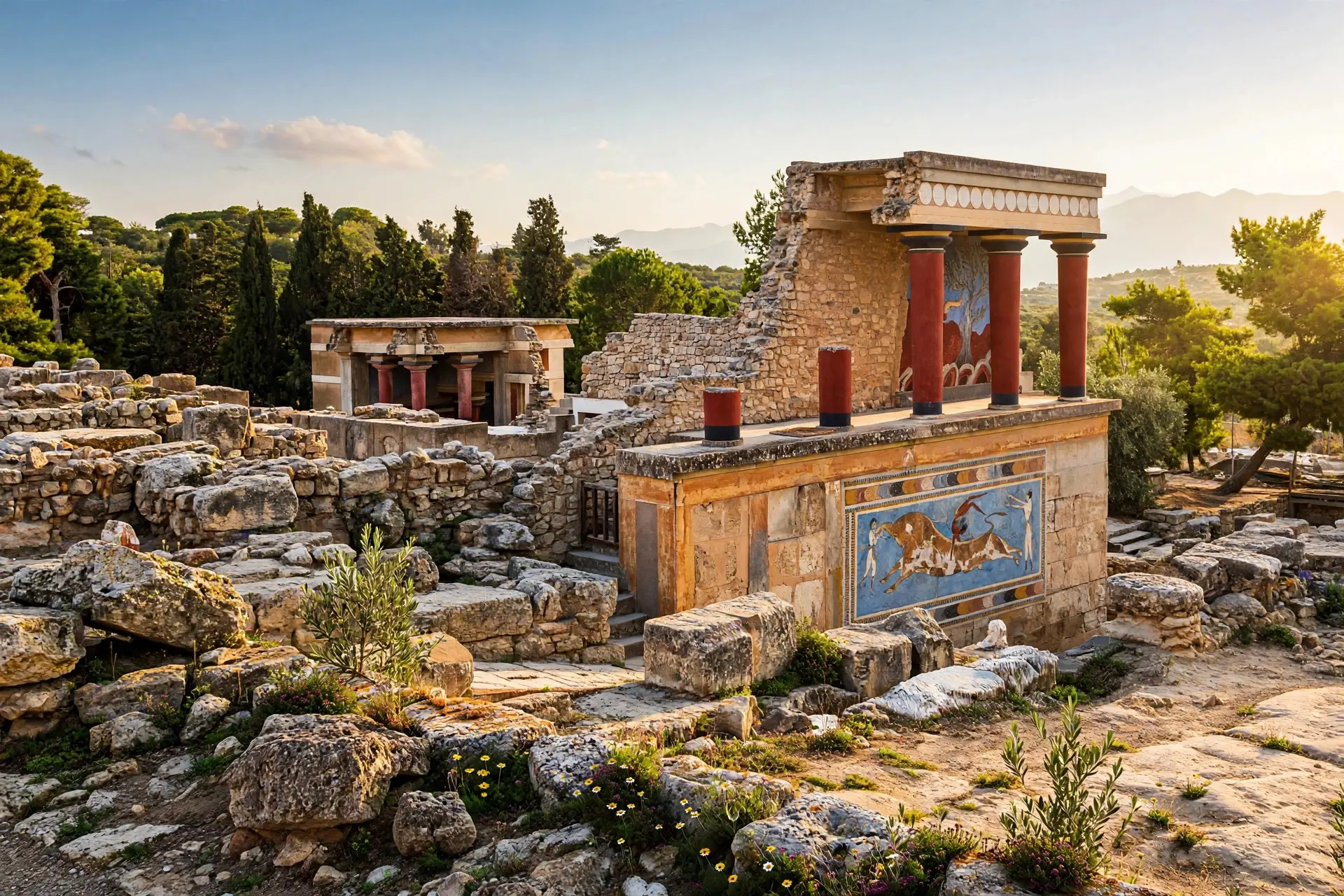
- The Bull-Leaping Fresco decorated the east side of the palace at Knossos and dates to the Final Palace period, about 1450-1400 BC. The original hangs in the Heraklion Archaeological Museum; a replica stands at Knossos. Penn Museum Knossos Palace
- Three athletes take part: two figures painted white (women, by Minoan artistic convention) steady the bull at each end, while a third figure painted reddish-brown (a man) somersaults over its back. Penn Museum
- A bronze group in the British Museum, made around 1600 BC, is the only complete three-dimensional depiction of the leap. The tiny leaper connects to the bull only by his hair, and a stray pair of feet on the bull's back betrays a casting fault. Society & Animals
- Sir Arthur Evans, who excavated Knossos, called the performances "the feats of the Circus, performed in honor of the great Minoan Goddess" in 1921. Society & Animals
- In southwest France, the course landaise keeps bull-jumping alive: athletes vault over charging cows that are never harmed, and one jump, the saut de l'ange ("the angel's leap"), mirrors the "flying leap" shown in Minoan seals. Penn Museum
- Bull-leaping scenes also turned up far from Crete: 16th-century BC wall paintings at Tell el-Dab'a in Egypt and 17th-century BC seals at Alalakh in Syria show the practice was known across the eastern Mediterranean. Penn Museum
What did the Minoan bull-leaping ritual look like?
Evans reconstructed the move as a four-part sequence from the artwork: the leaper approached the bull, grasped it by the horns, let the animal's tossing motion launch the vault onto its back, and then sprang off onto the ground behind it. It is a neat, cinematic reading, and it stuck for decades.
There is a catch. The famous fresco is not a photograph of a single moment. It was painted in stucco relief on an upper-story wall, fell in fragments during the palace's destruction, and was reassembled by modern hands. In the Penn Museum's caption, "the darker fragments are the recovered pieces," which means much of the smooth, flowing scene is reconstruction. Later studies also found that artists did not all draw the leap the same way. A. Sakellariou and John Younger catalogued the variations and tied different styles to different phases of Late Minoan culture. Younger's 1976 conclusion is telling: bull-leaping appears in art near the beginning of the Late Bronze Age, and when the practice faded around 1340 BC, later artists drew a "floating pose" no longer copied from the sport. Style tracked practice, as it would if artists recorded real performances. The roots may run deeper: a clay vessel from a tomb at Koumasa in southern Crete, dated to about 2000-1900 BC, shows three figures clinging to a bull's horns.
Did anyone really jump over a bull?
At one extreme, some scholars doubt the leap was ever performed. J. Alexander MacGillivray, quoted by the Penn Museum, "asserts that no person ever jumped over a bull's back on Crete or anywhere else," reading the scenes instead as a celestial drama of Orion, Taurus, and Perseus. The Penn Museum's Jeremy McInerney pushes back: the scenes vary too much to depict a single myth. Why would a cosmic drama need assistants holding the horns, or show a calm bull sitting with folded legs, or a bull with its forelegs hooked over what looks like an altar? Variations like these make sense if artists were commemorating specific performances. Then there is the living proof: the course landaise, still practiced in southwest France, is an almost exact parallel of the Minoan version. The cows are not attacked, stabbed, or slaughtered; the contest is judged on athleticism. One event, the saut de l'ange, has the jumper leap straight along the same axis as the charging animal, and McInerney writes that "it looks exactly like the flying leap depicted in Minoan glyptics." He watched the youth championships in the small French town of Le Houga in November 2010 and confirmed both the athletes' grace and the animals' aggression. If French teenagers can do it today, the claim that Bronze Age athletes could not looks like the weaker argument.
Was it a sport, a ritual, or palace politics?
The honest answer is that it may have been all three, and the Minoans left no rulebook to settle it. Evans read the scenes as religion: circus feats honoring a goddess. But as McInerney notes, there is no Minoan liturgical text to check that against. The Linear B tablets from Knossos record deities and cattle (one ox is named "Woinikos," meaning ruddy) as palace bookkeeping, not belief, so any reading of Minoan religion stays tentative. What the objects do show is status. Carved gold signet rings depicting bull-leaping were popular with Minoan officials: 53 sealings from ten Knossos replica rings have been found from Chania to Zakros and even on Thera, and six of the ten rings depict bull-leaping. These were the accessories of the elite, which suggests the ritual carried serious ideological weight.
McInerney goes further and argues the ritual was an instrument of power. Bull imagery clusters at Knossos and is uncommon at the other palaces. Running a spectacle like this needed trained athletes and purpose-bred animals, just as the modern course landaise runs on sixteen ganaderias, breeding farms for some 1,200 vaches landaises, plus dedicated training schools. Whoever controlled the stock and the specialists controlled the show: in McInerney's reading, Knossos used bull-leaping the way a capital uses a stadium. The religious thread is real as well. The Boxer rhyton from Hagia Triada, carved in relief with scenes of boxing and bull-leaping, weighs 1 kg (2.2 pounds) empty and 3 kg (6.6 pounds) when full, and it could only ever have been a ceremonial vessel. Bull's-head rhyta from Knossos were libation vessels, poured through a hole in the muzzle and filled through the head or by immersion, with the liquid held inside by the siphon principle as long as a thumb closed the top opening, as the Metropolitan Museum of Art explains. Nanno Marinatos has argued these vessels may have held sacrificial blood poured as a libation, and the Hagia Triada sarcophagus of the early 14th century BC shows a trussed bull awaiting sacrifice.
What do most people get wrong about bull-leaping?
| The common assumption | What the evidence actually says |
|---|---|
| It was like Spanish bullfighting | The bull was never harmed. Depictions of bull-leaping that involve killing are rare, and the point was to demonstrate skill, not to wound the animal. |
| Only men took part | The fresco's color convention marks two athletes as women and the leaper as a man. A minority reading suggests the colors instead marked age or rank, but mixed participation is the mainstream view. |
| The fresco is a snapshot of one real leap | It is a modern reconstruction from fragments, and scholars read it as a stock scene or composite of phases rather than a single instant. |
| It is just a myth, like the Minotaur | Seals, rings, figurines, an ivory leaper of about 1600-1500 BC, and a bronze group all depict it across centuries and regions. Myths do not leave that kind of paper trail. |
| The leapers were ordinary daredevils | The institution needed bred animals, training, and elite backing. Senta German has proposed the performers were high-status youths; McInerney argues they were Knossos-trained specialists. |
| One more correction for the gender question. Evans assumed the two skin colors meant boys and girls leapt together, then invented "ritual transvestism" to explain why he could not tell them apart. Shapland calls this one of the myths of bull-leaping: the colors more likely marked age or status. | |
| The takeaway is modest for a topic this dramatic. Bull-leaping was probably a sport, a rite, and a political spectacle at the same time, and the exact mechanics are still argued over 3,400 years later. The Minoans left art, not explanations, so every generation gets to argue with them. It is the same puzzle as other Bronze Age feats, like the Great Pyramid's precise alignment to true north: the evidence is real, the technique is gone, and the debate is the fun part. | |
| How we made this article: FactSpire researched and drafted it with AI assistance and checked every fact against the sources listed above. |
Frequently asked questions
Did the Minoans really leap over bulls?
Most scholars say yes. John Younger's 1976 study traced changing leap styles across the Late Bronze Age, shifts that make little sense unless artists were recording a real practice. France's living course landaise shows the feat is possible: athletes still vault over charging cows there without weapons.
Was bull-leaping a sport or a religious ritual?
Probably both at once. Sir Arthur Evans read the scenes as circus feats performed for the Minoan Goddess, while archaeologist Jeremy McInerney argues the spectacle also served palace politics, since Knossos monopolized the trained athletes and the animals. Elite gold rings commemorated the events, marking their prestige.
Where can I see the Bull-Leaping Fresco?
The original fresco is in the Heraklion Archaeological Museum in Crete, which holds the most important collection of Minoan art in the world. A replica stands at the palace of Knossos itself, so visitors can see the scene near where it was painted.
How is bull-leaping different from bullfighting?
The bull was never harmed. Unlike modern bullfighting, the point of bull-leaping was agility and control, not killing the animal. In France's course landaise today the cows are never attacked, stabbed, or slaughtered, and the contest is judged on the athlete's skill alone.
Sources
- Bulls and Bull-leaping in the Minoan World, Penn Museum (Expedition Magazine)
- Jumping to Conclusions: Bull-Leaping in Minoan Crete, Society & Animals (Brill)
- Terracotta vase in the form of a bull's head, The Metropolitan Museum of Art
- The Bull-Leaping Fresco: A Minoan Masterpiece of Athleticism and Ritual, Knossos Palace