How Egyptians Aimed the Great Pyramid at True North
The Great Pyramid faces true north within four arcminutes. A 2017 test showed an equinox shadow could do it — but a two-star method also dates the work.
Key takeaways
- The Great Pyramid's sides track the cardinal directions to better than four arcminutes, roughly one-fifteenth of a degree.
- Kate Spence's 2000 method used the simultaneous transit of Kochab and Mizar to find north, dating construction to within about five years.
- Glen Dash's 2017 equinox experiment with a simple gnomon reproduced both the accuracy and the direction of the pyramids' error.
- Three large pyramids share the same slight counterclockwise error, which argues for one consistent surveying method.
- No surviving Egyptian text names the method the surveyors actually used.
The leading answers are stars and shadows. The Great Pyramid's sides track true north within four arcminutes, a sliver of sky roughly an eighth of the Moon's width. A field test showed that a wooden stick's shadow on the autumn equinox can hit that precision and reproduce the pyramid's error direction. No Egyptian text confirms which technique they used.
Key facts
- The builders set the Great Pyramid to the cardinal points with an accuracy better than four arcminutes, or one-fifteenth of one degree, according to engineer Glen Dash's 2017 paper in the peer-reviewed Journal of Ancient Egyptian Architecture (source).
- Khufu's neighbor Khafre managed about six arcminutes and Sneferu's Red Pyramid at Dahshur about 8.7; all three lean slightly counterclockwise from the cardinal axes, a shared fingerprint of error (source).
- In 2000, Cambridge Egyptologist Kate Spence proposed the simultaneous transit method: sighting the stars Kochab and Mizar as they aligned vertically across the celestial pole, and dating Khufu's pyramid to 2478 BC within about five years (source).
- Dash tested the solar alternative himself on September 22, 2016, in Connecticut: tracking a vertical rod's shadow through the equinox produced a near-perfect east-west line with a mean error of 7.3 arcminutes, slightly counterclockwise, matching the pyramids (source).
- The Egyptians could have predicted the equinox by observing the summer solstice and counting forward 91 days, using nothing more than a clear sky and arithmetic (source).
- For all the testing, no Old Kingdom inscription, papyrus or wall text names any alignment method, so every theory is reverse-engineered from the finished stone (source).
Why did aiming north need help at all?
True north is the direction of the Earth's axis, not the location of a star. Around 2600 BC, no bright star sat anywhere near the celestial pole. Earth's axis slowly wobbles against the background stars, a cycle called precession, and in the middle of the third millennium BC the sky around the pole was empty. So the surveyors could not simply sight a "north star" the way a medieval navigator would.
That absence shapes every serious theory. Each proposal starts from the same problem: true north was a place the builders had to infer rather than see. Whether they did it with star pairs or with sunlight, they needed a procedure that turned an invisible axis into a line on the ground accurate to a fraction of a degree, because a small angular mistake at the base would have grown into an obvious twist by the time the courses reached 146.6 metres (481 ft).
How would a two-star method have worked?
Kate Spence's 2000 Nature paper offered the first proposal that named a specific target in the sky and also explained the size of the pyramids' errors. The idea: watch the stars Kochab (in Ursa Minor) and Mizar (in Ursa Major) circle the pole from opposite sides. When one reaches its highest point and the other its lowest, the invisible line between them stands vertical. Hang a plumb line against that pair and mark where it falls, and you have true north. Because the pole drifts, the line between the two stars passed exactly through it in only one year, which Spence calculated as 2467 BC. Before that year the vertical pair pointed a touch to one side of north, and after it a touch to the other. The drift grows steadily at 27 arcminutes per century, so one arcminute of misalignment equals roughly 3.7 years, which turns every measured error into a date. Spence's date for Khufu's pyramid came out at 2478 BC, with a stated precision of about five years. The method is elegant, but it has taken hits. A 2001 correction in Nature by Dennis Rawlins and Keith Pickering found an arithmetic error and argued a different star pair fit better. A 2022 recalculation by Irina Tupikova of the Max Planck Institute, using modern precession theory, left the Kochab-and-Mizar target a systematic 21.2 arcminutes from where the pyramids actually point. And the pyramid of Djedefre, Khufu's successor, sits about 49 arcminutes off, far outside what the star-clock predicts. The stellar method survives because it is the only proposal that doubles as a calendar, but the numbers never quite line up.
What did the stick-and-shadow experiment prove?
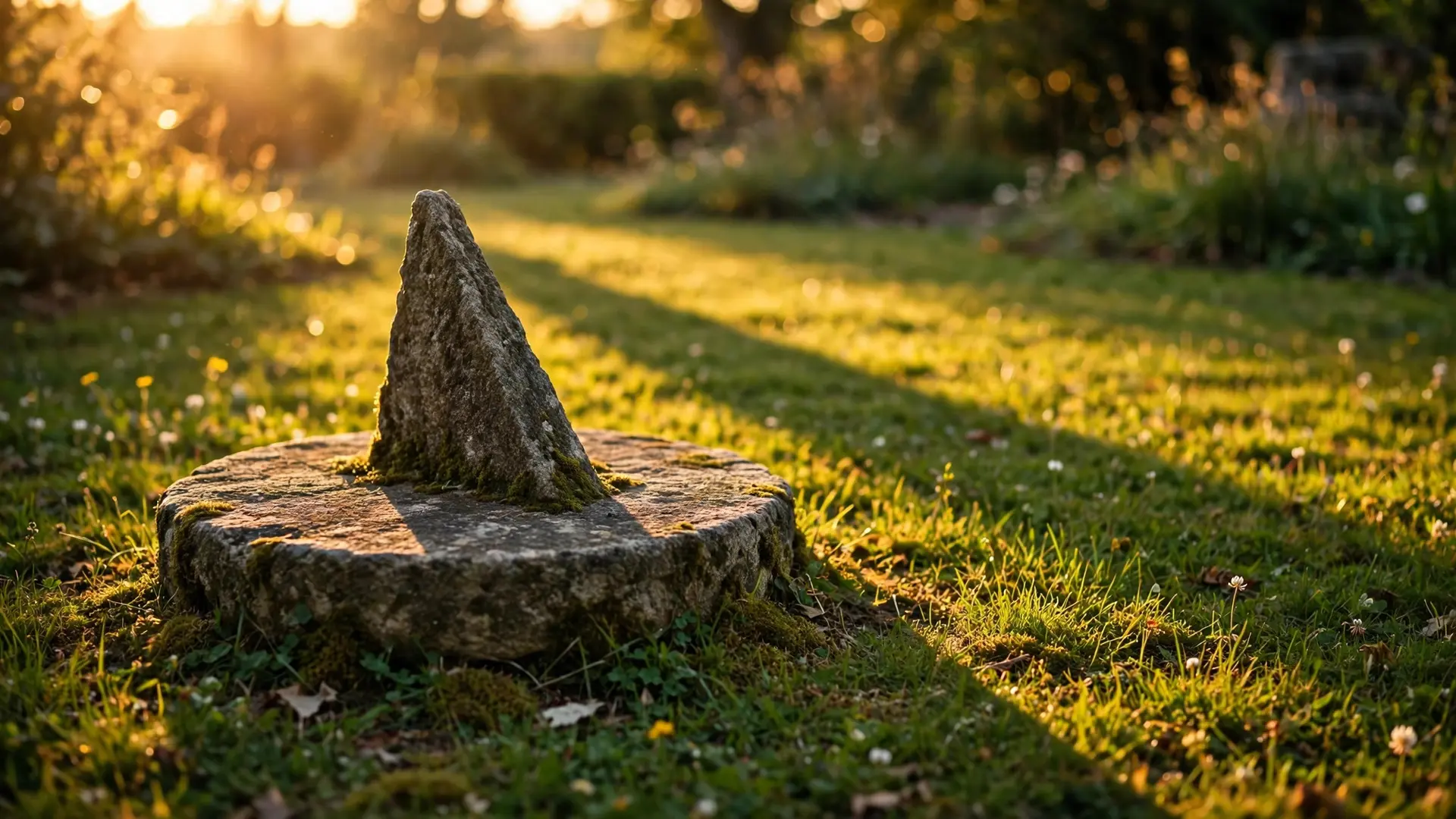
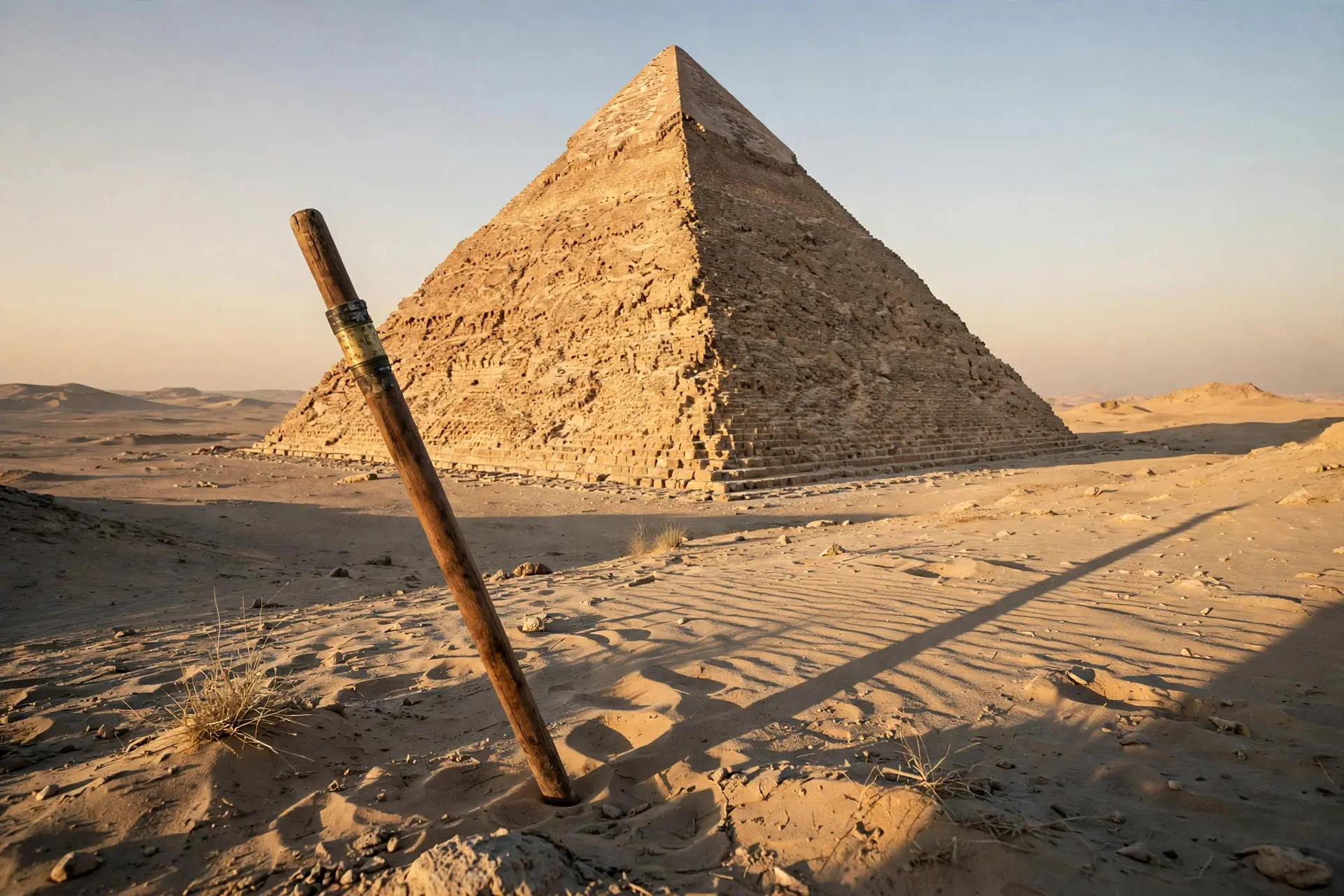
Glen Dash's answer needs no stars at all. Stand a vertical rod, a gnomon, in the ground on the day of the equinox. From dawn to dusk, the tip of its shadow traces a straight line across the sand, running very nearly east to west. On every other day of the year the track curves, and recovering north from a curve needs geometry. At the equinox the line is simply drawn out over an afternoon, and a crew only has to stretch a cord along it. He ran the test. On September 22, 2016, Dash set a 0.91 m (3 ft) by 6.10 m (20 ft) platform with a wooden dowel gnomon at his home in Pomfret, Connecticut, and marked the shadow's tip at regular intervals through the day. His result came out with a mean error of 7.3 arcminutes, within 1.5 arcminutes of the 5.9 the method predicts for an autumn equinox. Critically, it also came out counterclockwise, the same direction the pyramids lean. His experiment explains the one pattern the stellar proposals struggle with: every error leans the same way.
The trade-off is that a shadow cannot tell you the year. Finding north this way needs a clear, sunny day and a crew able to count 91 days forward from the summer solstice to locate the equinox. Dash called it the simplest workable method imaginable, but he was careful to say it only shows what the Egyptians could have done, not what they did.
What do we still not know, and what gets misreported?
The most common mistake is treating the alignment as solved. It is not. Four candidate methods have now been field-tested and found workable: Flinders Petrie's pole star (1883), Joseph Dorner's circumpolar star (1981), Martin Isler's solar gnomon (1989) and Spence's simultaneous transit (2000), plus Dash's equinox variant (2017). Testing has added knowledge without producing a winner. A timeline of the argument shows how each answer addressed a different gap:
| Year | Proposal | Who | The catch |
|---|---|---|---|
| 1883 | Pole star method | Flinders Petrie | No pole star existed then |
| 1981 | Circumpolar star method | Joseph Dorner | Never fully published |
| 1989 | Solar gnomon (Indian circle) | Martin Isler | Needs geometry off-equinox |
| 2000 | Simultaneous transit, Kochab and Mizar | Kate Spence, Nature | Arithmetic challenged in 2001 |
| 2001 | Corrected pair: Thuban and 10 Draconis | Rawlins and Pickering, Nature | No Egyptian text names the stars |
| 2017 | Equinox gnomon field test | Glen Dash, JAEA | Gives a direction, never a date |
| 2022 | Kochab and Mizar, recomputed | Irina Tupikova | 21.2 arcminute systematic offset |
| Two more gaps deserve honesty. First, the errors may simply record surveyors getting better at their job over successive projects rather than any celestial mechanism at work. Second, as Dash himself wrote, no engineering documents or architectural plans have been found that explain how the Egyptians aligned any temple or pyramid, and it remains possible that several methods were used on different monuments. | |||
| Here is one way to feel the scale of the achievement. Kochab sits 15.84 degrees from the celestial pole, a gap that would hold about thirty full Moons end to end, so one Moon spans roughly 31.7 arcminutes of sky. The Great Pyramid's four-arcminute error is about one-eighth of the Moon's apparent width. Bronze Age surveyors, with rope, plumb lines and patience, aimed a 146.6-metre (481 ft) mountain of stone to within a sliver of the Moon. | |||
| They left no record of the trick. That silence is the real mystery: not whether they could find north, which they plainly could, but which of the several working methods they actually chose on the Giza plateau some 4,500 years ago. For comparison with how they solved the harder logistics of moving 2.3 million stone blocks, see the pyramid construction account; for the earlier pyramid-building tradition, see Imhotep's step pyramid at Saqqara; for another ancient precision-alignment feat, the tunnel of Eupalinos; and for the lifting technology behind monuments, how Egyptians raised their obelisks. | |||
| How we made this article: FactSpire researched and drafted it with AI assistance and checked every fact against the sources listed above. |
Frequently asked questions
How accurately is the Great Pyramid aligned to true north?
Better than four arcminutes, which is one-fifteenth of a degree. That is a sliver of sky about one-eighth the apparent width of the Moon. The Pyramid of Khafre manages about six arcminutes and the Red Pyramid at Dahshur about 8.7. All three are rotated slightly counterclockwise from the cardinal axes, which may be a fingerprint of the method.
What is the simultaneous transit method?
Egyptologist Kate Spence proposed in 2000 that builders sighted two circumpolar stars, Kochab and Mizar, and marked north when the pair stood vertically one above the other. The line between the stars passed exactly through the celestial pole in 2467 BC, so the method also works as a dating clock, placing Khufu's pyramid at 2478 BC with a claimed precision of five years.
Could the Egyptians have used the sun instead of stars?
Engineer and archaeologist Glen Dash tested that idea on September 22, 2016. Planting a vertical rod and tracking its shadow through the equinox gave a nearly perfect east-west line with a mean error of 7.3 arcminutes, slightly counterclockwise — the same direction the pyramids miss. The method needs only a clear day and a way to count 91 days forward from the summer solstice.
Do we actually know which method they used?
No. No surviving Old Kingdom document names the stars, the stars' positions, or any surveying procedure for the pyramids. The stellar and solar methods have each been field-tested and found workable, but every proposal is reverse-engineered from the stone. Several methods may even have been used on different pyramids.
Sources
- Occam's Egyptian razor: the equinox and the alignment of the pyramids, The Journal of Ancient Egyptian Architecture
- Secret to Great Pyramid's Near Perfect Alignment Possibly Found, Live Science
- Ancient Egyptian chronology and the astronomical orientation of pyramids, Nature
- Kochab: Did It Aim the Pyramids North?, FreeAstroScience