The Minoans: Europe's Lost First Civilization
Long before Athens or Rome, the Minoans built Europe's first civilization on Crete — multi-story palaces, flush toilets, and a script no one can read.
Key takeaways
- The Minoans of Bronze Age Crete (c. 3100–1100 BC) are widely regarded as the first civilization in Europe.
- British archaeologist Arthur Evans uncovered the Palace of Knossos in 1900 and named the civilization after the mythical King Minos.
- The Minoans used two writing systems, Linear A and Cretan hieroglyphs, that remain undeciphered to this day.
- A massive volcanic eruption at Thera around 1600 BC devastated them; by 1450 BC Crete fell under Mycenaean control.
Long before Athens invented democracy and a thousand years before Rome became an empire, Europe's first great civilization was already thriving on a sunlit island in the Aegean Sea. The Minoans of Crete built multi-story palaces with running water, painted their walls with some of the most vivid art of the ancient world, and sailed trade networks that reached Egypt and the Near East. Then they vanished — so completely that their very existence was forgotten for over 3,000 years. The Minoans are a reminder that complexity is not a one-way street: societies can be staggeringly advanced, and still be lost.
How was a forgotten civilization rediscovered?
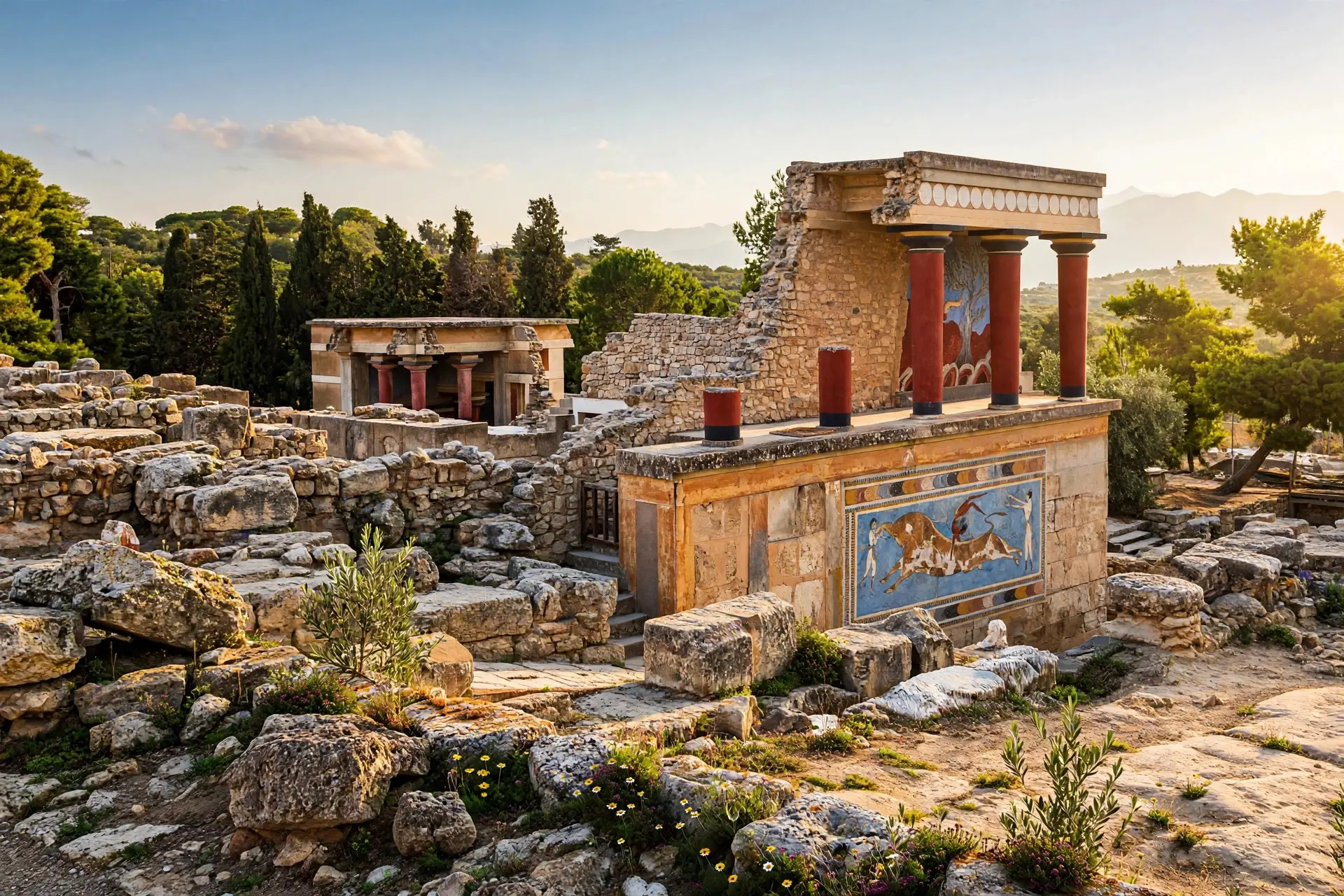
Nobody knew the Minoans existed until a stubborn British archaeologist dug them up. In 1900, Arthur Evans began excavating at Knossos on Crete, unearthing the sprawling remains of a Bronze Age palace complex that defied everything Victorian scholars believed about early Europe. This was not a tribal village — it was a monumental building with multiple levels, grand staircases, light wells, massive columns, and storerooms that once held vast archives of clay tablets. Evans named the civilization he found after the legendary King Minos of Greek myth, the ruler said to have kept the Minotaur in his labyrinth. The palace's maze-like layout — corridors twisting around courtyards and chambers with no obvious plan — likely gave birth to that very legend. Evans spent decades excavating and, controversially, reconstructing parts of the palace in concrete, so that much of what visitors see at Knossos today is his interpretation blended with Bronze Age stone. What no one disputes is what lay beneath: Europe's first civilization, fully formed, at a time when most of the continent was a patchwork of farming villages.
How advanced were the Minoans really?
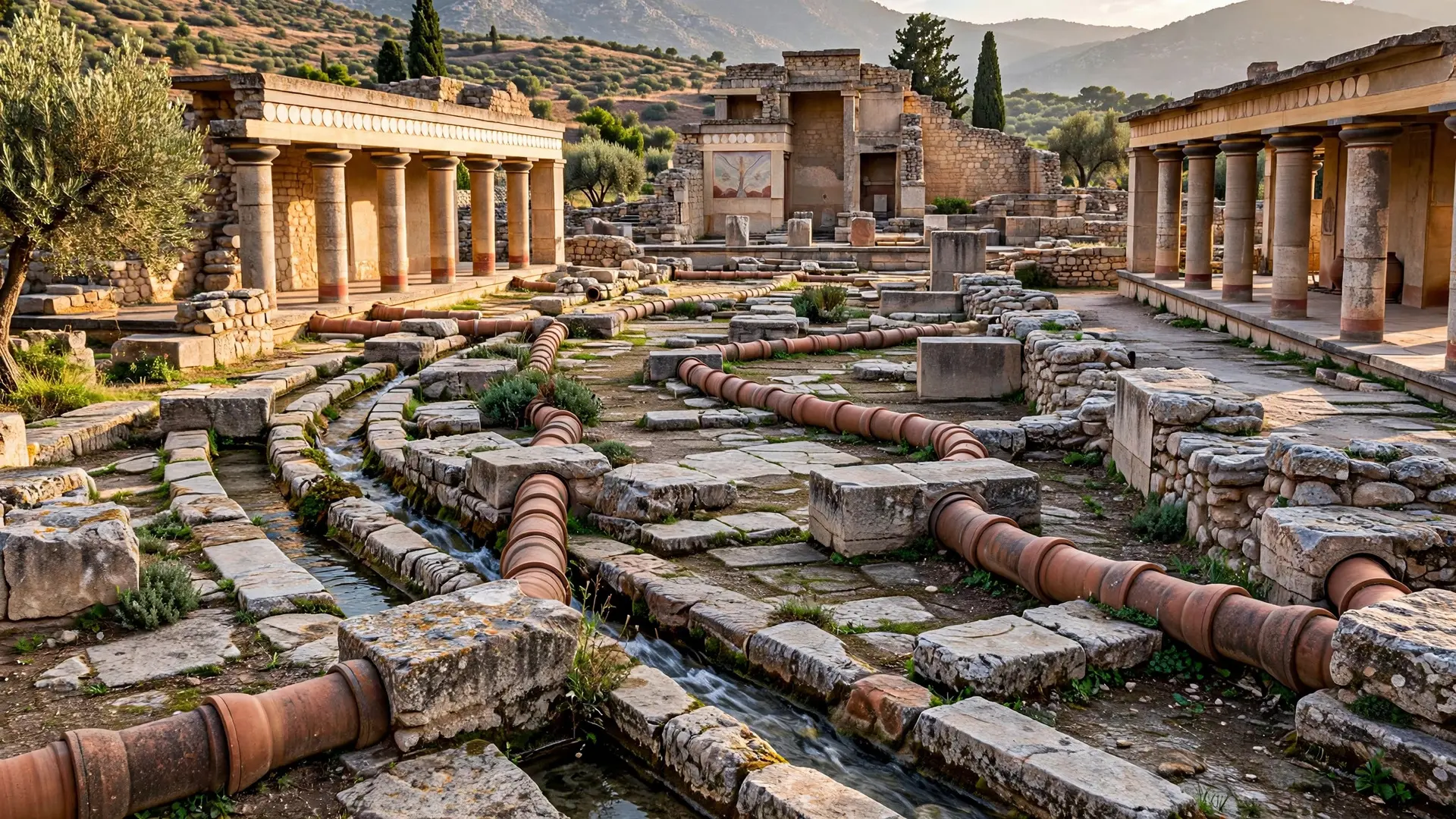
Shockingly advanced — and not just for the Bronze Age. The Minoan palaces had sophisticated plumbing systems, including what were essentially flush toilets and running water, centuries before Rome's famous aqueducts. The Romans would later master large-scale water engineering, but the Minoans got there first on a domestic scale. Their architects stacked floors around open courtyards, letting light and air flow through buildings in a climate-conscious design that feels strikingly modern.
Their art is even more revealing. Minoan frescoes — painted on wet plaster at Knossos, Phaistos, and elsewhere — burst with movement and color: dolphins diving, lilies swaying, athletes somersaulting over charging bulls. The famous bull-leaping fresco shows acrobats vaulting over a bull's horns, suggesting rituals or sports that blended athleticism with religion. Unlike the stiff, formal art of contemporary Egypt or Mesopotamia, Minoan art feels alive, almost joyous — nature rendered with an ecstatic energy that would not be matched for a thousand years.
What was Minoan society built on?
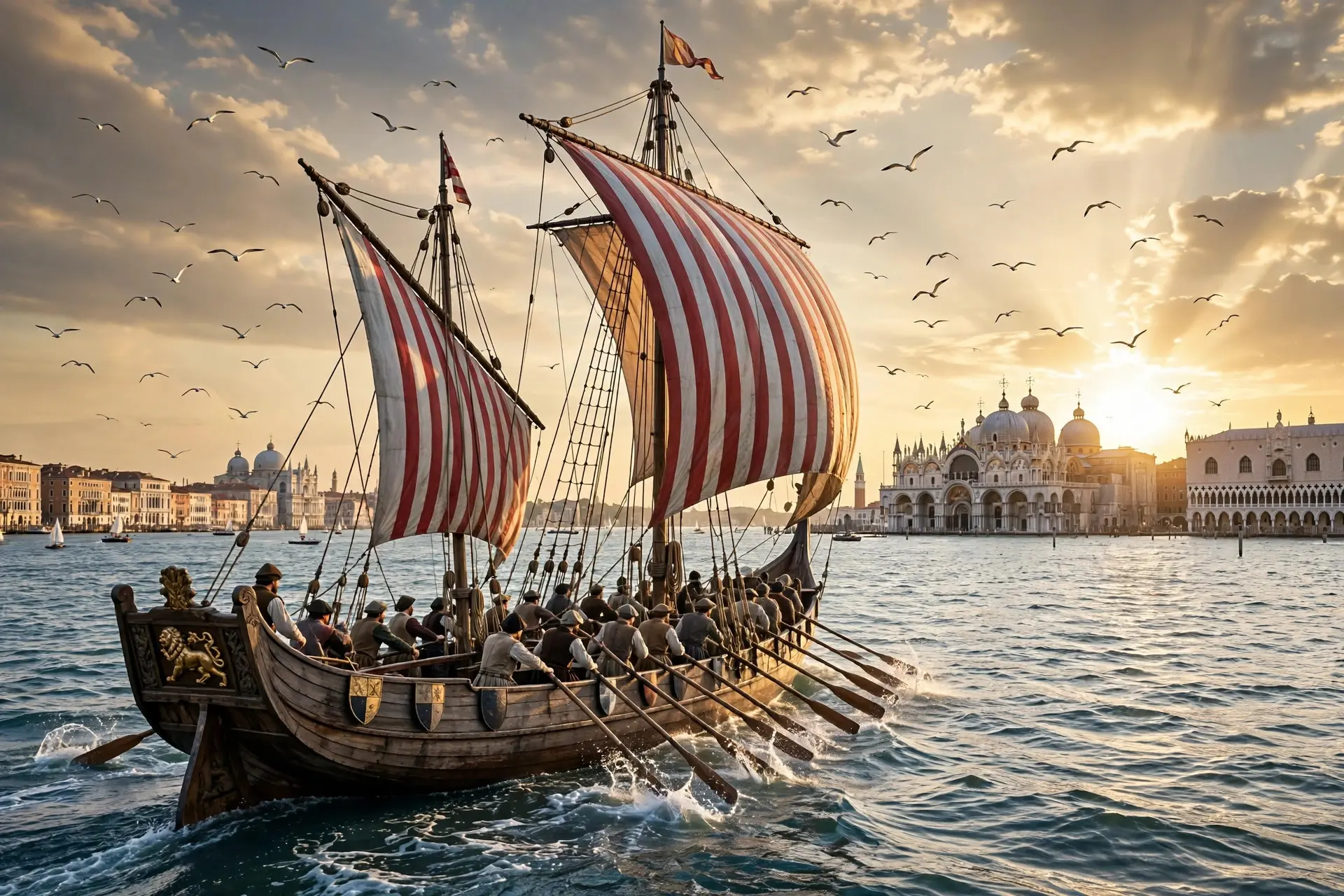
Sea power. Crete sits at the crossroads of the Aegean, and the Minoans turned geography into empire. They exported olive oil, wine, pottery, and luxury crafts across the eastern Mediterranean, importing in return the copper and tin — hard to obtain on Crete — needed to make bronze. Their ships reached Egypt, Syria, and the Levant, and Minoan goods and artistic influence spread from Cyprus to the Greek mainland. This was a trade civilization, not a military one. The palaces appear to have been administrative and religious centers rather than fortresses — notably, the great Minoan sites lack the defensive walls that bristle around later Mycenaean citadels. The Minoan fleet, the story goes, was their wall. What little we can infer about their religion points to powerful female deities — the famous Snake Goddess figurines from Knossos suggest a goddess-centered faith very different from the patriarchal pantheons that followed. A wealthy, artistic, sea-faring society that worshipped goddesses and ran on trade: the Minoans challenge every stereotype of what "primitive" antiquity looked like.
Can anyone read their language?
No — and that is one of the great mysteries of the ancient world. The Minoans developed two writing systems: Cretan hieroglyphs and a script called Linear A, pressed into clay tablets found by the hundreds at Knossos and other sites. Neither has been deciphered. The language they recorded is not recognizably Indo-European or Afroasiatic; it may belong to a family we have never otherwise encountered.
What makes this maddening is that the code should be breakable. After around 1450 BC, the mainland Mycenaean Greeks adapted Linear A into Linear B, which was used to write early Greek — and Linear B was cracked in 1952 by Michael Ventris. But Linear B writes Greek; Linear A writes something else entirely, and without a bilingual text — without a Rosetta Stone — linguists have no reliable key. The Library of Alexandria may have held works that could have helped, but they are gone. So the Minoans remain silent in their own voice, the one civilization whose libraries we can hold in our hands but never read.
What destroyed the Minoans?
The leading suspect is fire from the sky. Around 1600 BC, the volcanic island of Thera — modern Santorini — tore itself apart in one of the largest eruptions of the Bronze Age. Tsunamis swept across the Aegean and smashed into Crete's northern ports. Ash blanketed fields. The buried city of Akrotiri on Thera itself, preserved like a Bronze Age Pompeii, shows how sudden and total the devastation could be. The Minoans did not vanish overnight — they rebuilt after the eruption — but their trade network, their fleet, and their economic foundations were fatally shaken. Historians debate how directly Thera caused the end. The eruption's date and the Minoan decline do not line up perfectly, and some argue the Minoans survived Thera only to be undone by earthquakes, internal unrest, or invasion. What is certain is the outcome: after about 1450 BC, Crete came under the cultural and political domination of the mainland Mycenaean Greeks, who took over the palaces and ran them in their own language. By 1100 BC, the palace culture was gone entirely, and the Minoans slipped into myth — a half-remembered world of labyrinths and bulls that the Greeks of classical times barely understood as real. Yet their influence survived them. Mycenaean art, architecture, and administration absorbed deep Minoan influence, and the Mycenaeans in turn shaped classical Greece. In a very real sense, the Minoans are the first link in the European chain — the civilization that proved complexity could flourish on European soil. Göbekli Tepe shows that monumental building predates even farming; the Minoans show what happens when that impulse matures into palaces, ports, and writing. They were lost for three millennia. What they built — and what we still cannot read — is a reminder that history is not a ladder we climb, but a tide that sometimes takes the shore with it.
Frequently asked questions
Who were the Minoans?
A Bronze Age civilization centered on the island of Crete, flourishing roughly from 2000 to 1450 BC, known for palaces, vibrant art, and sea trade. They are often called Europe's first civilization.
Why did the Minoans disappear?
A massive volcanic eruption at Thera around 1600 BC brought tsunamis and ash that devastated Crete. The weakened Minoans were later overtaken by Mycenaean Greeks after about 1450 BC.
What is Linear A?
One of two undeciphered Minoan writing systems found on clay tablets at Knossos. Because no one can read it, the Minoan language itself remains unknown.