The Baghdad Battery: Ancient Electricity or Myth?
A clay jar with copper and iron inside has been called a 2,000-year-old battery. The replicas make voltage, but the archaeology points somewhere stranger.
Key takeaways
- The object is a small clay jar holding a copper cylinder and an iron rod, sealed with bitumen, found near Baghdad in 1936.
- In 1938 Wilhelm König proposed it was a galvanic cell, possibly used for electroplating, but archaeologists today generally reject that reading.
- Replicas filled with vinegar or lemon juice do produce a small voltage, yet a replica proving possibility does not prove ancient use.
- Nearly identical vessels from Seleucia and Ctesiphon held rolled papyrus and bronze sheets, supporting a ritual or scroll-container explanation.
- The pottery style points to the Sasanian period, from 224 CE onward, rather than the earlier Parthian date König first suggested.
The Baghdad Battery is a small clay jar with a copper tube and an iron rod inside it, and it has been asked to carry a very large claim: that people in ancient Iraq built an electric battery some 1,700 years before Alessandro Volta. Replicas of the jar do produce a measurable voltage when filled with a sour liquid. But a replica can only show that something was possible. The harder question, whether anyone actually used the jar that way, is where the battery story falls apart, and where a stranger and better-supported story takes its place.
What exactly was found near Baghdad?
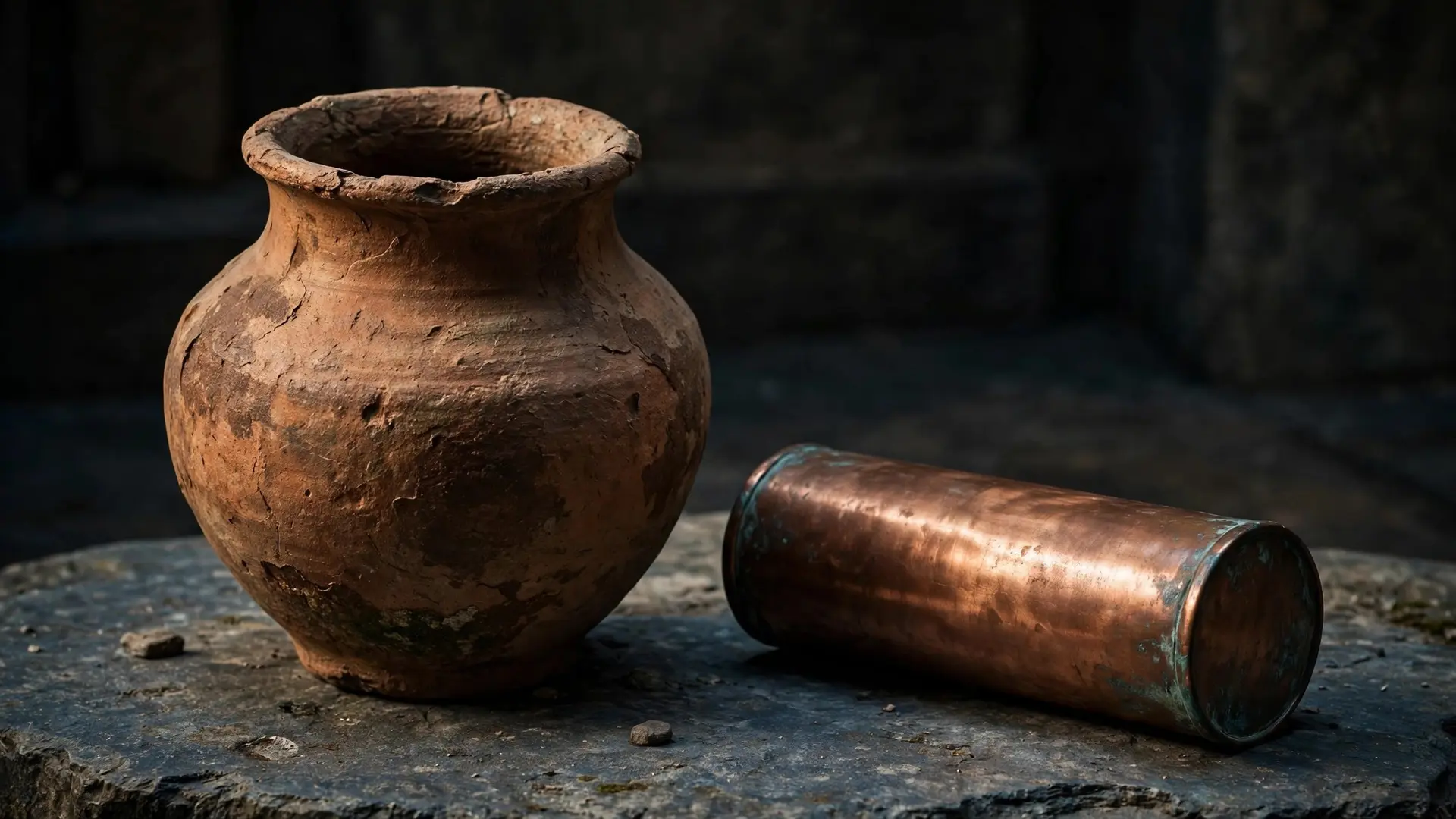
The jar came to attention at Khujut Rabu, a site near Baghdad close to the ancient city of Ctesiphon, in 1936. It is a modest object, roughly 13 to 15 centimetres tall, made of yellowish clay. Inside it sat a cylinder rolled from copper sheet, about 9 centimetres tall, with a heavily corroded iron rod suspended down its centre. A plug of bitumen, a natural asphalt, held the rod and the cylinder in place at the mouth of the jar. The copper cylinder was not watertight, so any liquid poured into the jar would have reached both metals. The man who made the jar famous was Wilhelm König, then working at the National Museum of Iraq. In 1938 he published a short paper suggesting that the arrangement might form a galvanic cell, a device in which two different metals in a liquid generate current, and he speculated that it could have been used to plate gold onto silver objects. The idea was sensational, and it travelled fast, helped by a popular science-fiction magazine article the following year. But König's own note was phrased as a question, not a conclusion, and he himself recorded the comparable finds that would later undermine his theory. Those parallels matter more than the jar alone. In 1930, excavators at Seleucia, also on the Tigris, found four similar clay vessels sealed with bitumen. Three of them held bronze cylinders containing plant matter, one of them a rolled sheet that looked like papyrus. In nearby Ctesiphon, six more vessels turned up, some holding sealed bronze rolls with decomposed fibres inside, others holding lead plates or corroded iron nails wrapped in fibre. None of these looked like workshop equipment. They looked like deposits of objects that had been deliberately sealed away, and that resemblance is the thread that pulls the battery story loose.
Why does the battery theory fail to convince archaeologists?
The first problem is dating. König placed the jar in the Parthian period, roughly the last centuries BCE to the early third century CE, which made the claim of an ancient battery seem all the more dramatic. But St John Simpson of the British Museum later pointed out that the grounds for that date were unclear, and that the pot itself looks Sasanian, the style that followed the Parthians from 224 CE onward. The original excavation was not well recorded, so the date cannot be settled from the dig itself. The jar is still old, well over a thousand years, but it belongs to a different century and a different empire than the popular version admits. The second problem is the missing evidence that any real electrical craft would leave behind. No wires have been found with the jars, and the copper cylinder does not project above the bitumen seal, so there is no obvious terminal to connect a wire to. No object from the period has been shown by analysis to have been electroplated, while the thin gold coatings that do survive from the region are consistent with fire gilding, a process using mercury amalgam that was well known in the ancient world. A battery used for plating should have plated something, and it should have left a workshop. Instead the jars turn up in grave and ritual contexts, alongside objects associated with blessings and protection. The third problem is the company the jar keeps. The Seleucia and Ctesiphon vessels, nearly identical in form, held rolled organic material that reads far more naturally as written texts than as electrical parts. On this reading, the copper cylinder protected a rolled blessing or incantation, the iron nails pinned it in place, and the bitumen sealed the whole deposit, perhaps as a protective charm buried in a grave or a building. Researchers who favour this view note that copper and iron both carried magical associations in the period, and that the jars were found near incantation bowls, vessels inscribed with spells against demons. The battery reading asks us to believe in a secret electrical tradition that left no texts, no tools, and no products. The ritual reading asks us to believe in a kind of object that the same sites produce in quantity.
What do the replicas actually prove?
The replicas prove the chemistry, and only the chemistry. Fill a copy of the jar with vinegar, grape juice or lemon juice, and the copper-iron pair generates a small voltage, roughly half a volt per jar in most tests, and about four volts when ten jars are wired together in series, as the television programme MythBusters demonstrated in 2005. That series could plate a small token with zinc overnight and push a current through needles pressed into skin, though it could not shock dry skin. A 2026 reconstruction went further, treating the clay jar and its tin-lead solder as a second, outer cell, and reported more than 1.4 volts from a single assembled device. Chemistry World reported the result while noting that archaeologists who study the object remained unconvinced, with one telling the magazine it may not have been a battery at all. None of this settles intent, and the history of the replica tests is itself a caution. The best-known early gilding demonstration, staged by museum director Arne Eggebrecht in 1978 with grape juice and a bank of replicas, was later found to have left no notes and no photographs in the museum archive, and retellings upgraded its thin silver deposit into gold. A later critic's summary captures the logic cleanly: a successful replica shows that a supposed ancient technique was possible, never that it was actually used. By that standard, the Baghdad Battery is possible and unproven at the same time, and the gap between those two words is where most of the myth lives. There is also a quieter possibility that splits the difference. Some researchers have suggested that a jar of this shape could have delivered a mild tingling sensation in a ritual or healing setting, without anyone understanding electricity as such. Ancient physicians did use the shocks of electric rays to dull pain, so a faint current might have seemed like a supernatural touch. That idea is intriguing, but it rests on the same missing evidence as the plating theory: no text describes the practice, and no jar has been found wired for use on a person. It remains a speculation, honestly labelled as one.
So what should we call it?
Call it the Khujut Rabu jar, and keep the word battery in quotation marks. The object itself is genuine, strange, and worth studying, and the debate around it has taught archaeologists a useful discipline: resemblance to a modern device is not evidence of an ancient function. A clay pot with two metals inside looks like a battery only if you already know what a battery looks like. To the people who sealed it, it may have looked like a safe place for a blessing, a charm against harm, or a gift for the dead. The jar also belongs to a larger family of ancient objects whose fame outruns their evidence. The Antikythera mechanism really was a geared calculating device, and it survives to prove it, gear by gear. The Baghdad jar proves something else, almost the opposite: that a simple shape can fool a century of onlookers into seeing their own technology reflected in the past. And like Greek fire, whose formula was genuinely secret and genuinely lost, the jar reminds us that ancient crafts could be sophisticated without being modern. The most honest verdict is also the most interesting one. The jar could make a spark of current, but the people who buried it probably wanted something older and stranger than electricity: protection, written down, sealed in metal, and hidden in the earth.
Frequently asked questions
Could the Baghdad Battery actually generate electricity?
A reconstruction can. Copper and iron in an acidic liquid form a simple cell, and replicas produce a fraction of a volt each. That shows the shape can work as a cell, not that anyone in ancient Iraq used it that way.
Why do most archaeologists doubt the battery theory?
No wires, terminals, or electroplated objects from the period have been found, and similar jars held rolled texts and ritual materials. The battery reading also requires a whole electrical craft that left no other trace in the record.
What was the jar probably for?
The leading alternative is that it held written blessings or protective texts, sealed inside metal cylinders. Comparable finds at Seleucia and Ctesiphon, with papyrus and bronze rolls, make this the best-supported reading, though it is not proven either.
How old is it?
That is disputed too. König dated it to the Parthian period, but the British Museum's St John Simpson noted the pottery style is Sasanian, placing it after 224 CE. The original excavation was poorly recorded, so the date rests on the style of the pot.
Sources
- Baghdad Battery, KÜRE Encyclopedia
- The Baghdad Battery: Ancient Electricity or Sacred Storage?, EsoVitae
- Baghdad battery reconstruction shows ancient artefact produced higher voltage than previously found, Chemistry World