The Mariana Trench: Earth's Deepest Frontier
The Mariana Trench plunges nearly 11 kilometers into the Pacific — deeper than Everest is tall. How it formed, its first explorers, and what lives there.
Key takeaways
- The Mariana Trench plunges nearly 11 kilometers deep; Challenger Deep lies more than 2 kilometers below Everest's summit.
- It formed where the dense Pacific Plate dives beneath the smaller Mariana Plate, carving a crescent about 2,550 kilometers long.
- At Challenger Deep, pressure reaches about 1,071 times atmospheric pressure, with water at just 1 to 4°C.
- In 1960, Jacques Piccard and Don Walsh descended in the bathyscaphe Trieste, spending about twenty minutes on the ocean floor.
- The Mariana snailfish lives at around 8,200 meters — yet explorers have found plastic bags and wrappers on the trench floor.
Somewhere in the western Pacific, southwest of Guam, the seafloor splits open and plunges to a depth of nearly 11 kilometers. That is the Mariana Trench, the deepest known scar on Earth's surface. Its lowest point, Challenger Deep, lies more than 2 kilometers below the summit of Mount Everest — you could set the entire mountain on the trench floor and still have deep water closing over its peak. The trench is not a bottomless pit. It is a wound in the planet's crust, and like most geological wounds, it has an explanation, a history, and — improbably — life.
A canyon born of colliding plates
The Mariana Trench exists because two tectonic plates are meeting in slow-motion collision. The Pacific Plate, one of the oldest and densest sections of ocean crust on the planet, is sliding westward and diving beneath the smaller Mariana Plate. As the Pacific slab bends downward into the mantle, it carves a crescent-shaped gash roughly 2,550 kilometers long and 69 kilometers wide — a chasm often compared to the Grand Canyon, only vastly deeper and larger. This is a subduction zone, the same class of geological machinery that builds volcanic arcs and triggers mega-earthquakes elsewhere around the Pacific. The Mariana Islands themselves are the volcanic consequence of that diving slab, sitting roughly 200 kilometers to the west of the trench axis. The trench is the scar; the islands are the smoke. The numbers are humbling. At Challenger Deep, the water column above the floor exerts a pressure of about 1,071 times atmospheric pressure — roughly 15,750 pounds per square inch, or the weight of eight tons pressing on every square inch of surface. The water temperature down there sits between 1 and 4 degrees Celsius. It is a world of perpetual night, freezing cold, and crushing force. And yet the trench floor is not sterile.
How we measured the unmeasurable
Nobody has ever seen the bottom of Challenger Deep with anything but instruments and cameras, yet we know its depth with remarkable precision — and the story of how we learned it is a miniature history of oceanography.
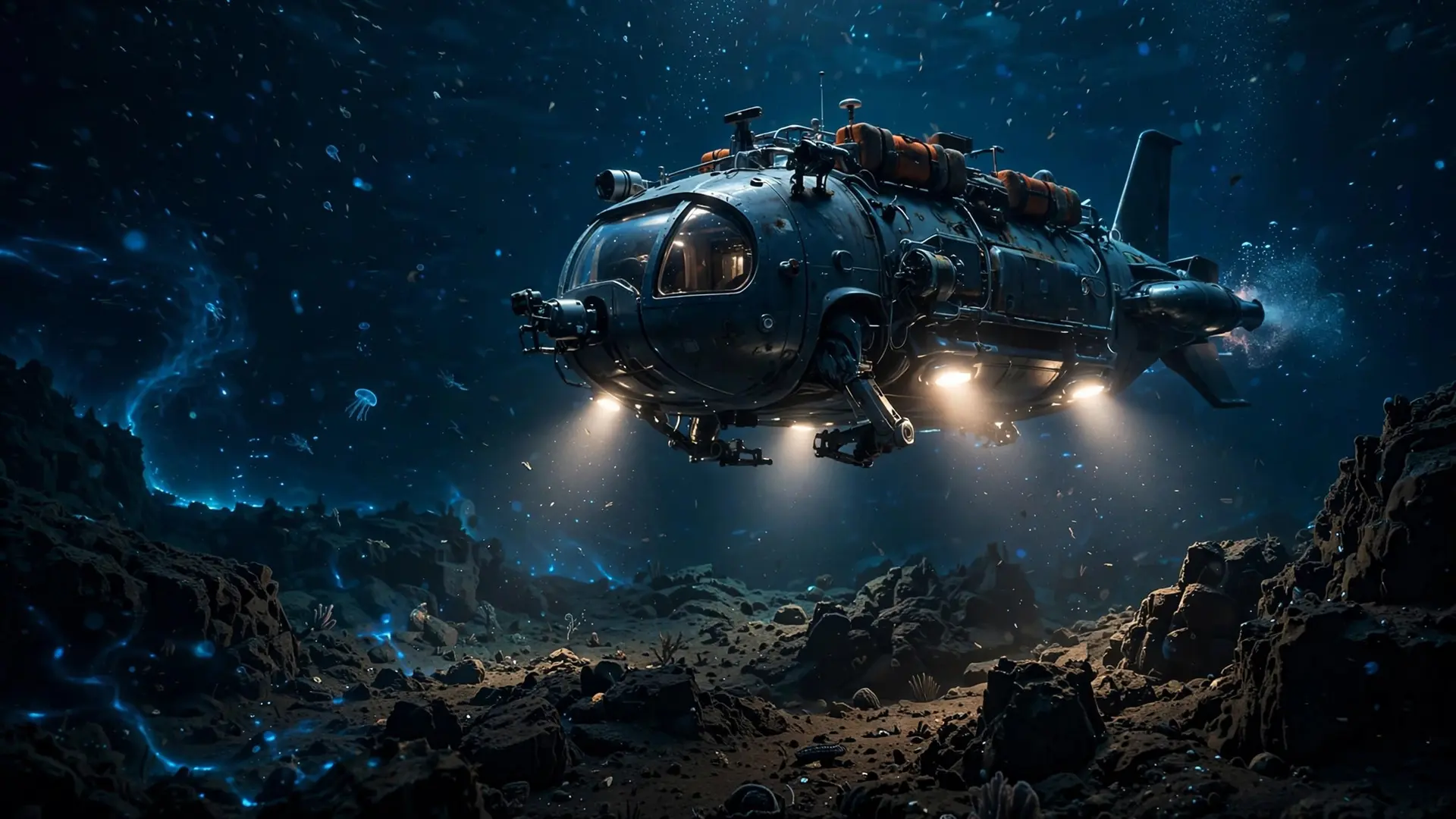
The first measurement came in 1875, when the crew of HMS Challenger lowered a weighted rope over the side and found a depth of 8,184 meters — the deepest sounding anyone had ever recorded. The trench, named after the nearby Mariana Islands, was born into science that day. By mid-century, echo sounding had pushed the number deeper still, but every survey disagreed slightly, which is why you will still see competing figures in print. The most precise modern estimate, published in 2021 from pressure-sensor transects taken on the seafloor in 2020, puts Challenger Deep at 10,935 meters, give or take six. The most famous visit, though, happened on January 23, 1960. The bathyscaphe Trieste, a strange vessel with a small steel crew sphere slung beneath a huge gasoline-filled float, carried Swiss engineer Jacques Piccard and U.S. Navy Lieutenant Don Walsh down for four hours and forty-seven minutes. At around 9,000 meters one of the outer window panes cracked with a sound that shook the vessel. They kept descending anyway — if the cabin had failed, they would already have been crushed — and spent roughly twenty minutes on the ocean floor at about 11,000 meters. It was the first time any vessel, crewed or uncrewed, had touched the deepest known point of the oceans. A 2019 solo dive later reached 10,925 meters, close to the record.
Life rewrites the rules down there
The trench's greatest surprise is biological. For decades, the hadal zone — depths below 6,000 meters, named for Hades — was assumed to be a desert. Instead, cameras and sampling gear have found a functioning, specialized ecosystem.
The deepest-living fish known to science, the Mariana snailfish (Pseudoliparis swirei), has been filmed and collected at depths around 8,200 meters. It is small, pink, and soft-bodied, with no swim bladder and a nearly translucent body — adaptations that let it survive pressure more than 800 times greater than at the surface. Its species name honors Herbert Swire, a crew member of the HMS Challenger expedition that discovered the trench. Beyond the fish, the bottom crawls with supergiant amphipods — crustaceans several times the size of their shallow-water cousins — and hosts xenophyophores, giant single-celled organisms that can grow to the size of a human palm, among the largest individual cells on Earth. Scripps researchers have even found single-celled monothalameans at 10.6 kilometers, nearly at the trench's maximum depth. Then there are the chemical curiosities. NOAA expeditions in the region discovered the Champagne vent at the NW Eifuku volcano, which emits nearly pure liquid carbon dioxide — one of only two such sites known — and a pool of liquid sulfur at the Daikoku submarine volcano, the only other place known to host molten sulfur being Jupiter's moon Io. In 2009 the United States designated the area the Mariana Trench Marine National Monument, recognizing its geological and biological uniqueness. There is a darker thread in the story. Explorers reaching the floor have found plastic bags, candy wrappers, and other debris; the trench's funnel shape concentrates what sinks. In a place where fish feed on what drifts down from above, even the deepest point on Earth is not beyond humanity's litter.
What the trench teaches us
The Mariana Trench upends a tempting misconception: that the unknown lies outward, in space, while our own planet is mapped. In truth, we have charted the surface of the Moon and Mars in finer detail than we have the seafloor of the deepest trenches. Only a few dozen people have ever visited Challenger Deep, and each visit finds something unexpected. That is why the trench matters beyond the superlative of depth. It is a laboratory for the extremes of pressure physics, for how life adapts to conditions that should be unsurvivable, and — since hadal trenches elsewhere may harbor similar ecosystems — a preview of what alien oceans like those beneath the ice of Jupiter's moon Europa might contain. The ocean's greatest depth is not an empty pit; it is a reminder of how much of our own planet remains unexplored, far from the farthest point from any land at all. Eleven kilometers down, in total darkness, fish with gelatinous bodies glide past palm-sized single cells, under pressure that would flatten steel — and we have only just begun to look.
Frequently asked questions
How deep is the Mariana Trench?
Nearly 11 kilometers; the most precise modern estimate puts Challenger Deep at 10,935 meters, give or take six.
Who first reached the bottom of the Mariana Trench?
Jacques Piccard and Don Walsh, who descended in the bathyscaphe Trieste on January 23, 1960, after a four-hour-forty-seven-minute descent.
Is there life in the Mariana Trench?
Yes — the Mariana snailfish at 8,200 meters, supergiant amphipods, and palm-sized single-celled xenophyophores, all adapted to crushing pressure.