How Old Is the Grand Canyon? Ancient Rocks, Young Gorge
The Grand Canyon's oldest rocks are about 1.8 billion years old, but the gorge itself is mostly 5 to 6 million years young. Here is how geologists know both.
Key takeaways
- The Vishnu Schist in the canyon's depths was metamorphosed about 1.75 billion years ago, while the Kaibab Formation on the rim is about 270 million years old.
- According to the National Park Service, the Colorado River and its side streams cut the canyon itself within roughly the past five or six million years.
- At the Great Unconformity, sandstone laid down about 508 million years ago rests directly on schist more than a billion years older.
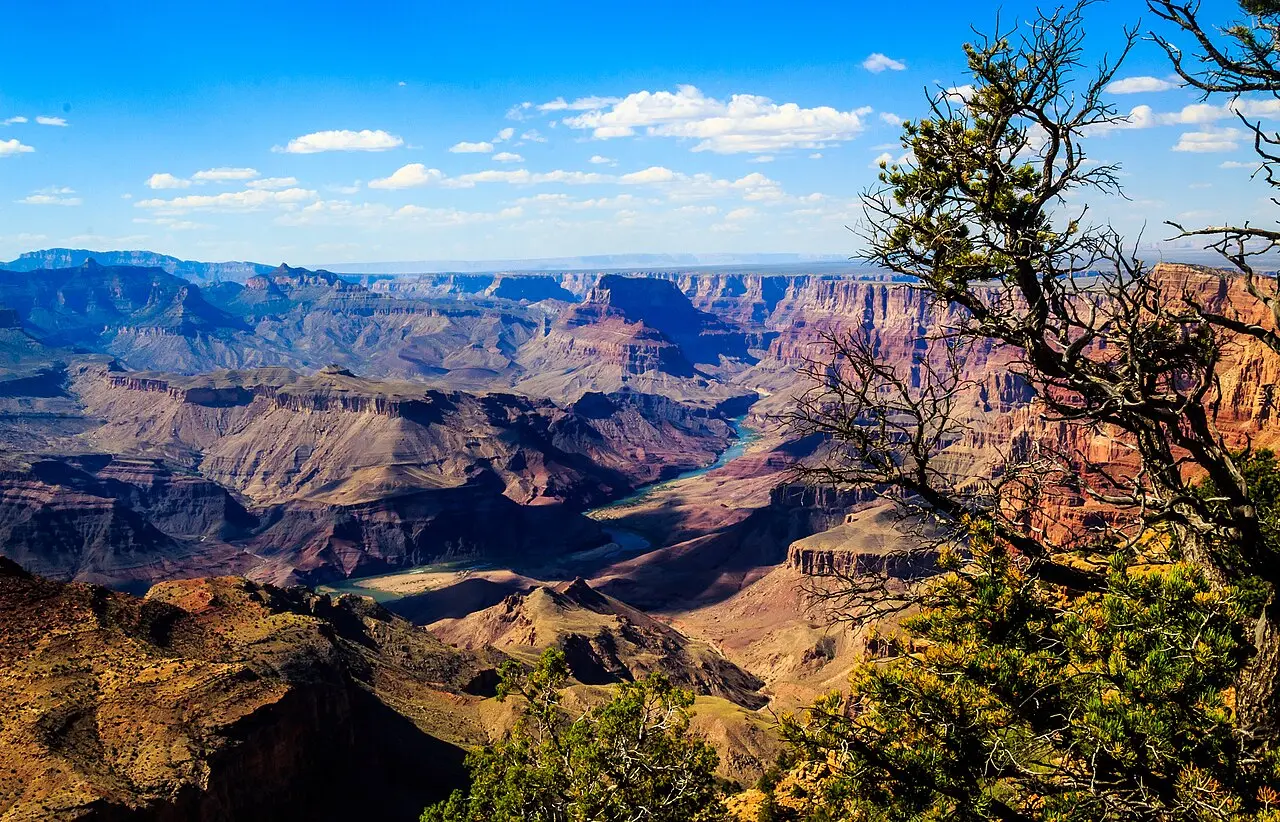
- The canyon is about 446 km (277 river miles) long, up to 29 km wide and about 1.6 km deep on average, reaching about 1,830 m at its deepest.
- A 2012 study argued the western canyon was cut close to its modern depth 70 million years ago; a 2014 study says older segments were linked 5 to 6 million years ago.
The Grand Canyon is young, but the rocks it cuts through are ancient. The dark schist that lines the canyon's inner gorge took its present form about 1.75 billion years ago, while the canyon itself, the National Park Service says, was carved by the Colorado River largely within the past five or six million years. Old rocks, young canyon: the gap between those two clocks is the key to understanding the place.
How old are the rocks in the Grand Canyon?
The walls hold nearly 40 identified rock layers, and they read like a stack of pages with the oldest at the bottom. At the base lie crystalline rocks, among them the Vishnu Schist, which were squeezed and heated deep in the crust around 1.75 billion years ago and later invaded by molten rock that cooled into granite. The park puts the age of its oldest rocks at about 1.8 billion years. Above them, in some places, lies a tilted wedge of sediment and lava that began accumulating about 1.2 billion years ago and grew to roughly 4,000 meters (13,000 ft) thick. Mountain building around 725 million years ago lifted and tilted those layers, and erosion then removed them from most of the region. Then the sea returned, again and again. Between about 550 and 250 million years ago, a series of marine incursions from the west laid down the sandstone, shale and limestone that form most of the upper walls, a pile 730 to 1,500 meters (2,400 to 5,000 ft) thick, with layers from the Cambrian through the Permian periods. The rim itself is the Kaibab Formation, about 270 million years old, a limestone that formed on a sea floor and now stands as high as 2,700 meters (9,000 ft). Judging from nearby outcrops, another 1,200 to 2,400 meters (4,000 to 8,000 ft) of younger Mesozoic rock once lay on top. Almost all of it has since been stripped away.
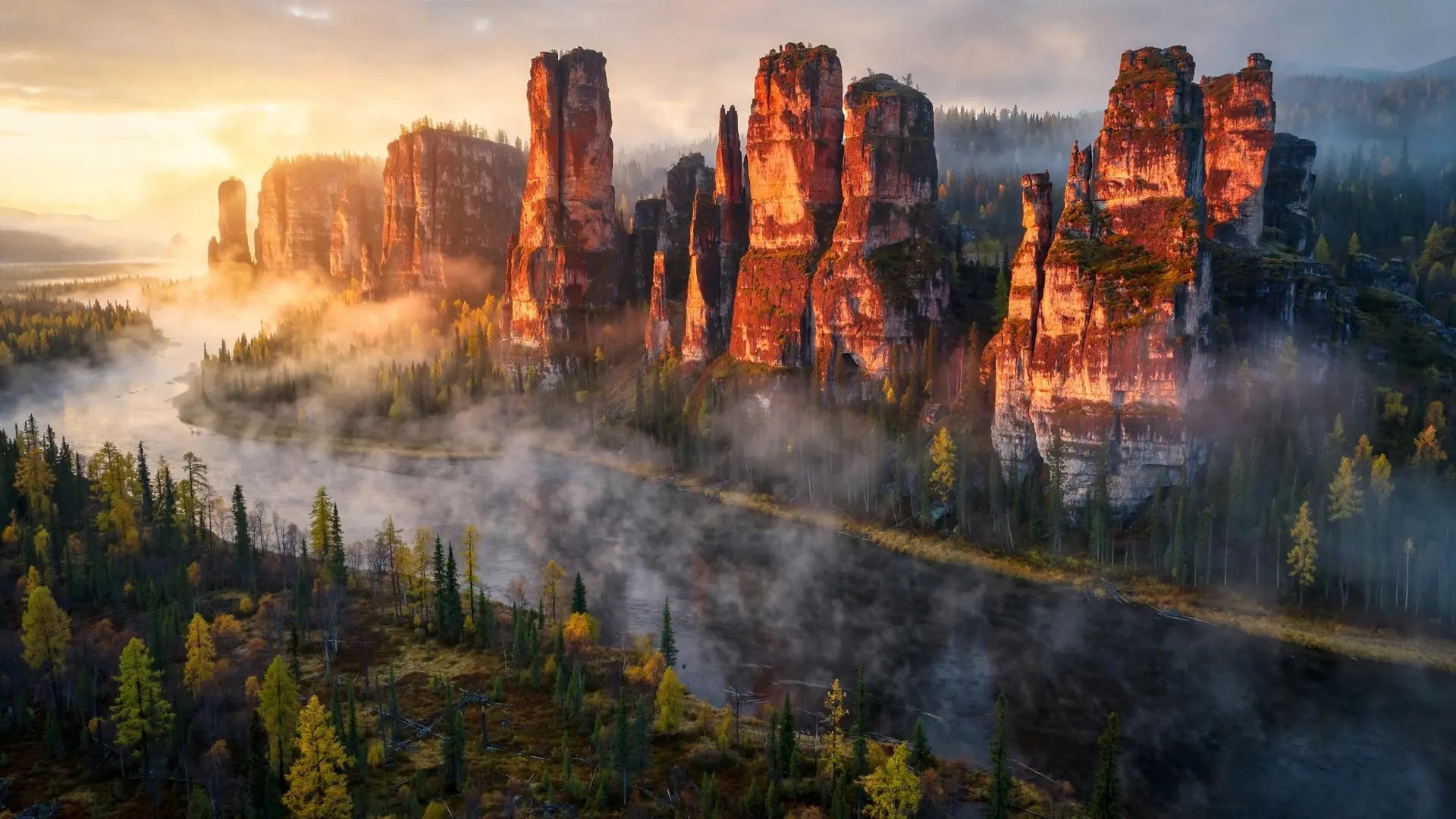
Where Cambrian layers rest directly on the schist, there is a famous break in the record called the Great Unconformity: sandstone that the park dates to about 508 million years ago sitting on rock more than a billion years older, with everything in between simply missing. What removed it is still debated. One study, published in PNAS at the end of 2018, proposed that glaciers of the late Neoproterozoic Era ground away an average of 3 to 5 kilometers of crust worldwide. During the same Cambrian period, reef-builders on the far side of the planet were laying down the limestone that now stands as Siberia's Lena Pillars.
When did the Colorado River carve the canyon?
The rocks had to be lifted before a river could cut into them. Between about 70 and 30 million years ago, beginning with the mountain-building pulse known as the Laramide Orogeny, the region was pushed upward into the high Colorado Plateau. Unlike the folded ranges thrown up where continents collide, such as the Himalayas, the plateau rose with its layers still lying close to flat, which is why the canyon walls look like a sliced layer cake. The carving came much later. The National Park Service places the formation of the canyon within the past five to six million years, and considers the river itself slightly older: an ancestral Colorado River has existed for at least 7 million years, and possibly 10 million. In that time the river and its tributaries opened a gorge about 446 kilometers (277 river miles) long, about 16 kilometers (10 miles) wide from rim to rim on average and up to 29 kilometers (18 miles) at its widest. It averages about 1.6 kilometers (1 mile) deep and reaches roughly 1,830 meters (6,000 ft) from rim to river at its deepest. Spread over five or six million years, that depth works out to roughly a third of a millimeter of downcutting a year, about the thickness of three sheets of paper.
How can a river cut so deep, so fast?
By using rock to cut rock. Water alone wears down hard rock slowly, but water loaded with sand, gravel and boulders is far more effective. Stones swept along the bed by the current act as hammers and chisels, battering and grinding at the rock beneath them. The work went fastest during the great spring floods of the years before the river was dammed upstream, when the Colorado carried enormous loads of sediment; its highest recorded flood, in 1884, is now estimated by the US Geological Survey at about 210,000 cubic feet (5,950 cubic meters) per second, a downward revision of the older 300,000-cubic-foot figure that still appears on the National Park Service's geology page.
The plateau's height gave the river a long way to fall on its journey to the sea, and the tributaries did the widening. Side streams fed by rain and snowmelt gnaw sideways into the walls, a process the park expects to continue for as long as water runs down them. In winter, ice forming in cracks pries rock apart on the exposed cliffs. The dry climate helps as well: with little soil or vegetation to protect it, bare rock weathers and breaks down readily. The hardest material, the crystalline rock of the inner gorge, resists best, which is why the river runs through narrow, steep-walled gorges where it has cut into the basement. Today the Colorado averages about 91 meters (300 ft) wide and 12 meters (40 ft) deep as it passes through the canyon.
Is the Grand Canyon really 70 million years old?
Not everyone accepts the young-canyon story. In 2012 the geologists Rebecca Flowers and Kenneth Farley published a study in Science that used helium in grains of the mineral apatite as a kind of thermometer. As erosion strips away the rock above, buried grains cool, and the helium they retain records when that cooling happened. Their results suggested that the western Grand Canyon had been cut to nearly its present depth about 70 million years ago, when dinosaurs still lived. Two years later, a team led by the geologist Karl Karlstrom replied in Nature Geoscience with a paper whose title sums up the counterargument: the Grand Canyon formed five to six million years ago "through integration of older palaeocanyons". On this view, some stretches of the canyon really are much older, but they were separate valleys until the Colorado linked them into one continuous gorge and deepened it. The National Park Service keeps the five-to-six-million-year date, while acknowledging that several hypotheses about how the river formed are still debated. Part of the disagreement comes down to what counts as the Grand Canyon. If it means any deep valley that once existed somewhere along its route, parts of it may be ancient. If it means the single, through-going canyon cut by the Colorado, the evidence points to a young landscape. So how old is the Grand Canyon? Its rocks span well over a billion years, from schist formed about 1.75 billion years ago to the 270-million-year-old limestone on the rim. The canyon is a recent cut through that record, made largely within the past five or six million years, even if pieces of it may be older. Standing on the rim, you are looking at two kinds of time at once: the slow stacking of ancient seas and mountains, and the comparatively quick work of a river that has not finished its job.
Frequently asked questions
How old is the Grand Canyon?
According to the National Park Service, the canyon was carved largely within the past five or six million years, though some researchers argue that parts of it are far older. The rocks it exposes are much older, up to about 1.8 billion years.
How was the Grand Canyon formed?
The Colorado Plateau was uplifted between about 70 and 30 million years ago. Later, the Colorado River and its side streams sliced down through the raised layers, using the sediment and stones carried by floods as cutting tools.
How deep is the Grand Canyon?
About 1.6 kilometers (1 mile) on average, and roughly 1,830 meters (6,000 feet) from rim to river at its deepest point.
What is the Great Unconformity?
It is a gap in the rock record where layers about 508 million years old sit directly on schist more than a billion years older, so the rocks from the time in between are missing.
Sources
- Geology - Grand Canyon National Park, U.S. National Park Service
- Geologic Formations - Grand Canyon National Park, U.S. National Park Service
- Frequently Asked Questions, U.S. National Park Service
- Neoproterozoic glacial origin of the Great Unconformity, Proceedings of the National Academy of Sciences
- Formation of the Grand Canyon 5 to 6 million years ago through integration of older palaeocanyons, Nature Geoscience
- Strandlines from large floods on the Colorado River in Grand Canyon National Park, Arizona, U.S. Geological Survey