The Green Flash: The Sunset Phenomenon Explained
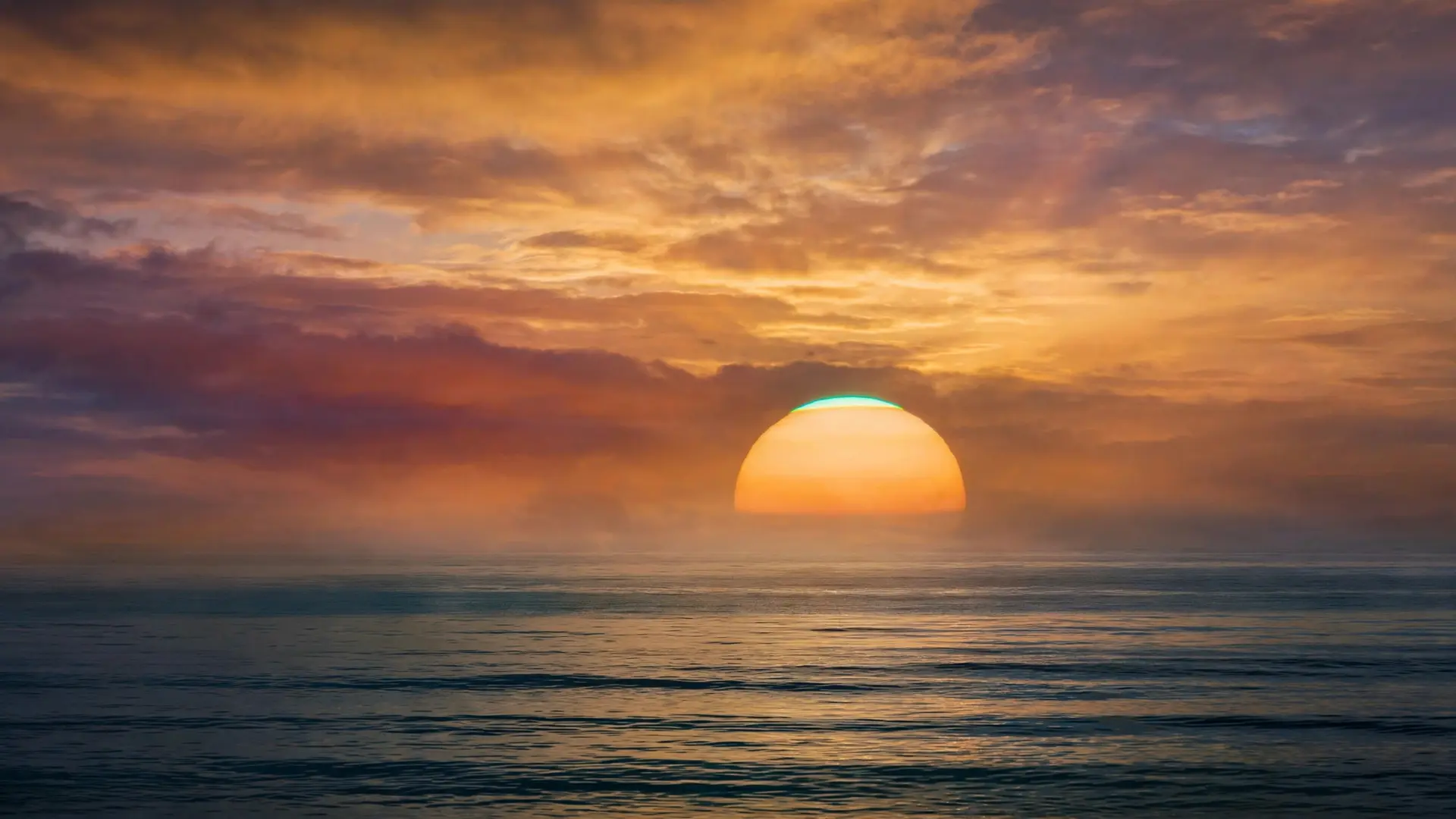
For a second at sunset, the sun's upper edge can flash emerald green. Refraction splits sunlight into colors while a mirage widens the green sliver.
Key takeaways
- The green flash is the last sliver of the sun's light, split by refraction so that only a green segment remains briefly visible above the horizon.
- The atmosphere acts like a prism: shorter wavelengths (green, blue) bend more than red and orange, so green sits highest on the sinking sun's image.
- Blue would bend even more, but it is scattered away by air molecules along the long horizon path — leaving green as the color that survives.
- A mirage from layered air magnifies the color separation, stretching a green rim that lasts a fraction of a second into a flash lasting a few seconds.
- The flash is most often seen over the ocean with a clear horizon and steady air; it can also appear at sunrise and on the Moon and bright planets.
The green flash is real, and it is not the sun changing color. It is the last surviving fragment of sunlight, pulled apart by Earth's atmosphere into separate colors, leaving a sliver of green at the sun's upper edge for a second or two before it vanishes. That glow only appears when two things line up: the air must split sunlight the way a prism does, and a mirage must widen that splitting enough for eyes to catch it.
What splits the sunlight?
As the sun sinks toward the horizon, its light reaches you at a shallow angle, cutting through a much thicker slice of the lower atmosphere than it does at midday. Air bends light, and it bends each color by a slightly different amount. Shorter wavelengths bend more: blue and green are bent the most, orange and red the least — the same dispersion that paints a rainbow across the sky after rain. Think of the sinking sun as a stack of overlapping colored disks, one for each part of the spectrum, slightly offset from one another. The red disk sits lowest, the blue disk highest. As the sun drops, the red and orange disks slide below the horizon first. Blue, bent the most, would logically be the last to go — but along the long, dusty path through the dense air hugging the horizon, blue light is scattered out of your line of sight before it can reach you. That scattering is a cousin of the process that makes the daytime sky blue. What survives is green: bent more than red, scattered less than blue. For a heartbeat, the top of the green disk is the only part of the sun still above the horizon — and that is the flash.
Why does a mirage matter?
Here is the catch: the color separation described above happens at essentially every sunset. A razor-thin green rim sits along the sun's upper edge on most clear evenings, but it is so thin and so brief that the naked eye cannot pick it out.
That is where the mirage comes in. When air near the ground is arranged in layers of different temperatures, each layer bends light by a slightly different amount, acting like an extra lens stacked on top of the atmosphere's prism. This uneven bending stretches the green segment taller and holds it visible longer — from a split second to several seconds. The commonest variety is the inferior-mirage flash, seen with the naked eye right as the last of the sun disappears — the same family of mirage that makes heat shimmer above hot asphalt. It looks oval and flattened underneath and lasts one or two seconds. Other setups give other forms: a mock-mirage flash from a temperature inversion can pinch the upper rim into a thin ribbon; beneath a strong inversion, a sub-duct flash can shape the sun into an hourglass whose upper half glows green for up to fifteen seconds; and the rarest form, the green ray, is a pillar of green light that appears to shoot upward just after sunset, with no confirmed photograph known to exist.
How can you actually see one?
You need a perfectly clear view of the horizon, clean and steady air, and your eyes on the right spot at the right moment. That is why the flash is most commonly reported over the ocean — a sea horizon is distant, flat, and free of dust. Airline pilots flying westward report flashes regularly, since their route slows the sunset and stretches the moment. Green flashes are not limited to sunsets or to the sun. The same optics operate at sunrise, playing in reverse as the sun's upper edge crests the horizon. Near the equator the whole event is compressed and the flash hardly ever lasts more than a second. If you want to try, pick an evening with clear, calm air and a wide western horizon over water, and watch only as the disk touches the horizon, keeping your gaze fixed on the very top edge. It may take many attempts; plenty of dedicated watchers have chased the flash for years before their first sighting.
A short history of chasing the flash
The phenomenon has been noticed for a long time. In 1869, physicist James Prescott Joule wrote to the Manchester Literary and Philosophical Society describing the setting sun's final glimpse as bluish-green, though he offered no explanation. It was Jules Verne who turned the flash into legend. His 1882 novel Le Rayon-Vert (The Green Ray) described a green no artist could ever mix on a palette — a shade found neither in vegetation nor in the clearest sea. The book popularized the flash across Europe, and the name stuck. Expeditions carried the chase to the ends of the Earth. In October 1929, Admiral Byrd's expedition at Little America in Antarctica watched the flash flicker on and off for a reported 35 minutes as the sun skimmed the southern horizon, its meteorologist recording starlike green points of light winking from notches in the snow surface. In 1960, astronomer D. J. K. O'Connell captured the phenomenon on color film for the first time while working at the Vatican Observatory. Modern understanding owes much to Andrew T. Young of San Diego State University, whose models of atmospheric refraction explain exactly which air layers produce which kind of flash. And one of the best places on Earth to see it remains Cerro Paranal in Chile, home of the European Southern Observatory's Very Large Telescope: at 2,600 meters in the Atacama Desert, the air is so stable that the flash is a relatively common sight there.
What people get wrong about it
The biggest misconception is the one the name invites: nothing about the sun itself changes. The green is not painted on the sun; it is what remains of ordinary sunlight after the atmosphere has sorted and scattered it. It is also not an omen. Pirates of the Caribbean: At World's End cast it as the sign of a soul returning from the dead, and folklore in various places treats it as lucky or prophetic. The truth is less mystical but more satisfying: pure optics, repeatable wherever air, horizon, and geometry cooperate. A sunset you have watched a thousand times contains a hidden green second. It lasts barely long enough to notice, and the atmosphere serves it up only when the air is layered just so. That is the whole phenomenon: white light, bent and sifted by the sky, leaving green as its parting word.
Frequently asked questions
What is the green flash?
A brief emerald-green glow seen right at the sun's upper edge at the moment it crosses the horizon. It typically lasts one to three seconds and is caused by atmospheric refraction splitting sunlight into colors.
Why is the flash green and not blue?
Blue light bends the most and should be the last color visible, but along the long path through low, dense air near the horizon, blue is scattered out of sight. Green is the shortest wavelength that survives the trip, so green is what you see.
Can you see the green flash at sunrise too?
Yes. The same optics work in reverse: just before the sun crests the horizon at dawn, a green flash can appear at its upper edge. Clear air and an unobstructed horizon matter more than the time of day.
Is the green flash a myth?
No — it is a documented, photographed optical phenomenon. It was first photographed in color in 1960, and observatories in ideal locations record it regularly. Most people simply never look at the sun's upper edge at exactly the right moment in steady, clear air.