What Causes Halos and Sun Dogs Around the Sun?
Halos and sun dogs are sunlight bent by hexagonal ice crystals high overhead. The ring always sits 22 degrees from the sun — and physics explains why.

Key takeaways
- A 22° halo is a ring of light around the sun made when sunlight refracts through hexagonal ice crystals in high cirrus clouds.
- The ring's radius is fixed by physics: a hexagonal ice prism bends light by about 22°, so billions of crystals paint a circle at that angle.
- Sun dogs are bright spots beside the sun, formed when flat plate-shaped ice crystals drift horizontally and bend light toward you.
- You don't need cold ground weather — cirrus ice forms kilometers up, so halos can appear anywhere, in any season.
- Halos show red on the inner edge and blue outside — the reverse of a rainbow's color order.
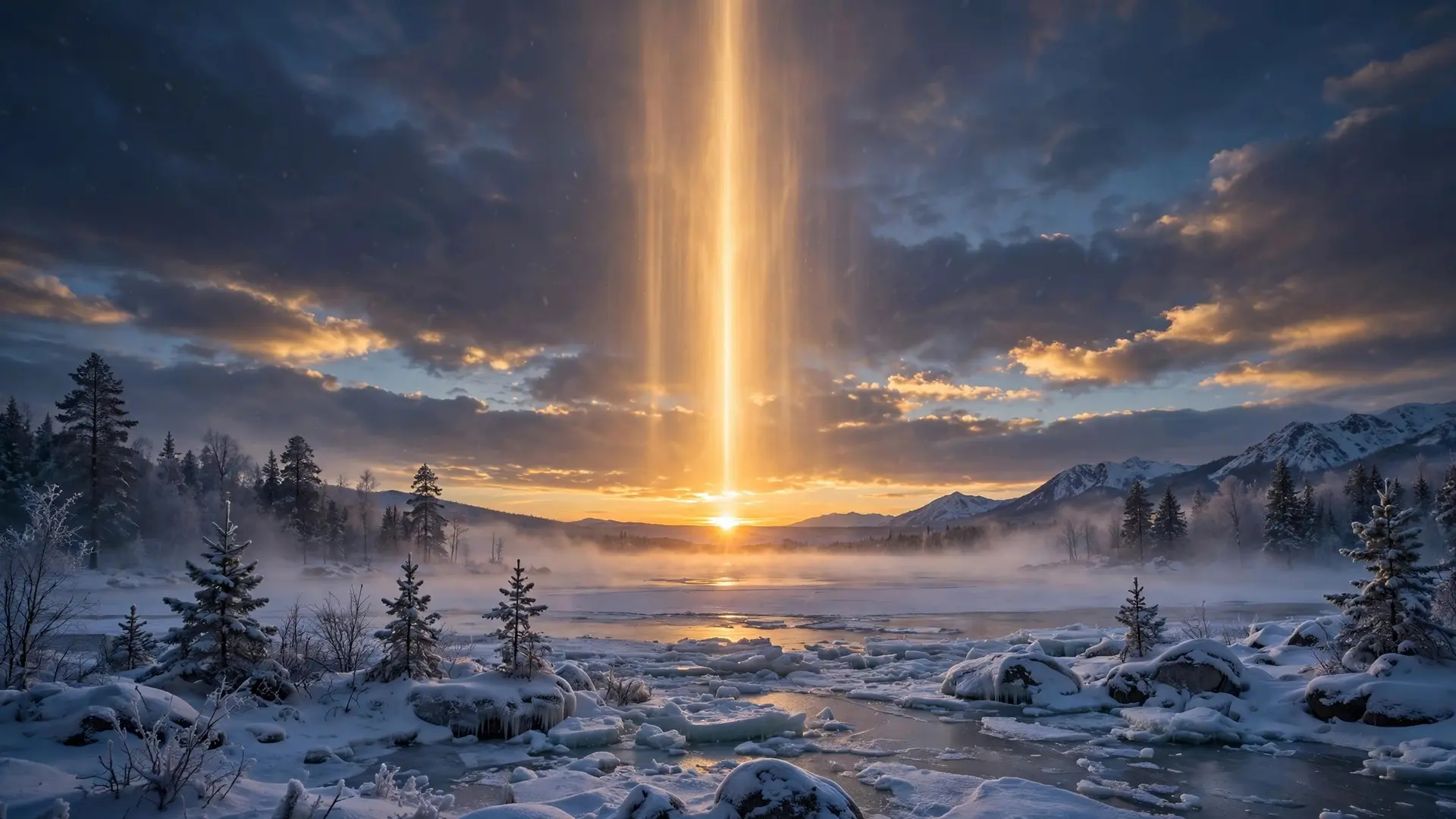
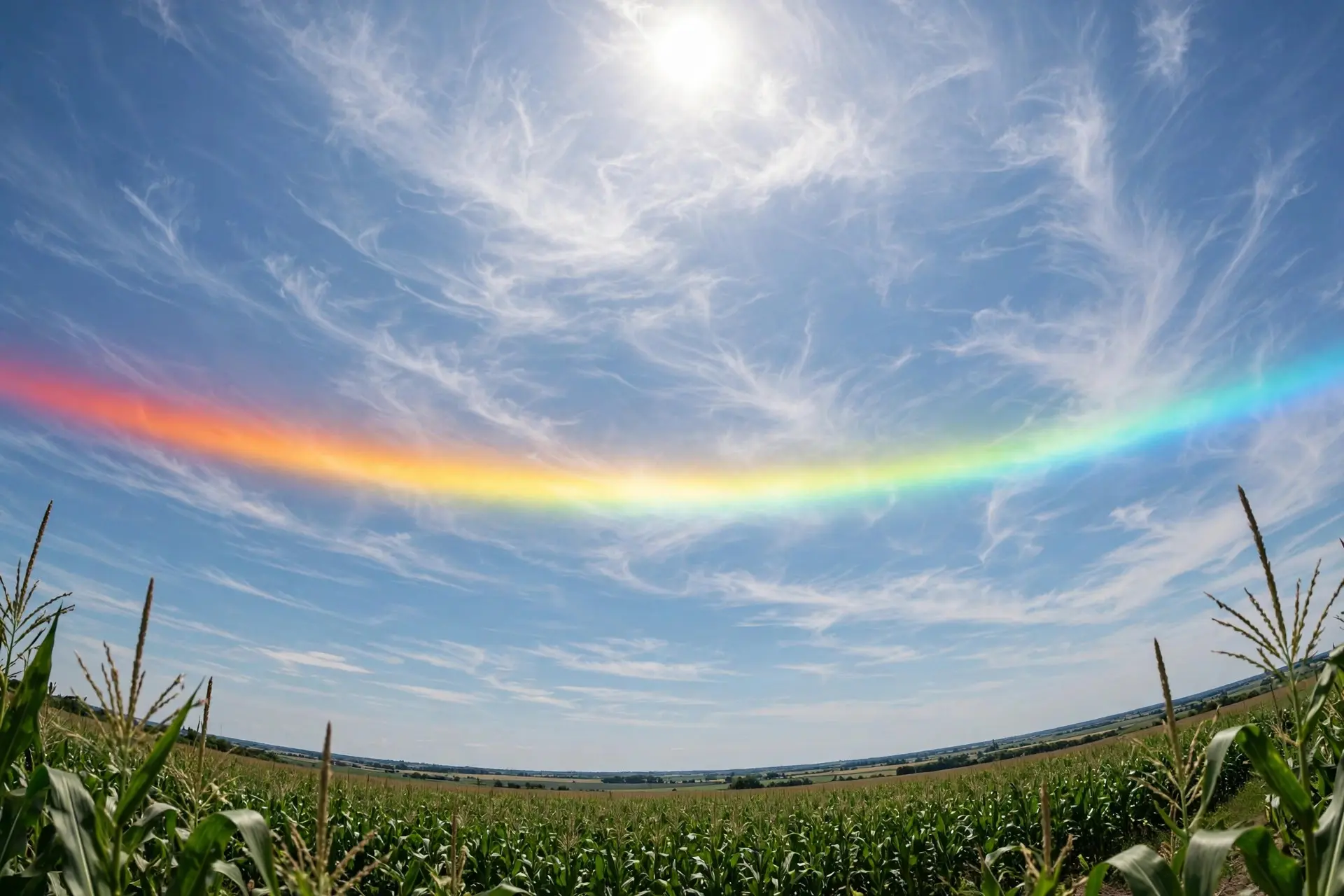
The ring is a 22-degree halo, and the bright spots flanking the sun are sun dogs. Both are made the same way: sunlight refracting through millions of tiny hexagonal ice crystals floating kilometers overhead in thin cirrus clouds. Each crystal acts like a miniature prism, and because the geometry of ice is fixed, the bent light always reaches your eyes at the same angle — which is why the ring's radius never changes. You do not need any special equipment to check the angle yourself. Stretch your arm straight out, spread your fingers wide, and cover the sun with your thumb. The tip of your little finger should land right on the halo. It works every time, because the 22 degrees is physics, not coincidence.
What exactly am I looking at?
The full display has two main characters. The halo itself is a large, faint circle centered on the sun with a radius of about 22 degrees. It usually looks whitish, but look closely and you may catch a red inner edge nearest the sun fading to bluish on the outside — almost like a rainbow, except the colors run in the opposite order, and the ring sits around the sun itself rather than opposite it. The sun dogs are the showier part. Officially called parhelia — Greek for "beside the sun" — they are bright, often vividly colored spots that appear to the left and right of the sun at the same height, sitting right on the halo's edge. Their inner edges glow red-to-orange facing the sun, with bluish-white tails streaming away. On a good morning they can be so brilliant that startled observers mistake them for a second sun, which is why they are also called mock suns. Pairs are the classic sight, though sometimes only one appears, depending on where the ice is thickest.
Why is the ring always 22 degrees?
The answer lives inside the crystal. An ice crystal in a cirrus cloud is a hexagonal prism — six-sided, like a microscopic pencil cut short. When sunlight enters one face of the prism and exits through a different, non-adjacent face, the light is bent, and the smallest bend that geometry allows is about 22 degrees. Physicists call this the angle of minimum deviation, and for visible light passing through hexagonal ice it is essentially a constant of nature. Now multiply that crystal by billions. In a thin cirrus deck, the crystals tumble in completely random orientations, so at every point around the sun some crystals happen to be angled to send their bent light to your eyes. The result is a circle of light at a fixed 22-degree distance from the sun — a ring painted by geometry. The ring has a sharp inner boundary and a fuzzy outer one, because while most light bends by the minimum 22 degrees, some bends by more, smearing light outward past the ring. There is a rarer, bigger cousin worth knowing about: the 46-degree halo. It forms when sunlight passes through a side face and then an end face of a column-shaped crystal, and it appears as a larger, fainter, more diffuse ring. Spotting one is a genuinely good day.
What is the difference between a halo and a sun dog?
Same ice, different choreography. A halo needs its crystals in random orientations, which spreads the bent light into a full circle. A sun dog needs flat, plate-shaped crystals drifting with their broad faces horizontal — as gravity pulls them downward, the air flowing around them lines them up like tiny falling leaves settling flat. Light passing through these aligned plates gets bent toward anyone viewing them edge-on, which only happens at two spots: left and right of the sun. That is why sun dogs sit on the halo's edge, at the same elevation as the sun, and why they are brightest when the sun is low — in the early morning or late afternoon. A low sun means the light travels nearly horizontally through the plates, the exact alignment that sends the brightest bent light to your eyes. As the sun climbs higher, the rays skew away from the horizontal, the sun dogs drift farther from the 22-degree ring, and eventually fade.
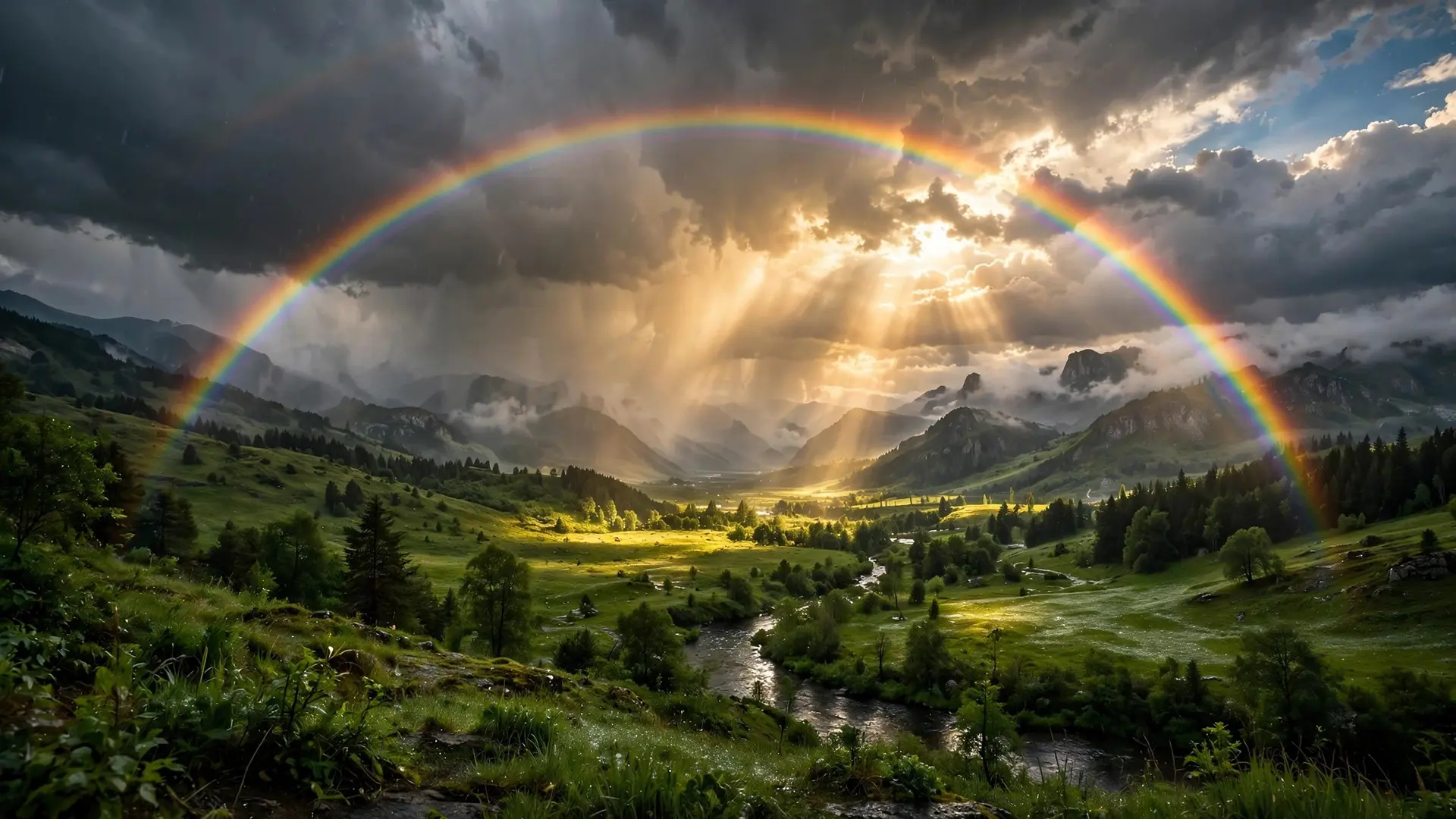
Compare this with their more famous cousin, the rainbow. Both are sunlight sorted by color, but a rainbow is made by liquid water droplets bending light back toward the point opposite the sun, while a halo is made by ice bending light around the sun itself. Rainbows put red on the outside; halos put red on the inside. And unlike the aurora — another kind of sky light show, caused by charged particles striking the upper atmosphere — halos need nothing more exotic than cold, high cloud.
Do you need freezing weather to see them?
This is the most common misconception, and the answer is no. Cirrus clouds are made of ice by definition: they float several kilometers up, where the air is far below freezing no matter what the thermometer says on the ground. NASA notes that sun dogs can appear anywhere in the world, at any time of year, regardless of surface temperature — a beachgoer in the tropics can see one just as easily as a researcher in Antarctica, as long as thin cirrus veils the sun. Winter does help, though. The sun stays low, which favors bright sun dogs, and the air often holds more ice. The most spectacular displays happen in cold, high, mountainous regions, where microscopic ice crystals called diamond dust can hang in the freezing air near the ground itself, turning the whole sky into a hall of prisms. One piece of folklore survives with some physics behind it: halos can herald a change in the weather. Thin cirrostratus often arrives ahead of a warm front, so a halo around the sun sometimes means rain is on the way within a day or so. It is not a promise — just the sky's way of showing you the leading edge of a storm system, written in ice. Next time you spot that pale ring or those twin mock suns, you are seeing geometry made visible: hexagonal ice, sunlight, and your own eyes lined up at exactly 22 degrees. No two displays are identical, because no two clouds arrange their crystals the same way — but the angle, at least, is always the same. If you enjoyed this, the same physics of bending light explains why rainbows form the way they do, and scattering by much smaller particles is what makes the daytime sky blue.
Frequently asked questions
What is a sun dog?
A bright spot of light beside the sun — the scientific name is parhelion, Greek for 'beside the sun'. It forms when sunlight refracts through flat hexagonal ice crystals floating horizontally in high clouds.
Why are sun dogs red on the inside edge?
Ice bends different wavelengths by slightly different amounts. Red light bends least, so it lands closest to the sun, with green and blue farther out — the reverse of a rainbow's color order.
Can you see a halo around the moon too?
Yes. Lunar halos and moon dogs form exactly the same way when the moon is bright enough. They are fainter than solar halos, but easier to notice against a dark sky.