The Physics Behind Rainbows: Why Sunlight Splits Into Color
A rainbow is not an object but a cone of light aimed at your eye. See how raindrops bend, reflect, and split sunlight — and why each bow spans 42 degrees.
Key takeaways
- Sunlight refracts as it enters a raindrop, reflects once inside it, and refracts again on exit — with water bending each wavelength by a different amount.
- The primary rainbow always appears 42 degrees from the antisolar point, with red on the outer edge and violet on the inner edge.
- A secondary bow, from light reflecting twice inside droplets, sits at 51 degrees, looks fainter, and reverses the color order.
- A rainbow is not an object but an angle-dependent pattern; each droplet sends only one color strongly toward your eye.
- Descartes calculated the 42-degree geometry in 1637; Newton explained the colors in 1704 with his theory of light.
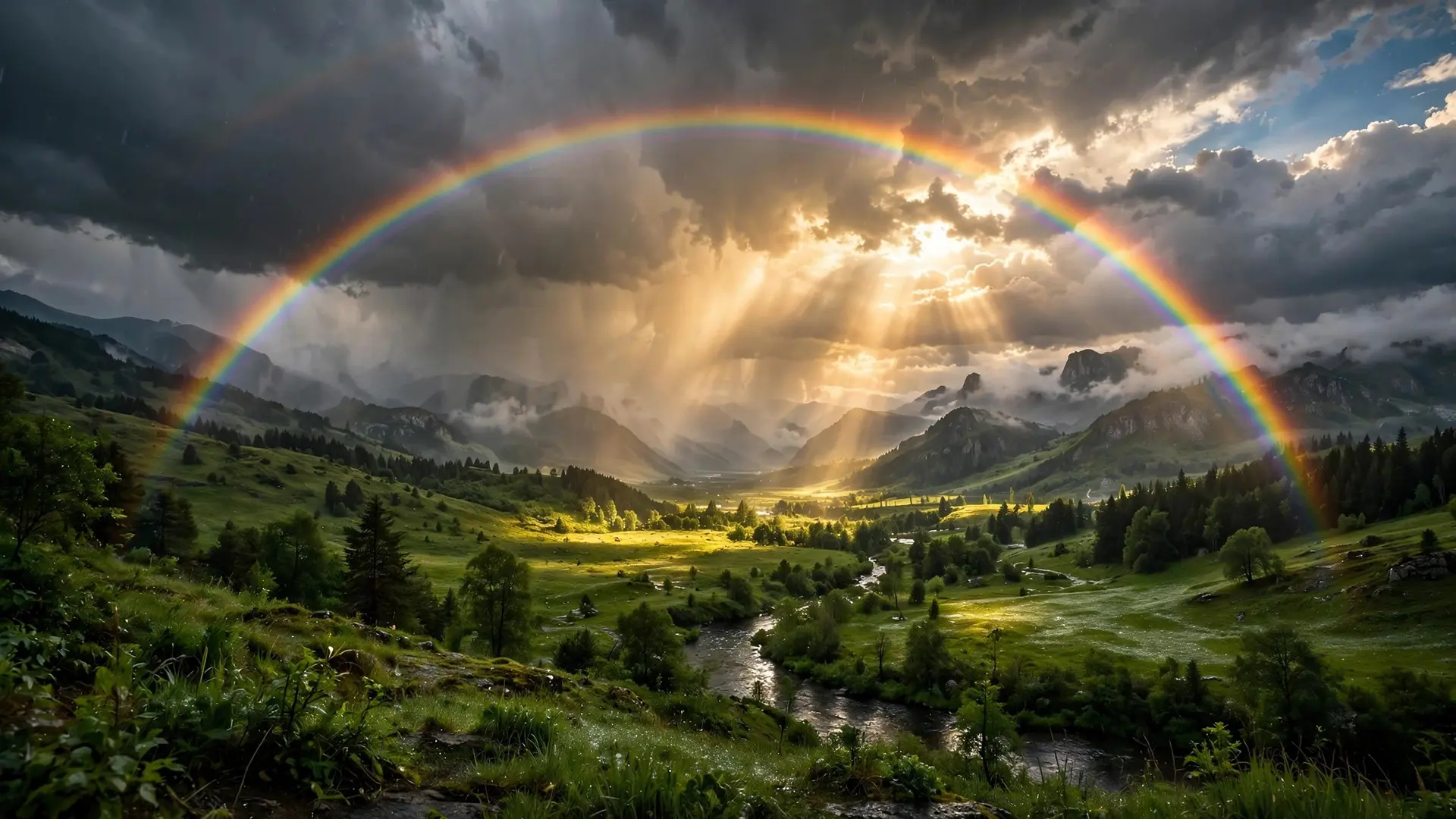
A rainbow is not an object hanging in the sky. It is a cone of color aimed at your eye, created when sunlight passes through millions of raindrops, each one bending, reflecting, and splitting the light. Red light always ends up on the outer rim and violet on the inner edge because each color leaves the droplets at a slightly different angle. And every rainbow you will ever see measures exactly 42 degrees from the point in the sky directly opposite the Sun.
What actually happens inside a single raindrop?
Each raindrop is a tiny, almost perfectly spherical lens, and the full rainbow is the work of millions of them acting in concert. Sunlight strikes a droplet, and on entering, it slows down and bends — this is refraction. Because water's refractive index changes with wavelength (1.331 for red light, 1.342 for violet, according to the OpenStax physics table), the colors already begin to separate as the light crosses the boundary. Violet, the shortest visible wavelength, bends the most; red bends the least. This spreading of white light into its spectrum is called dispersion, and it happens with any wave whose speed depends on its wavelength. The bent, separating light then travels to the back interior surface of the droplet, where it bounces — a single internal reflection — and heads back toward the front surface. It is worth noting that the reflection itself does nothing to separate the colors: the law of reflection is the same for every wavelength. The reflection merely redirects the light. When the light reaches the front surface again, it refracts a second time as it exits into the air, and the colors spread even farther apart. So the recipe for one droplet's contribution is: refract, reflect, refract. Each wavelength emerges from the droplet at a slightly different angle, and across millions of droplets those angles add up to the bands of color we see. The rainbow's hues are a continuous spectrum — we typically name six (red, orange, yellow, green, blue, violet), sometimes seven with indigo, but there are no hard borders between them. Light and water are old partners in the sky: the blue of the daytime sky is another trick of sunlight scattering in the atmosphere.
Why is every rainbow a 42-degree circle?
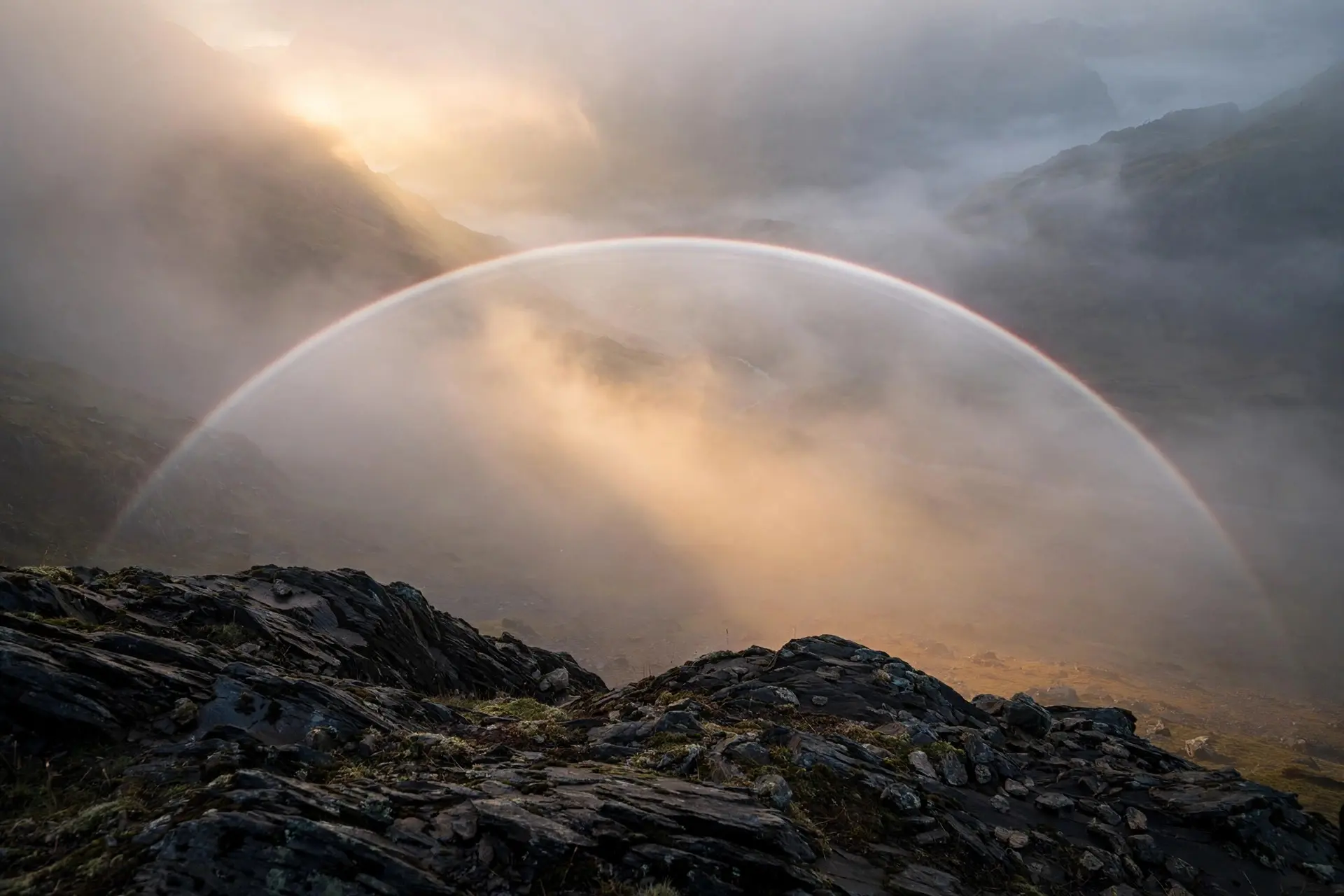
Here is the part most people never learn: the rainbow you see depends entirely on where you stand. The crucial reference point is the antisolar point — the spot in the sky directly opposite the Sun, on a line through your eyes. Primary-rainbow light reaches your eyes from droplets sitting about 42 degrees away from that point. Every droplet at that angle is sending you one particular color strongly: the droplets at 42 degrees from the antisolar point deliver red, and those at a slightly smaller angle deliver violet. That is why the bow is red on the outside and violet on the inside. Because the angle is the same in every direction around the antisolar point, the full rainbow is a complete circle centered on that point. The ground gets in the way — it hides the lower half — so what we usually see is an arc. From a high vantage point, such as an airplane, where nothing blocks the view downward, observers can and do see the entire circle. Move your head and the exact droplets contributing to your view change, yet the bow stays glued to its position relative to the Sun. Your rainbow is literally personal: someone standing beside you is watching a rainbow made from different raindrops. No two observers ever see precisely the same bow. The conditions are strict, which is why rainbows are special occasions rather than everyday sights. The Sun must be behind you, low enough in the sky, and rain must be falling in front of you — you always look away from the Sun to see a rainbow. The effect is most spectacular against a dark, stormy background, which makes the colors pop, and it shows up in garden sprinklers and waterfall mist just as reliably as in rain.
What about double rainbows and the dark band?
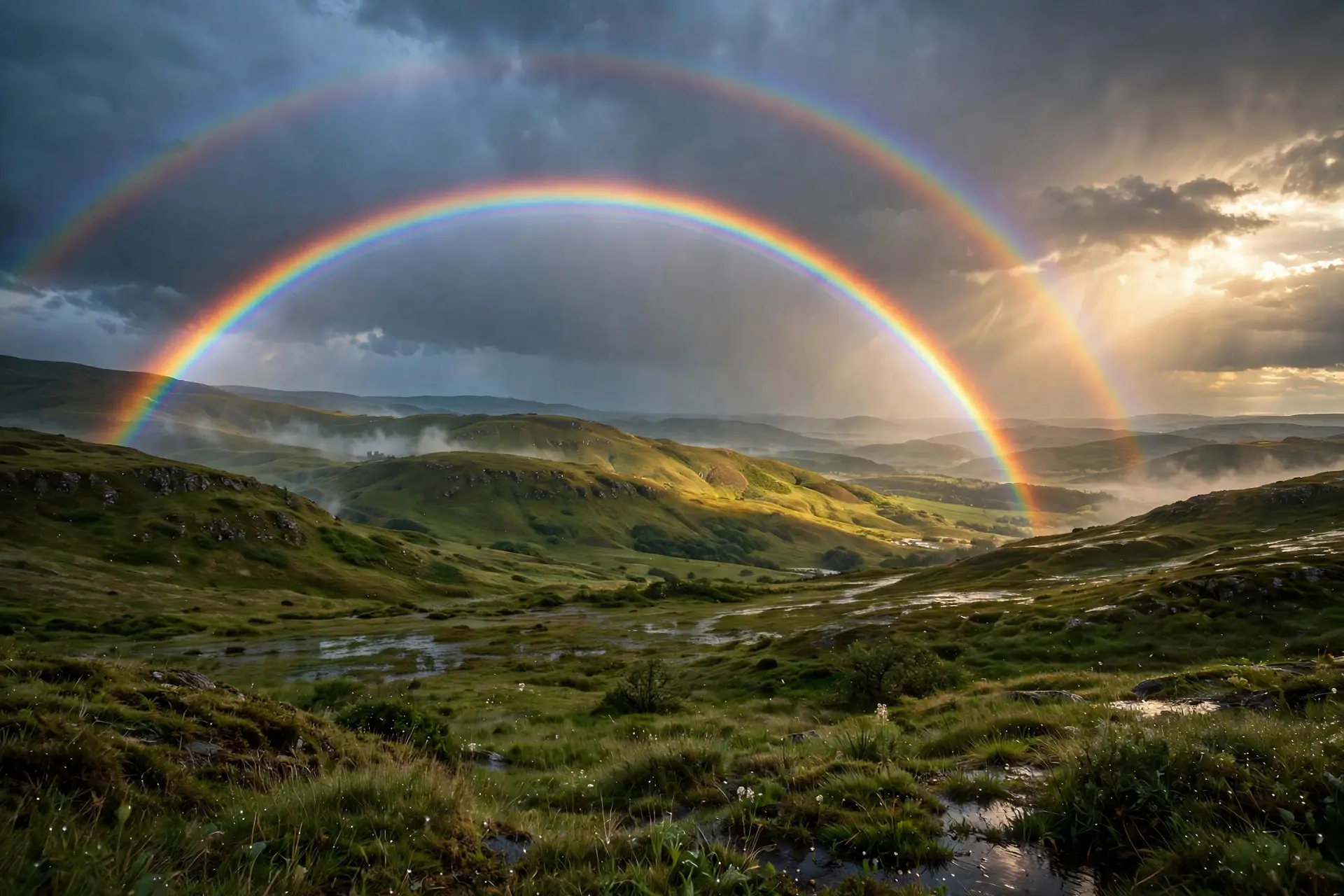
Sometimes a second, fainter bow appears above the primary one, with its colors reversed — violet on the outside, red on the inside. This secondary rainbow comes from light that reflects twice inside each droplet before escaping. The extra bounce costs the light energy, so the secondary bow is dimmer, and the reversed geometry of the double reflection flips the color order. It sits at roughly 51 degrees from the antisolar point.
Between the two bows, careful observers can spot a noticeably darker strip of sky. This is Alexander's dark band, named for Alexander of Aphrodisias, who described it around 200 AD — some eighteen centuries before anyone understood it. The geometry explains it beautifully: the primary bow's light emerges at angles up to about 42 degrees, while the secondary bow's light emerges at angles of about 51 degrees and beyond. No droplet sends light into the zone between, so that slice of sky receives neither bow's brightness. It is a shadow of geometry, visible to anyone who knows where to look. A rainbow is a gentle phenomenon, but the sky holds wilder light shows too. The aurora looks like painted curtains in the night sky, yet its cause is entirely different — charged particles from space striking the upper atmosphere, not sunlight and rain.
How did we figure all of this out?
The rainbow was one of the first natural puzzles to fall to the scientific method, and the story spans cultures and centuries. Aristotle wrote about rainbows in the fourth century BCE without cracking their mechanics. The breakthrough experiments came from Kamal al-Din al-Farisi, a Persian scholar working between 1267 and 1319. Without a microscope to inspect real raindrops, he built an enormous model of one: a large glass vessel filled with water, placed inside a darkened chamber where he could control the light. From the multicolored spectra he observed, he deduced that droplets decompose white light into the colors of the rainbow. In Germany, Theodoric of Freiberg reached similar conclusions with different equipment. Both stood on the shoulders of Ibn al-Haytham, often regarded as the founder of optics and among the first to formalize the scientific method. The geometry fell next. In 1637, René Descartes published a calculation showing that light reflecting inside a spherical drop of water piles up at a maximum angle of about 42 degrees — exactly the rainbow's size — and even explained the dark band. But Descartes could not explain the colors; his model had nothing correct to say about them. That final piece waited for Isaac Newton, whose 1704 book Opticks applied the new idea that the refractive index of water varies with color: smallest for red, largest for violet. With that, the angles of the bow, its color sequence, and the reversed secondary bow all fell out of a single theory. So the next time a storm passes and the light shifts, remember what you are looking at: sunlight that has traveled 150 million kilometers, bent twice and bounced once inside a raindrop, separated into its spectrum, and delivered to exactly one spot in space — the spot where your eyes happen to be. The rainbow is not painted across the sky. It is geometry, water, and light, and it exists only because you are there to see it.
Frequently asked questions
Why is the outside of a rainbow always red?
Red light is bent the least as it leaves the droplets, so it emerges at the widest angle — about 42 degrees — and lands on the outer rim, while violet bends more and lands on the inner edge.
Why do two people see different rainbows?
Each observer's rainbow is a personal cone of light centered on their own antisolar point. The droplets feeding your rainbow are not the same ones feeding the person standing next to you.
Can you reach the end of a rainbow?
No. It is a geometric pattern, not a physical object fixed in space, so it moves with you and has no end you could ever stand beneath.