Why the Sun Is White, Not Yellow: the Truth About Its Color
Why is the sun white not yellow? Above Earth's atmosphere it shines white, but Rayleigh scattering strips blue light away, so it looks yellow from Earth.
Key takeaways
- The Sun emits white light: a mix of nearly every visible color that peaks in yellow-green, confirmed by solar spectra from the McMath-Pierce Solar Observatory.
- Air molecules scatter blue light about nine times more strongly than red light, which is why the sky is blue and the direct solar beam looks yellowish.
- Astronomers call the Sun a G2 'yellow dwarf' from its spectral class, not its true color; its surface runs at 5,780 K (5,507°C / 9,944°F).
- Near the horizon, sunlight crosses far more air, so most blue is scattered away and the Sun glows orange-red at sunset.
The Sun is white. Seen from above Earth's atmosphere, its light mixes every visible color into brilliant white, peaking in yellow-green rather than yellow. From the ground, the air scatters blue light sideways, which is why the sky looks blue and why the leftover beam from the Sun itself looks yellow.
Key facts
- The Sun's effective surface temperature is 5,780 K (5,507°C / 9,944°F), placing it in spectral class G2 on the main sequence (Georgia State University).
- A solar spectrum made at the McMath-Pierce Solar Observatory shows the white-appearing Sun emits nearly every visible color, but is brightest in yellow-green light (NASA Science).
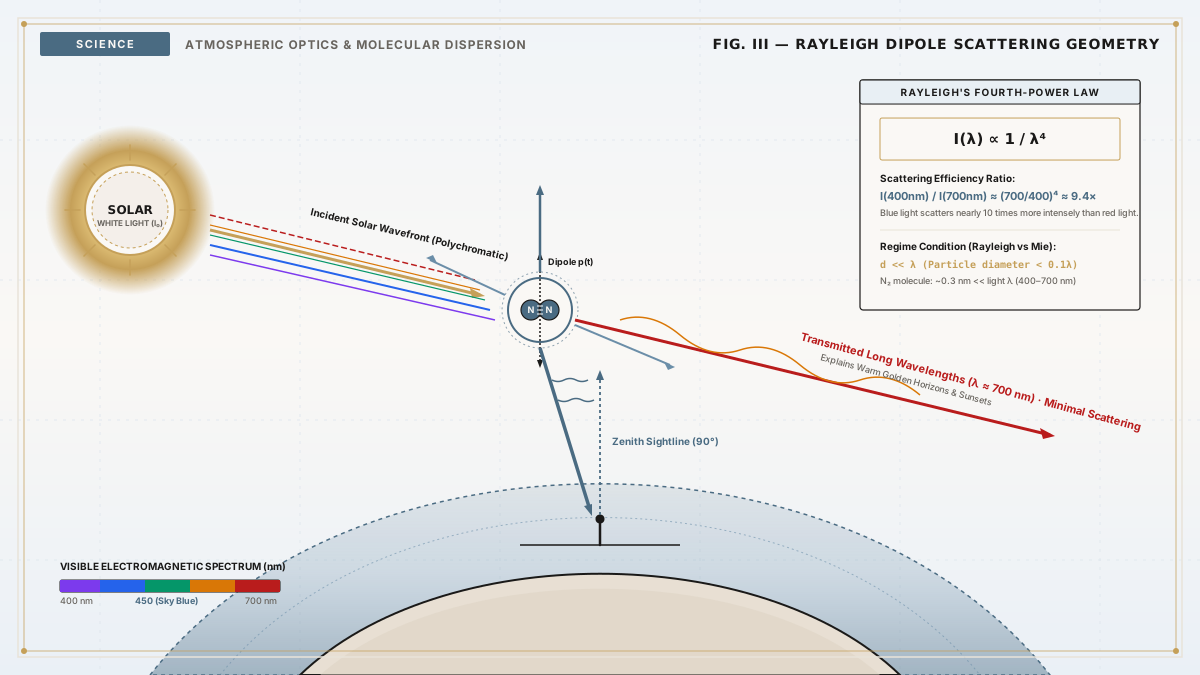
- Blue light at 400 nm is scattered roughly 9 times more strongly than red light at 700 nm, because Rayleigh scattering strength rises as 1/wavelength^4 (NASA Goddard).
- For every ten violet photons scattered out of a sunlight beam, only about one red photon is scattered, so the transmitted beam warms in color (Stanford Solar Center).
- At sunrise and sunset, sunlight must cross far more atmosphere than at noon, so the longer path strips out the shorter blue wavelengths and leaves orange and red (NASA Earth Observatory).
Why does the Sun look yellow from Earth?
Because Earth's air edits sunlight before it reaches your eyes. The atmosphere is mostly nitrogen and oxygen, and these molecules are far smaller than a wavelength of visible light. When sunlight passes through, the molecules scatter the shorter wavelengths much more efficiently than the longer ones. This is Rayleigh scattering, named for Lord Rayleigh, who worked out the mathematics in the 1870s, and its defining rule is simple: scattering strength climbs as one over the wavelength to the fourth power. Two things follow from that lopsided scattering, and they are really one effect seen from two directions. The blue light bounces sideways into every part of the sky, so the sky itself glows blue. Meanwhile, the beam that continues straight from the Sun to your eye has lost a fraction of its blue. What remains is slightly biased toward the warmer wavelengths, and your visual system reads the mixture as yellowish. The Stanford Solar Center puts the numbers on it plainly: for every ten violet photons scattered out of a sunlight beam, only about one red photon is scattered, and red, orange and yellow cross the atmosphere more readily than blue.
There is a second, subtler reason the Sun looks yellow, and it lives in your head rather than the sky. Human color vision constantly recalibrates: the brain sets its idea of "white" against the ambient light of the scene. Against a huge dome of scattered blue, your visual system shifts its white point, which makes the bright solar disk read as yellow by contrast. Strictly speaking, color is a physiological experience, and the same beam of light can look different depending on what surrounds it.
What color is the Sun when seen from space?
White. Above the atmosphere there is no shell of air to steal the blue, so the full mixture of wavelengths arrives at the eye unfiltered, and the mixture looks white. NASA's Astronomy Picture of the Day describes it as "our white-appearing Sun," and the evidence comes straight from a prism. When sunlight is passed through a prism-like device, as was done at the McMath-Pierce Solar Observatory, the spectrum shows light of nearly every color with dark absorption lines where gases above the Sun's surface absorb specific wavelengths. The overall blend is white, brightest in yellow-green. That same spectrum taught us what the Sun is made of: helium was first identified in 1870 in a solar spectrum, decades before it was found on Earth. Never try to check this with your own eyes. The Sun is dangerously bright from Earth, from orbit, or from anywhere else, and you should never look directly at it without certified solar protection. The question of its color is about physics and perception, not an invitation to stare.
Why do astronomers call it a "yellow dwarf" if it is white?
The nickname comes from classification, not from looking at it. Stars are sorted by spectral class, a sequence running from hot blue O stars through B, A, F, G and K stars down to cool red M dwarfs. The Sun sits in class G2 on the main sequence, and G stars have traditionally been described as "yellow" because their radiation peaks near the yellow-green part of the spectrum. "Yellow dwarf" marks the Sun's temperature and its life stage, a middle-aged main-sequence star, not the color of its light as a human eye sees it. This is also why so many pictures of the Sun look yellow, orange, or red even though the underlying light is white. Solar telescopes such as NASA's Solar Dynamics Observatory observe in narrow ultraviolet bands the eye cannot see at all, and the golds, teals and reds in those images are false colors assigned to specific wavelengths of ionized iron or helium so scientists can track different layers of the solar atmosphere. The familiar yellow Sun in textbooks is partly convention and partly instrumentation, layered on top of the atmosphere's own tinting.
Why does the Sun turn orange and red at sunset?
At noon the Sun's light takes the shortest possible route through the air, so only a little blue is scattered away and the disk can look nearly white even from the ground. Near the horizon the geometry changes completely. Sunlight must slice through the greatest thickness of atmosphere, and the longer path gives scattering far more chances to work. First the blue is depleted, then the green and yellow thin out, until only the longest wavelengths survive the trip. That is why the low Sun glows orange and red, and it is the same physics behind orange sunsets and phenomena like the green flash at the Sun's upper edge. Dust, smoke, sea salt and pollution complicate the picture further, since larger particles scatter light more evenly across colors than air molecules do. That is why sunsets after big volcanic eruptions or during wildfire season burn deeper red: more particles mean more scattering of whatever short wavelengths remain. The Sun itself has not changed color during the day. The filter between the Sun and you has.
What do most people get wrong about the Sun's color?
Most of the confusion comes from treating color as a property of the Sun alone, when it is really a three-way negotiation between the star, the atmosphere, and the eye. Here is how the common claims hold up.
| Claim | Verdict | Why |
|---|---|---|
| The Sun is yellow | Myth | Its light is a white mixture of nearly every visible color; yellow is the atmosphere's tint. |
| "Yellow dwarf" means the Sun looks yellow | Myth | The label comes from spectral class G2 and stellar tradition, not from its observed color. |
| Space photos prove the Sun's color | Myth | Solar telescopes use false colors for invisible ultraviolet wavelengths. |
| The Sun changes color at sunset | Myth | The star is steady; the longer path through the air removes the blue. |
| Cameras show the Sun's true color | Half true | Cameras record the yellowish beam faithfully, but the beam is already filtered by the air. |
| The Sun's spectrum peaks in yellow | Myth | The spectrum is brightest in yellow-green, and the blended result is white. |
| The deeper point is that there is no single "true" color of the Sun independent of an observer. Above the atmosphere it is white, from the ground at noon it is near-white with a warm cast, at sunset it is orange-red, and none of those views is the star lying to you. Each one is an honest report of what the light looked like after its 150-million-kilometer journey, including the last hundred kilometers through Earth's air. | ||
| So the next time you see the familiar yellow disk in a child's drawing, smile at it. It is not the color of the star. It is a portrait of our atmosphere, drawn in sunlight, with the blue stolen out and painted across the sky instead. Like rainbows, it is sunlight and air and geometry conspiring to make something more interesting than either could manage alone. | ||
| How we made this article: FactSpire researched and drafted it with AI assistance and checked every fact against the sources listed above. |
Frequently asked questions
Is the Sun actually yellow or white?
White. The Sun emits a mix of nearly every visible color, brightest in the yellow-green band, and that mixture reads as white to human eyes. The yellow tint is added by Earth's atmosphere, which scatters the shorter blue wavelengths out of the direct beam before it reaches the ground.
Why do observers above the atmosphere see a white Sun?
With no air in the way, nothing scatters the blue light sideways, so the full mix of wavelengths arrives unfiltered and looks white. Down on Earth, nitrogen and oxygen molecules strip the short blue wavelengths out of the beam and spread them across the sky, leaving the light that reaches your eyes warmer and yellowish.
Why does the Sun look red at sunset?
Near the horizon, sunlight travels through the greatest thickness of air, and the long path scatters away almost all the blue, then much of the green and yellow. The longer orange and red wavelengths survive the trip, so the low Sun and the clouds around it glow orange and red.
If the Sun is white, why is it called a yellow dwarf?
"Yellow dwarf" is a nickname from stellar classification, not a color measurement. The Sun sits in spectral class G2 on the main sequence, and G stars are traditionally described as yellow. The label marks its temperature and life stage, while direct measurements of its light show a white mixture peaking in yellow-green.
Sources
- Stanford SOLAR Center -- Ask A Solar Physicist FAQs - Answer, Stanford University
- APOD: 2015 June 28 - All the Colors of the Sun - NASA Science, NASA Science
- Rayleigh Scattering, NASA Goddard Space Flight Center
- Crepuscular Rays and Light Scattering - NASA Science, NASA Earth Observatory
- The Sun, Georgia State University