Why Does the Dark Side of a Crescent Moon Glow at Night?
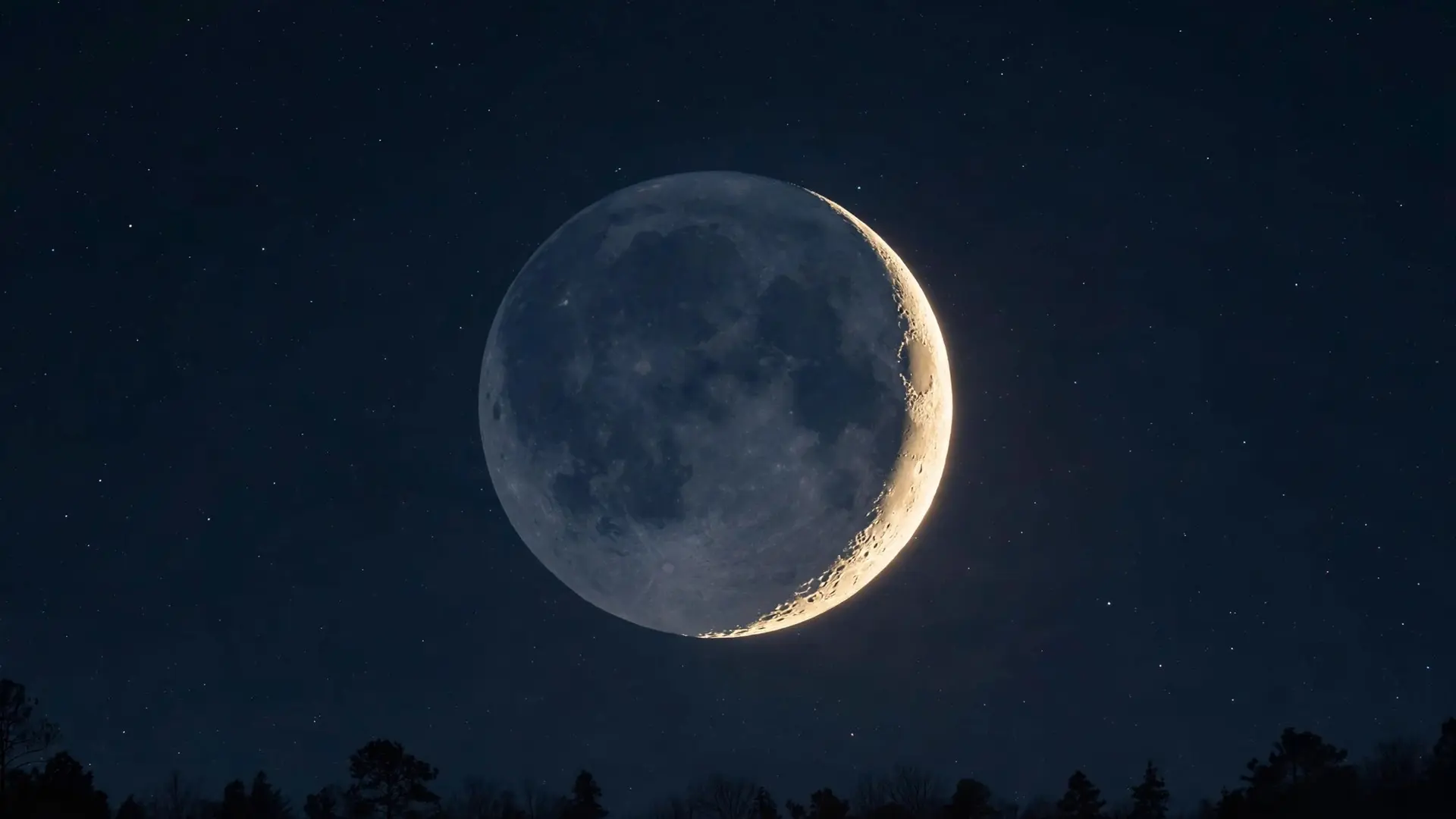
Why does the dark side of a crescent moon glow? Earthshine is sunlight reflected off Earth onto the Moon's night side, first explained by da Vinci.
Key takeaways
- The dark side's glow is earthshine: sunlight reflected off Earth onto the Moon's night side, then reflected back to our eyes in a double bounce.
- It shows best a few days before and after the new Moon, and runs about 10 percent brighter than average in the spring months.
- Leonardo da Vinci first explained the glow in the early 1500s, correctly blaming reflected earthlight but wrongly crediting Earth's oceans instead of its clouds.
- Scientists have measured earthshine continuously since 1997 because its brightness tracks Earth's cloudiness and reflectivity over time.
The dark side is lit by earthshine: sunlight that bounces off Earth's clouds and surface, reaches the Moon, and reflects back to your eyes. The surprise is that the glow's brightness tracks Earth's cloud cover, so astronomers use the Moon as a giant mirror to measure our planet's changing reflectivity.
- The bright crescent receives direct sunlight; the dark face is lit only by light reflected off Earth first, a double bounce from Sun to Earth to Moon to Earth (NASA Science).
- Earthshine is easiest to see a few days before and after the new Moon, when Earth appears nearly full from the Moon and the reflected light is strongest (NASA Science, NASA APOD).
- The glow runs about 10 percent brighter than average in the spring months, when Northern Hemisphere snow and ice are still on the ground (NASA Science, Live Science).
- Scientists from the New Jersey Institute of Technology and Caltech have measured earthshine since the 1980s, and continuously since 1997, because its brightness depends on Earth's total reflectivity (NASA Science).
- Leonardo da Vinci explained the glow in the early 1500s in his notebooks, correctly blaming reflected earthlight but wrongly crediting the oceans; clouds reflect about 50 percent of sunlight, oceans only about 10 percent (American Astronomical Society).
Where does the light on the dark side actually come from?
Start with the geometry. A new Moon happens when the Moon sits roughly between Earth and the Sun, so the side facing us gets almost no direct sunlight. But while our view of the Moon is dark, the view from the Moon is anything but: an observer standing on the lunar surface at that moment would look up and see Earth hanging in the sky nearly full, blazing with reflected sunlight. That light falls onto the Moon's night side, and a fraction of it bounces back toward Earth. That is the faint, ghostly disk you can sometimes make out cradling the bright crescent. The Moon itself produces no light: like every other solid world in the solar system, it shines only by reflection. The bright sliver is direct sunshine; the dim remainder is sunshine that has already survived two reflections, first off Earth and then off the gray lunar surface. Each bounce costs most of the light, which is why earthshine looks like a pale echo of a full Moon. It is also why the glow only shows when the crescent is slim: a nearly full Moon floods the sky with so much direct light that the faint reflection is washed out.
Folklore gave the effect lovely names. A waxing crescent cradling its ghostly disk is "the old Moon in the new Moon's arms," while a waning crescent earns "the new Moon in the old Moon's arms." Astronomers also call it earthlight, and sometimes the da Vinci glow, after the first person known to explain it.
Who first explained it, and what did they get wrong?
Leonardo da Vinci sketched the Moon's ashen glow in the early 1500s and reasoned out its cause at a time when most educated people still believed the Sun, Moon and planets all orbited Earth. His notebooks, including the 72-page Codex Leicester, argue that the glow between the horns of the new Moon is sunlight reflected off Earth onto the Moon. He wrote that the idea the Moon has light of its own "is false," arguing the glimmer came from Earth's oceans and inland seas, then catching the Sun. He was right about the mechanism and wrong about the mirror. Da Vinci assumed the oceans did the reflecting, but modern measurements show clouds do the heavy lifting: clouds reflect about 50 percent of incoming sunlight, oceans only about 10 percent, and land somewhere between 10 and 25 percent. Ice and snow reflect 40 to 90 percent but cover far less area than clouds. So the glow you see is mostly a portrait of Earth's cloud decks.
When is earthshine at its brightest?
Timing matters on two scales. Night to night, the glow is strongest around the new Moon, for a few days before and after, because that is when Earth looks fullest from the Moon. Look after dusk in the western sky for a waxing crescent, or before dawn in the eastern sky for a waning one. A dark sky away from city lights helps; binoculars or a small telescope make the ghostly disk unmistakable. Season to season, the glow peaks in the spring. NASA's Earth Observatory notes that earthshine is brightest between April and June. The reason is reflectivity: in the Northern Hemisphere spring, winter snow and ice still blanket the high latitudes, and snow and ice throw back far more light than vegetation or open water. There is a second, smaller peak in the Southern Hemisphere spring. During those months the reflected light runs about 10 percent brighter than average. In winter the Arctic gets little sunlight to reflect at all, so the glow dims even though the nights are long. If you have ever struggled to see it, the season may be the culprit. A slim May crescent in a dark sky is the classic setup, and it is no coincidence that the phenomenon's modern nicknames keep company with spring stargazing guides.
How do scientists use the glow to study Earth's climate?
Here the ghostly light turns into a working instrument. The brightness of earthshine depends on Earth's total reflectivity, its albedo, and that albedo is governed mainly by clouds: the cloudier the planet, the brighter the glow. By watching the Moon, scientists can watch Earth's energy budget shift from year to year without leaving the ground.
Researchers from the New Jersey Institute of Technology and the California Institute of Technology have been measuring earthshine since the 1980s, and continuously since 1997. Comparing their measurements with NASA's global cloud-cover data, they confirmed the cloud link and reconstructed two decades of reflectivity change. Their early results showed the planet growing sunnier and less cloudy from 1984 to 2000, then cloudier again from 2001 to 2003, brightening the albedo back toward pre-1995 levels. Albedo decides how much solar energy Earth absorbs, so these numbers feed directly into climate models. The record has also delivered a warning. Scientists at the Big Bear Solar Observatory in California report that as oceans warm, the amount of low cloud over the eastern Pacific is shrinking, slightly reducing Earth's reflectiveness and therefore the intensity of the glow. The da Vinci glow, in other words, is quietly dimming. Astronomers have generalized the idea to "planetshine," using Saturn's reflected light to reveal some of its moons, and studying Earth's vegetation tint as a possible biomarker for life on distant worlds. The Moon is, among other things, a mirror pointed at home.
What do most people get wrong about the dark side's glow?
| The myth | The reality |
|---|---|
| You are seeing the far side of the Moon. | The far side never faces Earth. The glow sits on the night half of the near side, the face we always see. |
| The Moon makes its own faint light. | The Moon produces no light at all. The glow is sunlight that has bounced twice: off Earth, then off the Moon. |
| Da Vinci explained it perfectly. | He nailed the cause but blamed the oceans. Clouds, reflecting about 50 percent of sunlight versus the oceans' 10 percent, are the real mirror. |
| It looks the same all year. | It peaks in spring (April to June), running roughly 10 percent brighter than average, and dims when the Arctic goes dark in winter. |
| One more misconception: the idea that earthshine is too faint to matter. Astronaut Michael Collins, approaching the Moon with Apollo 11 in July 1969, reported that "The Earthshine coming through the window is so bright you can read a book by it." No one has yet stood on the lunar surface during its night to experience that earthlit darkness from the ground, but the view from orbit suggests it is anything but dark. | |
| The next time a slim crescent hangs in the evening sky, look past the bright sliver. The faint disk beside it is not an illusion and not the far side. It is a lunar rainbow's quieter cousin: sunlight that left the Sun, touched Earth's clouds, crossed to the Moon and came back to find you. For all its faintness, that light carries a live reading of our planet's weather, which is more than most moonlight ever manages. The glow is unrelated to why the Moon looks bigger near the horizon, a separate trick of perception, and a reminder that the Moon shapes our world in more ways than light: its gravity also drives the ocean tides. | |
| How we made this article: FactSpire researched and drafted it with AI assistance and checked every fact against the sources listed above. |
Frequently asked questions
Is the glowing dark side the far side of the Moon?
No. The glow sits on the Earth-facing side, on the night portion of the Moon we always see. The far side never faces us at all. What you are seeing is indirect sunlight: light that bounced off Earth, lit up the lunar night, and reflected back toward your eyes.
Why is earthshine brightest in spring?
Earth's reflectivity peaks in the Northern Hemisphere spring, when winter snow and ice still cover high latitudes and reflect far more light than vegetation or open water. NASA notes the glow is roughly 10 percent brighter than average around April and May, with a smaller second peak in the Southern Hemisphere spring.
Did Leonardo da Vinci really explain earthshine?
He did, and remarkably early. In the early 1500s he recorded the Moon's ashen glow in his notebooks and reasoned it was sunlight reflected off Earth onto the Moon. His one error was the source: he blamed Earth's oceans, but modern measurements show clouds reflect about 50 percent of sunlight compared with about 10 percent for oceans.
Can I see earthshine with the naked eye?
Yes. Look for a slim crescent a few days before or after the new Moon, in a dark sky away from city lights. After dusk, watch the western sky for a waxing crescent; before dawn, watch the eastern sky for a waning one. Binoculars make the ghostly full disk even clearer.
Sources
- Earthshine, NASA Science
- Earthshine and Climate, NASA Science
- Leonardo Da Vinci and Earthshine, American Astronomical Society
- How to see ghostly 'Da Vinci glow' illuminate the crescent moon this week, Live Science
- APOD: 2021 October 18 - Earthshine Moon over Sicily, NASA Science