What Is a Moonbow, and How Do You See One?
A moonbow is a rainbow lit by the moon instead of the sun. Learn why it glows white, what rare conditions create one, and where to see this ghostly night arc.
Key takeaways
- A moonbow is a rainbow made by moonlight — the same refraction-and-reflection physics inside water droplets as a daytime rainbow.
- It looks white to the human eye because moonlight is too faint to trigger the color-sensing cone cells in our retinas.
- Moonbows need a full moon low in a dark sky plus mist or rain opposite the moon, so they are far rarer than solar rainbows.
- Cumberland Falls in Kentucky is the only place in the Western Hemisphere where a moonbow appears on a predictable schedule.
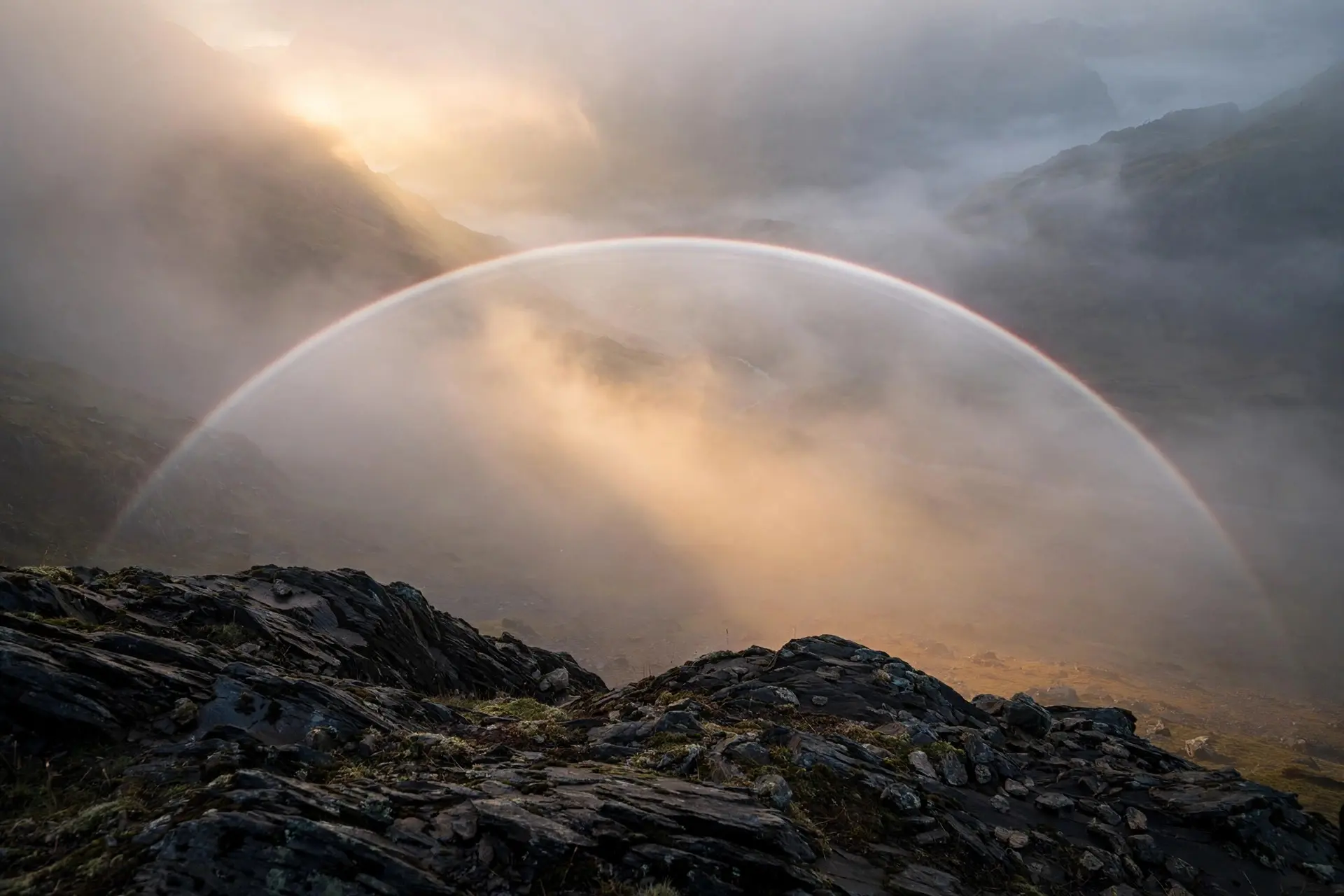
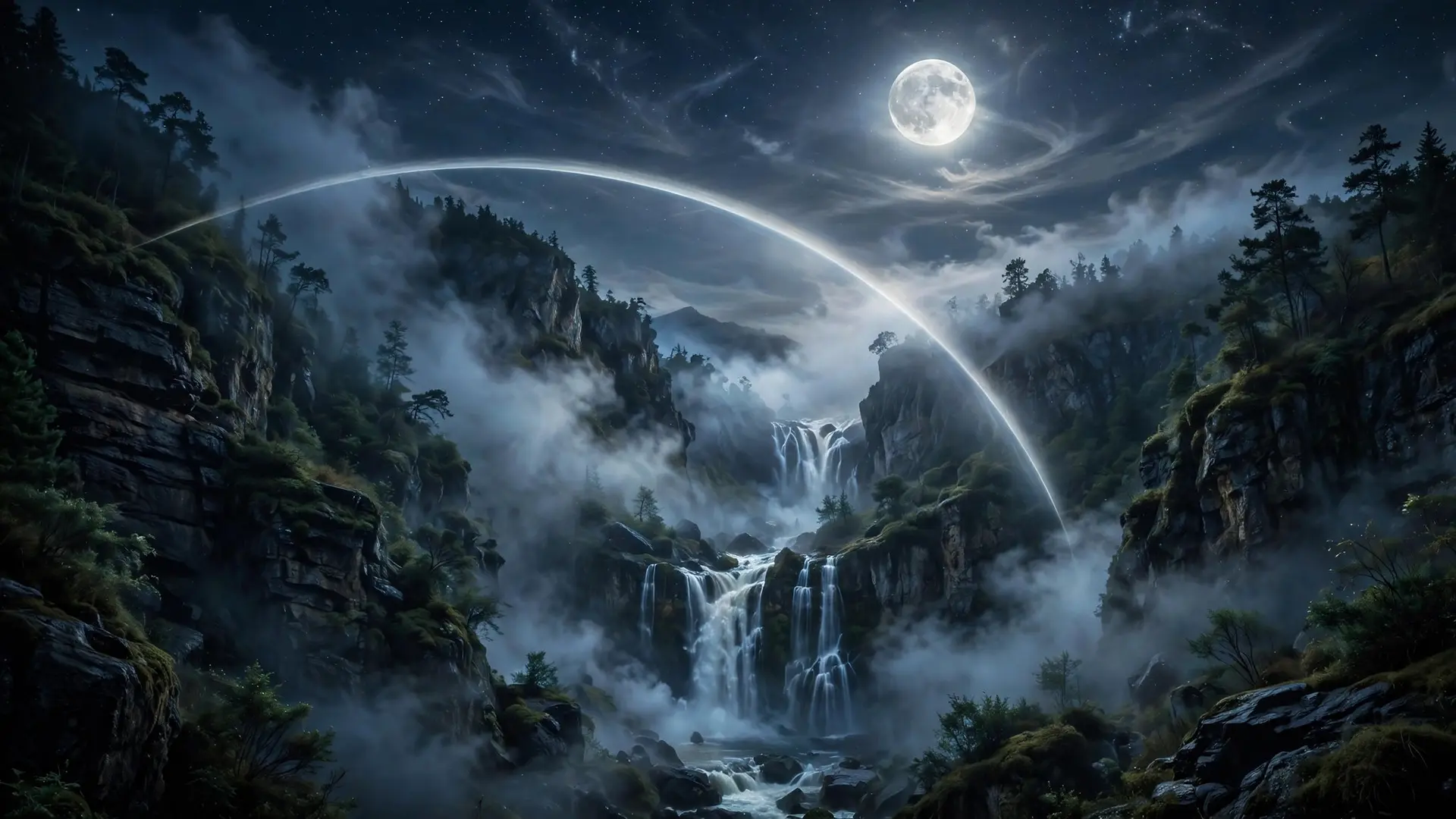
A moonbow is a rainbow made by moonlight instead of sunlight — lunar light bent and reflected inside countless water droplets to paint an arc across the night sky. The physics is identical to a daytime rainbow, but because moonlight is so much fainter, the human eye sees the bow as a ghostly white arch. Cameras, given a long exposure, can coax out its hidden colors.
How does moonlight create a rainbow?
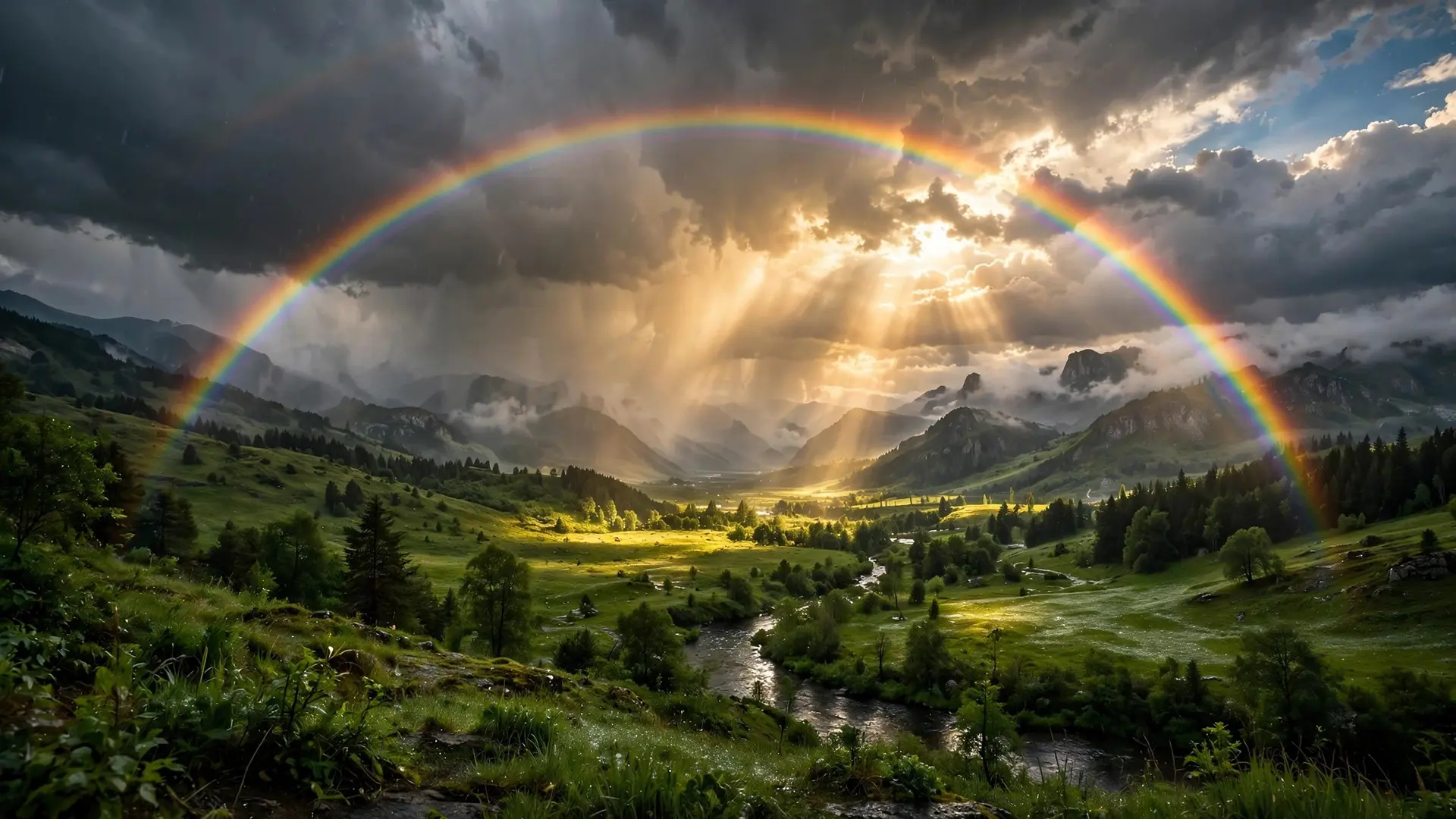
The mechanism is exactly the one behind an ordinary rainbow. A moonbeam enters a water droplet — rain, mist, or waterfall spray — and bends at the surface, a process called refraction. Inside the droplet the light reflects off the back wall, then bends again as it exits. Each droplet acts like a tiny prism, spreading the light into its component colors, and millions of droplets working together draw the familiar arc. Do not confuse this with a lunar halo — the ring sometimes seen around the moon is made by refraction through ice crystals high in the atmosphere, not by droplets. Since moonlight is really reflected sunlight, the palette of a moonbow is nearly the same as the one you see after a sunlit shower. NASA's Astronomy Picture of the Day captured this beautifully on July 4, 2001, when a moonbow arched over Salt Pond Bay in St. John, in the Virgin Islands. A thirty-second exposure was needed to bring the bow out, and the resulting photograph looked almost like it had been taken in daylight. If you want to understand the solar version first, learn how ordinary rainbows form in sunlight — everything that applies to daytime bows applies here, only dimmer.
Why does a moonbow look white instead of colorful?
The short answer is that your eyes are not built for this. Human vision relies on two kinds of sensors: rods, which detect brightness in dim light but see only in shades of gray, and cones, which perceive color but need plenty of light to switch on. Moonlight reflected through droplets is simply too faint to wake the cones, so the rainbow arrives as a pale, silvery arc — the reason moonbows are sometimes called "white rainbows."
A camera has no such limitation. Given a long exposure, its sensor patiently accumulates photons, and the full spectrum emerges: red on the outside of the arc, violet on the inside. That is why almost every striking moonbow photograph you have ever seen glows with color while eyewitnesses describe a white ghost. Both views are honest — they are just recordings made with different instruments.
Why are moonbows so hard to catch?
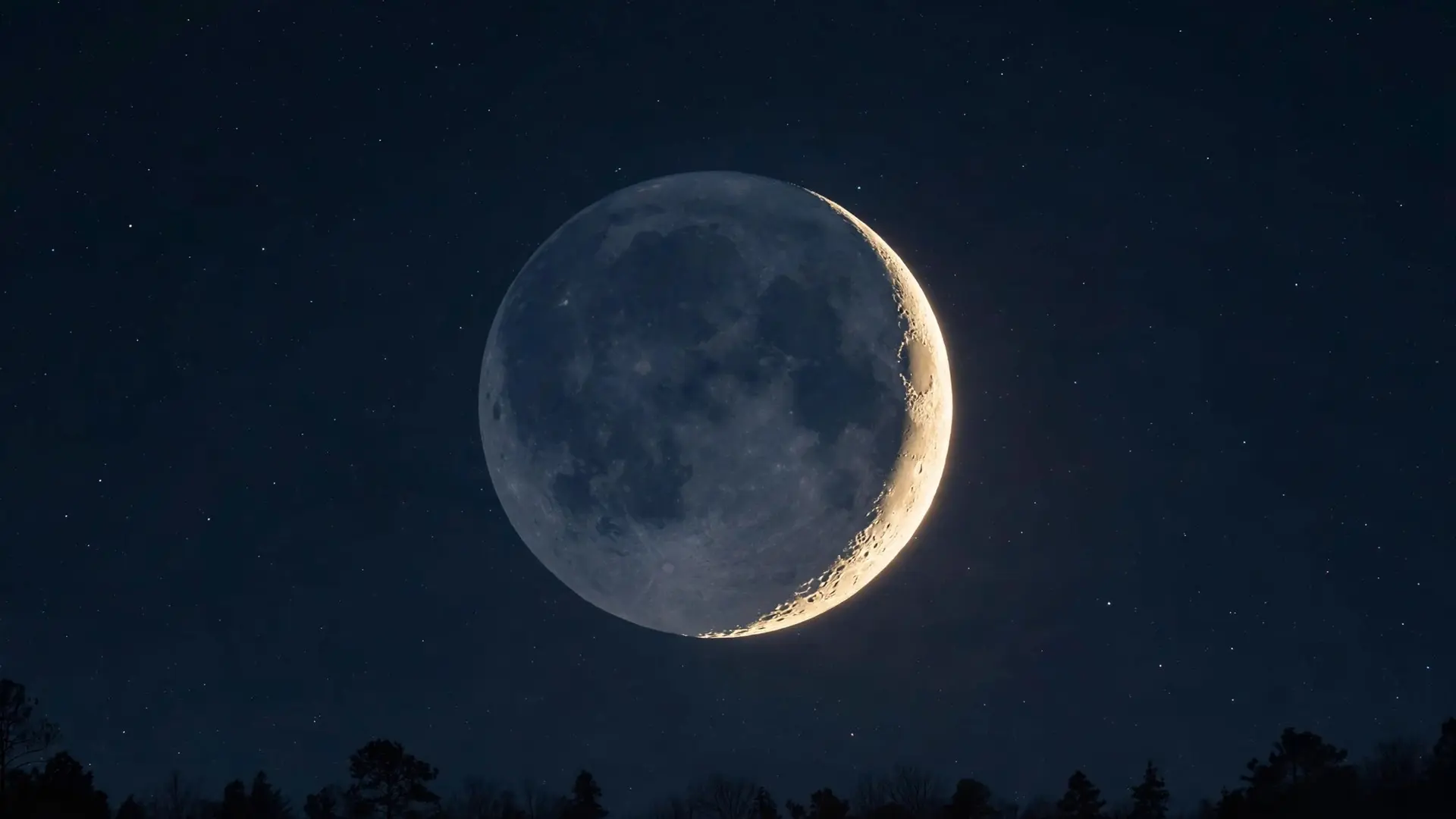
Four separate conditions must align, and that makes a moonbow far rarer than its solar twin. First, the moon needs to be full or nearly so — only then is there enough light to work with. Second, the moon has to ride low — under roughly 42 degrees above the horizon. That is not arbitrary: a rainbow's center always sits at the point directly opposite its light source, so the higher the moon climbs, the lower the bow sinks until it slips beneath the horizon entirely. Third, the sky must be genuinely dark, and that requirement quietly eliminates most nights. A rising full moon arrives while the sky is still bright with dusk, so observers often need to wait until a few hours after sunset — or rise a few hours before sunrise — when darkness has fully settled in. Finally, there must be water droplets opposite the moon: rain falling away from you or, even better, a permanent curtain of waterfall mist. This combination is so demanding that people have been writing about it for millennia. Aristotle described moonbows in his Meteorology around 350 BCE, and they have been a subject of fascination — and sometimes frustration — ever since.
Where in the world can you see one?
Rainshower moonbows can technically appear anywhere, but they are fleeting, sometimes lasting only ten to thirty minutes and occurring just a handful of times a year at any given spot. For something you can actually plan a trip around, there are only two reliably predictable venues on Earth: Cumberland Falls in Kentucky and Victoria Falls on the Zambia–Zimbabwe border.
Cumberland Falls is the standout in the Western Hemisphere — the only place there where a moonbow appears on a schedule. The falls pour a 125-foot-wide curtain of water down a 68-foot drop, earning the nickname "Niagara of the South," and the gorge sits at just the right angle: the falls face north, which lets low moonlight strike the rising mist perfectly. When the conditions click, the bow appears for roughly two nights on either side of the full moon, strongest between dusk and midnight, and the state park publishes an annual moonbow calendar so visitors can plan. Victoria Falls offers the same reliability at a grander scale, with its enormous plume of spray rising hundreds of meters into the air. Other promising sites include Yosemite's waterfalls in late spring, the town of Waimea on Kauai — nicknamed "the town that sees moonbows" — and Croatia's Plitvice Lakes.
How can you see a moonbow yourself?
Start with the calendar. Check a moonbow schedule — Kentucky State Parks publishes one each year for Cumberland Falls, with the 2026 season including the nights of October 24 through 28 — and plan your visit within two days of the full moon. Then watch the weather: you need a clear sky and, at a waterfall, a healthy river, since thicker mist makes a brighter bow. Dark-sky sites are worth the drive, because stray light will wash out something this delicate. When the night comes, give yourself an edge. Arrive at the overlook well before the predicted window and spend ten to twenty minutes letting your eyes fully adapt to the dark. Keep your phone in your pocket and use a red flashlight — every flash of white light costs you and everyone around you their night vision. Stand with the moon at your back and look toward the mist opposite it. Bring a tripod and a camera capable of long exposures; a thirty-second shot can reveal the colors your eyes will never see. And even if the bow refuses to appear, you will have spent the night under a full moon in some of the darkest scenery in the country. Like the aurora or the glow of noctilucent clouds, the chase itself is part of the reward. Moonbows remind us that the night sky is not simply the day sky with the lights off. It has its own rainbows, its own rules, and its own quiet patience — a pale arc drawn by reflected sunlight, visible only to those willing to stand in the dark and wait.
Frequently asked questions
Can you see a moonbow with your naked eye?
Yes, under the right conditions — but expect a ghostly white arc, not a colorful band. The colors only show up in long-exposure photographs because camera sensors can collect faint light over time.
What is the best time to look for a moonbow?
Go within about two nights of a full moon, after the sky is fully dark, and look at mist or rain opposite the moon. The moon itself must be low in the sky, ideally below 42 degrees above the horizon.
Are moonbows mentioned anywhere in history?
Yes — Aristotle described moonbows in his Meteorology around 350 BCE, making them one of the oldest recorded atmospheric optics phenomena.
Is a moonbow the same as a lunar halo?
No. A moonbow is formed by refraction in liquid water droplets, while a lunar halo is made by refraction through ice crystals high in the atmosphere.