Why Is Büsingen a German Exclave Inside Switzerland?
Büsingen is German land entirely surrounded by Switzerland, where people pay in Swiss francs and voted 96% to leave Germany. Why is it still German?
Key takeaways
- Büsingen is a German municipality of about 1,450 people, entirely surrounded by Switzerland.
- The rest of Germany is only 680 m (2,230 ft) away at the narrowest point, across a strip of Swiss land.
- In a 1918 referendum, 96% of voters chose to join Switzerland, but no land exchange could be agreed.
- Since October 1967 the village has sat inside the Swiss customs area, with no border controls.
- Residents pay in Swiss francs, use two postcodes, and hold the rarest German license plate, BÜS.
Büsingen is a German municipality of about 1,450 people entirely surrounded by Switzerland. It stayed German because of a 1693 kidnapping that angered Austria, and in 1918, 96% of its people voted to join Switzerland, but no land swap could be agreed, so it remains a German exclave inside Switzerland.
- Büsingen is a German municipality of about 1,450 people, surrounded on every side by Switzerland. WorldAtlas
- The rest of Germany is only 680 m (2,230 ft) away at the narrowest point, across a strip of Swiss land holding the village of Dörflingen. Jana Meerman
- In a referendum held after the First World War in 1918, 96% of Büsingen's voters chose to become part of Switzerland. Jana Meerman
- Since October 1967 there has been no border control between Büsingen and Switzerland, and the village sits inside the Swiss customs area. Jana Meerman
- Residents pay in Swiss francs, use two postcodes, and carry the BÜS license plate, the rarest in Germany, with only about 700 in use. Amusing Planet
How did a German village end up inside Switzerland?
Büsingen's strange position dates to before Germany or Switzerland existed in their modern forms. In the Middle Ages the village was part of the Landgraviate of Nellenburg, which came under Habsburg Austrian control in 1465. From then until 1805 it formed part of Further Austria, a collection of scattered Austrian possessions far from the main empire. The turning point was a family feud. In 1693 the village was under the control of the Austrian feudal lord Eberhard Im Thurn. After an argument with the town's pastor, Eberhard was accused of secretly being a Catholic. His own cousins kidnapped him and handed him over to the Swiss authorities in Schaffhausen. He spent six years in a dungeon before he was returned to Büsingen, physically and mentally battered, and he then converted to Catholicism. The abduction nearly led to war between Austria and Switzerland. A few decades later, when Austria sold its local holdings to the Swiss canton of Zurich, it held on to Büsingen, reportedly just to spite the Swiss. The village ended up completely surrounded by Swiss territory. The Napoleonic Wars then moved it from owner to owner: in 1805, under the Peace of Pressburg, Büsingen became part of the Kingdom of Württemberg, and five years later, in 1810, it passed to the Grand Duchy of Baden. In 1871 Baden, including Büsingen, became part of the German Empire. A village that had started as a feudal footnote had become a German exclave, a piece of Germany entirely enclosed by Switzerland.
Why didn't the 1918 referendum change anything?
The people of Büsingen did try to fix the anomaly. In 1918, after the First World War, a referendum was held in the village, and 96% of voters chose to become part of Switzerland. The result was overwhelming, and Switzerland was willing. But no land transfer took place, because Switzerland could not offer Germany anything suitable in exchange. Germany kept the village, and later attempts to move it to Swiss sovereignty also failed. The Second World War added another strange chapter. In 1945 Büsingen was temporarily assigned to the French occupation zone, although the Swiss objected, saying that no sovereign German government existed with which to negotiate. To keep the village from becoming a haven for Nazi war criminals, a limited number of French soldiers were allowed in to maintain law and order. In 1952 Büsingen officially joined the new state of Baden-Württemberg under the Federal Republic of West Germany. The settlement that finally defined its status came in the 1960s. A formal agreement was reached in 1967, and Büsingen officially entered into a customs union with Switzerland. There has been no border control between the village and Switzerland since October 1967. At the same time, the former German exclave of Verenahof, consisting of just three homes, became part of Switzerland.
What is daily life like in a town with two countries?
Daily life in Büsingen is an exercise in doubling up. Residents pay in Swiss francs, although euros are also accepted. Until the late 1980s, Büsingen did not even accept the Deutsche Mark, and its post office accepted only Swiss francs as payment for German stamps. Most residents work in Switzerland, in nearby Swiss towns, and are paid in Swiss francs. Even the electricity comes from Switzerland, although the wall sockets in homes are standard German ones. The village has two postcodes, D-78266 for Germany and CH-8238 for Switzerland, and two phone prefixes, +49 for Germany and +41 for Switzerland. Deutsche Post delivers there, but several other German delivery services cannot, because they are not allowed to cross the Swiss customs area even to reach a German village. Both German and Swiss police have a presence: there can be three German police officers per 100 inhabitants and a total of ten Swiss officers at any one time. A troublemaker caught in Büsingen may be tried in a German court or a Swiss one, depending on which police force made the arrest. Children go to a local German school, but after primary school parents can choose a German or a Swiss school for secondary education, and many teenagers study across the border. Residents can take out German or Swiss health insurance. The local football team, FC Büsingen, is the only German team to play in the Swiss Football League. Cars carry the BÜS license plate, the rarest in Germany, with only about 700 in use, and the plates are treated as Swiss for customs purposes.
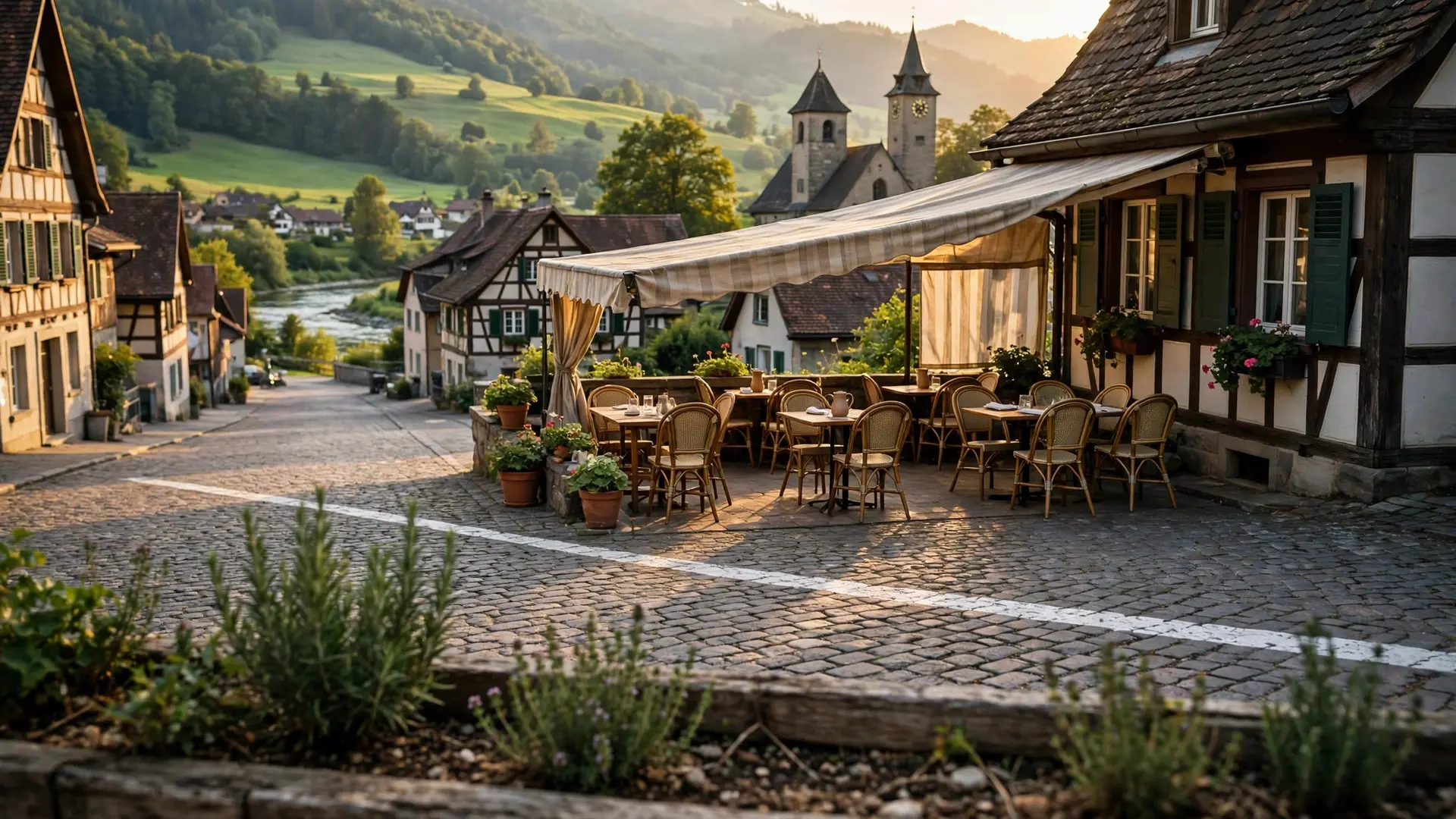
The border itself is almost invisible, and the village plays with that. The Waldheim restaurant sits exactly on the line, with the border painted across its outdoor terrace, so diners can sit in Germany while talking to a dog a few metres away in Switzerland. A marked circular trail, the Enklavenweg, walks visitors around the exclave and explains its status. Swiss flags fly in private gardens, and the village celebrates Switzerland's National Day on August 1. When BBC reporter Larry Bleiberg asked the town's deputy mayor about that, he explained: "Our spirit and heart are Swiss."
What do most people get wrong about Büsingen?
The first mistake is to call Büsingen Swiss. It is not. It is German soil: its people pay German income tax, vote in German elections, and send their children to a German primary school. What is Swiss is the economy. The village sits outside the European Union's customs area and inside Switzerland's, so EU customs rules do not apply there. When residents buy goods in the EU and export them to Büsingen, they can claim back the VAT they paid, and purchases made inside Büsingen carry Swiss VAT, which is lower than German rates. Residents also pay no property tax. The second mistake is to say the 1918 referendum failed. It did not fail; it passed with 96% of the vote. What failed was the land swap that would have put the result into effect. Switzerland had nothing to offer in exchange, and Germany was not willing to give up territory for nothing. A vote can be unanimous and still change nothing when the map has no room for it. The third mistake is to assume the arrangement is a tax trick with no downside. It is not. Because of the tangle of German and Swiss taxation, residents often pay nearly double what their German or Swiss counterparts pay, and the village has the highest average age of residents in the whole state, partly because of the high cost of living. The balance tips the other way for pensioners: in Germany, pensions carry little to no tax, so Büsingen attracts Swiss retirees. Young people tend to move out into Switzerland, and retired people tend to move in. Büsingen is not the only place where borders misbehave. In Baarle, a Belgian-Dutch border runs through houses and the front door decides a building's country. Kaliningrad is a far larger Russian exclave, cut off from Russia by Lithuania and Poland. And Point Roberts is an American exclave that can only be reached by land through Canada. Each one has its own story, but Büsingen is the only one whose people voted almost unanimously to leave, and stayed anyway.
| Year | What happened |
|---|---|
| 1465 | Büsingen's region comes under Habsburg Austrian control |
| 1693 | Feudal lord Eberhard Im Thurn is kidnapped by his own family and held in Schaffhausen |
| 1805 | Büsingen becomes part of the Kingdom of Württemberg |
| 1810 | Büsingen passes to the Grand Duchy of Baden |
| 1871 | Baden, including Büsingen, joins the German Empire |
| 1918 | A referendum sees 96% vote to join Switzerland; no transfer follows |
| 1952 | Büsingen joins the new state of Baden-Württemberg |
| 1967 | Büsingen enters the Swiss customs area; border controls end |
| Büsingen endures because nobody has found a tidier answer. A kidnapping in 1693, a referendum in 1918, and a treaty in 1967 each failed to move it, and the village has made a life out of the result: German by law, Swiss by habit, and content to celebrate both flags. | |
| How we made this article: FactSpire researched and drafted it with AI assistance and checked every fact against the sources listed above. |
Frequently asked questions
Is Büsingen in Germany or Switzerland?
Büsingen is legally German. It belongs to the state of Baden-Württemberg and its people pay German income tax. But it is entirely surrounded by Switzerland, sits inside the Swiss customs area, and daily life runs on Swiss francs, Swiss electricity and Swiss phone networks.
Why did Büsingen vote to join Switzerland in 1918?
After the First World War, Büsingen's people voted 96% in favor of joining Switzerland, the country that already shaped their daily lives. The transfer never happened because Switzerland could not offer Germany any land in exchange, so the village stayed German despite the vote.
Can you visit Büsingen?
Yes. There are no border controls, and you can drive in from Switzerland without noticing the border. The village has a marked circular trail, the Enklavenweg, that explains its unusual status, and a restaurant with the border painted across its terrace.
What currency do they use in Büsingen?
Swiss francs, even though the euro is Germany's currency. The preference goes back decades: until the late 1980s, Büsingen did not even accept the Deutsche Mark. Euros are also accepted in shops, but francs remain the everyday currency.
Sources
- Büsingen am Hochrhein: The Town Torn Between Two Countries, Amusing Planet
- A Guide to the German Exclave of Büsingen am Hochrhein, Jana Meerman
- A brief visit to Switzerland and the German exclave of Büsingen, Northtrotter
- The Municipality Of Büsingen am Hochrhein Where Binationality Is A Way Of Life, WorldAtlas