Why Is Kaliningrad Cut Off From the Rest of Russia?
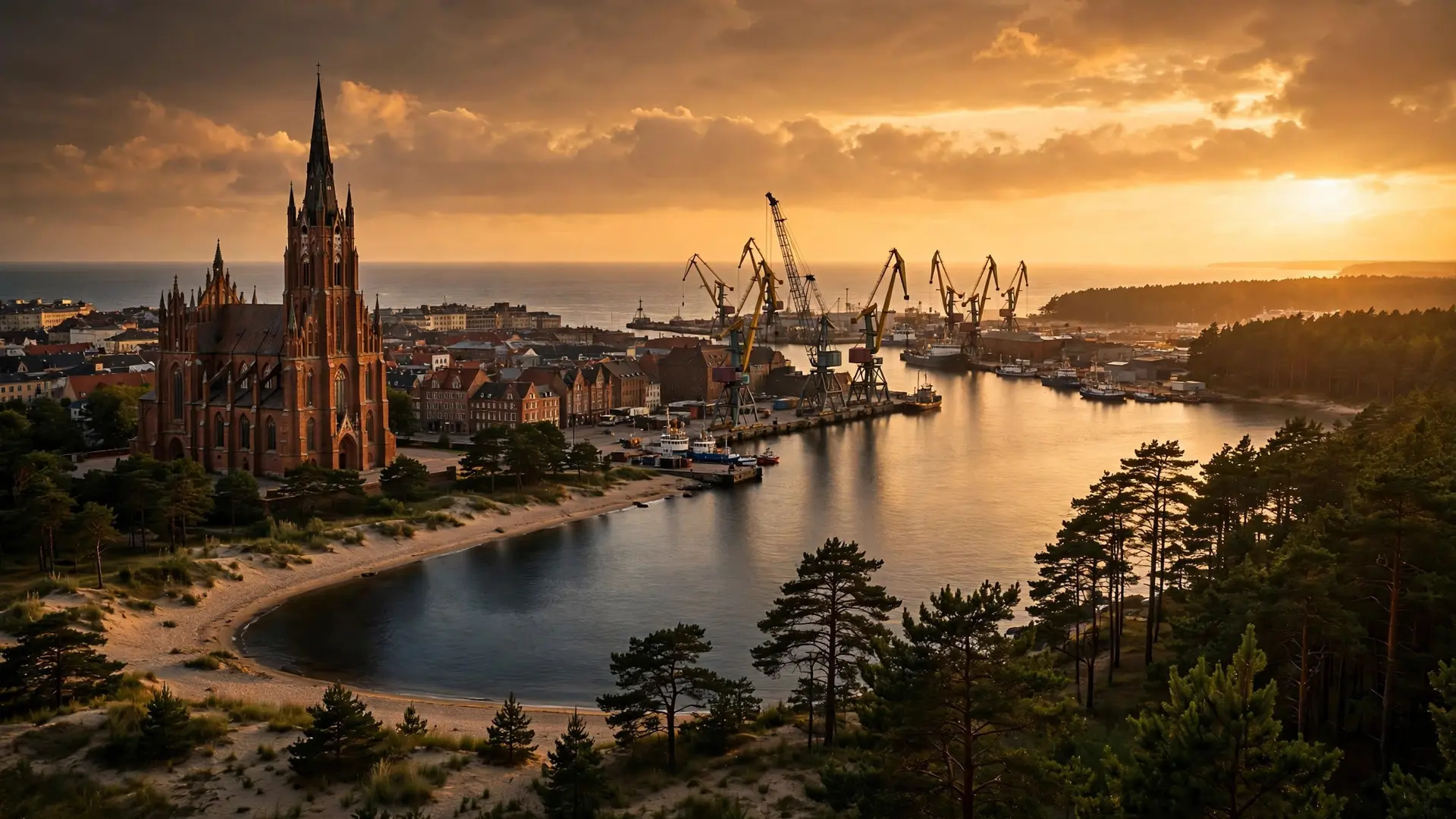
Kaliningrad is a Russian exclave wedged between Poland and Lithuania, with no land border with Russia. It was a German city given to the Soviet Union in 1945.
Key takeaways
- Kaliningrad is a Russian exclave: it borders Poland and Lithuania and the Baltic Sea, but shares no land border with the rest of Russia.
- The city was Königsberg, capital of German East Prussia, until the 1945 Potsdam Conference agreed in principle to transfer it to the Soviet Union.
- It only became cut off in 1991, when Lithuania, Belarus and Latvia became independent and the Soviet Union collapsed around it.
- Kaliningrad matters to Russia as the home of its Baltic Fleet and its only ice-free Baltic port, reached by rail through Lithuania and Belarus.
Look at a map of Europe and one piece of it seems to be in the wrong place. On the Baltic coast, wedged between Poland to the south and Lithuania to the north and east, sits a region of Russia with no land connection to Russia at all. Its capital, Kaliningrad, is a Russian city of roughly a million people in its wider region, and the only way to reach the rest of Russia by land is through two other countries. Kaliningrad is not a mistake on the map. It is a leftover of the Second World War that only became strange when the country that created it ceased to exist. The short answer is that Kaliningrad was not always cut off. It became an exclave in 1991, when the Soviet Union collapsed around it. Everything since — the transit disputes, the military attention, the strategic anxiety — follows from that moment.
What was Kaliningrad before it was Russian?
Before 1945, Kaliningrad was Königsberg, a German city with a history far older than Russia's claim to it. The old town grew up around a fortress built in 1255 by the Teutonic Knights, and it later became the capital of East Prussia. It was a Hanseatic trading city, a Prussian coronation city — Frederick III of Brandenburg crowned himself the first king of Prussia in its castle chapel in 1701 — and the home of the philosopher Immanuel Kant, who was born there in 1724. By the nineteenth century it was Germany's main naval base on the Baltic after Kiel. The Second World War destroyed it. After a two-month siege, the Red Army took the ruined city in April 1945, and the fate of Königsberg and its surrounding region was settled at the Potsdam Conference that summer. The conference's protocol recorded that the Soviet Union's western frontier on the Baltic should run from the Bay of Danzig eastward to the meeting point of Lithuania, Poland and East Prussia, and that the conference had agreed in principle to the transfer of Königsberg and the adjacent area to the Soviet Union. The American and British governments declared they would support the proposal at a forthcoming peace conference.
The language mattered: the transfer was agreed "in principle" and "pending the final determination of territorial questions at the peace settlement." That peace settlement, in the form the Allies imagined in 1945, never arrived. But the facts on the ground did. The northern part of East Prussia became the Kaliningrad region of the Soviet Union, administered as part of the Russian republic. In 1946 the city was renamed Kaliningrad, and in 1947 the remaining German population was evicted and replaced by settlers recruited mainly from Russia and Belarus. The city was closed to foreigners until 1991, and its German past was largely paved over with Soviet apartment blocks, though fragments survived: the ruined cathedral, Kant's grave, and a handful of Gothic churches.
How did it become an exclave?
For more than forty years, none of this looked odd on a map. Kaliningrad was simply the western edge of the Soviet Union, connected to Moscow through the Soviet republics of Lithuania and Belarus. Its separation from the rest of Russia was invisible because there was no border to cross: Lithuania, Belarus and Russia were all parts of one state. The collapse of the Soviet Union changed everything without moving a single border stone. Lithuania, Latvia and Belarus became independent countries in 1991, and Poland, already independent, lay to the south. Suddenly the region that had been the Soviet Union's Baltic corner was a Russian island on land: separated from the rest of Russia by roughly 360 kilometres of Lithuanian, Belarusian and Latvian territory, bordered by Poland and Lithuania, and open only to the Baltic Sea in the west. The exclave was not created by a new decision. It was revealed by the disappearance of the state that had surrounded it. The new neighbours soon joined the institutions that defined the other side of the old Cold War divide. Poland and Lithuania are both members of the European Union and NATO, which means Kaliningrad now sits entirely inside territory belonging to the EU and NATO, except for its coastline. The rail link that carries people and goods between Kaliningrad and the rest of Russia runs through Lithuania and then Belarus, under arrangements negotiated when relations were far warmer than they are now. The gap between Kaliningrad and Belarus, a Russian ally, is the Suwałki Gap: a strip of land between Poland and Lithuania only about 60 miles wide, and the only overland route by which NATO could reinforce the Baltic states from Poland. Both sides watch it closely.
Why does Russia care so much about it?
Kaliningrad's value to Russia is disproportionate to its size, and it explains why a territorial oddity keeps making headlines. It is the home of Russia's Baltic Fleet, and it is Russia's only ice-free port on the Baltic Sea: the ports nearer St Petersburg freeze in winter, while Kaliningrad's harbour, connected by a dredged channel to the naval base at Baltiysk, stays open. Russia has stationed Iskander missiles there, which are capable of carrying nuclear warheads, though Moscow has never confirmed whether any deployed there are nuclear-armed. Western intelligence sources have said openly that the missiles are present.
That combination — a cut-off territory, a fleet base, and advanced missiles — is why a dispute over freight became a crisis in 2022. After Russia's full-scale invasion of Ukraine, Lithuania began applying European Union sanctions to sanctioned goods travelling by rail to Kaliningrad, including some iron and steel products. Russia called the move a blockade and threatened consequences; Lithuania and the EU replied that Lithuania was simply applying sanctions that had already been agreed, that passenger traffic and unsanctioned goods were unaffected, and that the restrictions applied only to the listed goods. The standoff eventually eased, but it showed how easily an exclave becomes a pressure point: every train to Kaliningrad crosses a NATO and EU member state, and every sanction on those trains is felt in Moscow as a threat to Russian territory. The vulnerability runs both ways, which is what makes the exclave so tense. From Moscow's perspective, a million Russian citizens and a fleet base depend on transit through Lithuania. From NATO's perspective, the Baltic states depend on the narrow Suwałki Gap, with Russian territory on one side and a Russian ally on the other. Each side's weak point sits next to the other's, and the exclave is the reason they are adjacent at all.
Could Kaliningrad ever stop being cut off?
Nothing in geography forces the current arrangement to last forever, but nothing in politics points to an easy change either. Russia will not give up its only ice-free Baltic port and fleet base, Lithuania and Poland will not surrender their sovereignty over the transit routes, and no border change in Europe is imaginable without a crisis far larger than the one that created the exclave. The arrangements that keep it functioning — transit agreements, sea and air links, the special economic zone that exempts most imports and exports from customs duties — are workarounds, not solutions. Kaliningrad is best understood not as an anomaly but as a fossil. It preserves the borders of 1945 inside the map of today: a German city transferred to the Soviet Union, renamed, repopulated and rebuilt, then stranded when the Soviet Union vanished. It was connected for as long as the empire that made it lasted, and cut off the moment that empire ended. The exclave is not the puzzle. The puzzle is that a map drawn at Potsdam, with its careful phrase "pending the final determination," is still the map Europe lives with. For other places where borders produce strange geography, see the enclaves of Baarle, where Belgium and the Netherlands interlock street by street, Bir Tawil, the land no country claims, and Pheasant Island, shared between France and Spain.
Frequently asked questions
What is an exclave?
An exclave is a territory of one country that is geographically separated from the rest of that country by foreign territory. Kaliningrad is Russia's exclave: it is separated from mainland Russia by Lithuania, Belarus and Latvia, and can only be reached by land through other countries.
Why does Russia own Kaliningrad if it does not border Russia?
Kaliningrad was the German city of Königsberg until the end of the Second World War. At the 1945 Potsdam Conference, the Allied powers agreed in principle to transfer Königsberg and its surrounding area to the Soviet Union. It was part of the Russian republic within the Soviet Union, so when the Soviet Union collapsed in 1991, it stayed with the new Russian Federation — now cut off from it.
How do people and goods travel between Kaliningrad and the rest of Russia?
By land, transit runs by rail and road through Lithuania and then Belarus. By sea and air, Kaliningrad connects directly across the Baltic Sea. In 2022, Lithuania began applying European Union sanctions to certain sanctioned goods in transit, such as some iron and steel products, which turned the rail link into a diplomatic flashpoint.
What is the Suwałki Gap?
The Suwałki Gap is the roughly 60-mile strip of land between Poland and Lithuania that separates Kaliningrad from Belarus, a Russian ally. It is the only land route by which NATO could reinforce the Baltic states from Poland, which is why strategists on both sides treat it as one of Europe's most sensitive stretches of ground.
Sources
- Kaliningrad | History, Map, & Points of Interest, Encyclopaedia Britannica
- Kaliningrad: Key to the Russia-West Crisis, Brookings Institution
- No. 1430: Text Submitted by the Soviet Delegation, Office of the Historian, U.S. Department of State