Aurora Borealis: The Science Behind the Northern Lights
Charged particles collide with Earth's atmosphere to paint the sky green, purple and red. Discover the physics behind the aurora's shimmering curtains of light.
Key takeaways
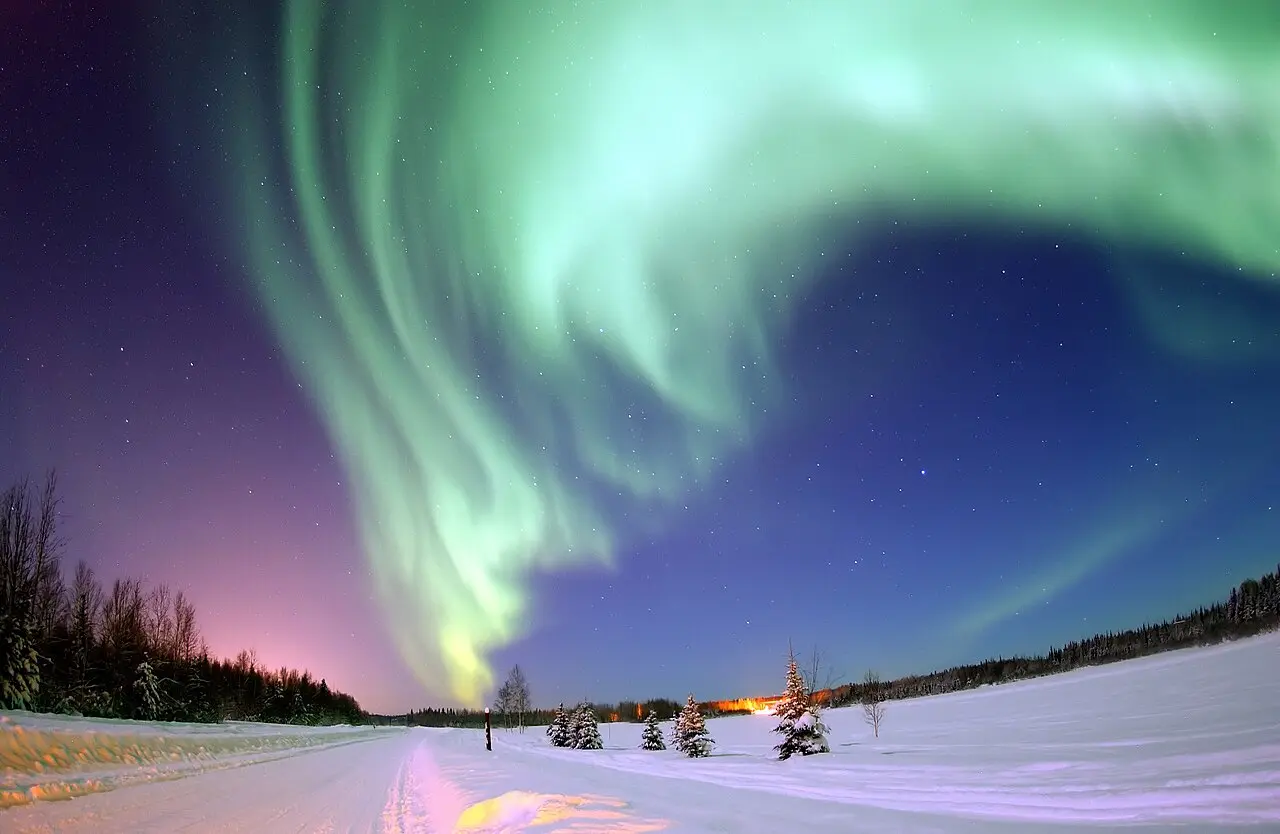
- Auroras glow when fast electrons, energized by the solar wind and steered by Earth's magnetic field, strike oxygen and nitrogen mostly 100 to 300 km above the ground.
- Green, the most common color, comes from atomic oxygen at 557.7 nm; red comes from oxygen at 630 nm in thinner air higher up, and nitrogen adds blue and purple.
- Auroras gather in two ovals around the magnetic poles, and because field lines link the hemispheres, the northern and southern lights usually brighten together.
- NASA and NOAA announced in October 2024 that the Sun had reached solar maximum, months after a G5 storm pushed auroras as far south as the southern United States.
- Phones record aurora colors that eyes miss because the eye's color-sensing cones need more light than a faint display gives, while cameras use long exposures.
The northern lights are the upper atmosphere glowing under a rain of fast electrons, mostly between about 100 and 300 kilometers overhead. The Sun supplies the energy, Earth's magnetic field aims it at two rings around the magnetic poles, and the colors reveal which gas was struck and at what height. Every display is the last step of a journey that began hours or days earlier, some 150 million kilometers away.
What causes the northern lights?
The journey starts with the solar wind, a stream of charged particles that the Sun sheds in every direction, all the time. The slow wind near the plane of the planets moves at about 400 kilometers per second, a trip of roughly four days to Earth, while streams from coronal holes reach 500 to 800 km/s. Coronal mass ejections (CMEs), eruptions that hurl billions of tons of magnetized gas into space, can arrive in as little as 15 to 18 hours. Earth's magnetic field, the magnetosphere, deflects most of this flow. The trouble starts when the magnetic field carried by the solar wind points roughly opposite to Earth's own. The two fields can then join up, a process called magnetic reconnection, and solar-wind energy pours in. Much of it is stored in the magnetotail, the part of Earth's field that the wind drags out behind the planet on its night side. Stretched field lines eventually snap back like an overloaded rubber band. The release, called a substorm, sets up strong electric fields that accelerate electrons down Earth's field lines into the atmosphere. Some of those electrons may have started out in the solar wind, but what turns them into aurora-makers is the push they get close to Earth. As University of Glasgow physicist Alexander MacKinnon has noted, the familiar "particles from the Sun" explanation holds only in a few special cases. The Sun provides the power more than the ammunition. Field lines crowd together near the magnetic poles, so the electrons land in two rings, the auroral ovals. Beneath them, at around 60 to 75 degrees of latitude, aurora appears on more than half of all nights, according to NOAA's Space Weather Prediction Center. The ovals follow the magnetic poles rather than the geographic ones, and the northern magnetic pole is itself drifting toward Siberia, though more slowly than it did in the 2000s. Because the same field lines link both hemispheres, the aurora borealis and the southern aurora australis usually brighten together. On 18 paired flights out of Anchorage and Christchurch, University of Alaska and Los Alamos researchers found the two auroral zones behaving alike, sometimes as exact copies. A 2009 study in Nature added a caveat: they are not always mirror images.
Why is the aurora green, red or purple?
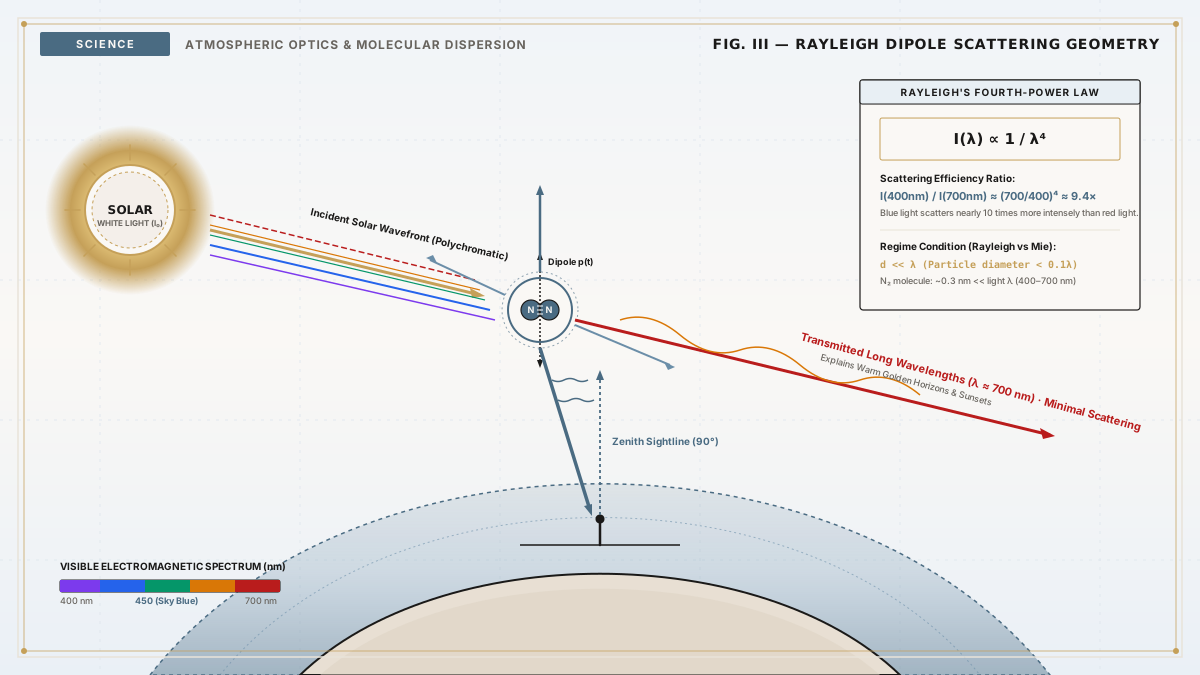
When an electron slams into an oxygen atom or a nitrogen molecule, it kicks the target into an excited state. The target then sheds that energy as light at a few very specific wavelengths, a fingerprint of the gas. Unlike the blue of the daytime sky, which is sunlight scattered by molecules in the air, auroral color is light the air makes itself. Green, the classic aurora color, comes from atomic oxygen emitting at 557.7 nanometers, mostly between about 100 and 200 km up. By atomic standards it is slow: UNSW chemist Timothy Schmidt notes that the excited atom takes almost a second, on average, to release its photon. In the dense air near the ground it would bump into a neighbor long before then and lose the energy without glowing. Red is the same story pushed to an extreme. Oxygen's 630 nm red line comes from a state that must survive for about two minutes before it glows, so it appears only in the thinnest air, above roughly 200 km. That is why red usually crowns the top of a display. All-red auroras, 300 to 500 km up, are rare, and the eye is poor at seeing red in the dark anyway. Nitrogen supplies the rest of the palette. Ionized nitrogen molecules emit blue and red light, which can blend into the magenta fringe often seen along the bottom edge of a curtain, around 100 km up or lower. Where light from different heights overlaps along your line of sight, the sky can look pink, purple or even white.
Why do some years bring far more auroras?
The Sun runs on a magnetic cycle of roughly 11 years. Toward solar maximum, sunspots multiply, and with them the flares and CMEs that drive the biggest geomagnetic storms. On 15 October 2024, NASA and NOAA announced that the Sun had entered the maximum period of Solar Cycle 25, and the Royal Observatory of Belgium, keeper of the international sunspot number, later placed the smoothed peak in October 2024. The decline is no shutdown: NASA notes that fairly significant storms often strike as a cycle winds down. This cycle has already produced a storm for the record books. After a sprawling sunspot group called region 3664 fired a volley of Earth-directed CMEs, NOAA logged its first G5, or "extreme", geomagnetic storm since 2003 on the evening of 10 May 2024. Auroras were seen as far south as the southern United States and northern India, and NASA later called the display possibly among the strongest in 500 years of records.
The benchmark is still 1859. On 1 September, the English astronomers Richard Carrington and Richard Hodgson, observing separately, saw a brilliant white flare burst from a sunspot group, the first solar flare ever recorded. The storm that followed pushed auroras as far south as the Caribbean. Currents surging through telegraph wires threw strong sparks and left many lines unusable, and operators between Boston and Portland, Maine, disconnected their batteries and sent messages on auroral current alone.
Why does your phone see colors your eyes miss?
Many people who went out in May 2024 saw a pale, grayish glow overhead and then a blaze of pink and green on their phone screens. The eye has two kinds of light sensors: rods, which are far more sensitive but colorblind, and cones, which see color but need more light. A faint aurora registers mostly on the rods. Phones compensate with long exposures, high sensitivity and software that stacks and brightens several frames, capturing color that was really there, though processing can make it look more vivid than it was. Bright displays do show color to the naked eye, and green is easiest because the eye responds best to it. Not every strange glow is an aurora, either. Around 2016, amateur photographers in Alberta brought scientists a narrow, mauve ribbon of light, often trimmed with green stripes nicknamed the "picket fence". It became known as STEVE. A 2019 study in Geophysical Research Letters found that, apart from a boost in oxygen's red line, its mauve light is a smooth continuum spread across the visible spectrum, unlike the sharp lines of an aurora. It is not an aurora, and exactly what makes it glow is still being worked out.
When and where can you see the aurora?
Location matters most. Northern Norway, Finnish and Swedish Lapland, Iceland, Alaska and northern Canada sit beneath or near the northern oval, while Tasmania and New Zealand's South Island offer some of the best southern views. Farther from the poles you need a storm. NOAA's rough rule uses the 0-to-9 Kp index of geomagnetic activity: the oval's equatorward edge sits near 66 degrees geomagnetic latitude at Kp 0 and shifts about 2 degrees toward the equator per step, reaching roughly 48 degrees at Kp 9. Timing comes next. NOAA's forecasters say the best aurora usually comes between about 10 pm and 2 am local time, and the weeks around the spring and autumn equinoxes tend to be the most rewarding. Summer is out at high latitudes, where the midnight sun leaves no dark sky. Get away from city lights, face the pole, and expect a full moon to make the display look fainter. From a hilltop with a clear view north, you can spot aurora as much as 1,000 km farther north. Every aurora is the final frame of a long relay. The Sun flings out magnetized gas, Earth's magnetic field soaks up the energy and releases it in bursts, and electrons racing down the field lines make oxygen glow green and red and nitrogen blush purple. Add a dark, clear night under the oval, and the relay ends with you.
Frequently asked questions
What causes the northern lights?
Energy from the solar wind and solar eruptions is stored in Earth's magnetic field and released in bursts that fire electrons down the field lines into the upper atmosphere. The electrons excite oxygen and nitrogen, which shed that energy as light.
Why are the northern lights mostly green?
Most auroral light comes from oxygen atoms roughly 100 to 200 km up, which glow green at 557.7 nm. The human eye is also most sensitive to green, while the red light oxygen gives off higher up is much harder for us to see.
Do the southern lights happen at the same time as the northern lights?
Usually, yes. The same magnetic field lines connect the two polar regions, so displays in both hemispheres tend to brighten together, although they are not always perfect mirror images.
When is the best time to see the aurora?
NOAA's forecasters say the best displays usually come between about 10 pm and 2 am local time, and the weeks around the spring and autumn equinoxes tend to be the most rewarding. You need a dark, clear sky away from city lights.
Sources
- Auroras, NASA Science
- Aurora, NOAA Space Weather Prediction Center
- Tips on Viewing the Aurora, NOAA Space Weather Prediction Center
- What causes the different colours of the aurora? An expert explains the electric rainbow, The Conversation
- Are the northern lights caused by 'particles from the Sun'? Not exactly, The Conversation
- Auroras North and South, University of Alaska Fairbanks Geophysical Institute
- Asymmetric auroral intensities in the Earth's Northern and Southern hemispheres, Nature
- NASA, NOAA: Sun Reaches Maximum Phase in 11-Year Solar Cycle, NASA Science
- Solar Cycle 25 reached its maximum in October 2024, Royal Observatory of Belgium (SIDC)
- How NASA Tracked the Most Intense Solar Storm in Decades, NASA Science
- Eyewitness Reports of the Great Auroral Storm of 1859, NASA Goddard Space Flight Center
- First Observations From the TREx Spectrograph: The Optical Spectrum of STEVE and the Picket Fence Phenomena, Geophysical Research Letters