How the Pantheon's Dome Spans 43 Meters Without Steel
How did the Pantheon's dome span 43 meters with no steel? Graded concrete, deep coffers, and an open oculus hold the 43.3-meter dome up after 1,900 years.
Key takeaways
- The Pantheon's dome spans 43.3 meters (142 feet) with no steel reinforcement, and it is still the largest unreinforced concrete dome in the world.
- Builders graded the concrete from heavy basalt at the base to light volcanic stone at the top, cutting tensile stress by about 80 percent.
- The shell thins from 6.4 meters (21 feet) at the base to 1.2 meters (4 feet) at the oculus, and 140 coffers cut further weight from the upper dome.
- The 8.2-meter (27-foot) oculus removes the heaviest part of the crown and is the building's only source of natural light.
- The present building was completed around AD 125 under Hadrian, after fires destroyed two earlier versions on the same site.
How did the Pantheon's dome span 43 meters with no steel? Roman builders graded their concrete from heavy stone at the base to feather-light pumice at the top, thinned the shell as it rose, and cut 140 deep coffers into its underside. Nearly 1,900 years later, it still holds the record as the largest unreinforced concrete dome in the world. The dome is a hemisphere of Roman concrete, a mix of lime, volcanic ash called pozzolana, and stone aggregate. Modern concrete hides steel bars inside it to handle pulling forces. The Pantheon has none. Its builders solved the problem with geometry and weight control: take mass out of the top, keep it low down, and let the shape carry the load.
- The dome measures 43.3 meters (142 feet) across, and the height from the floor to the oculus matches it, so a sphere 43.3 meters wide would fit inside the rotunda. Encyclopaedia Britannica
- The shell thins from about 6.4 meters (21 feet) at the base to about 1.2 meters (4 feet) at the oculus rim. Illustrarch
- The oculus is about 8.2 meters (27 feet) across and is the building's only source of natural light. Rain enters through it and drains through 22 small holes in the floor. Illustrarch
- The dome's concrete is graded into six layers, ending in scoria, a low-density volcanic rock, at the top. Smarthistory
- Mark and Hutchinson's analysis found graded aggregate cut tensile stress in the dome by roughly 80 percent compared with uniform concrete. Illustrarch
- The present building was completed around AD 125 under Hadrian, after fires in AD 80 and AD 110 destroyed two earlier versions. Smarthistory
Why is a 43-meter concrete span so hard to build?
Concrete is strong when squeezed and weak when pulled apart, and that split is the whole problem. A dome's weight presses down on its supports and drives the base of the dome outward. Near the crown, the curve of the shell pulls apart sideways, a force called hoop tension. The wider the span, the larger those forces grow, and the heavier the dome, the worse they get. Modern builders answer this with steel: bars embedded in the concrete take the pulling forces. Roman builders had no steel reinforcement, no Portland cement, and no computer models. A solid concrete hemisphere 43.3 meters (142 feet) across should have cracked under its own weight and fallen in. Instead of adding strength to resist the load, the Pantheon's builders removed load wherever the dome could least afford it, with three ideas: graded concrete, a thinning shell, and a hollowed crown.
How did the builders span 43 meters with graded concrete?
The concrete changes as it climbs. At the base, the aggregate is heavy basalt and travertine, dense stone that anchors the shell to the drum below. Higher up, the mix shifts to brick and tufa, a lighter volcanic stone. Near the crown, the aggregate is pumice and scoria, volcanic rock filled with tiny air pockets. Encyclopaedia Britannica describes the grading as running from heavy basalt low down, through brick and tufa, to the lightest pumice toward the center of the vault. Smarthistory notes the dome's concrete is graded into six layers, with the lightest volcanic rock at the top, so the dome grows lighter exactly where its own weight would hurt it most. The shell also thins as it rises, from about 6.4 meters (21 feet) at the base to about 1.2 meters (4 feet) near the oculus, so the top carries far less mass than the bottom. The effect is large. Finite element analysis by scholars Mark and Hutchinson found that graded aggregate cut tensile stress in the dome by roughly 80 percent compared with uniform-density concrete. That single choice turned a span that should have failed into one that has lasted nearly 1,900 years. The binder mattered too: lime mixed with pozzolana, volcanic ash from the region around Pozzuoli near Naples, hardens into concrete that keeps gaining strength over time. The same material let Romans build harbors that set underwater, and researchers have found that Roman concrete can repair its own cracks as minerals grow inside it.
What do the coffers and the oculus actually do?
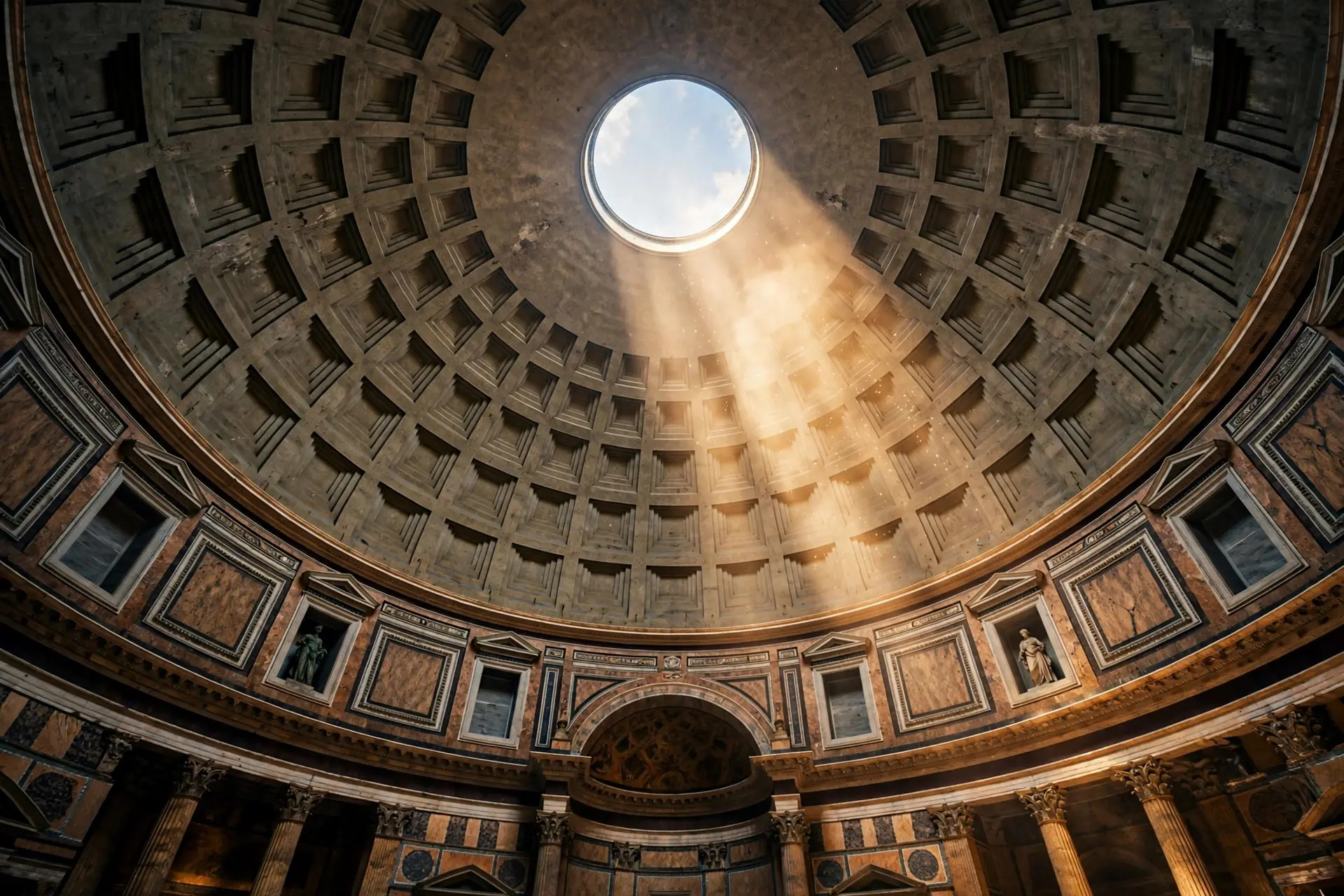
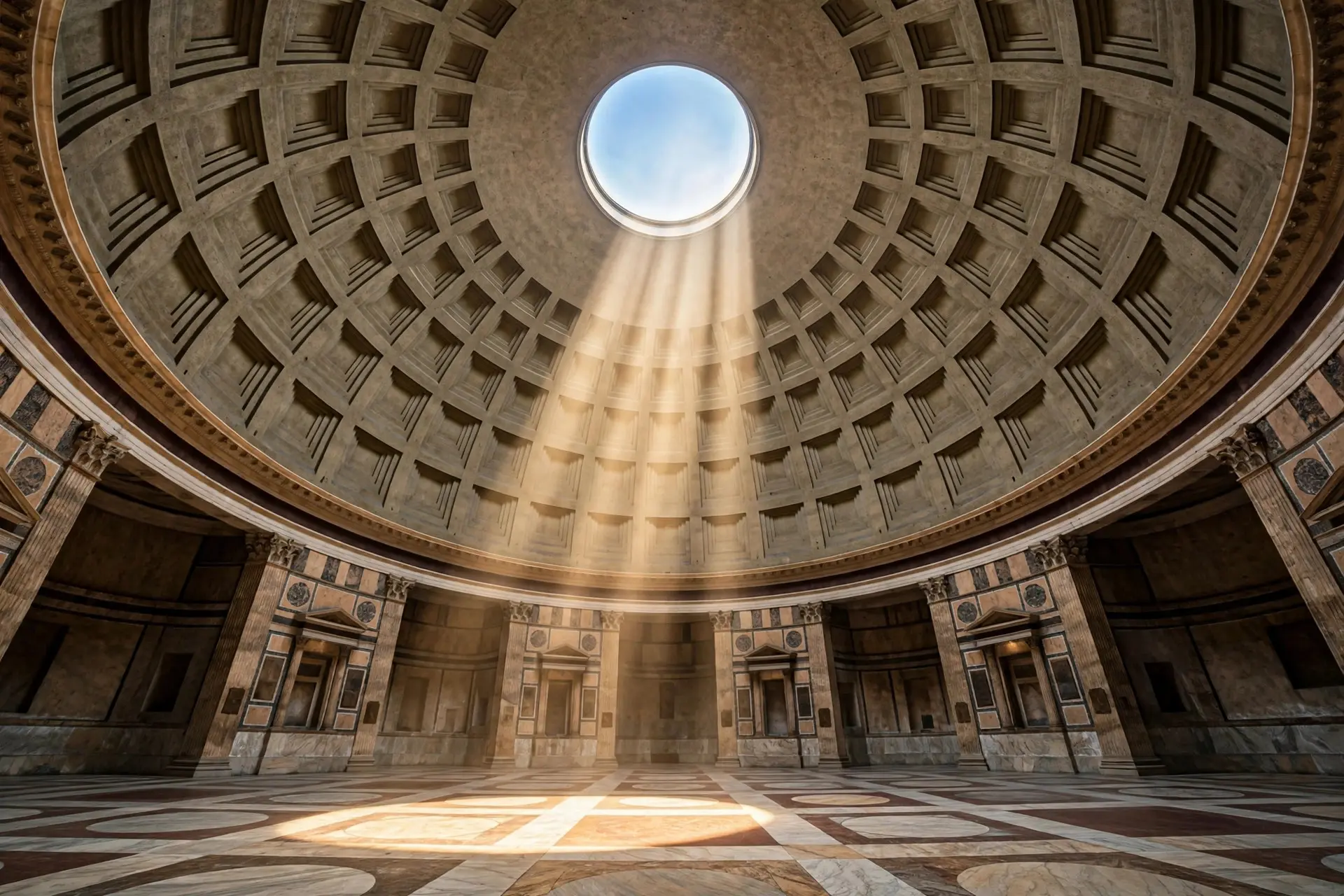
Look up inside the Pantheon and the dome is covered in square recesses: 140 coffers in five rings of 28, each ring smaller than the one below it. They once held gilded bronze rosettes, long since removed. The coffers are not only decoration: each one scoops concrete out of the shell, removing weight from the upper dome while the ribs between them keep carrying the load, and the pattern shrinks toward the crown, where the dome is thinnest and weakest. The oculus finishes the job. The circular opening at the crown is about 8.2 meters (27 feet) across, and it removes the very top of the dome, where hoop tension peaks and a solid cap would add the most useless weight. It is the building's only source of natural light: with no windows anywhere in the rotunda, a shaft of sun moves across the coffers, walls, and marble floor as the day passes. Rain falls straight through onto a floor that curves gently upward, and 22 small holes near the center drain it away. The opening was designed this way from the start, and the drainage still works today.
How does the drum carry the dome's weight?
A light dome still needs something to push against. The rotunda walls, called the drum, are about 6 meters (20 feet) thick at the base, a ring of brick-faced concrete that absorbs the dome's outward thrust. Encyclopaedia Britannica notes that the drum is strengthened by huge brick arches and piers set inside the walls, and that the upper third of the drum overlaps the lower part of the dome, helping to contain the thrust. Hidden relieving arches and vaults run through the wall mass, channeling loads around the niches and down to the foundations. Below ground, the support continues: the building sits on a foundation ring 15 feet (4.6 meters) deep and 24 feet (7.3 meters) wide, ringed by further support rings. After nearly 1,900 years, the structure shows almost no settlement. The system works as a whole: light crown, heavy base, thick walls, and deep foundations, each part sized for the forces it meets.
What do most people get wrong about the Pantheon?
| Claim | What the evidence shows |
|---|---|
| Marcus Agrippa built the Pantheon standing today. | Agrippa built the first Pantheon around 27 to 25 BCE. It burned in AD 80, its replacement burned in AD 110, and the present building was completed around AD 125 under Hadrian, who kept Agrippa's name on the portico. |
| The oculus is a hole left by damage or a missing roof. | The opening was designed into the dome. It lightens the crown, where tension is worst, and it is the only source of natural light. |
| The dome is solid concrete of one mix. | The concrete is graded into six layers, from heavy basalt low down to light volcanic stone at the top, and the shell thins from 6.4 meters to 1.2 meters. |
| The coffers are only decoration. | Each coffer removes concrete from the upper dome. The ribs between them keep the shell continuous, so the dome loses weight without losing strength. |
| The building survived because it was forgotten. | It became the church of Santa Maria ad Martyres in AD 609 and stayed in continuous use, which protected it from stone-robbing that stripped other Roman buildings. |
| The inscription is the easiest mistake to make. Visitors read Agrippa's name across the portico and assume the whole building is his, but brick stamps found in the walls in 1892 showed otherwise: the surviving rotunda and dome belong to the rebuilding under Hadrian, with some evidence that work began under Trajan around AD 114. Four centuries later, the builders of the Hagia Sophia faced a harder version of the same problem, roofing a square hall instead of a round one. Earlier Greek builders had roofed temples such as the Parthenon with stone and timber beams, which limited how wide a room could be. Concrete freed Roman builders from that limit, and the Pantheon shows how far they pushed it. | |
| The dome endures because its builders treated weight as the enemy and removed it with care: they graded the stone, thinned the shell, hollowed the surface, opened the crown, and set the mass on walls and foundations built to take the push. St. Peter's Basilica in Rome has a dome 41.47 meters (136 feet) across, still smaller than the Pantheon's 43.3 meters (142 feet). No dome of unreinforced concrete has matched the Pantheon since, and the record has now stood for nearly 1,900 years. | |
| How we made this article: FactSpire researched and drafted it with AI assistance and checked every fact against the sources listed above. |
Frequently asked questions
How did the Pantheon's dome span 43 meters with no steel?
Roman builders graded the concrete so it grew lighter as it rose, thinned the shell from 6.4 meters at the base to 1.2 meters at the top, and cut 140 coffers into the underside. The open oculus removed the crown, where the pulling forces are worst, and the thick drum walls absorbed the outward push.
What is the Pantheon's dome made of?
It is Roman concrete, a mix of lime, volcanic ash called pozzolana, and stone aggregate. The aggregate changes with height: heavy basalt and travertine low down, brick and tufa in the middle, and light volcanic stone such as pumice and scoria near the top.
How big is the oculus in the Pantheon?
The oculus is about 8.2 meters (27 feet) across. It has never had glass or a cover, and it is the only source of natural light in the rotunda. Rain falls through it onto a slightly curved marble floor, where 22 small holes drain the water away.
Who built the Pantheon that stands today?
The building standing today was rebuilt under Emperor Hadrian and completed around AD 125. Marcus Agrippa built the first Pantheon on the site around 27 to 25 BCE, but fires in AD 80 and AD 110 destroyed it and its replacement. Hadrian kept Agrippa's name on the portico inscription.
Sources
- Pantheon | Definition, History, & Facts, Encyclopaedia Britannica
- The Pantheon (Rome), Smarthistory
- The Pantheon Rome: History, Dome, and Ancient Concrete Engineering Explained, Illustrarch
- The Pantheon, The Engines of Our Ingenuity, University of Houston
- The Pantheon in Rome, The History of Art