How Did the Romans Build Concrete Harbors Underwater?
Roman harbors needed walls that hardened underwater. Volcanic ash and lime, poured into wooden boxes at Caesarea, gave them that. Seawater made it stronger.
Key takeaways
- Roman harbor concrete used lime mixed with pozzolana, a volcanic ash, which reacted to form a mortar that could harden underwater.
- At Caesarea, built around 22 to 10 BCE, the harbor named Sebastos was the largest artificial harbor in the open sea up to that time.
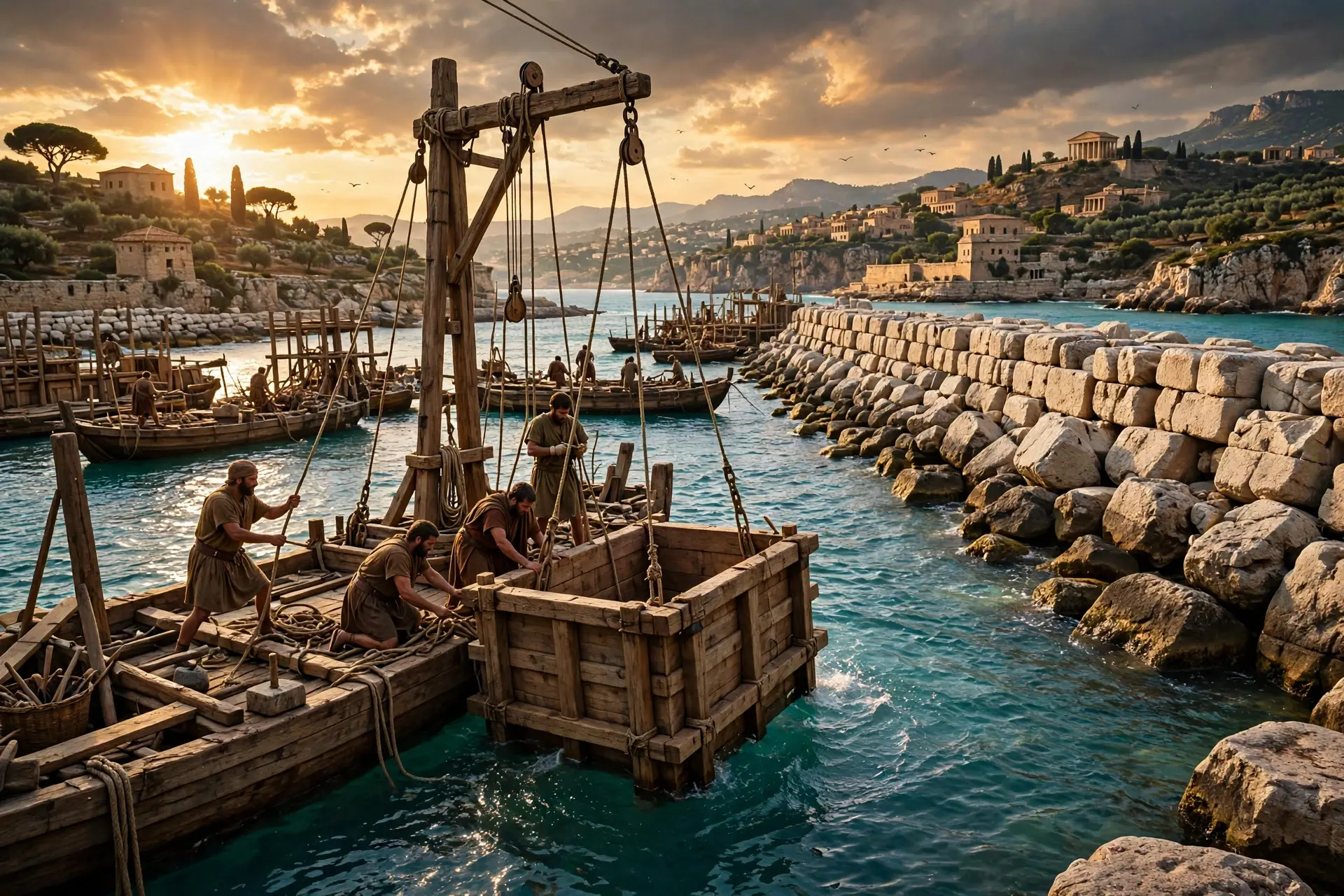
- Builders poured the mix into wooden boxes on the seabed, using a tube kept below the rising concrete surface so seawater would not wash it away.
- Seawater later helped the concrete: minerals called aluminous tobermorite and phillipsite grew inside it and strengthened the matrix.
- Roman harbor concrete has survived about two orders of magnitude longer than Portland cement concrete in seawater, according to the study reported by the American Ceramic Society.
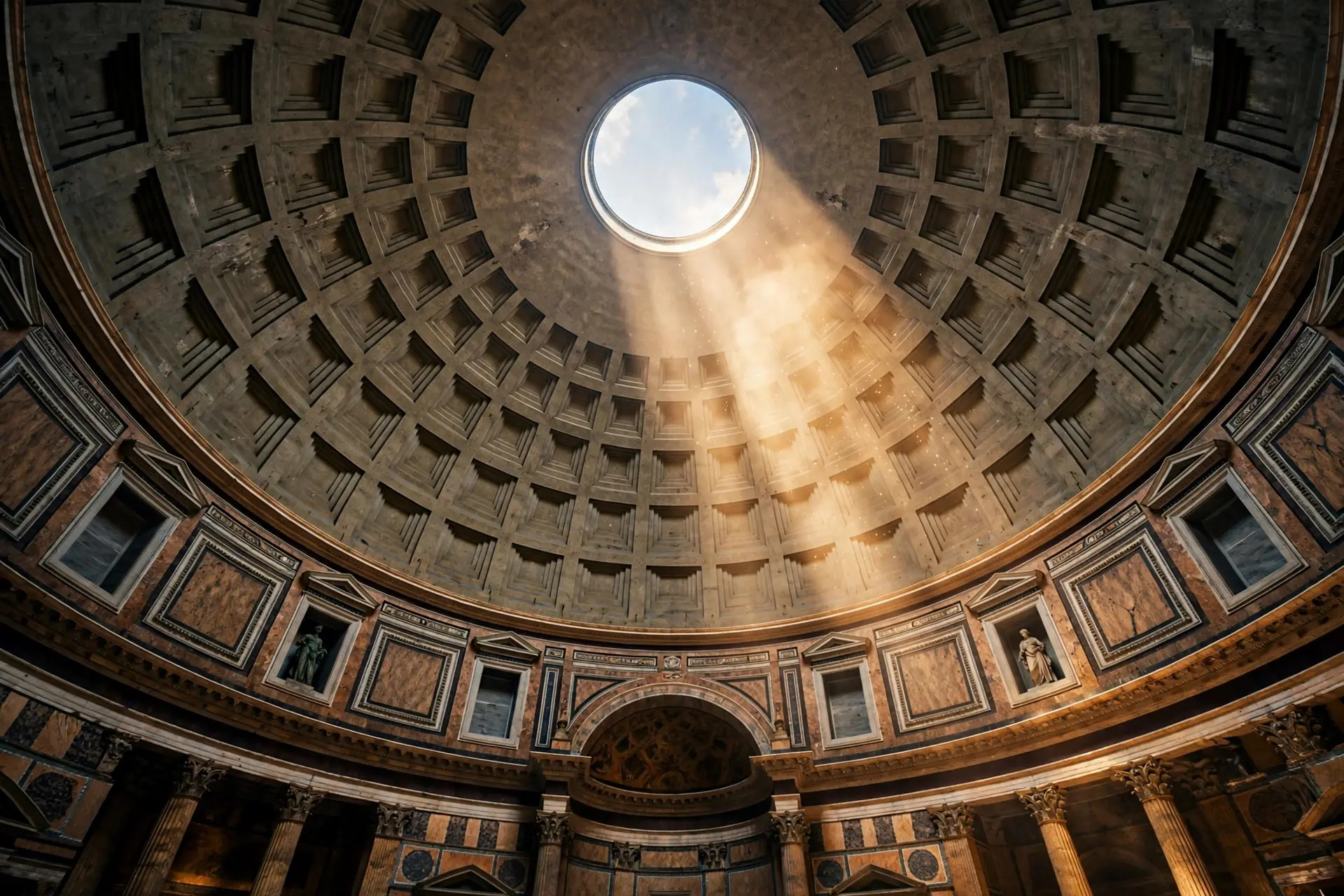
Most building materials get weaker in the sea. Roman harbor concrete did the opposite, or at least it lasted so long that the difference looked like a reversal. The Roman writer Pliny the Elder, writing around AD 79, claimed that this concrete, once in contact with seawater and submerged, became a single stone mass, impregnable to the waves and stronger every day. Modern laboratory work suggests he was not merely boasting. The sea itself helped finish the material. On land, the same material helped raise the great dome of the Pantheon, but the place to see that idea at full scale in water is Caesarea Maritima, on the eastern Mediterranean coast. There, around 22 to 10 BCE, Herod the Great built a harbor where nature had provided almost none of the help a port normally needs. The result was a test of a new material, a new construction method and a great deal of imported volcanic ash, all at once.
Why Was Caesarea Such a Difficult Place for a Harbor?
A good natural harbor offers shelter: a bay, a headland, a reef that breaks the waves before they reach the shore. Caesarea offered a shifting sand beach, exposed to the longest fetch in the Mediterranean and to a strong current running along the shore. Fetch means the distance wind can travel over open water, gathering energy, so waves arriving at Caesarea had a long run-up. Any breakwater there would have to create shelter from scratch, in open water, and then hold it. That political choice made the engineering harder. The harbor, named Sebastos, the Greek equivalent of Augustus, was meant as a monument to the emperor and to Herod's standing. It also had to work as a trading port, with room for ships to tie up, load and unload in safety. The solution was two massive breakwaters, or moles, reaching nearly 1,600 feet out to sea and forming two basins. The longer southern breakwater curved toward the shorter, straight northern one, leaving a gap of about 60 feet as the harbor entrance. Both breakwaters were wide enough, about 150 and 200 feet respectively, to carry warehouses on top and give access to ships inside. Three large concrete islands at the entrance may have carried sculpture that also served as navigation marks, and an inner basin near the shore added more dock space. None of that could have been built by stacking stone in the surf and hoping it stayed put. The breakwaters needed solid foundations on sand, in moving water. That is where the concrete came in.
What Was in Roman Harbor Concrete?
The mix was lime, volcanic ash called pozzolana, water and rubble aggregate, including chunks of volcanic rock. Pozzolana, named for Pozzuoli near Naples, is rich in silica and alumina. When it meets lime and water, it reacts to form strong binding minerals, a process called a pozzolanic reaction. Unlike ordinary lime mortar, which hardens by drying and absorbing carbon dioxide from the air, this mixture could set underwater, which made it a hydraulic concrete. For Caesarea, pozzolana was imported from the Bay of Naples, a long supply line for a building site on the opposite side of the Mediterranean. That import is itself evidence of how much the builders trusted the material. Local stone and sand were available, but the volcanic ash was not, and the harbor was designed around it anyway. The concrete made at Caesarea differed from contemporary Italian examples, researchers note, because of the exposed shoreline, the distance from the ash source and possibly a workforce less familiar with hydraulic concrete. Builders adapted the recipe and the formwork to local conditions rather than copying an Italian template exactly. It is important not to picture this concrete as a modern pour. Roman workers laid it rather than pumping it, placing mortar and aggregate in forms and building up mass in sections. The chemistry was the revolution, not the delivery system, and the delivery system still needed ingenuity.
How Did Workers Pour Concrete Underwater Without It Washing Away?
They did not pour it into open water. They poured it into boxes. At Caesarea, archaeologists have identified three ways of setting and curing hydraulic concrete underwater inside wooden formwork, and the variety itself is revealing. Builders were experimenting at scale, trying more than one method on the same harbor. One method used a box of vertical planks driven into the sea floor, braced by horizontal beams, which was then filled with concrete. Another, identified by the Caesarea Ancient Harbour Excavation Project, used a large double-walled hollow box built on shore and towed into position; mortar filled the space between the walls until the form sank, after which it was filled with concrete. A third method used barges built with horizontal planks, partly filled with concrete in shallow water for easier towing, then fully filled at the site until they sank into place. A further detail shows how carefully the pour itself was managed. Builders used a large wooden tube with flexible leather joints, held so its mouth stayed beneath the rising surface of the concrete inside the form. That kept the fresh mix from meeting open seawater and dispersing before it could harden. Several tubes were probably used at once, worked by people standing on the already built breakwater or in anchored barges nearby.
Once the concrete islands were in place, they were joined by parallel masonry walls, and the space between was left for the sea to fill with sand over a few years. The walls were then topped and paved to hold the sand in position. On top of the breakwaters stood barrel-vaulted warehouses and promenades, giving access to ships tied in the harbor. Underwater excavators have spent decades studying these remains, and the sequence of blocks, walls and fills is still legible on the seabed.
Why Did Seawater Strengthen the Concrete Instead of Destroying It?
The short answer is that the concrete kept reacting long after it set. At first, volcanic ash and lime formed a lumpy binding material known as calcium-aluminum-silicate-hydrate. Lime was consumed in that early reaction, and for a long time researchers assumed the story ended there. Newer analyses of harbor samples, including material drilled at Portus Cosanus in Tuscany, show a second act. As seawater infiltrated the concrete, it slowly dissolved small amounts of minerals inside it, making the fluid in tiny pores more alkaline. In those sealed, highly alkaline pockets, rare minerals could grow at ordinary temperatures over long periods. The key ones are aluminous tobermorite, which forms crack-stopping fibres and plates inside voids, and a related mineral called phillipsite. Instead of weakening the material, seawater dissolving minerals inside it allowed these crystals to grow and reinforce the matrix from within. That process explains Pliny's observation in modern terms. The American Ceramic Society reports that Roman harbor concrete structures survive about two orders of magnitude longer than Portland cement seawater concrete structures, a difference of roughly a hundredfold. The researchers stress that they do not yet know exactly how long tobermorite takes to form at low temperature, since the process is far too slow to reproduce by waiting in a laboratory. They are turning instead to natural analogues, such as the young volcanic island of Surtsey in Iceland, where similar minerals form in rock. There is a lesson here that goes beyond harbors. Modern concrete in the sea usually fails because steel reinforcement rusts, cracks open, and salt water accelerates the damage. Roman harbor concrete contained no steel to rust, and its binder did not sit still. It changed, slowly, in response to the very environment that attacked it. That does not make it a recipe modern builders can copy directly, since modern structures have different loads, speeds of construction and safety requirements. But it does explain why a harbor built on an exposed sand beach more than two thousand years ago can still be studied, dived and mapped today. The aqueduct builders of Rome moved water with gravity and patience. The harbor builders at Caesarea worked with a different kind of patience, trusting a material that would keep curing long after the last workboat had left. They built a port where the sea gave them no shelter, using a concrete that treated the sea not as an enemy to be kept out, but as a partner in its own hardening.
Frequently asked questions
Why did ordinary mortar fail underwater?
Most lime mortars need air to harden, so they wash apart or stay soft when submerged. Roman harbor mortar used volcanic ash, which reacts with lime and water to form binding minerals even under the sea.
How did builders place concrete on the seabed?
They set wooden formwork boxes on the sea floor, then poured concrete into them through a tube whose mouth stayed below the rising surface. That kept the mix from dispersing in the water before it hardened.
Did seawater damage Roman harbor concrete?
Over time it helped it. Seawater moving through the concrete dissolved minerals and created alkaline fluids in which strengthening crystals grew, so the material could become denser rather than simply crumbling.
Sources
- High-tech methods confirm Pliny the Elder's observations and reveal new insights into strength of Roman concrete, The American Ceramic Society
- Caesarea Maritima: Pioneering Hydraulic Concrete in 22-10 BCE, Geotech
- Caesarea's Mighty Harbor, Biblical Archaeology Society