How Deep Is China's Sansha Yongle Blue Hole, Really?
How deep is the Sansha Yongle Blue Hole? The South China Sea sinkhole drops 300.89 m (987 ft). Here is how surveyors measured it in 2016 and 2017.
Key takeaways
- The Sansha Yongle Blue Hole drops 300.89 m (987 ft), refined to 301.19 m (988 ft) by a 2017 robotic survey.
- It sits in Yongle Atoll in the Paracel Islands, about 400 km (249 miles) south of Sanya, China.
- Water below about 80 m (262 ft) has almost no oxygen, so almost nothing lives in the deep part.
- It held the deepest-blue-hole record from 2016 until 2024, when Mexico's Taam Ja' passed 420 m (1,378 ft).
- The hole is not a straight shaft: it bends sideways, narrowing to 26.2 m (86 ft) near the bottom.
How deep is the Sansha Yongle Blue Hole? It drops 300.89 m (987 ft), and a 2017 survey refined that figure to 301.19 m (988 ft). It sits in an atoll in the South China Sea, and it held the record as the deepest blue hole on Earth, until a Mexican blue hole took the title in 2024.
- First measured in March 2016: 300.89 m (987 ft). Scientific Reports
- Refined by a 2017 robotic survey: 301.19 m (988 ft) below the 10-year mean sea level. Scientific Reports
- The mouth averages 130 m (427 ft) across and narrows to 26.2 m (86 ft) near the bottom. Scientific Reports
- Below about 80 m (262 ft), the water holds almost no oxygen and barely moves. Scientific Reports
- In 2024, Mexico's Taam Ja' Blue Hole passed 420 m (1,378 ft) without reaching bottom, taking the record. Frontiers in Marine Science
- Local fishermen have known the hole since the Tang and Song dynasties, and they call it Longdong, or Dragon Hole. Scientific Reports
What is a blue hole, and where is this one?
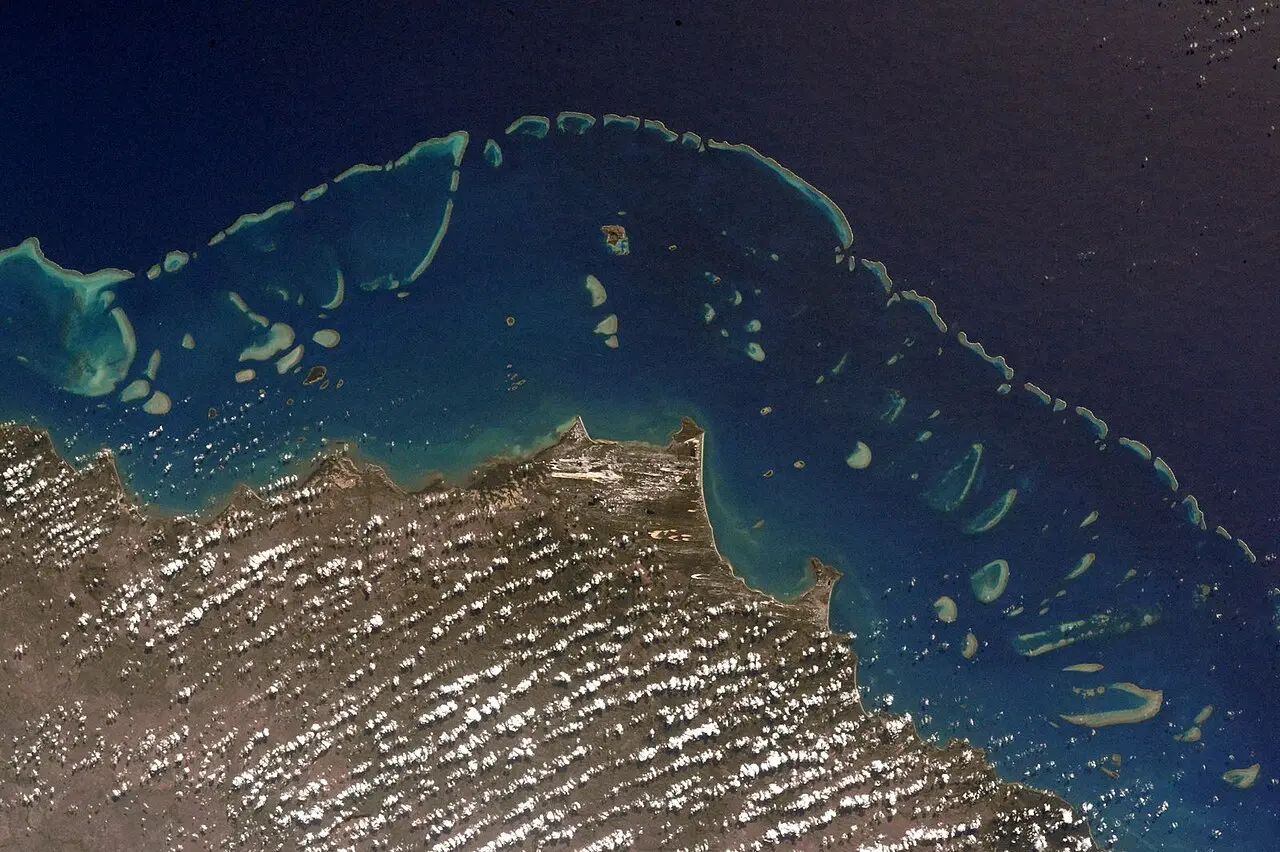
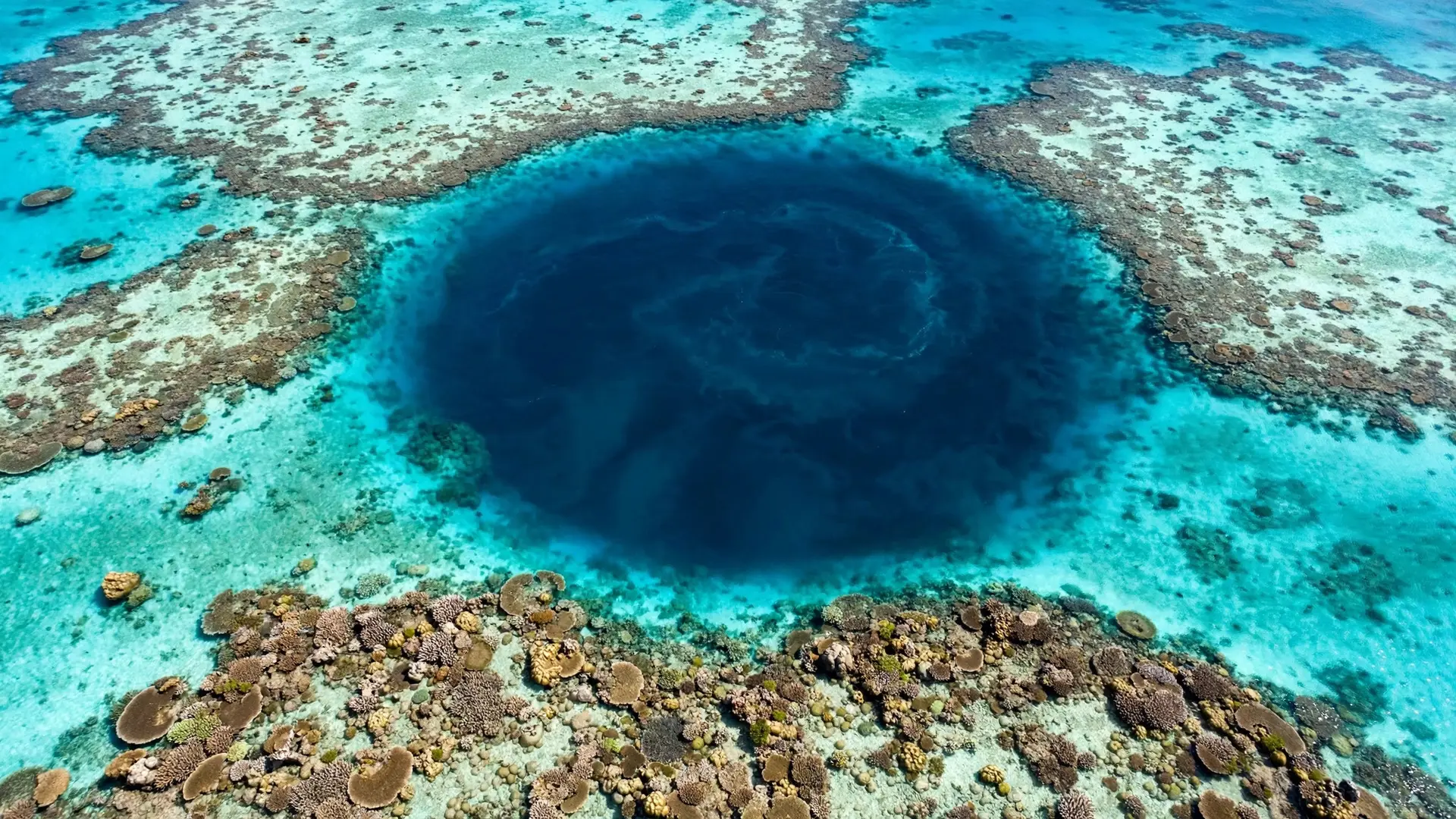
A blue hole is an underwater sinkhole, much like one on land, that opens into the sea. NOAA Ocean Exploration describes them as ecological hotspots, often full of marine life and set in otherwise bare seafloor. They get their name from the view above: dark blue water ringed by pale turquoise shallows. The Sansha Yongle Blue Hole sits at the eastern end of Yongle Atoll in the Xisha Islands, known in English as the Paracel Islands, in the South China Sea, at about 16.5 degrees north and 111.8 degrees east, roughly 7 km (4.3 miles) from Jinqing Island and about 400 km (249 miles) south of Sanya, on Hainan Island. Scientific Reports The hole opens inside a coral reef, and from the air it looks like a dark eye, hence the local name "eye" of the South China Sea. Blue holes form in limestone or coral rock: slightly acidic water carves caves underground, and when a roof gives way, the opening collapses into a sinkhole. Many began as dry caves during the last ice age, then filled as the sea rose. Scientific American
How did researchers measure a depth of 300.89 m?
Chinese fishermen have used the hole since as early as the Tang and Song dynasties, but no one measured it until a team from the Sansha Ship Course Research Institute for Coral Protection began work there in August 2015. Scientific Reports
The team used a small underwater robot, a VideoRay Pro 4, fitted with a depth sensor, sonar scanners, cameras and current meters. In March 2016, it measured a depth of about 300.89 m (987 ft) from the sea surface. Announced in July 2016, the hole got its formal name, the Sansha Yongle Blue Hole, from the Sansha city government on July 24, 2016. GeoGarage That first figure came with a catch: the 2016 robot could not reach every part of the hole, and its operators could not confirm it touched the bottom. The hole also turned out to be far from a straight shaft, which made the depth hard to pin down. So a team from the First Institute of Oceanography ran a fuller survey from May 15 to June 5, 2017, with a professional-grade underwater robot carrying acoustic positioning, a Doppler velocity log, multibeam sonar and water gauges. It mapped the hole in three dimensions and measured its lowest point at 301.19 m (988 ft) below the 10-year mean sea level, with an error margin of about 0.02 m (0.8 inches). Scientific Reports The two numbers describe the same hole against different reference points: 300.89 m is the depth from the sea surface on the day of the first survey, the figure most news reports quote, while 301.19 m is the more careful measurement, tied to a fixed sea-level datum. Either way, the hole is nearly deep enough to hold the 330 m (1,083 ft) Eiffel Tower. GeoGarage
What did the 2017 survey find inside the hole?
The survey showed the hole is shaped like a ballet dancer's shoe, not a simple vertical pit. The entrance averages 130 m (427 ft) across, reaching about 162.3 m (533 ft) at its widest. Below the rim, the walls drop almost straight down to about 50 m (164 ft), then the shaft bends: between 90 m (295 ft) and 158 m (518 ft) it turns sharply northeast, and the bottom tip sits about 118 m (387 ft) sideways from the center of the entrance. Scientific Reports The walls hold small side caves, the two largest at about 33 m (108 ft) and 43 m (141 ft) down, and near 76 to 78 m (249 to 256 ft) a staircase of steep ledges. Researchers suggest the step marks a long pause in sea-level rise during the Younger Dryas, a cold snap at the end of the last ice age. The deep part keeps narrowing to only 26.2 m (86 ft) wide at 279 m (915 ft) down, then opens slightly into a tilted bowl at the bottom. Scientific Reports Life in the hole is split in two. The upper water holds more than 20 species of fish and other animals, but tides and waves reach only about 60 m (197 ft) down, and no passage connects the cave to the open sea. Below about 80 m (262 ft), the water barely moves and has almost no oxygen, and below about 100 m (328 ft) almost nothing lives. Scientific Reports Scientific American
Why is it no longer the deepest blue hole?
For eight years, the Yongle hole held the record, beating the previous holder, Dean's Blue Hole in the Bahamas, by 99 m (325 ft). Scientific Reports Then a hole in Mexico took the title. The Taam Ja' Blue Hole sits in Chetumal Bay, at the southeast corner of Mexico's Yucatan Peninsula. On December 6 and 13, 2023, researchers lowered a CTD profiler on about 500 m (1,640 ft) of cable. The casts reached 416.0 m (1,365 ft) and 423.6 m (1,390 ft) without finding the bottom. Published on April 29, 2024, they establish Taam Ja' as the deepest-known blue hole on Earth. Frontiers in Marine Science
| Blue hole | Location | Depth |
|---|---|---|
| Taam Ja' | Chetumal Bay, Mexico | More than 420 m (1,378 ft); bottom not reached |
| Sansha Yongle | South China Sea | 301.19 m (988 ft) |
| Dean's | Long Island, Bahamas | About 202 m (663 ft) |
| Dahab | Red Sea, Egypt | About 130 m (427 ft) |
| Great Blue Hole | Belize | About 125 m (410 ft) |
| Gozo | Malta | About 60 m (197 ft) |
| Taam Ja' is at least 119 m (390 ft) deeper than the Yongle hole, and its true depth is still unknown. The Yongle hole keeps a different distinction: it is the deepest blue hole ever mapped in full three dimensions, while Taam Ja' has no complete map because no instrument has reached its floor. | ||
| Other record-breaking water bodies: the deepest lake in Africa, Lake Tanganyika, the saltiest lake on Earth, Don Juan Pond, the lowest place on land, the Dead Sea shore, and the deepest canyon on Earth, the Yarlung Tsangpo. The reef around the Yongle hole belongs to the same coral world as the Great Barrier Reef. |
What most people get wrong about the Dragon Hole
The first mistake is the record itself. Many pages still call the Yongle hole the deepest blue hole in the world, which was true from 2016 until 2024. The April 2024 Taam Ja' paper changed that. The second mistake is the shape. Photos from above make it look like a neat round well, but the 2017 map shows a bent, five-part cave that leans sideways as it drops, so a plumb line from the center of the mouth would miss the bottom by more than 100 m (328 ft). The third mistake is the dragon. Longdong means Dragon Hole, and local legend links it to the Monkey King of the 16th-century novel Journey to the West, who supposedly took his golden cudgel from an undersea dragon kingdom. That is a story, not a survey result. The fourth mistake is about life. The hole looks inviting from above, with bright reef water and fish near the surface, but the deep water is almost lifeless: the oxygen runs out, the water stops moving, and below about 100 m (328 ft) there is almost nothing alive. The Yongle hole is still worth attention: it is the deepest blue hole ever mapped in detail. Its record lasted eight years, and the next record holder may last even less time. How we made this article: FactSpire researched and drafted it with AI assistance and checked every fact against the sources listed above.
Frequently asked questions
How deep is the Sansha Yongle Blue Hole?
The first measurement in March 2016 put the depth at 300.89 m (987 ft). A fuller survey in 2017, using a professional-grade underwater robot, refined that figure to 301.19 m (988 ft) below the 10-year mean sea level. That makes it about 99 m (325 ft) deeper than the previous record holder, Dean's Blue Hole in the Bahamas.
Where is the Sansha Yongle Blue Hole?
It sits at the eastern end of Yongle Atoll in the Xisha, or Paracel, Islands in the South China Sea, at about 16.5 degrees north and 111.8 degrees east. It lies roughly 7 km (4.3 miles) from Jinqing Island and about 400 km (249 miles) south of Sanya on the island of Hainan.
Is the Sansha Yongle Blue Hole still the deepest blue hole in the world?
No. It held the title from 2016 until 2024, when researchers reported that the Taam Ja' Blue Hole in Chetumal Bay, Mexico, reached 423.6 m (1,390 ft) on a probe lowered in December 2023. The probe never reached the bottom, so Taam Ja' is deeper still by an unknown amount, and the Yongle hole is now the second deepest known.
Can divers explore the Sansha Yongle Blue Hole?
Not far down. The upper water holds more than 20 species of fish and other marine life, but below about 100 m (328 ft) the water has almost no oxygen, and the deep water below 80 m (262 ft) barely moves at all. That is why scientists mapped the hole with robots instead of divers, and why diving in blue holes is widely described as extremely dangerous.
Sources
- Three-dimensional (3D) morphology of Sansha Yongle Blue Hole in the South China Sea revealed by underwater remotely operated vehicle, Scientific Reports
- Recent records of thermohaline profiles and water depth in the Taam ja' Blue Hole (Chetumal Bay, Mexico), Frontiers in Marine Science
- South China Sea Blue Hole Could Be World's Deepest, Scientific American
- Blue Hole, NOAA Ocean Exploration
- Researchers just discovered the world's deepest underwater sinkhole in the South China Sea, GeoGarage