Why Is the Dead Sea the Lowest Place on Land?
The Dead Sea sits about 430 metres below sea level because plates are pulling its valley floor down while evaporation traps it. Here is why it keeps falling.
Key takeaways
- The Dead Sea's surface sits roughly 430 metres below sea level, the lowest land elevation on Earth.
- It lies in a rift valley where plates are pulling apart, dropping the valley floor over millennia.
- With no outlet to the sea, water leaves only by evaporation, concentrating salt and lowering the level.
- The lake is falling by about a metre a year, largely because Jordan River water is diverted upstream.
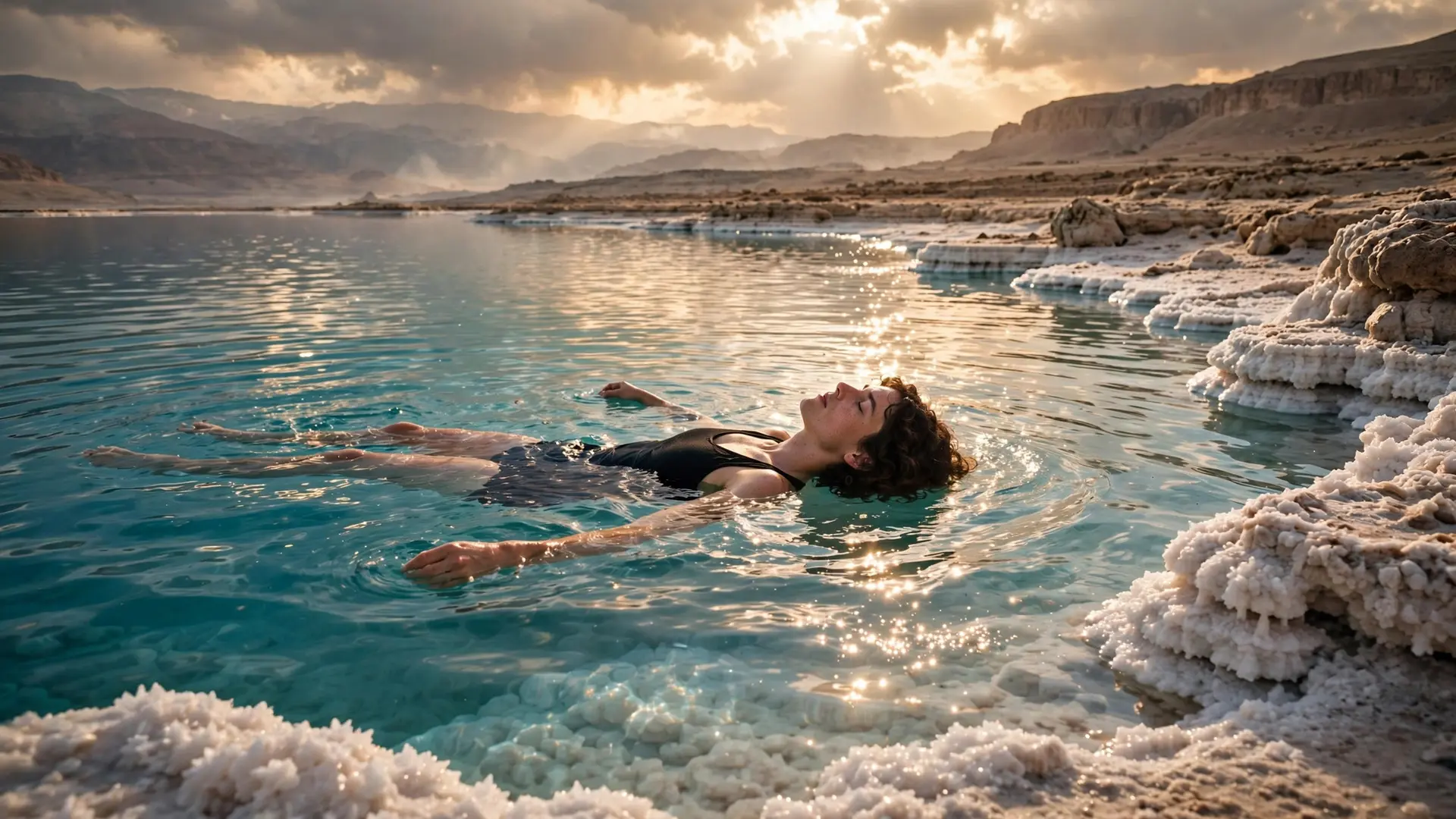
The Dead Sea is the lowest place on land because the ground beneath it is sinking. Its surface sits roughly 430 metres below sea level, lower than any other exposed shoreline on Earth. That depth is not an accident of erosion or a quirk of measurement. It is the result of tectonic plates pulling apart, a valley floor dropping over millions of years, and a lake with nowhere to drain. Stand on its shore and the paradox is immediate. The water is famously buoyant, the air feels thick and warm, and the surrounding desert mountains rise steeply on both sides. You are standing at the bottom of a geological staircase that never quite reaches the sea, in a basin that keeps getting deeper relative to the oceans it cannot join.
What pulls the Dead Sea downward?
The Dead Sea lies in the Jordan Rift Valley, a long depression where the African and Arabian plates are moving apart. NASA's Earth Observatory describes the process plainly: as the plates part, the land between them has subsided for millennia, and that sinking created the Dead Sea. Rivers, most notably the Jordan River, drain into the deep basin formed by the parting plates, and evaporation is the only outlet for the water. Think of the rift as a valley that is being stretched, not dug. As the crust thins and drops, the floor falls below the level of the surrounding land and, eventually, below sea level itself. The Dead Sea occupies the deepest part of that dropped floor. Its neighbours tell the same story in miniature: the whole rift system runs for more than 1,000 kilometres from the Sinai Peninsula towards Turkey, carrying a chain of valleys and lakes, but only the Dead Sea reaches this extreme depth. This is why the usual explanations fall short. The Dead Sea is not low because it was carved by a river, and it is not low because it sits in a crater. It is low because the crust beneath it is still, in geological terms, coming apart. The sinking did not happen in a single event, and it has not stopped. It is a slow, ongoing process, measured in millimetres a year over immense spans of time, yet its cumulative result is a shoreline hundreds of metres beneath the Mediterranean, only about 100 kilometres away.
Why does the water stay trapped so low?
A basin below sea level still needs a reason to hold water at that level rather than filling up or drying out entirely. The Dead Sea's answer is its closed drainage. The Jordan River flows in from the north, carrying fresh water and dissolved minerals washed from rocks upstream. Smaller streams add their share. But no river flows out. In the hot, arid climate, water escapes only by evaporation, and on a hot summer day NASA notes that the surface can drop by two to three centimetres from evaporation alone.
Evaporation does two things at once. It keeps the lake from filling, and it concentrates everything dissolved in the water. That is the direct link between the Dead Sea's depth and its saltiness: the same closed system that traps water at the bottom of a rift also traps salt. Live Science, citing the National Oceanic and Atmospheric Administration, puts the brine at five to nine times as salty as seawater, and notes that below about 100 metres the water becomes so concentrated that salt builds up on the seafloor. The question of why the Dead Sea is so salty deserves its own answer, but the short version is that the lake is a trap with only one exit, and that exit lets water out while leaving minerals behind. An earlier series of lakes once occupied this valley, but the last of them disappeared about 15,000 years ago, leaving the Dead Sea behind — a reminder that the basin is not stable. The claim needs a careful qualifier: lowest on land. The ocean floor plunges far deeper, and trenches in the Pacific reach more than 10,000 metres below sea level. But those are not land in the everyday sense; they are under water. The Dead Sea's shores are dry ground, walked on by people, lined with roads and resorts. That is what makes the record striking. It is not the deepest point on the planet. It is the lowest place a person can stand on dry land without being underwater. Figures for its elevation vary slightly by date, and that variation is itself informative. NASA's older Earth Observatory page gave nearly 400 metres below sea level, Live Science gave 429 metres, and Yale Environment 360, writing later, gave roughly 420 metres. The differences do not reflect disagreement. They reflect a moving target: the surface keeps falling, so a figure from one decade is already out of date in the next. Quoting roughly 430 metres today captures the current position while acknowledging that the lake is still on its way down. Other low places make useful comparisons. Death Valley in California sits about 86 metres below sea level. Much of the land reclaimed in the Netherlands lies below sea level too, but only by a few metres, and only because engineers drained and diked it. The Dead Sea needs no pumps.
Why is the Dead Sea falling even lower?
If the story ended with tectonics, the Dead Sea would be a stable curiosity. Instead, it is falling by about a metre a year, and the cause is largely human. The Jordan River, its main source of fresh water, has been heavily diverted for agriculture and drinking water. Yale Environment 360 reports that the river's flow has dropped by more than 98 percent, and that evaporation now far exceeds inflow: in one period studied, about 725 million cubic metres evaporated each year while only about 350 million cubic metres entered.
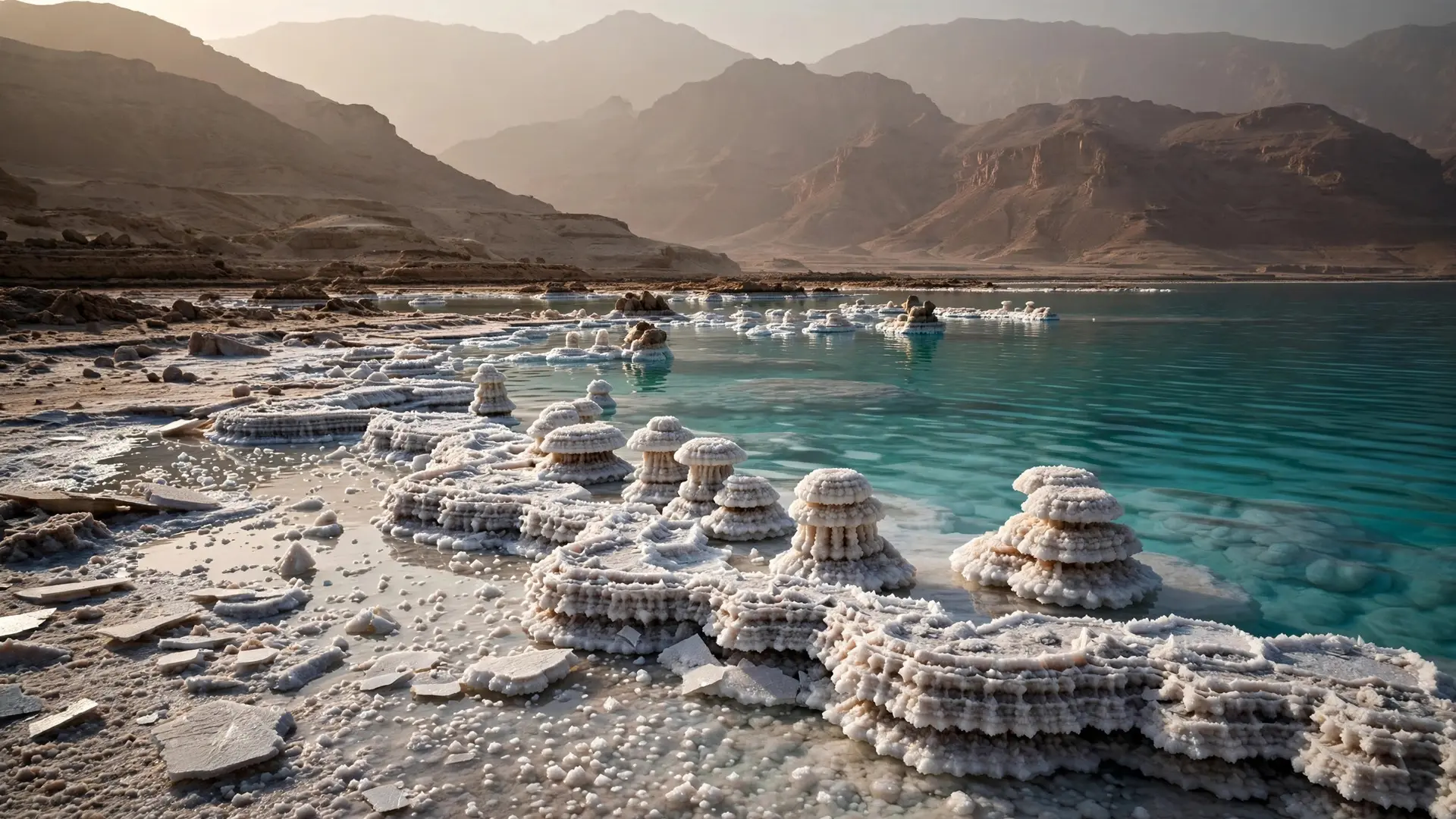
The consequences are visible along the shore. As the water retreats, it exposes salt layers that were once submerged. Fresh groundwater then dissolves those layers, creating underground voids that collapse into sinkholes. Thousands of sinkholes have opened around the coastal plain, threatening roads, buildings, and farmland. Salt-encrusted rocks that used to sit underwater now stick out of dry ground, marking old shorelines like tidemarks on a draining bath. There is also a quieter loss. The retreating water threatens springs and oases on the northern and western shores, habitats that support endemic species and lie on a major route for migrating birds.
What has the Dead Sea meant to people?
The lake's low, salty character has drawn people for thousands of years. NASA notes that ancient Egyptians used its salts for mummification, fertilisers, and potash, and modern industries still extract sodium chloride and potassium salts from its waters for uses ranging from water conditioning to road de-icing and plastics manufacture. Its shores have hosted health resorts since antiquity, trading on the buoyancy of the brine and the mineral-rich mud. Its cultural weight runs deeper still. Between 1947 and 1956, ancient texts were discovered in caverns near the sea's north-eastern shore. Those Dead Sea Scrolls include some of the oldest preserved fragments of the Hebrew Bible and other Judeo-Christian writings. That history sharpens the present dilemma. Proposals to save the lake, most famously a plan to carry water about 180 kilometres from the Red Sea, have been debated for decades. Yale Environment 360 reports early cost estimates as high as 10 billion dollars, alongside concerns that mixing Red Sea water into the Dead Sea would alter its chemistry. Critics argue the project is at least as much about supplying drinking water to Amman as about rescuing the lake.
What does the lowest place teach us?
The Dead Sea's depth is a lesson in how slowly geology works and how quickly people can change its outcome. Plates pulling apart over millions of years set the stage. A closed basin and fierce evaporation wrote the second act. Human diversion of a single river is now writing the third, at a pace of about a metre a year. That pace is what makes the record worth watching rather than merely admiring. A lowest point that keeps getting lower is not a fixed trophy. It is a gauge, showing how much water a region takes from its rivers and how much it returns. As long as the Jordan's flow remains a small fraction of its former volume, the gauge will keep dropping, and the shoreline will keep retreating from the resorts and roads built to meet it. The Dead Sea will remain the lowest place on land for the foreseeable future, because no other land basin comes close. But the number attached to that title will keep changing, and so will the landscape around it. The lake sits at the bottom of a rift because the Earth pulled the ground down. Whether it stays a living lake, rather than a shrinking salt pan, now depends less on geology and more on the choices made upstream.
Frequently asked questions
Is the Dead Sea really below sea level?
Yes. Its surface sits roughly 430 metres below sea level, making its shores the lowest land-based elevation on Earth. The exact figure keeps changing because the water level is still falling.
Why is the Dead Sea so salty?
The Jordan River brings in water and dissolved minerals, but the lake has no outlet. Water escapes only by evaporation, leaving the salts behind, so the brine grows ever more concentrated.
Will the Dead Sea disappear?
Not imminently, but it is shrinking steadily. Without more inflow, it will keep retreating to a smaller, saltier remnant, leaving sinkholes and abandoned shorelines behind.
Sources
- Dead Sea, NASA Earth Observatory
- The Dead Sea, NASA Science
- Why Is the Dead Sea So Salty?, Live Science
- The Dead Sea is Dying: Can A Controversial Plan Save It?, Yale Environment 360