What Is the Saltiest Lake on Earth? It's Don Juan Pond
What is the saltiest lake on Earth? Don Juan Pond in Antarctica stays liquid at -50°C (-58°F) at over 40 percent salinity, saltier than the Dead Sea.
Key takeaways
- Don Juan Pond in Antarctica stays liquid at -50°C (-58°F) thanks to salinity over 40 percent, more than ten times the ocean's.
- 90 to 95 percent of its dissolved salts are calcium chloride, which drives the freezing point far below seawater's.
- The pond held the 'saltiest body of water' title from its 1961 discovery until 2017, when Ethiopia's Gaet'ale Pond measured 433 g/L.
- Brown University researchers showed the pond's water comes from the air, as soil salts pull moisture from the atmosphere.
- The ankle-deep pond now covers about 0.03 sq km, down from 0.25 sq km on 1977 USGS maps.
Don Juan Pond in Antarctica's Wright Valley stays liquid at temperatures down to -50°C (-58°F), saltier than the Dead Sea at more than 40 percent salinity. The catch: since 2017, a tiny pond in Ethiopia named Gaet'ale has measured even saltier, at 433 g/L, ending Don Juan's 56-year run as the undisputed champion. The key facts, each confirmed in a source you can open:
- In 2014, NASA described Don Juan Pond as the world's saltiest body of water, with salinity over 40 percent against 3.5 percent for the open ocean.
- Between 90 and 95 percent of the pond's dissolved salts are calcium chloride, which pushes the freezing point far below seawater's and keeps it liquid at -50°C (WorldAtlas).
- The pond's salinity has been measured from 200 g/L in wet periods to 474 g/L during evaporative draws, averaging around 400 g/L (WorldAtlas).
- In 2017, Ethiopia's Gaet'ale Pond was measured at 433 g/L (43.3 percent) by Addis Ababa University researchers, a Guinness-confirmed result that displaced Don Juan's 1961-2017 reign (WorldAtlas).
- Brown University geologists Jay Dickson and James Head showed in 2013 that the pond's water comes from the atmosphere: salts in the soil pull moisture from the air through deliquescence (NASA).
Where is Don Juan Pond?
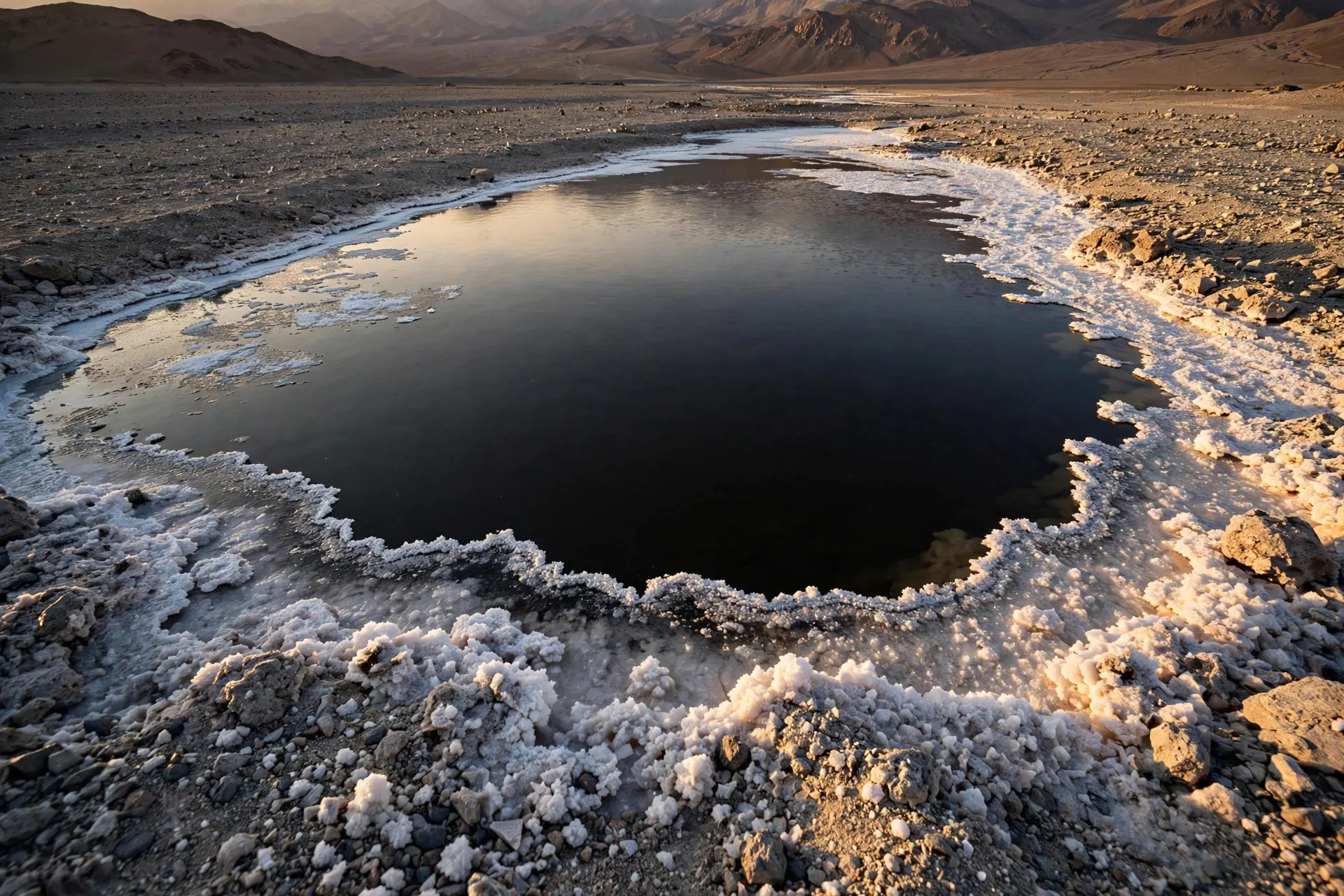
The pond sits in the lowest part of Upper Wright Valley, one of the McMurdo Dry Valleys in Victoria Land, Antarctica. The Dry Valleys are among the most extreme places on the planet: it rarely snows there and never rains, winter temperatures drop to -50°C (-58°F), and nearly every lake and pond sits under ice several meters thick. NASA's Earth Observing-1 satellite photographed the pond on January 3, 2014, showing its dark ellipse against the salt-encrusted lakebed, with the permanently frozen Lake Vanda visible to the northeast.
Don Juan Pond is not much to look at. It is ankle-deep, a shallow flat-bottomed pool whose area has shrunk dramatically in recent decades: USGS topographic maps from 1977 show it covering about 0.25 square kilometers (62 acres), while today it covers only about 0.03 square kilometers. In December 1998 it was almost dry everywhere except a few tens of square meters of water pooled around large boulders. What it lacks in size it makes up for in chemistry.
Why is Don Juan Pond so salty?
Ordinary seawater is mostly sodium chloride, table salt, at about 35 grams per liter. Don Juan Pond is a different recipe entirely: 90 to 95 percent of its dissolved load is calcium chloride. That matters because dissolved salts interfere with the formation of ice crystals, lowering the temperature at which water freezes. Calcium chloride does this far more aggressively than table salt, which is why the pond stays liquid at -50°C while every other water body in the Dry Valleys freezes solid. The numbers put it in perspective. Don Juan's salinity ranges from 200 g/L in wetter periods to 474 g/L when evaporation concentrates the brine, averaging around 400 g/L, roughly twelve times the ocean. The famous Dead Sea, by comparison, sits at 337 g/L (34 percent). The Great Salt Lake swings between 5 and 27 percent depending on the arm. Tanzania's Lake Natron owes its own extreme chemistry to sodium carbonate rather than chloride, a different kind of harsh. Nobody fully agrees on where all that calcium chloride comes from. For decades, hydrologists assumed deep groundwater bubbled up from below, carrying dissolved minerals from the rocks under the valley floor. A competing idea says the salts form near the surface, in the soils of the valley walls. The truth may be a mix of both, and researchers are still working it out.
Where does its water come from?
This is where the story gets strange. In one of the driest places on Earth, a pond persists, so the water must be coming from somewhere. The old assumption was groundwater upwelling. But in 2013, Brown University geologists Jay Dickson and James Head published a study in Scientific Reports that pointed to the sky instead.
The pair set up cameras that took thousands of time-lapse photographs of the pond and its surroundings. What they saw: salts in the soil sucking available moisture straight out of the air, a process called deliquescence. The water-rich salts then trickle downslope toward the pond, often mixing with small amounts of meltwater from snow and ice, leaving dark water tracks on the ground that are visible even from satellites. Two months of images taken at five-minute intervals mapped the inputs precisely: freshwater arrives from the west, while previously undocumented seeps of brine feed in from the east, pulsing with daily spikes in surface temperature. Input from deep groundwater was not observed. The finding has an interplanetary echo. The same deliquescence process may explain the dark briny streaks that orbital cameras have spotted on Mars, which is one reason astrobiologists find Don Juan Pond so interesting. "Mars has a lot of salt and used to have a lot of water," Dickson told NASA.
Is Don Juan Pond still the saltiest lake on Earth?
Honestly, it depends on the year you ask. From its discovery in 1961 until 2017, Don Juan Pond held the title of saltiest body of water on Earth without serious challenge. Then came Gaet'ale Pond: a 60-meter pool in Ethiopia's Danakil Depression, fed by a hot spring reactivated by a 2005 earthquake, where 2017 measurements led by Erika Pérez and Yonas Chebude of Addis Ababa University found 433 g/L, confirmed by Guinness World Records. The Danakil Depression is already one of the strangest places on Earth; it now hosts the saltiest water, too. But the crown is messier than it looks. Don Juan's own salinity has been measured as high as 474 g/L during evaporative draws, higher than Gaet'ale's 433. The two ponds are both tiny, both swing with the seasons, and "saltiest" depends on when the sample was taken. Here is how the contenders compare:
| Body of water | Peak measured salinity | Standing |
|---|---|---|
| Gaet'ale Pond, Ethiopia | 433 g/L (43.3%) | Guinness-confirmed saltiest natural body of water (2017) |
| Don Juan Pond, Antarctica | 474 g/L (peak); ~400 g/L average | Saltiest of the Antarctic lakes; held the world title 1961-2017 |
| Lake Retba, Senegal | ~400 g/L (40%) | Ties Don Juan's average |
| Dead Sea | 337 g/L (34%) | Most famous; ranks behind the leaders |
| Great Salt Lake | 142-317 g/L (5-27%) | Varies by arm and season |
| Open ocean | 35 g/L (3.5%) | The baseline |
| What most people get wrong is assuming the Dead Sea wins. It does not even medal. And the deeper point is that Don Juan Pond remains unique regardless of the ranking: it is the only major Antarctic lake that almost never freezes, a calcium-chloride anomaly in a frozen continent, and a working model for how liquid water might persist on Mars. | ||
| The saltiest lake on Earth is a title, and titles change hands. The stranger fact is that liquid water exists at all in a valley that never sees rain, at fifty below zero, in a pond you could wade across. Don Juan Pond does not need the crown to be remarkable. | ||
| How we made this article: FactSpire researched and drafted it with AI assistance and checked every fact against the sources listed above. |
Frequently asked questions
Where is Don Juan Pond?
In the lowest part of Upper Wright Valley, in Antarctica's McMurdo Dry Valleys. It sits about 9 km west of the permanently frozen Lake Vanda, in a polar desert where it rarely snows and never rains, and winter temperatures drop to -50°C (-58°F).
Why doesn't Don Juan Pond freeze?
Between 90 and 95 percent of its dissolved salts are calcium chloride, which depresses the freezing point far below that of ordinary seawater. With salinity over 40 percent, the brine stays liquid at temperatures that freeze every other lake in the McMurdo Dry Valleys solid.
Is the Dead Sea the saltiest lake in the world?
No. The Dead Sea, at 337 g/L (34 percent), is famous but ranks behind several hypersaline lakes. Don Juan Pond averages around 400 g/L and peaks at 474 g/L, while Ethiopia's Gaet'ale Pond was measured at 433 g/L in 2017 and confirmed by Guinness World Records.
Could anything live in Don Juan Pond?
Possibly. NASA notes the pond's tantalizing appeal for astrobiologists: if microscopic life survives in such extreme brine, it strengthens the case that life could exist in salty features on Mars. Researchers have found hints of biological activity, though abiotic chemistry could explain it.
Sources
- Saltiest Pond on Earth, NASA Earth Observatory
- December Puzzler Answer: Don Juan Pond, NASA Science
- The World's Saltiest Bodies of Water, WorldAtlas