How Angkor Wat's Builders Moved Millions of Stone Blocks
How did Angkor Wat's builders move millions of sandstone blocks from Mount Kulen? They floated them down a 37 km canal shortcut to the temple site.
Key takeaways
- Angkor Wat used 5 to 10 million sandstone blocks, each weighing up to 1,500 kg, all cut at quarries near Mount Kulen.
- Builders floated the blocks 37 km down a purpose-built canal network instead of hauling them 90 km by river and lake.
- The canal shortcut helps explain how the temple rose in about three decades under King Suryavarman II.
- The sandstone came from about 50 quarries found along an embankment at the foot of Mount Kulen.
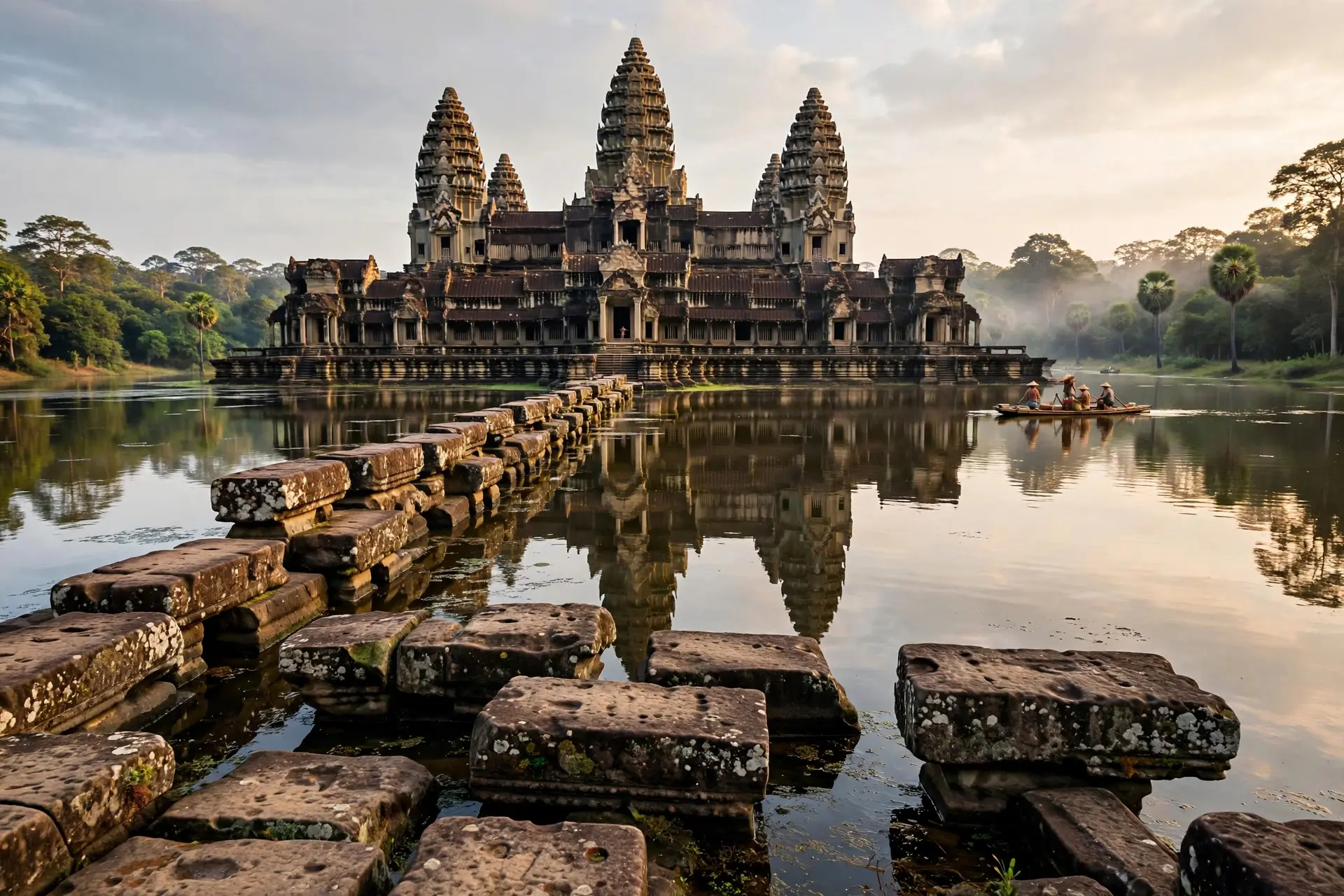
- Angkor Wat covers 400 acres and is the world's largest religious structure.
They floated them. Angkor Wat's builders cut 5 to 10 million sandstone blocks at Mount Kulen, loaded them onto rafts, and floated them 37 kilometres (23 miles) down a canal network to the temple site. The shortcut cut the old 90-kilometre (56-mile) river route by more than half and helped finish the world's largest religious structure in about three decades.
- Angkor Wat used 5 to 10 million sandstone blocks, each weighing up to 1,500 kilograms (3,300 pounds).
- The blocks travelled 37 kilometres by canal, instead of 90 kilometres by river and lake.
- Researchers found about 50 quarries along an embankment at the foot of Mount Kulen.
- King Suryavarman II, who ruled from 1113 to about 1150, ordered the temple built over roughly three decades.
- The complex covers 400 acres (160 hectares), making it the world's largest religious structure.
- The wider Angkor site stretches across about 400 square kilometres of temples, reservoirs and canals.
Where did Angkor Wat's stone come from?
From a mountain about 37 kilometres northeast of the temple. The sandstone used in Angkor Wat was quarried at the foot of Mount Kulen, known in Khmer as Phnom Kulen, where the rock matches the blocks in the temple walls. A survey by Etsuo Uchida of Waseda University in Japan and his team found around 50 quarries along an embankment at the mountain's base. Angkor Wat was the state temple of King Suryavarman II, built in the early 12th century as a Hindu shrine to the god Vishnu and as the king's own tomb. Its five towers stand for the five peaks of Mount Meru, the mountain where Hindu gods were believed to live, and its wide moat stands for the ocean around that mountain. The whole complex covers 400 acres, and the wider Angkor site, with its scores of temples and huge reservoirs, stretches across about 400 square kilometres. Moving the stone was a project on the same scale as the temple itself.
Why was the old route so slow?
Before the canal discovery, archaeologists assumed a long, awkward journey. The accepted theory ran like this: blocks were dragged overland from the quarries to a river, floated down to Tonle Sap, the great lake south of Angkor, then sailed across the lake and rowed upstream along the Siem Reap River to the building site. The full trip measured about 90 kilometres, and the final stretch ran against the current, which meant slow, hard rowing with a 1.5-ton block on board. That route never quite added up. At that pace, moving 5 to 10 million blocks should have taken far longer than the roughly three decades the temple actually took to build. The numbers pointed to a faster method, but nobody could see it from the ground. The answer only showed up when researchers looked at the landscape from above.
How did the canal shortcut work?
Uchida's team studied satellite images of the land between Mount Kulen and Angkor and found a network of hundreds of canals and roads linking the quarries directly to the temple site. The route measured only 37 kilometres, less than half the old river route, and it ran mostly downhill, so rafts loaded with stone could float toward Angkor with the flow of water instead of fighting it. The canals were not natural rivers pressed into service. The pattern points to channels built for moving stone: they link the quarries to the temple, run mostly downhill, and join short stretches of river where that helped. The survey found the quarry sites at the mountain end and the canal grid at the temple end, with the route between them far shorter than the old river journey. The shortcut changes the arithmetic of the whole project. Moving each block became a short float downstream instead of a long haul by land and a slow row upstream. It also shows what the Khmer were best at: not just carving stone, but shaping water. The same skill built the reservoirs and canals that watered Angkor's rice fields and fed its cities, and UNESCO lists those hydraulic works as part of what makes the site exceptional.
| Old river route | Canal shortcut | |
|---|---|---|
| Distance | About 90 km (56 miles) | About 37 km (23 miles) |
| Path | Overland drag, then Tonle Sap lake crossing | Direct canal from the quarries |
| Final stretch | Rowed upstream on the Siem Reap River | Downhill float with the water flow |
| Speed | Days of hauling, sailing and rowing | A far shorter raft trip downstream |
What most people get wrong about Angkor Wat's construction
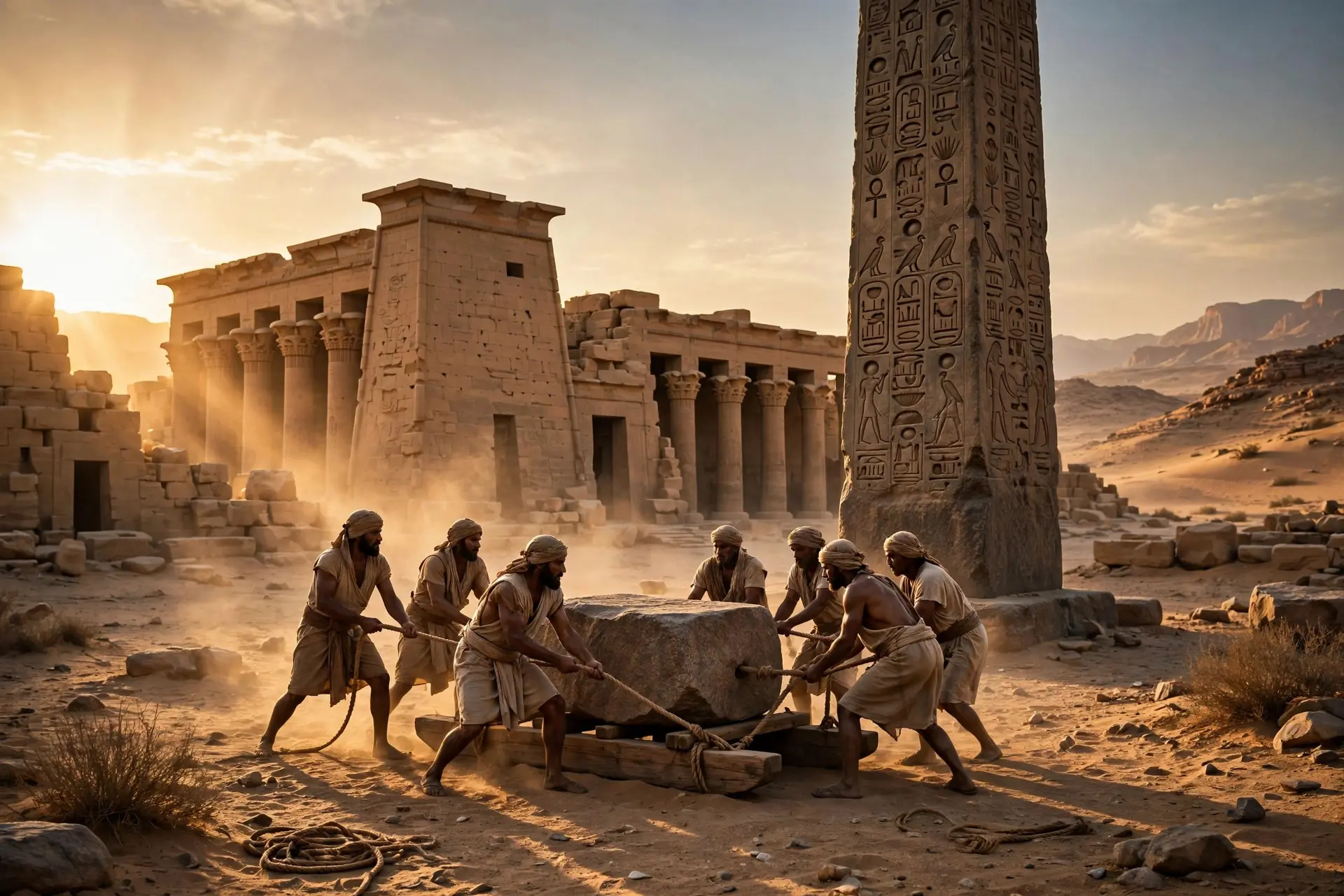
The common picture is thousands of workers dragging stones through the jungle, and that picture is only half right. Dragging happened at the quarry end, where blocks were loaded onto sledges and hauled to the water. But the long journey was a water journey, and the Khmer built the waterway for it. The canals were infrastructure, planned and dug, not a lucky river. A second mistake is the idea that the temple took centuries. It did not. Construction ran for about three decades under one king, Suryavarman II, and the canal system is the most likely reason the schedule held. A third is treating Angkor Wat as a single temple. It is a complex of more than a thousand buildings inside a walled enclosure, and the stone-moving operation supplied the entire site, not one shrine. The lesson travels well beyond Cambodia. Like the Egyptian crews who moved pyramid stones and the granite workers who drilled hard stone with copper tools, the Khmer solved a heavy-lifting problem by changing the route instead of adding muscle. The Inca masons who fitted stone without mortar worked the same way, letting geometry and gravity do what force could not. And like the crews who raised Egypt's obelisks, they finished a monument that still defines its civilization nine centuries later. Angkor Wat still stands because its builders thought in systems. They quarried in one place, dug a canal to move the stone, and built a temple that doubled as a model of the universe. The canal is gone from most maps, but its logic is still visible in the temple: millions of blocks, each up to 1,500 kilograms, all in the right place, delivered by water. How we made this article: FactSpire researched and drafted it with AI assistance and checked every fact against the sources listed above.
Frequently asked questions
Where did Angkor Wat's stone come from?
The sandstone came from quarries at the foot of Mount Kulen, about 37 km northeast of the temple. Researchers found around 50 quarries along an embankment at the mountain's base, and the stone there matches the blocks in Angkor Wat's walls.
How long did it take to build Angkor Wat?
About three decades. King Suryavarman II, who ruled from 1113 to about 1150, ordered the temple built as a Hindu shrine to the god Vishnu. The canal transport system is one reason the work moved faster than earlier estimates suggested.
Did workers drag the stones overland all the way?
No. The old theory had blocks dragged overland, then floated across Tonle Sap lake and rowed upstream, a 90 km trip. Satellite surveys found a 37 km canal network instead, which let rafts float the blocks straight to the site.
Why is Angkor Wat so large?
It was built as a state temple and royal tomb for Suryavarman II, and its design mirrors Hindu cosmology, with five towers standing for the peaks of Mount Meru. The complex covers 400 acres, making it the world's largest religious structure.
Sources
- Mystery of Angkor Wat Temple's Huge Stones Solved, Live Science
- Angkor Wat, Encyclopaedia Britannica
- Angkor, UNESCO World Heritage Centre