How Did the Inca Fit Stones Without Mortar?
Inca masons cut each stone to match its neighbors with hammerstones and tracing, letting gravity close the joint. Here is how their mortarless walls were built.
Key takeaways
- The Inca cut each stone to fit its exact neighbors, using hammerstones and abrasion instead of mortar, so joints closed by gravity and friction.
- Experimental archaeology suggests a 'scribe and fit' method: tracing the lower stone's outline onto the upper block, then grinding it down to match.
- Mortarless walls flex in earthquakes — stones shift slightly and resettle rather than cracking, an advantage in the seismically active Andes.
- The finest dry-stone work was reserved for temples and royal buildings; ordinary Inca structures used rougher stone set in mortar.
- Scanner studies show the famous knife-tight fit is mostly at the wall's face; deeper inside, joints can be concave or packed with rubble.
The short answer is patience and geometry. Inca masons shaped each block to match the exact stones beside it, wearing the faces down with harder stones and a method of tracing one stone's outline onto its neighbor, then let gravity pull the pieces together. No mortar was needed because every joint was custom-cut — and the mortarless fit turned out to be a feature, not a limitation, since the walls can flex in earthquakes instead of cracking. What looks like magic from a few steps back becomes methodical up close. The joints are tightest at the visible face, the stones are matched three-dimensionally like puzzle pieces, and the whole system was built by an empire that organized labor the way other states organized armies.
What does mortarless Inca masonry actually look like?
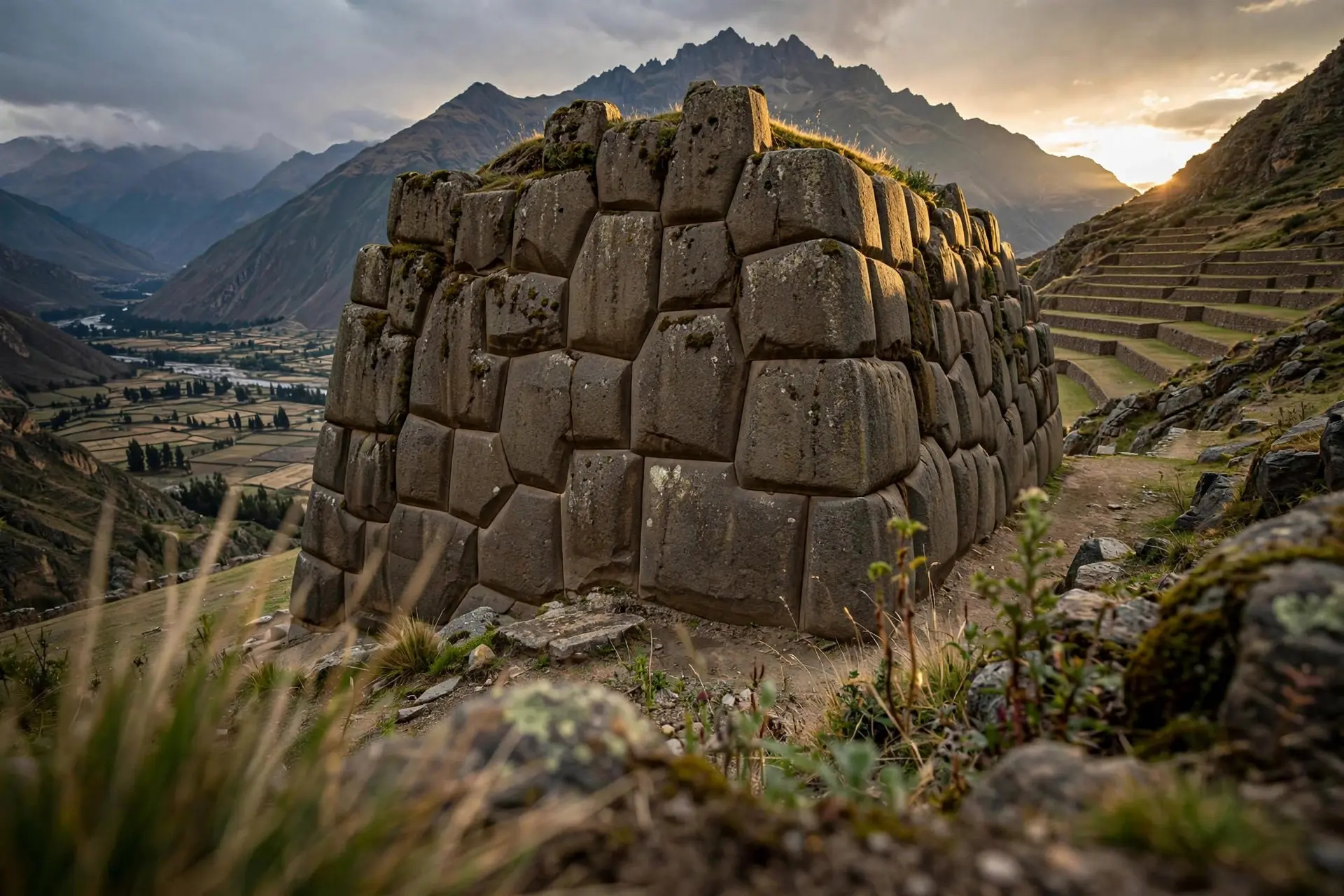
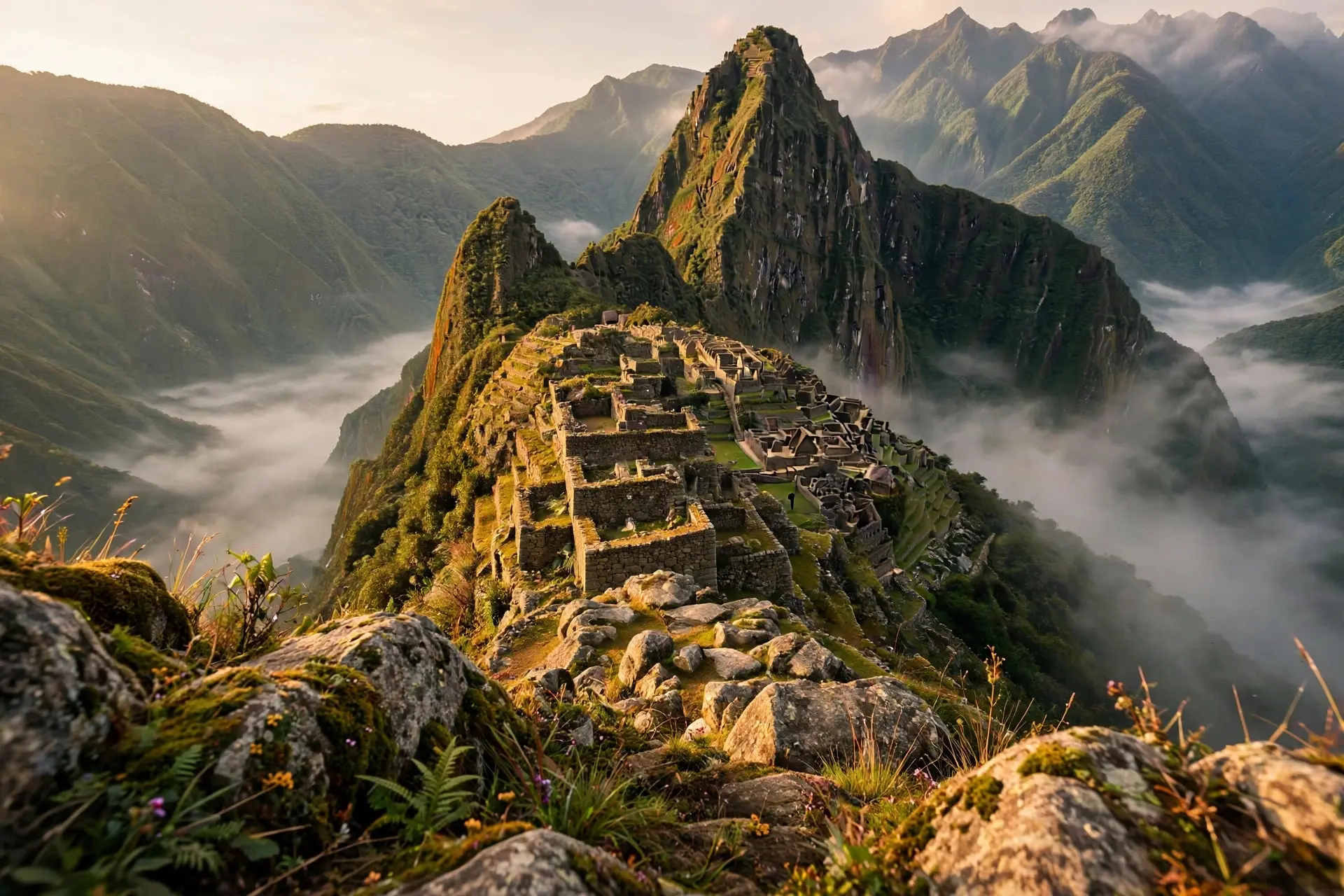
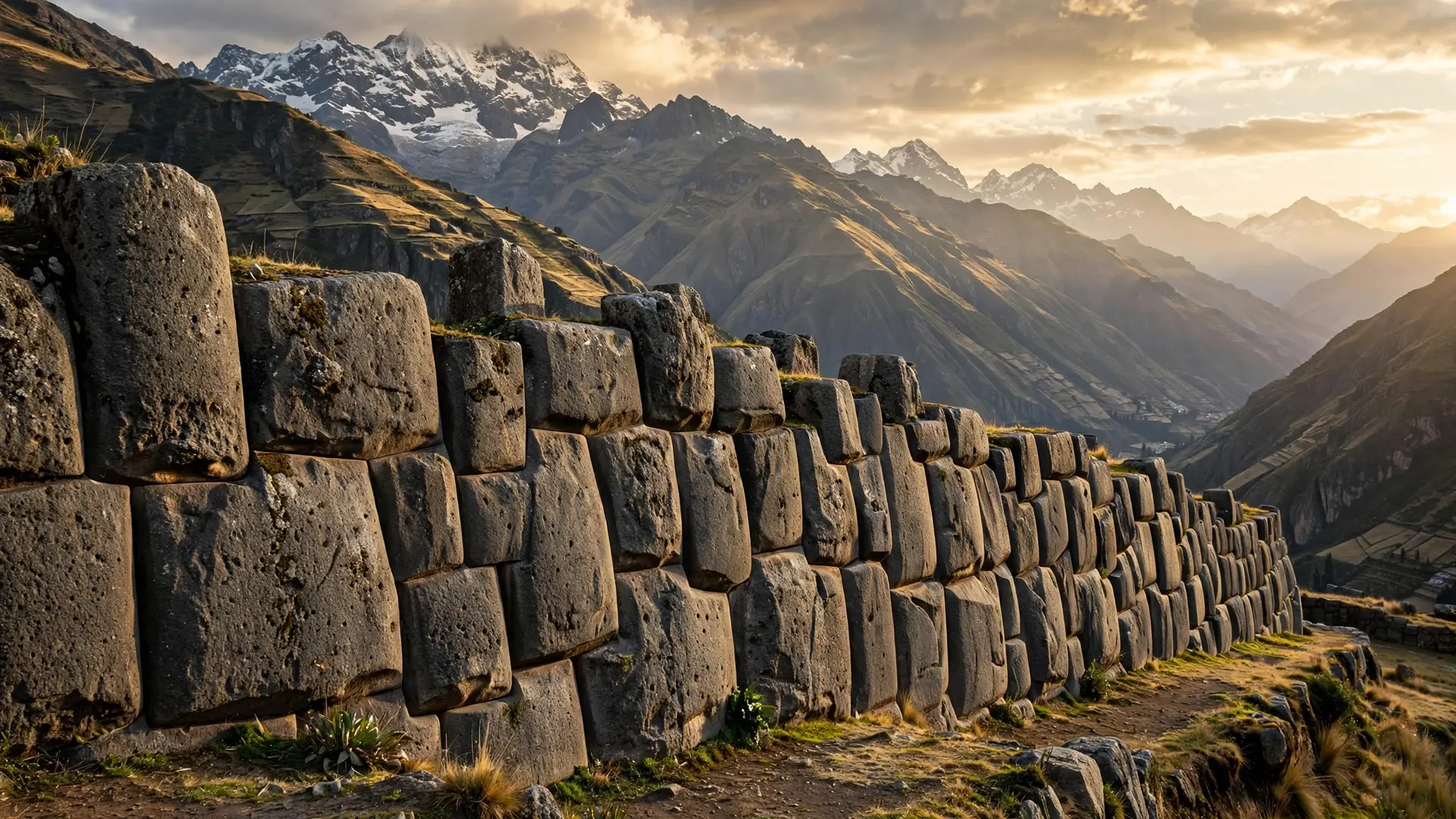
There are two signature styles. The first is coursed ashlar: rectangular blocks laid in neat horizontal rows, the kind of work you see in the Coricancha temple in Cusco and the Sun Temple at the royal mountain estate of Machu Picchu. The second is polygonal masonry, and it is the one that stops visitors in their tracks: huge irregular blocks with wavy edges and many angled corners, interlocking with every stone around them. The most famous example is the twelve-angled stone set into a street wall in Cusco, each of its edges fitted snugly against a different neighbor. Here is the first thing most summaries get wrong: this was not how the Inca built everything. Most ordinary Inca buildings were made of fieldstones or adobe set in mud mortar. The dry-laid precision work was reserved for temples, palaces and royal estates. The quality of the stonework advertised the importance of the building — walk up to a wall of perfect polygonal blocks and you knew you were somewhere that mattered.
How did they shape and fit the stones?
The toolkit was Stone Age-simple: hammerstones, mostly hard river cobbles of quartzite, some weighing up to around 10 kilograms. The architect and researcher Jean-Pierre Protzen spent years testing what these could actually do, and his experiments convinced him that Inca masons shaped stone by pounding, not slicing — striking the surface again and again to wear it down through percussion. Sand and water then polished the contact faces, and wooden wedges driven into natural cracks (and soaked so they swelled) helped split blocks from the quarry. The fitting itself is where the real ingenuity lives. One proposed method is trial and error on a heroic scale: rough-shape a block on the ground, hoist it into the wall, mark where it rubs, lower it, chip away the high spots, and repeat until the fit closes. The other is called scribing and coping. In this version the upper block is suspended just above the lower one — on wooden blocks or packed earth — and the mason traces the lower stone's profile onto the upper one with a wood or bone tool, then grinds the upper stone down along that line. As material comes off, gravity eases the block down into its seat. Protzen's own experiments pointed him toward trial and error, but both methods share the same principle: shape each stone to its neighbors, never to a standard size. No two blocks in a wall are interchangeable. None of this was quick, and the Inca compensated with organization. Their mit'a labor system required adult men to work on state construction projects, and Spanish chroniclers described the scale with something close to awe: Pedro Cieza de León, writing in the 1550s, reported around 20,000 workers on the Sacsayhuamán fortress above Cusco — thousands quarrying and dressing stone, thousands more hauling blocks with thick leather and fiber cables. Moving the stone was its own discipline: teams of men pulling ropes, wooden rollers and sledges, earthen ramps. Like Egypt's pyramid builders, the Inca proved that organized human muscle, given enough of it, can substitute for machines.
Why would anyone skip mortar on purpose?
Because the Andes shake. Mortar is rigid: when an earthquake hits, a mortared wall concentrates stress at its stiffest points and cracks. A dry-laid wall behaves differently. Each stone is held by geometry and weight alone, so during a tremor the blocks can shift by a hair and then settle back into place. Observers have described Inca blocks "dancing" during strong quakes and returning to their original positions afterward — which is exactly what you want a wall to do. The masons stacked the deck further. Inca walls typically lean slightly inward, by a few degrees, which lowers the center of gravity and adds stability. Doorways, windows and niches are trapezoidal — narrower at the top — a shape that sheds earthquake forces better than a rectangle. The famous pillowed look of polygonal walls, with convex faces and beveled, sunken joints, is not just decoration either: it gives each block room to move a fraction without jamming against its neighbors. The decision that looks like a limitation — building without mortar in an earthquake zone — is the reason these walls outlasted the colonial masonry later built on top of them.
Is the famous knife-blade test really true?
Mostly, and with an asterisk. The classic claim is that the joints are so tight you cannot slide a knife blade between the stones, and at the face of the wall that is genuinely true of the finest work. But modern scanner studies have shown that the perfect fit is mostly skin-deep: real stone-to-stone contact concentrates along the outer edge of the joint, roughly the first 10 to 20 centimeters, while the interior of the joint is often concave and sometimes packed with rubble. In some walls the snug lateral fit is only a few centimeters deep. This does not diminish the achievement — it explains it. The masons lavished their effort where it mattered: the visible seam that locks the geometry and carries the eye. Behind it, a looser core still lets the wall breathe and settle. It also punctures the wilder theories about the stonework. The tool marks are right there on the stone faces: hammerstone pocks, abrasion, patient percussion. We may never recover every detail of the masons' workflow, but the evidence says the method was human skill at an inhuman scale of patience — no lost technology required. Five centuries on, the walls still stand because the Inca understood their ground better than the ground understood them. They had no iron, no wheel in practical use, no written plans. What they had was stone, rope, sand, water, a labor system that could marshal tens of thousands of hands — and the insight that a wall which gives a little can stand forever.
Frequently asked questions
Did the Inca really use no mortar at all?
Not everywhere. Everyday Inca buildings used fieldstone and adobe set in mud mortar. The precision dry-stone technique was reserved for the most important temples, palaces and royal estates.
How did they cut stone without iron tools?
They pounded it. Experiments by archaeologist Jean-Pierre Protzen showed that hard river-cobble hammerstones can shape andesite by patient percussion, and sand with water polished the contact faces.
Why did mortarless walls survive earthquakes?
Because they flex. With no rigid mortar, individual stones can shift a fraction and settle back instead of cracking apart — a real advantage in the seismically active Andes.