The Fall of the Western Roman Empire, Explained
In 476 a Germanic general deposed the last Western emperor — but Rome's fall was a slow unraveling of armies, money and authority, not a single day's collapse.
Key takeaways
- In 476 CE the Germanic commander Odoacer deposed the last Western emperor, Romulus Augustulus, and sent the imperial regalia to the Eastern emperor Zeno.
- Britannica calls the fall 'multifaceted': 5th-century invasions plus corruption, weak armies and urban elites abandoning public service.
- Rome was sacked by the Visigoths in 410 — a shock that exposed the empire's weakening grip decades before 476.
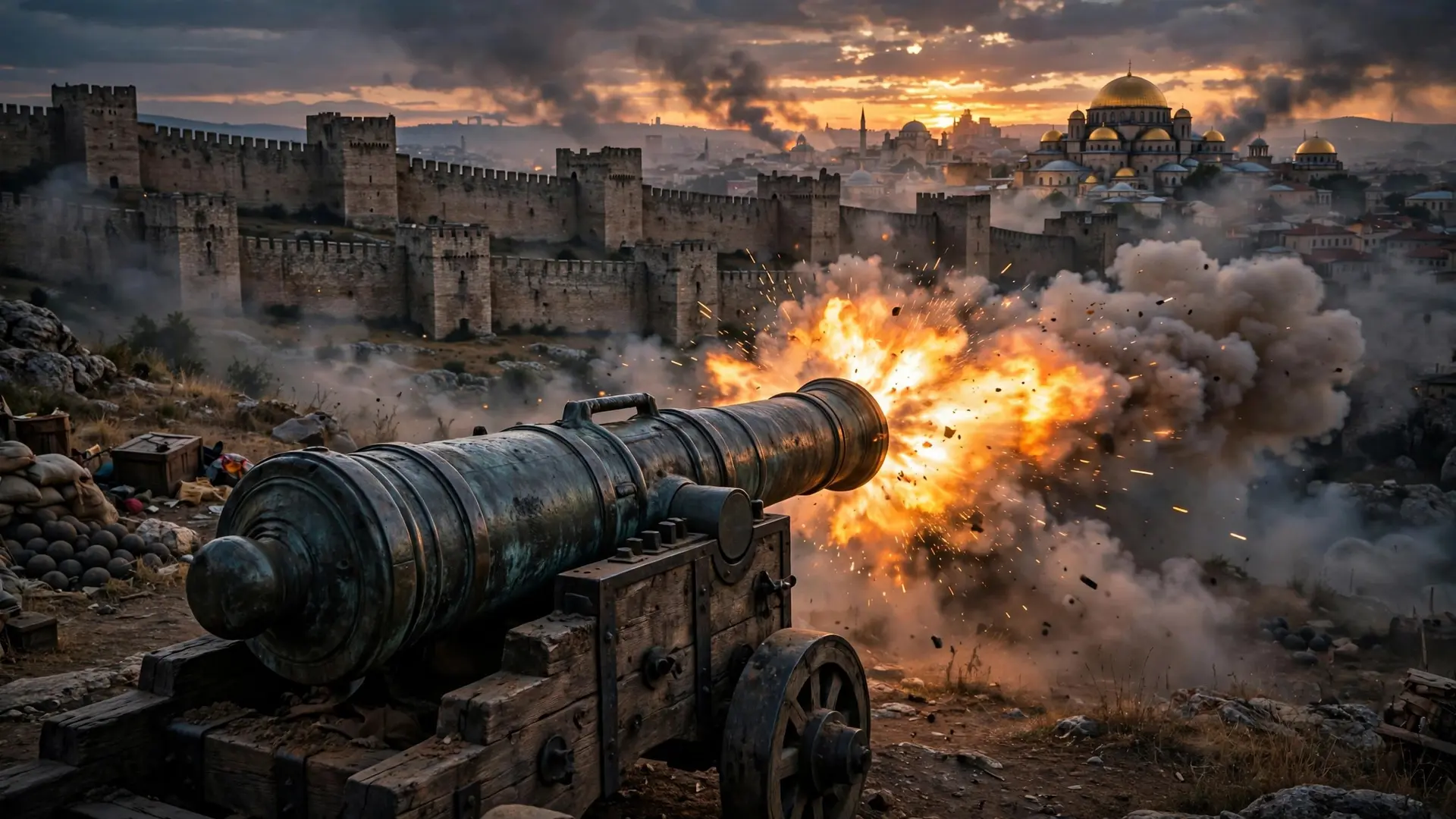
- The Eastern Roman Empire survived nearly 1,000 more years as the Byzantine Empire, finally falling in 1453.
- Historians increasingly read the 'fall' as a transformation: Roman law, language and the Church carried on under new rulers.
The textbook answer is 476 CE, when the Germanic commander Odoacer deposed the teenage emperor Romulus Augustulus and sent the imperial crown to Constantinople. But the honest answer is messier: by 476 there was barely an empire left to fall. The Western Roman Empire had been dissolving for decades as territory, tax revenue and military control slipped from Rome's grasp — and the "fall" is partly a label that later historians attached to a slow unraveling. That does not make 476 meaningless. It marks the moment when everyone stopped pretending. No one would wear the Western imperial title again.
What actually happened in 476?
By 475 the Western Empire was, in practical terms, Italy plus a few scraps of territory. Real power had belonged to generals for years. One of them, Orestes — a Roman officer who had once served as a secretary to Attila the Hun — overthrew the reigning emperor and installed his own young son on the throne. The boy was named Romulus Augustulus: Romulus for Rome's legendary founder, Augustus for its first emperor. Contemporaries mocked the diminutive as "little Augustus." He was about fourteen and never held real power. The end came from inside the army. Odoacer, a Germanic commander, led a revolt of the barbarian troops who demanded land in Italy. When Orestes refused, Odoacer had him killed and deposed the boy emperor. Instead of executing Romulus Augustulus, Odoacer retired him with a pension — the ancient world's gentlest regime change. Then came the gesture that made 476 symbolic. Odoacer sent the imperial regalia — the crown, the robes, the symbols of office — east to Emperor Zeno in Constantinople. The message was plain: there was no need for a separate Western emperor anymore. Zeno was, in theory, emperor of the whole Roman world; in practice, Odoacer ruled Italy himself as king, with the Senate's cooperation. The Western imperial throne simply went vacant, and stayed that way.
The date itself is a historian's choice more than a fact of nature. The 18th-century historian Edward Gibbon popularized 476 as the fall's demarcation, and the convention stuck — but other scholars nominate different moments: the Visigothic sack of Rome in 410, the Rhine frontier crossing of 406, or even 480, when the Eastern emperor Zeno formally dissolved the Western court after the assassination of Julius Nepos, the last Western emperor Constantinople recognized. Each date marks a different facet of the same long dissolution.
Why did the empire come apart?
Britannica's summary is the right starting point: the fall was "multifaceted." Start with the outside pressure. In the fifth century, peoples from beyond the frontiers — Goths, Vandals, Huns and others — pushed into Roman territory in waves the legions could no longer stop or absorb. In 410 the Visigoths sacked Rome itself, the first time the city had fallen to an enemy in centuries. The shock echoed across the Mediterranean world: if Rome could be looted, the empire's protection was a fiction. Then the internal decay that made the invasions fatal. Britannica lists corruption and abuse of power, undisciplined and poorly equipped soldiers, and the alienation of urban elites from public service — the wealthy classes who had once funded and run the cities simply stopped participating. Add the feedback loop that finished the job: as territory was lost, the tax base shrank; with less revenue, Rome could field fewer soldiers; with fewer soldiers, more territory was lost. By the final decades, the Western army was a shadow force, and the "barbarian kingdoms" carving up the provinces were often former Roman allies who had been settled inside the frontiers and granted land in exchange for military service. It is worth noting what did not happen. There was no single catastrophic battle, no dramatic last stand of the legions. Central authority thinned out province by province until, in Italy, a Germanic general was the only authority left standing.
Did Rome really fall at all?
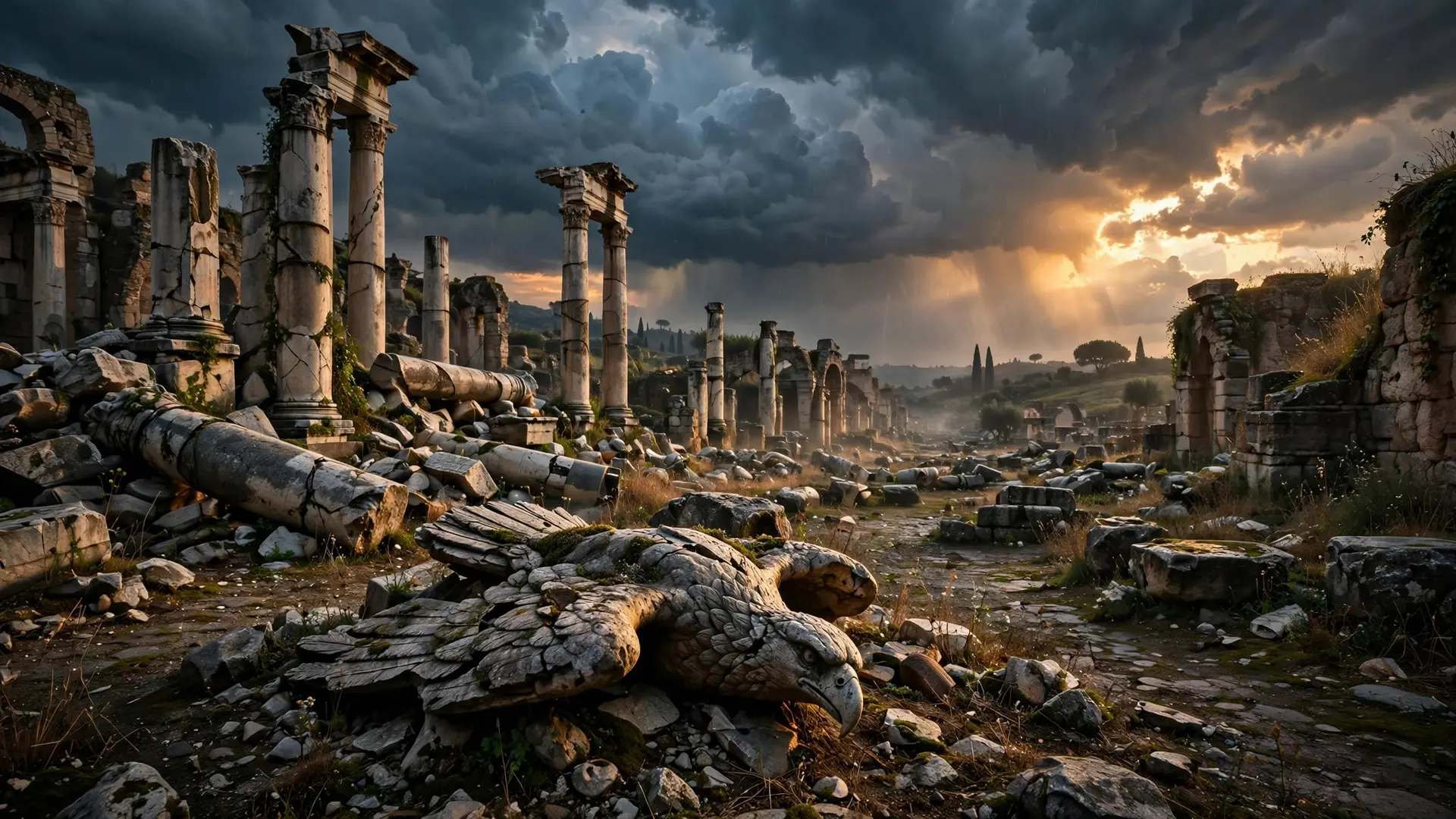
Here is the twist that complicates every simple version of the story: only half the empire fell. The East — richer, stronger, anchored on Constantinople — survived 476 entirely and continued as the Byzantine Empire for nearly another thousand years, until the fall of Constantinople in 1453. When schoolbooks say "Rome fell," they mean the Western administrative half. And even in the West, the break was softer than the word "fall" suggests. Odoacer kept the Roman administration running: the Senate met, the tax collectors collected, the laws stayed on the books. For an ordinary Italian farmer, the change of regime may have been barely noticeable. Many of these kingdoms were former Roman allies who had been granted lands inside the empire in exchange for military service, and they went out of their way to look Roman: the old administrative systems kept running, and the new kings acknowledged the Eastern emperor in Constantinople as their nominal overlord. The pretense of continuity was deliberate — legitimacy still wore a Roman face. The Germanic kingdoms that divided the old Western provinces — Visigoths in Spain, Vandals in North Africa, Franks in Gaul — ruled through Roman bureaucrats and Roman law, and they converted to Christianity, the empire's late religion. Latin fragmented into the Romance languages rather than dying; the Colosseum still dominated the skyline; the aqueducts still carried water where they had not been cut. Modern historians increasingly describe the period as a transformation rather than a collapse — "late antiquity" instead of "the Dark Ages." The political shell cracked, but Roman law, language, engineering and the Church carried the substance forward into medieval Europe. The empire did not so much die as dissolve into its successors. What ended in 476 was narrower and more specific: the idea that one emperor in the West could command the whole Roman world. That idea had been hollow for years. Odoacer just filed the paperwork — by mailing the crown to Constantinople and declining to replace the boy on the throne. The empire's real legacy was never the throne at all. It was the roads, the laws, the language and the cities, and those outlived every emperor, Western or Eastern, by a thousand years.
Frequently asked questions
Who was the last Roman emperor?
Romulus Augustulus, a teenager placed on the throne by his father in 475. The Germanic commander Odoacer deposed him in 476 but spared his life, retiring him with a pension.
Did the Eastern Roman Empire fall at the same time?
No. The East was richer and stronger and survived as the Byzantine Empire for nearly another thousand years, until Constantinople fell in 1453.
Was 476 really the day Rome fell?
More of a bookmark than a turning point. By 476 the Western emperor controlled almost nothing, and historians use the date as a convenient marker for a slow, decades-long process.