How the Meiji Restoration Turned Japan Into a Modern Power
In 1868 Japan's samurai elite dismantled their own feudal order, and the Iwakura Mission's two-year world tour gave them the blueprint for an industrial empire.
Key takeaways
- The Meiji Restoration began in 1868 when Emperor Meiji's supporters ended the Tokugawa shogunate and restored imperial rule after the Boshin War.
- In 1871 the roughly 300 feudal domains were abolished and replaced with centrally governed prefectures, ending 260 years of domain rule.
- The 1871–1873 Iwakura Mission toured America and Europe to study factories, schools, and governments, becoming the blueprint for reform.
- Samurai lost their stipends and, in 1876, their right to wear swords; a conscript army and mandatory schooling replaced feudal obligations.
- Within decades Japan had railways, telegraphs, a modern navy, and victories in the wars of 1894–95 and 1904–05 against China and Russia.
The strangest revolution in modern history was led by the very class it destroyed. The men who overthrew Japan's feudal order in 1868 were mostly samurai — and over the next decade they abolished the samurai class, the feudal domains, and the stipends their own families depended on. What drove warriors to dismantle their own world? The answer is a single idea, learned the hard way: Japan could only stay independent by becoming, on the surface, like the powers that threatened it.
What forced Japan's hand?
For more than 250 years, the Tokugawa shogunate had kept Japan largely sealed off, ruled by a military government in Edo while the emperor sat powerless in Kyoto. The seal broke in 1853, when American warships under Commodore Perry steamed into Tokyo Bay demanding the country open its ports. The shogunate signed the treaties, and Japan watched what happened next door: China, humiliated and carved up after the opium-wars-trade-empire, was becoming a semi-colony of the Western powers. The crisis destroyed the shogunate's credibility. The slogan of the dissatisfied samurai became sonnō jōi — "revere the emperor, expel the barbarian" — and the unequal treaties of 1858 made it clear that negotiation alone would never restore Japan's sovereignty. Young samurai from the southwestern domains of Satsuma and Chōshū organized an anti-Tokugawa alliance under the slogan of restoring the emperor. The last shogun, Tokugawa Yoshinobu, resigned in November 1867, and on January 3, 1868, the imperial restoration was proclaimed. The shogunate's remaining supporters fought back in the Boshin War of 1868–69, ending with the fall of Edo — renamed Tokyo, the "Eastern Capital," and made the new imperial capital.
Most revolutions stop at seizing power. This one was only beginning. In April 1868 the 16-year-old Emperor Meiji issued the Charter Oath, a five-article pledge promising deliberative assemblies, the end of "evil customs of the past," and that "knowledge shall be sought throughout the world" to strengthen the empire. The oath was deliberately vague — it prescribed no constitution — but it announced the regime's direction: everything foreign would be studied, and nothing traditional was untouchable.
Why did the samurai abolish themselves?
The first targets were the structures of feudalism itself. In 1869 the great daimyo of Satsuma, Chōshū, Tosa, and Hizen "returned" their lands to the emperor, and the rest followed. Then, in August 1871, the government moved decisively: the roughly 300 feudal domains (han) were abolished outright and replaced with prefectures run by centrally appointed governors. A political order that had stood for 260 years vanished in a single imperial decree. The old four-class system — samurai, farmer, artisan, merchant — was dismantled the same year. All were declared legally equal. Samurai stipends, the hereditary rice payments that defined the warrior class, were converted into lump-sum payments and the state took over the debts. A conscription law created a modern national army open to commoners, ending the samurai monopoly on arms. Finally, in 1876, the symbolic blow: samurai were prohibited from wearing the swords that had marked their status for centuries. The backlash was violent. Disgruntled samurai rose in the Saga Rebellion of 1874 and, most seriously, the Satsuma Rebellion of 1877, led by Saigō Takamori, himself a hero of the Restoration. A conscript army of peasants crushed the last samurai army — proof that the new order could defend itself against the old. The old world did not go quietly, but it went.
What did the Iwakura Mission actually learn?
The Restoration's leaders knew they were gambling: they had destroyed the old institutions but had not yet built the new ones. So in late 1871 they sent their best minds abroad. The Iwakura Mission, led by court noble Iwakura Tomomi and including future prime minister Itō Hirobumi, spent two years touring the United States and Europe, studying factories, schools, railways, navies, parliaments, and law codes. It was the largest fact-finding expedition any nation had ever sent, and it changed everything.
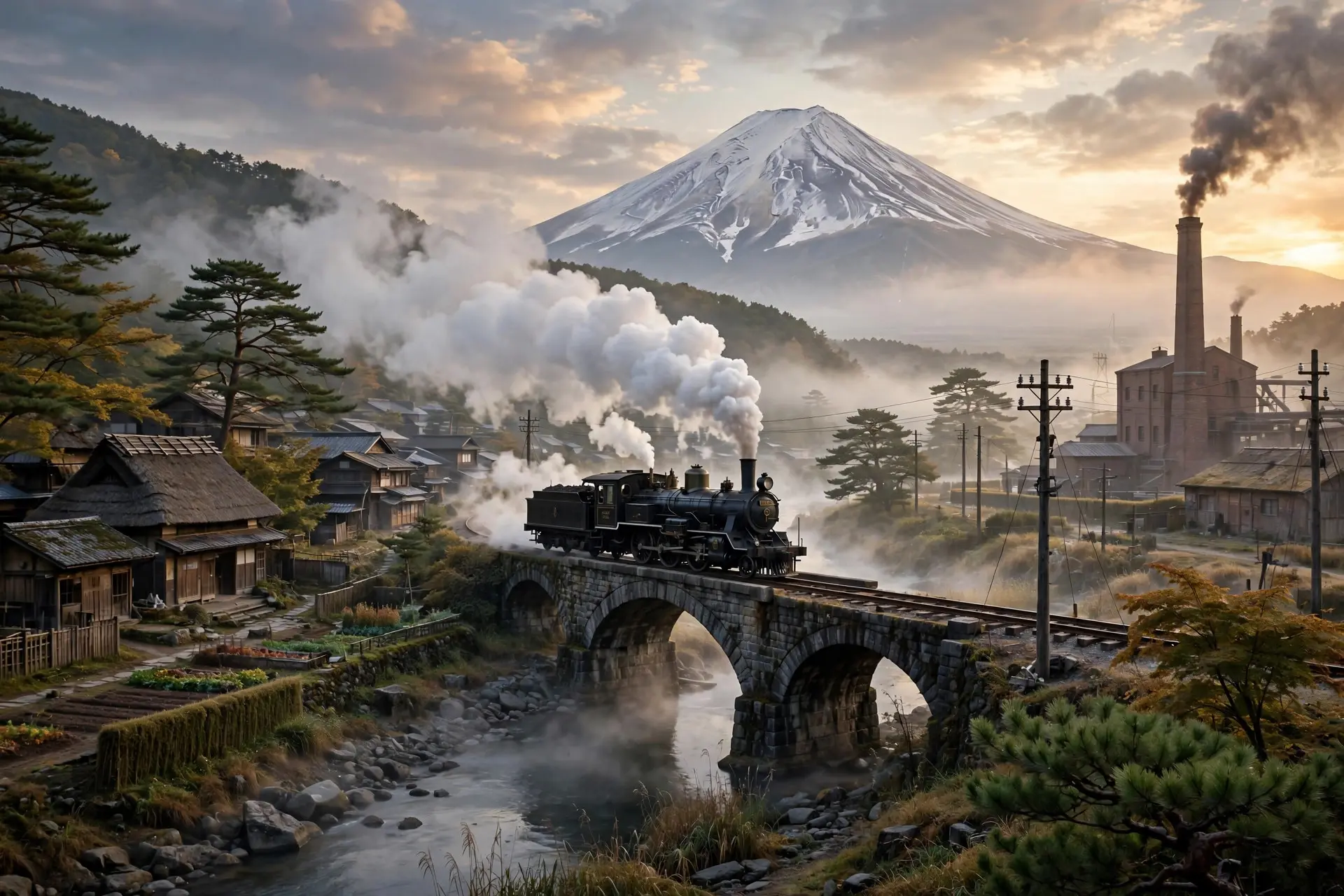
The mission returned in 1873 with a blunt verdict: Japan was decades behind, and catching up would require ruthless focus. The leaders suppressed the "Seikanron" plan to invade Korea, arguing that Japan was too weak for foreign adventures and must develop internally first. The mission's notes became the working blueprint for the next thirty years of reform, organized under the slogan fukoku kyōhei — "enrich the country, strengthen the military." What followed was a state-directed industrial sprint. The government financed harbors, lighthouses, railroads, and telegraph networks, imported foreign machinery and teachers, and sent students overseas. The printing-press-knowledge-monopoly account shows how information technology reshaped one civilization; Meiji Japan did the same thing deliberately, importing the West's knowledge systems wholesale. A national school system began in 1872, a cabinet system in 1885, the Meiji Constitution in 1889, and the elected Diet in 1890.
How fast did the transformation actually go?
The numbers are startling. Japan had 18 miles of railway track in 1872 and 7,100 miles by 1914. Its merchant fleet grew from 26 steamships in 1873 to 1,514 by 1913. Textile mills, shipyards, and arsenals rose where rice paddies had been, and the zaibatsu industrial combines concentrated capital at a speed no Western economy had ever matched. The military transformation proved the point. Japan defeated China in the Sino-Japanese War of 1894–95, then stunned the world in 1904–05 by defeating Russia — the first time an Asian power had beaten a European great power in modern war. In 1910 Japan annexed Korea, joining the ranks of the colonial empires it had once feared. By the death of Emperor Meiji in 1912, Japan was unrecognizably different from the feudal country of 1868: a parliamentary state, an industrial economy, and a great power with a modern navy. The Restoration's secret was not nationalism or tradition — both were abundant in countries that failed to modernize. It was institutional humility: a ruling class willing to send its leaders abroad as students, to copy what worked, and to destroy its own privileges for the sake of the project. The fall-of-constantinople-1453 article tells the story of an empire that could not adapt in time. Meiji Japan is the mirror image — a society that looked at the approaching storm, dismantled the ship it was standing on, and built a new one while the waves were rising.
Frequently asked questions
What was the Meiji Restoration?
The 1868 political revolution that overthrew Japan's Tokugawa shogunate and restored power to Emperor Meiji, launching the country's rapid transformation from a feudal society into a modern industrial state.
What did the Iwakura Mission do?
From 1871 to 1873, a delegation of Japan's top leaders toured the United States and Europe to study Western factories, schools, laws, and militaries. What they learned guided the reforms that abolished the samurai class and built modern institutions.
How did the Meiji reforms end the samurai?
The old four-class system was abolished by 1871, domains became prefectures, samurai stipends were commuted to lump sums, and a conscript army replaced samurai military privilege. In 1876 samurai were banned from wearing swords.
How fast did Japan industrialize after the Restoration?
Japan's railway network grew from 18 miles of track in 1872 to 7,100 miles by 1914, and its merchant fleet from 26 steamships in 1873 to over 1,500 in 1913. By 1905 Japan had defeated Russia, the first Asian victory over a European great power.