Death Valley: Why Is It So Extremely Hot?
Death Valley holds Earth's hottest air-temperature record: 134°F at Furnace Creek. Its secret isn't desert heat, but a below-sea-level basin that traps it.
Key takeaways
- On July 10, 1913, Furnace Creek recorded 134°F (57°C) — the highest air temperature ever measured on Earth.
- Death Valley is a long, narrow basin 282 feet (86 m) below sea level, walled by high, steep mountain ranges that trap heated air.
- Four mountain ranges between the valley and the Pacific create a compounding rain shadow; average rainfall is under 2 inches per year.
- Sinking air is compressed and reheated by the dense low-elevation air, generating moving masses of superheated air.
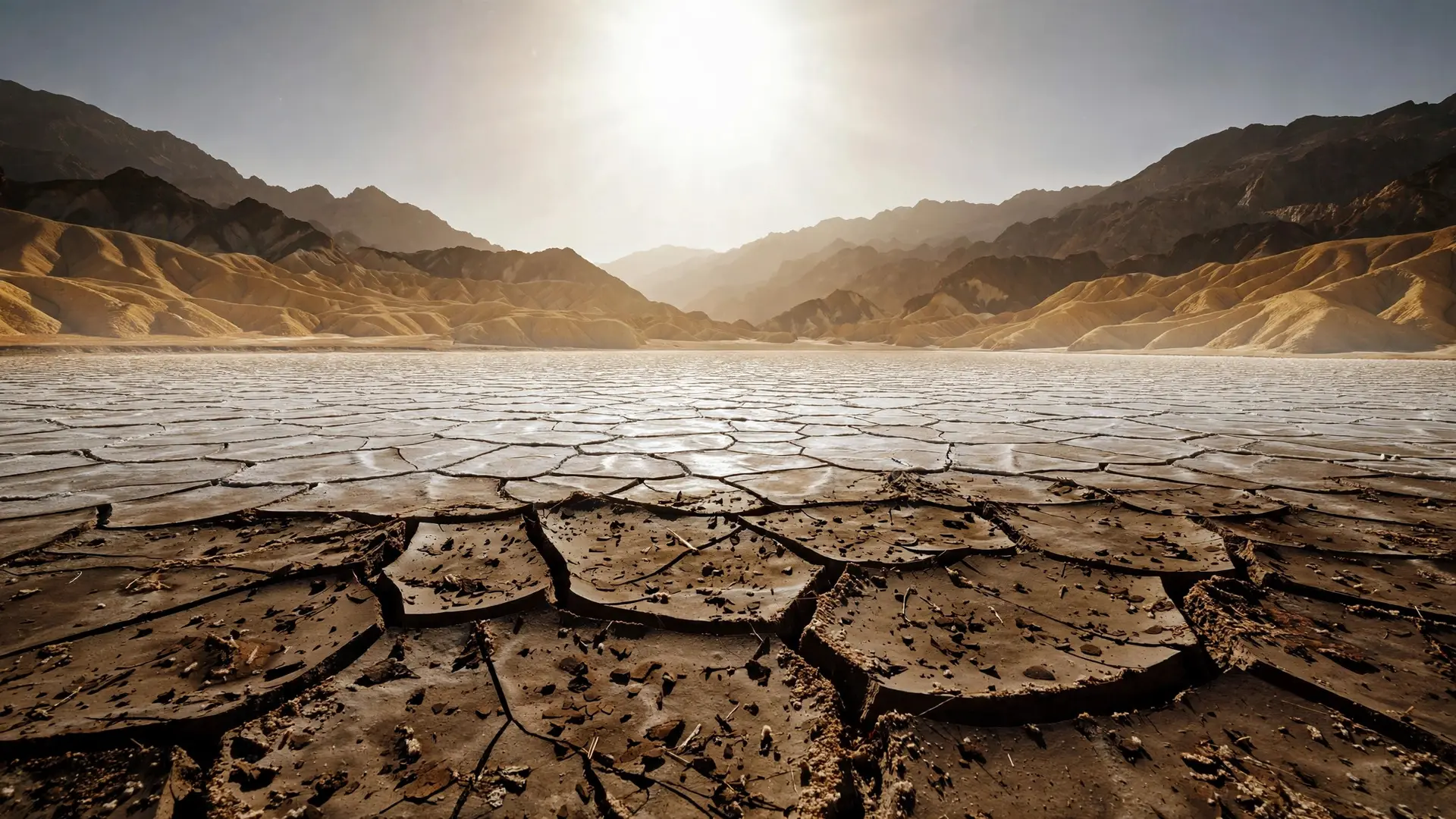
Death Valley is not hot simply because it is a desert. It is hot because of a geographical accident: a long, narrow basin sinking 282 feet below sea level, ringed by high, steep mountains that act like the walls of an oven. On July 10, 1913, the thermometer at Furnace Creek read 134 degrees Fahrenheit (57 Celsius) — the highest air temperature ever recorded on Earth, a record the valley has held for more than a century. Understanding why means looking at the shape of the land itself.
What makes Death Valley hotter than other deserts?
Sunlight is only half the story. The clear, dry air and sparse plant cover let the sun bake the valley floor, and heat radiates back from the rocks and soil — that much is true of every desert. What makes Death Valley different is what happens next. The heat has nowhere to go. Heated air rises, as it always does, but the surrounding mountains are too high to clear. The air cools slightly on the way up, then slides back down into the valley — and as it descends, it gets compressed. Compression heats air, and at the bottom of a basin sitting below sea level, the air pressure is unusually high, so the reheating is unusually strong. These pockets of descending, superheated air sweep through the valley floor, and the cycle repeats day after day. The National Park Service describes it as moving masses of superheated air, constantly recycled. Being below sea level matters in another way: the valley sits under a thicker column of atmosphere than the land around it. Air at lower elevation is denser and holds heat more stubbornly, like a blanket that never gets pulled back. Combine that with a landscape of dark rock and almost no vegetation — nothing to shade the ground, nothing to cool it through evaporation — and the desert floor becomes one of the most efficient solar collectors on the planet.
Nights offer little relief: summer lows often stay in the 85 to 95 degree range, so the ground never fully cools before the next day's baking begins. Elevation matters everywhere in the valley. Temperatures drop three to five degrees for every thousand feet of altitude, which is why the ridgelines above the basin stay noticeably cooler than the floor. Death Valley's floor is simply the worst seat in the house.
Why does no rain ever reach it?
The heat would be manageable if rain ever interrupted it, but Death Valley is starved of moisture by geography. Winter storms rolling in from the Pacific must cross four major mountain ranges to reach the valley. Each range forces the incoming air to climb, chilling it until its moisture spills out on the west-facing slopes. By the time the clouds cross to the eastern side, they have little water left — a rain shadow, multiplied four times over. The numbers are stark. Death Valley averages less than two inches of rain per year, a fraction of what most deserts receive. In 1929 and again in 1953, no rain fell at all. The driest stretch on record delivered only 0.64 inches across forty months, from 1931 to 1934 — barely a heavy dew spread over more than three years. Humidity is so low that sweat evaporates before you feel it, which quietly raises the danger of the heat: visitors can dehydrate fast without realizing how much water they are losing. When storms do punch through, usually in late summer, they arrive violently — sudden downpours on baked, impermeable ground trigger flash floods, the desert's one dramatic exception to its own dryness.
How hot has it actually gotten?
The 1913 record stands at the top of a long list of extremes. During the heat wave that produced it, five straight days sat at or above 129 degrees. The summers since have kept piling up records: 154 straight days above 100 degrees in 2001, 40 days above 120 in 1996, and 43 consecutive days at 120 or higher in 1917. The ground itself once hit 201 degrees at Furnace Creek on July 15, 1972 — a surface temperature hot enough to cook on. Meteorologists have debated the 1913 reading over the years, since early instruments were less reliable than today's. But the measurement remains the officially recognized world record, and Death Valley hardly needs it to make its case: modern summers there regularly produce some of the highest reliably measured temperatures on the planet. The deeper record tells the same story in slower motion. Average July highs at Furnace Creek sit around 116 degrees, and the summer of 2001 strung together 154 consecutive days above 100 — five months in which the valley never once dropped below triple digits during the day. Heat like that stops being weather and becomes climate.
Does it ever cool down?
Here is the twist the name hides: Death Valley has seasons. Winter days at low elevation are mild, often in the 60s and 70s, with nights that can dip toward freezing. In a delicious irony, 1913 — the year of the all-time heat record — also produced the valley's all-time cold: 15 degrees at Furnace Creek. The same clear skies and dry air that make summers brutal make winters beautifully mild, which is why the park draws most of its visitors between November and March. Spring brings wildflower blooms in wet years, and year-round the famously clear skies make the valley a stargazing destination. So the hottest place on Earth is not a place of constant fire. It is a place where geography conspires: a basin too deep for its own heat to escape, mountains that squeeze every drop of rain from the sky, and air that compresses itself hotter with every cycle. Other deserts get hot; Death Valley gets trapped. The Sahara is vastly larger and the Atacama is far drier — but neither one sits 282 feet below sea level with four mountain walls holding the lid on.
Frequently asked questions
Is Death Valley really the hottest place on Earth?
It holds the officially recognized world record for the highest air temperature, 134°F at Furnace Creek in 1913, and the U.S. National Park Service calls it the hottest place on earth. Summer days there routinely top 120°F.
Why doesn't the heat just blow away?
The valley is a deep basin ringed by mountains. Heated air rises, cools slightly before it can clear the walls, sinks back down, and gets compressed and reheated — a self-reinforcing cycle.
Does it ever rain in Death Valley?
Barely — under 2 inches a year on average. In 1929 and 1953 no rain fell at all, and one 40-month stretch in the 1930s brought only 0.64 inches.