Dead Sea Scrolls: What They Reveal About the Bible
A shepherd's find near Qumran led to some 900 manuscripts in 11 caves. How the Dead Sea Scrolls were sold and published, and what they changed about the Bible.
Key takeaways
- The Dead Sea Scrolls are the remains of roughly 900 Jewish manuscripts, copied between the third century BC and the first century AD and hidden in 11 caves near Qumran.
- Eleazar Sukenik began acquiring the first three scrolls on November 29, 1947; his son Yigael Yadin secretly bought four more for $250,000 after a June 1954 Wall Street Journal ad.
- About 230 of the manuscripts are biblical. The Great Isaiah Scroll, dated to around 125 BC, is roughly a thousand years older than the medieval Hebrew manuscripts known before 1947.
- Qumran kept different versions of biblical books side by side, while texts from other Judaean Desert sites are virtually identical to the later Masoretic text.
- In 2020 an independent report concluded that all 16 Dead Sea Scroll fragments owned by the Museum of the Bible in Washington were modern forgeries.
The Dead Sea Scrolls are the remains of roughly 900 Jewish manuscripts, copied between the third century BC and the first century AD and hidden in 11 caves around Qumran, in the cliffs above the northwest corner of the Dead Sea. They matter because they include the oldest known copies of books of the Hebrew Bible, about a thousand years older than the medieval manuscripts scholars depended on before 1947. They also revealed something nobody expected: before the Bible's text was fixed, several versions of it circulated at once.
How did a shepherd's find end up in a newspaper ad?
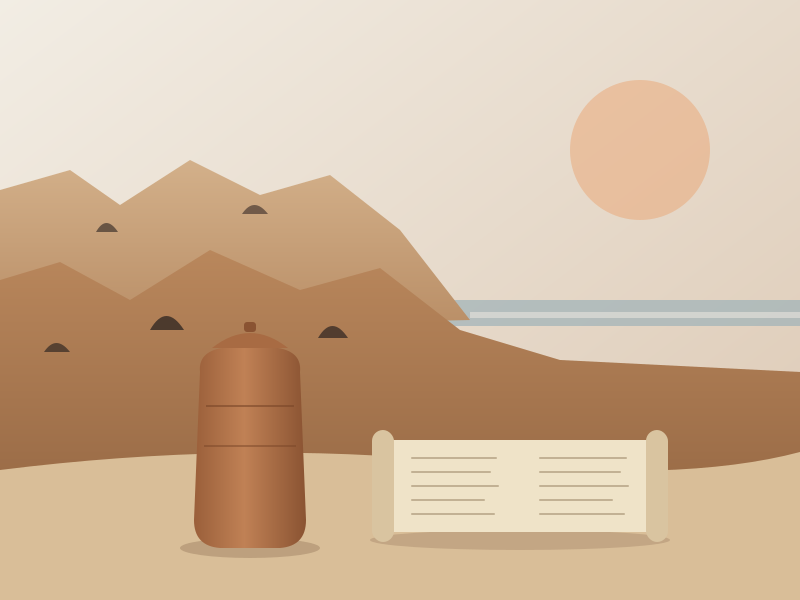
By most accounts the story begins in late 1946 or early 1947, with Muhammad edh-Dhib, a young shepherd of the Ta'amireh Bedouin, searching for a stray animal in the Judaean Desert. He threw a stone into a cave opening, heard pottery break, and climbed in to find clay jars holding seven scrolls. That cave is now known as Cave 1. The scrolls went to market in Bethlehem. Four passed through Khalil Eskander Shahin, a shoemaker and antiquities dealer known as Kando, to Athanasius Yeshue Samuel, the Syrian Orthodox Metropolitan of St Mark's Monastery in Jerusalem. The other three reached Eleazar Sukenik, an archaeologist at the Hebrew University, who recognized them as writings from the Second Temple period and began acquiring them on November 29, 1947, the day the United Nations voted to partition Palestine. War then made a deal for the other four impossible. Seven years later, still unable to get a good price, the Metropolitan placed a small advertisement in The Wall Street Journal on June 1, 1954, offering "The Four Dead Sea Scrolls" and suggesting they would make an "ideal gift to an educational or religious institution." Sukenik's son, the archaeologist Yigael Yadin, happened to be in the United States. Working through an intermediary and keeping Israel's involvement hidden, he bought all four for $250,000, with help from the philanthropist D. S. Gottesman. The scholar Harry Orlinsky checked them first under a false name. The four, which included the most complete scroll of all, a copy of Isaiah, were flown to Israel one at a time.
What else was hidden in the 11 caves?
Archaeologists led by G. Lancaster Harding and Roland de Vaux excavated Cave 1 in 1949, then the nearby ruins of Khirbet Qumran, where coins and pottery tied the settlement to the scrolls and gave rough dates. Between 1951 and 1956 the search turned into a race. Bedouin found five of the 11 scroll caves and archaeologists six. Cave 4, located by Bedouin in 1952, yielded hundreds of manuscripts in thousands of fragments, by far the largest share of everything recovered at Qumran. About 230 of the manuscripts are biblical. Only Esther is missing from the books of the Hebrew Bible, provided Ezra and Nehemiah are counted as a single book. The rest include hymns, rules for a religious community and other writings such as the War Scroll. Most are in Hebrew, about 13% in Aramaic and a handful in Greek, written mainly on parchment, with some on papyrus. One is engraved on metal: the Copper Scroll from Cave 3, a list of hiding places for treasure, so corroded that it had to be cut into strips in Manchester in the 1950s before anyone could read it. Who owned this collection is still argued over. De Vaux concluded that Qumran housed a community of Essenes, a Jewish sect that the Roman writer Pliny the Elder described living on the western side of the Dead Sea, with the town of Ein Gedi below them. The historian Norman Golb countered that the scrolls came from Jerusalem and were hidden ahead of the Roman siege of AD 70, while the archaeologist Yizhar Hirschfeld read Qumran as a wealthy country manor rather than a religious settlement. Many scholars still connect the scrolls with the Essenes, but that view is no longer taken for granted.
What did the scrolls change about the Bible's text?
Before 1947, the oldest complete Hebrew manuscripts of the Bible dated from around the 10th century AD. They belong to the Masoretic tradition, the standard Hebrew text behind modern Hebrew Bibles. Nobody could check how far that text had drifted in the thousand years before those copies were made. The Great Isaiah Scroll answered part of the question. Made of 17 sheets of parchment sewn together and more than seven meters long, it contains the entire Book of Isaiah and is usually dated to the second century BC, around 125 BC. Its text is broadly in line with the Masoretic version. Most differences are spelling, style or scribal slips, although in a few places it sides with the Septuagint, the ancient Greek translation.
Other scrolls told a messier story. The Qumran collection, in the words of the textual scholar Emanuel Tov, shows that "textual divergence was the rule rather than the exception at Qumran." A Jeremiah fragment known as 4QJer-b is shorter than the Masoretic text and orders its verses like the Greek Bible, evidence that the Greek translators had a different Hebrew edition in front of them. A copy of Samuel, 4QSam-a, includes a paragraph missing from the end of 1 Samuel 10 in the standard text, in which the Ammonite king Nahash gouges out the right eyes of the tribes of Gad and Reuben. The first-century historian Josephus tells the same story, which suggests his Bible contained it too. Scholars still disagree about whether the passage is original or a later expansion. Then the picture narrows. Biblical texts from other Judaean Desert sites, including Masada and caves used during the Bar Kokhba revolt of AD 132 to 135, are virtually identical to the medieval Masoretic text. One version had evidently won out, and its consonants changed very little over the following thousand years.
Why did it take until 1991 for everyone to see them?
Publication was entrusted to a small team of scholars, and the work crawled. For roughly four decades, access to the unpublished fragments stayed tightly controlled. Frustrated outsiders found a side door. In 1991 Ben Zion Wacholder and his student Martin Abegg used a computer to rebuild texts from a word index the editors had compiled in the 1950s, and the Biblical Archaeology Society published the results. On September 22 that year, the Huntington Library in California announced that any scholar could use its complete set of scroll photographs, effectively breaking the monopoly. Fame has also attracted fakers. At least 70 supposed fragments surfaced on the antiquities market from about 2002. The Museum of the Bible in Washington said in 2018 that five of its 16 pieces were probably forgeries, and in March 2020 an independent report by Colette Loll's firm, Art Fraud Insights, concluded that all 16 were fakes, most likely ancient leather inked in modern times. The first seven scrolls are in the care of the Israel Museum in Jerusalem, in a building called the Shrine of the Book, dedicated in April 1965 beneath a white dome designed to recall the lids of the jars that hid them. Ancient book collections rarely survive, as the slow decline of the Library of Alexandria shows. This one did, in a desert cave, and it turned the Bible's text from a single inherited document into a history that can be traced, variant by variant, back to the centuries when Judaism and Christianity were taking the shapes we know.
Frequently asked questions
Who found the Dead Sea Scrolls?
A young Bedouin shepherd, Muhammad edh-Dhib of the Ta'amireh tribe, found the first seven scrolls in a cave near Qumran in late 1946 or early 1947. Bedouin and archaeologists located 10 more scroll caves by 1956.
How much of the Bible is in the Dead Sea Scrolls?
All the books of the Hebrew Bible except Esther turn up among about 230 biblical manuscripts. The rest of the collection is hymns, rules and other religious writings, and some biblical scrolls preserve versions of the text that differ from the later standard one.
Who wrote the Dead Sea Scrolls?
Many scholars link them to the Essenes, a Jewish sect that Pliny the Elder placed on the western side of the Dead Sea. Others argue the scrolls came from Jerusalem and were hidden before the Roman siege of AD 70.
Sources
- The Dead Sea Scrolls - Discovery and Publication, Israel Antiquities Authority
- The Dead Sea Scrolls, The Israel Museum, Jerusalem
- The Qumran Library - Scrolls from the Dead Sea, Library of Congress
- The Dead Sea Scrolls discovery — still riveting after 70 years, Religion News Service
- Fake Dead Sea Scrolls Displayed at Museum of the Bible, Christianity Today