What Is the Coldest Ocean on Earth? The Southern Ocean
What is the coldest ocean on Earth? The Southern Ocean averages near freezing, drops to -2°C in winter, and only became the fifth ocean in 2021.
Key takeaways
- The Southern Ocean is the coldest ocean on Earth, with surface water ranging from -2°C (28°F) in winter to 10°C (50°F) in summer.
- It was only recognized as the world's fifth ocean in 2021, when National Geographic added it to maps on June 8, World Oceans Day.
- The Antarctic Circumpolar Current, formed about 34 million years ago, moves more water than any other ocean current.
- The ocean absorbs up to 40 percent of the carbon dioxide taken up by the world's oceans.
The Southern Ocean is the coldest ocean on Earth. Circling Antarctica inside the Antarctic Circumpolar Current, its surface water slides from about 10°C (50°F) in summer to -2°C (28°F) in winter, and the surprise is that cartographers only officially recognized it as the world's fifth ocean in June 2021.
- The Southern Ocean is the coldest ocean in the world, with surface temperatures between 28°F and 50°F (-2°C to 10°C), regularly freezing over between 55 and 65 degrees south latitude. (WorldAtlas)
- It is the second smallest ocean at 8,479,000 square miles (21,960,000 square km), averaging 10,728 feet (3,270 m) deep and reaching 24,382 feet (7,432 m) in the South Sandwich Trench. (WorldAtlas)
- The Antarctic Circumpolar Current started taking shape roughly 34 million years ago, when Antarctica broke away from South America, and it now moves more water than any other ocean current. (National Geographic)
- No wind-driven current on Earth is larger than the Antarctic Circumpolar Current, and no other current loops the whole planet; it reaches 4,000 m (2.5 miles) deep and spans more than 120 miles (193 km) wide. (Woods Hole Oceanographic Institution)
- National Geographic recognized it as the fifth ocean on June 8, 2021, World Oceans Day; NOAA recognized it the same year, while the U.S. Board on Geographic Names had used the name since 1999. (National Geographic)
- The ocean absorbs up to 40 percent of the carbon dioxide taken up by the world's oceans. (WorldAtlas)
Why is the Southern Ocean so much colder than the rest?
The short answer is isolation. The Antarctic Circumpolar Current flows eastward in a continuous loop around Antarctica, roughly centered at 60 degrees south latitude, and it acts as a thermal fence. Because no landmass interrupts it, westerly winds drive the current unimpeded, and the barrier keeps warmer water from the Pacific, Atlantic, and Indian Oceans from mixing southward. Inside the current, the water stays colder and slightly less salty than the ocean water to the north. Cold alone does not freeze the sea. Seawater must drop below its freezing point, and when it does, the process feeds the cold further. As ice crystals form, salt gets squeezed out of the forming ice into the water below, a process called brine rejection. The rejected brine is dense and sinks, driving part of the deep circulation that carries cold water around the planet. Westerly winds also drag surface water away from the continent, pulling cold water up from the depths in a process called upwelling.
Winter makes the contrast extreme. Between 55 and 65 degrees south, the ocean regularly freezes over, and winds can push waves to 33 feet (10 m) in winter, with some reports of far larger swells. WorldAtlas calls it the windiest ocean on Earth as well as the coldest, and the combination of ice, wind, and upwelling is what holds temperatures near freezing for months. It also explains why Antarctica is the coldest desert on Earth: the ocean current and the continent reinforce each other's chill.
How did the coldest ocean only become official in 2021?
The Southern Ocean is the only ocean defined by a current instead of by the continents that surround it, and that oddity delayed its recognition by nearly a century.
| Year | What happened |
|---|---|
| 1937 | The International Hydrographic Organization includes the Southern Ocean in its Limits of Oceans and Seas |
| 1953 | The IHO drops it after member nations disagree on the designation |
| 1999 | The U.S. Board on Geographic Names adopts the name; NOAA proposes a boundary from Antarctica's coast to 60°S |
| 2000 | The IHO surveys members on reinstating it; a draft fourth edition circulates in 2002 but is never formally adopted |
| 2021 | NOAA recognizes the ocean in February; National Geographic adds it to maps on World Oceans Day, June 8 |
| The core objection was geographic: most oceans are bounded by continents, while the Southern Ocean is bounded by a moving current. Geographers argued for decades over whether the waters around Antarctica were distinct enough to deserve their own name, or whether they were simply cold southern extensions of the Pacific, Atlantic, and Indian Oceans. As National Geographic Society geographer Alex Tait put it, scientists had long recognized the ocean, but without international agreement it was never officially recognized. The deciding factor was ecological separation: the current keeps the region's waters, chemistry, and species distinct. That history also explains a curious fact noted by marine biologist Sylvia Earle, who praised the 2021 change in an e-mailed statement to National Geographic by calling the Southern Ocean "the only ocean to touch three others and to completely embrace a continent rather than being embraced by them." |
What does the Antarctic Circumpolar Current actually do?
The Antarctic Circumpolar Current is the most powerful current system in the global ocean. It joins the Atlantic, Indian, and Pacific basins into one loop, and because the current reaches from the surface all the way to the seafloor, no other current on Earth moves as much water. At the surface it can run as fast as 2 knots (2.3 mph, or 3.7 km/h), driven by westerly winds with nothing to slow them down.
Its reach goes far beyond Antarctica. The current pulls water in from the three other oceans and helps power the global circulation system scientists call the conveyor belt, which moves heat around the planet. The Woods Hole Oceanographic Institution adds that no wind-driven current on Earth is larger than the ACC, and no other current loops the whole planet; it stretches from the surface to depths of 4,000 m (2.5 miles) and spans more than 120 miles (193 km) wide. Edmund Halley first recorded it during his 1699-1700 voyage aboard HMS Paramore, and James Cook and James Clark Ross each described it in their journals decades later. Cold, dense water that sinks off Antarctica also carries carbon into the deep ocean. The Southern Ocean's cold water, powerful overturning circulation, strong winds, and biological activity make it absorb up to 40 percent of the carbon dioxide taken up by the world's oceans, which gives the coldest ocean an outsized role in the climate. Scientists are now studying how a warming climate is altering the current, since some of the fastest melting of Antarctica's ice shelves has happened where the current runs closest to land.
What lives in water this cold?
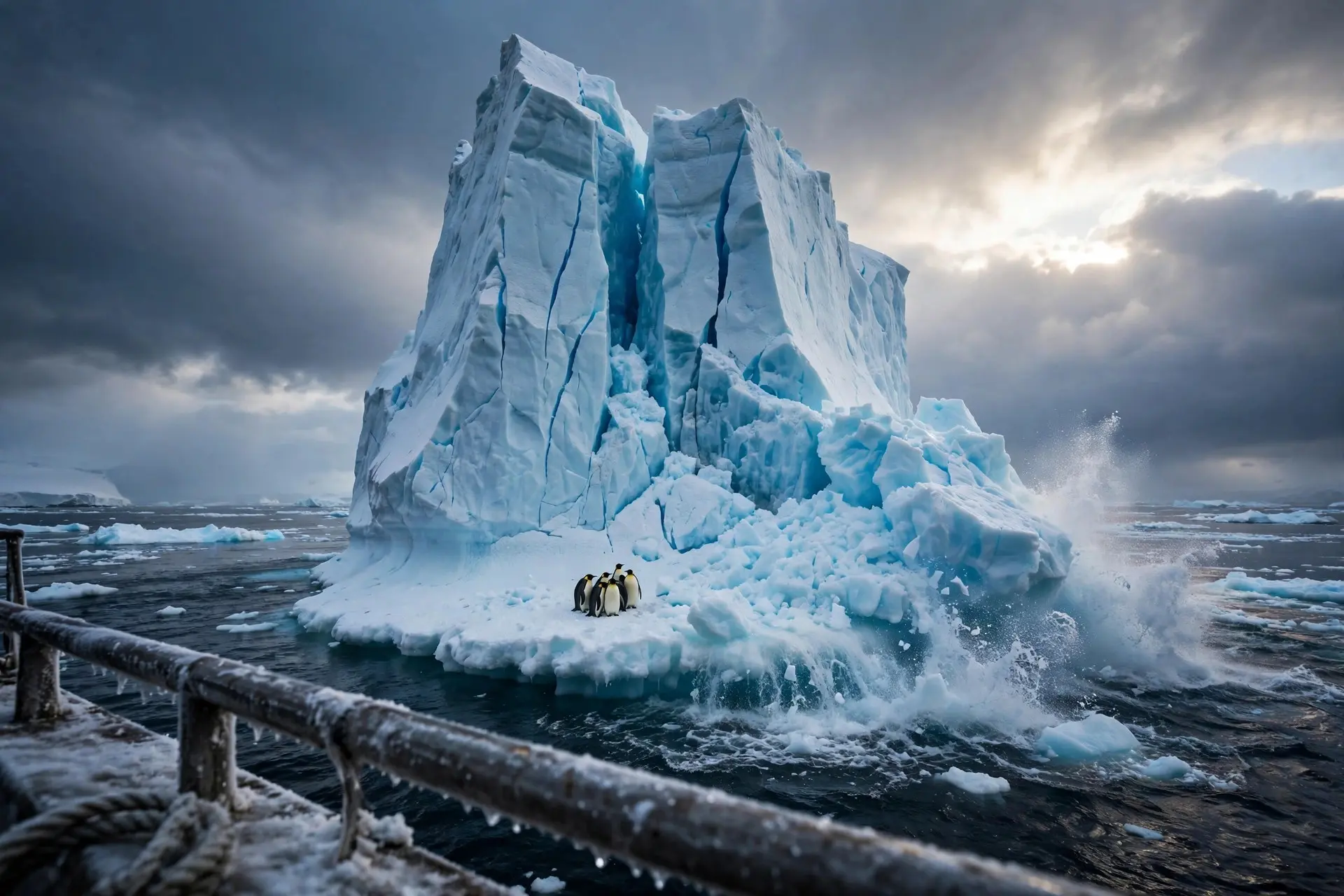
The Southern Ocean is harsh, but its oxygen-rich waters feed a dense food web. Upwelling currents lift nutrients to the surface, where plankton bloom. The plankton feed krill, and the krill feed fish, whales, and seals. One of the most common fish is the Antarctic cod, built to survive icy water. Phytoplankton blooms near the surface can be so large that they tint the water red with krill. Penguins are the ocean's icons. Of the 18 penguin species in the world, seven are native to Antarctica and the Southern Ocean: emperor, Adelie, chinstrap, gentoo, king, macaroni, and rockhopper penguins. Whales connect the region to the rest of the planet: humpbacks feed on Antarctic krill, then migrate thousands of miles north to winter off South and Central America. National Geographic reports that thousands of species live in the Southern Ocean and nowhere else, which is why conservation attention has grown. Catch limits were imposed in 1982, and the Ross Sea marine protected area established in 2016 is the largest marine protected area in the world.
What do people get wrong about the coldest ocean?
First, many people still count only four oceans. That number comes from maps that followed the International Hydrographic Organization's 1953 edition, which omitted the Southern Ocean. The five-ocean view is now standard in the United States and most countries, and it has been in common scientific use for decades. Second, "coldest" does not mean "frozen solid." Sea ice is seasonal: it spreads across the ocean in winter and retreats in summer. The current keeps the water moving all year, which is part of why the ecosystem stays so productive. Third, people mix up the ocean with the continent. The ocean is cold because of the current; the continent is a separate story, and so is the hidden underground ocean scientists think sits deep inside the planet. Even the Bentley Subglacial Trench, the deepest point on land, sits beneath Antarctic ice rather than in the ocean. The coldest ocean earns its title from water, wind, and one unbroken current, not from the land it circles. The Southern Ocean is the coldest ocean on Earth, and it is also the newest name on the map, a place where a single current draws the border. Its ice, its storms, and its carbon-hungry depths shape weather and sea level far beyond the Southern Hemisphere. How we made this article: FactSpire researched and drafted it with AI assistance and checked every fact against the sources listed above.
Frequently asked questions
Is the Southern Ocean really colder than the Arctic Ocean?
Reference works consistently name the Southern Ocean the coldest ocean on Earth, and it is also described as the windiest. The Arctic Ocean is the smallest ocean, and its ice-covered waters also hover near freezing, but the Southern Ocean holds the coldest-ocean title in sources such as WorldAtlas.
Why did it take until 2021 to recognize the fifth ocean?
The International Hydrographic Organization included the Southern Ocean in 1937 but removed it in 1953 after member-state disagreement. The U.S. Board on Geographic Names used the name from 1999, and NOAA proposed a 60°S boundary. National Geographic added it to maps on World Oceans Day, June 8, 2021.
Does the Southern Ocean freeze solid in winter?
No. It regularly freezes between 55 and 65 degrees south latitude in winter, but the Antarctic Circumpolar Current keeps the water circulating year-round. Sea ice spreads and retreats with the seasons instead of locking the whole ocean in solid ice.
What animals live in the coldest ocean?
Oxygen-rich cold water supports plankton, krill, fish, whales, and seals. Seven of the world's 18 penguin species are native to Antarctica and the Southern Ocean, including the emperor penguin. National Geographic notes that thousands of species live there and nowhere else.
Sources
- The Coldest Ocean On Earth, WorldAtlas
- Antarctic: Ocean Circulation - Dive & Discover, Woods Hole Oceanographic Institution
- There's a new ocean now—can you name all 5?, National Geographic