What Is the Belt of Venus, the Pink Band After Sunset?
What is the Belt of Venus? The pink band after sunset is sunlight bouncing off high air above Earth's own shadow. Here's when and where to see it.
Key takeaways
- The Belt of Venus is a pink band of sunlight backscattered from the high atmosphere, visible opposite the Sun just after sunset or before sunrise.
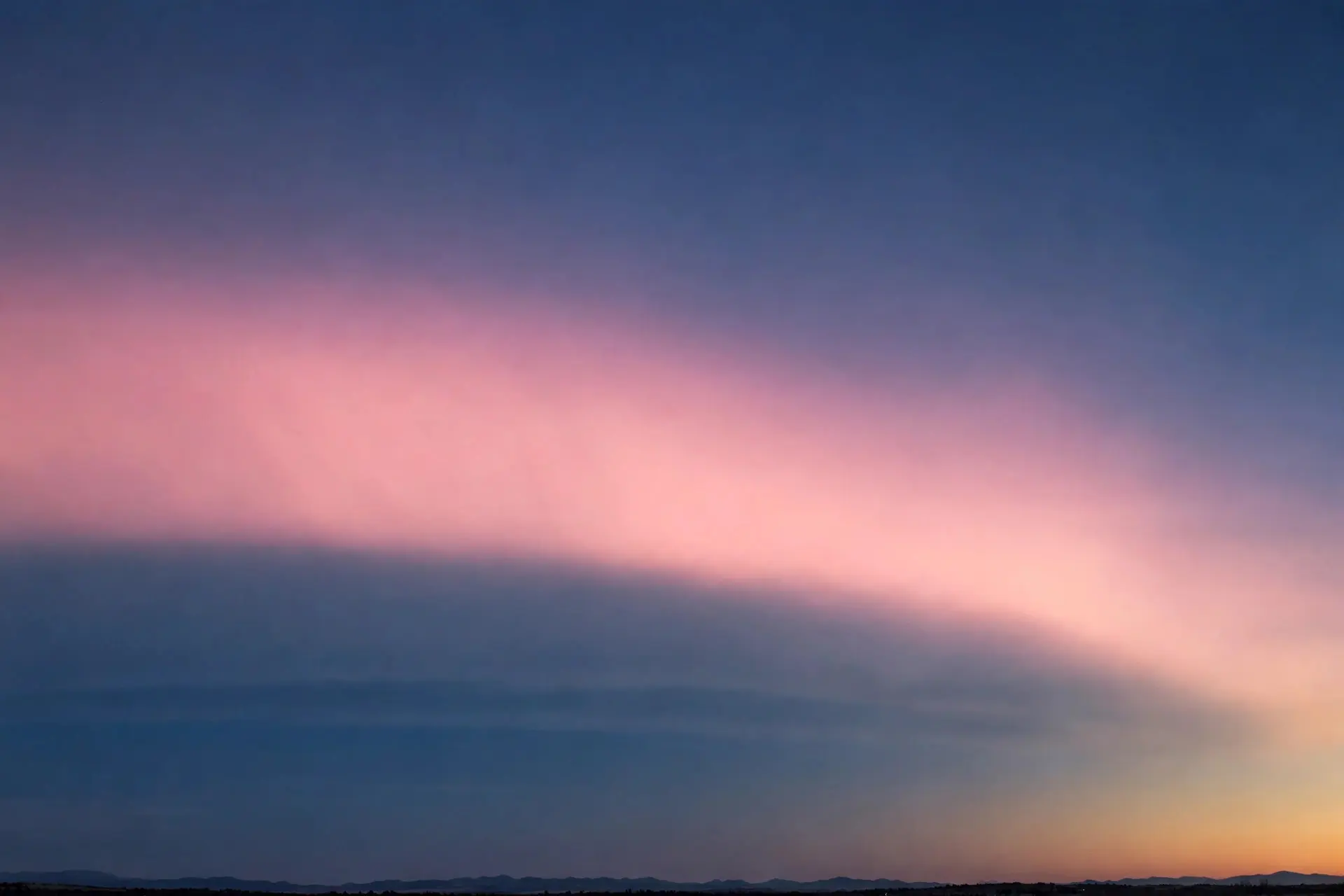
- The dark blue-gray band beneath it is the shadow of planet Earth itself, cast onto its own atmosphere and rising as night arrives.
- It has nothing to do with the planet Venus, which never strays more than about 45 degrees from the Sun and can never appear inside its own namesake belt.
- Watch the east 10 to 20 minutes after sunset on a clear evening; within 15 minutes the pink fades and only Earth's shadow remains.
That pink band is sunlight taking the long way home. After sunset, the Sun's rays skim through extra atmosphere, shed their blue light along the way, and bounce back as a rose-colored glow above the eastern horizon. The surprise is the dark band below it: that is the shadow of planet Earth itself, cast onto its own sky and rising as night arrives.
- The pink band sits roughly 10 to 20 degrees above the horizon, directly opposite the Sun: east after sunset, west before sunrise (Wikipedia overview, Scientific American).
- Sky & Telescope editor Tony Flanders timed the whole show: bright pink right after sunset, fainter and richer by 3 minutes, a rounded blue shadow band by 6 minutes, and pink gone by 15 minutes (Sky & Telescope).
- The glow is sunset light reflected off air some 50 to 100 miles (80 to 160 km) to the east of the observer (Sky & Telescope).
- The U.S. Naval Observatory divides twilight by how far the Sun sits below the horizon: civil twilight ends at 6 degrees, nautical at 12, astronomical at 18 (Side Column).
- Venus never appears more than about 45 degrees from the Sun, so the planet can never be found inside the belt that carries its name (Scientific American).
What exactly is the Belt of Venus?
Turn away from the sunset and you may find the sky doing something quieter and stranger. While the west burns orange, the eastern horizon can develop two broad bands: a dark blue-gray strip along the horizon and a pink or purplish ribbon floating above it. Together they can stretch across half the sky. The rosy band is the Belt of Venus, also known by the plainer name of the anti-twilight arch. The mechanics are simple geometry plus scattered light. After sunset the Sun is below your local horizon, but it still strikes the higher layers of the atmosphere to the east. The pink you see is that surviving sunlight, reddened by its long low journey through the air, bouncing back toward you off the upper atmosphere. It hangs roughly 10 to 20 degrees above the horizon, a diffuse arch rather than a sharp line. It forms around the antisolar point, the spot on the horizon directly opposite where the Sun went down, which is why it belongs to the side of the sky most sunset watchers never face.
This is not a rare event. It happens at nearly every clear twilight. It stays little known mostly because the western sky puts on the louder show, and few people think to turn around. Tony Flanders, who has written about the night sky for decades, admitted he had probably seen it hundreds of times before he ever recognized what it was.
Why does it look pink, and what is the dark band beneath it?
The pink comes from the same sorting of sunlight that paints a fiery orange sunset. Short blue wavelengths are scattered out of a light beam far more strongly than long red ones, the process behind the blue daytime sky. When sunlight travels the long, low path through the air after the Sun has set, most of the blue is scattered away before the beam reaches the eastern sky. What remains is weighted toward reds and yellows, and when that reddened light is scattered back toward you it mixes with the blue of the surrounding twilight. The result reads as pink, though it often wanders through rose, lavender, peach and dusty violet on different evenings. The dark band below is the more startling of the two. It is literally Earth's shadow. Toward the east the Sun set earlier, so it sits farther below the horizon there. The lowest air in that direction lies inside the planet's own shadow, while the air above it is still catching sunlight. The boundary between the two is what you see as the edge of the dark band. As twilight deepens and the Sun sinks further below the horizon, that boundary climbs, and the shadow rises with it. This is not a crisp silhouette; you are looking through a deep volume of hazy air, so the edge softens into a wide band rather than a hard line. Here is the twist worth sitting with: night itself is this shadow. When the Sun drops far enough, the rising shadow swallows the whole sky, and you are standing inside it. The Belt of Venus is just the visible front edge of night arriving.
Where does the name come from?
The name has nothing to do with the planet. It alludes to the girdle or breast-band of the goddess of love, Aphrodite to the Greeks and Venus to the Romans, a sash of beauty draped across the sky. The planet Venus orbits closer to the Sun than Earth does, so from our viewpoint it never wanders more than about 45 degrees from the Sun. The Belt of Venus, by definition, sits opposite the Sun. The planet can never appear inside its own namesake. The less poetic label, anti-twilight arch, describes the geometry better: this is the anti-twilight, the glow on the side of the sky opposite the afterglow. In a sense the Belt of Venus is alpenglow seen near the horizon, the same backscattered reddened sunlight that tints mountain peaks pink at dusk, stretched across the whole eastern sky.
How can you watch it happen?
You need a clear evening and an unobstructed view of the eastern horizon. A hilltop, lakefront or beach is ideal, though a flat horizon over prairie, desert or open water works too. Face east, away from the sunset, and start watching the moment the Sun drops. Flanders' timed observation from 2010 gives a minute-by-minute preview of what to expect:
| Minutes after sunset | What happens in the eastern sky |
|---|---|
| 0 | A bright pink band appears opposite the Sun: sunset light bouncing off air 50 to 100 miles (80 to 160 km) to your east. |
| 3 | The pink grows fainter but richer, and lifts off the horizon as a thin strip of blue sky opens beneath it. |
| 6 | The blue band below takes on shape, rounded and taller in the middle: Earth's shadow becoming visible. |
| 15 | The pink has faded away, but the shadow remains as a huge low hump of darker sky along the horizon. |
| Clean, dry air helps, which is why the band often looks most vivid in the winter months. More dust and haze in the air can also strengthen the effect, since there is more material for the light to bounce off. At dawn the whole sequence runs in reverse: look west before sunrise, and watch the shadow sink while the pink band fades into daylight. A higher viewpoint improves the contrast because less murky low air sits in the way, but elevation is not essential. | |
| While you wait, keep an eye out for the twilight's other performers. Crepuscular rays, the sunbeams that fan across the sky, share the same low-Sun geometry, and on the western horizon you might catch the elusive green flash at the exact moment of sunset. |
What do most people get wrong about it?
The dark band fools almost everyone at first glance. It looks like a bank of distant weather or an approaching storm front, dark enough to check the forecast for. It is neither. Clouds have edges, texture and local shapes; Earth's shadow is immense, smooth and aligned broadly with the horizon. It behaves less like an object passing through the sky than like the sky changing ownership. The second common mistake is assuming the pink band is a cloud lit by the sunset. There may be clouds catching the light too, but the Belt of Venus itself is clear air glowing: fine particles high in the atmosphere scattering back the reddened light. Photographs can exaggerate the colors, especially when saturation is pushed, but the phenomenon is readily visible to the unaided eye. The third is the planet mix-up, and it is the most persistent. Because it carries her name, people scan the pink band for Venus. The planet is up to 45 degrees away, near the Sun, never opposite it. The goddess's girdle belongs to the anti-sunset sky alone. There is no promise of spectacle on any given evening. Atmospheric conditions decide whether the belt arrives as a dramatic stripe or a restrained wash of color. That variability is part of the appeal: the mechanism is planetary, but the presentation depends on the evening. Turn around at the right moment, and the whole atmosphere becomes a screen for the shape of the world beneath your feet. How we made this article: FactSpire researched and drafted it with AI assistance and checked every fact against the sources listed above.
Frequently asked questions
Why does the Belt of Venus appear opposite the Sun?
It forms at the antisolar point, the spot on the horizon directly opposite the Sun's position. After sunset the Sun is below your western horizon, but its light still reaches the high air to the east. That lit air glows pink above the shadowed lower air, so you must turn away from the sunset to see it.
Is the Belt of Venus related to the planet Venus?
No, and the irony is the point. The name comes from the girdle of the Roman goddess Venus, not the planet. Venus orbits closer to the Sun than Earth does, so it never appears more than about 45 degrees from the Sun, which means the planet can never sit inside its own belt.
What is the dark band under the Belt of Venus?
It is Earth's shadow projected onto the atmosphere. After sunset the lowest air opposite the Sun lies inside the planet's own shadow, while higher air stays sunlit. As the Sun sinks further, the shadow boundary climbs, and the dark band rises and broadens until it becomes the night sky itself.
When is the best time to see the Belt of Venus?
On a clear evening, face east about 10 to 20 minutes after sunset, or face west before sunrise. The pink is brightest right after the Sun drops and usually fades within 15 minutes. Clean, dry winter air often shows the most vivid colour, and a hilltop, lakefront or beach with an open horizon works best.
Sources
- The Belt of Venus, Sky & Telescope
- Earth's Shadow and the Belt of Venus at Twilight, Side Column
- What Are Crepuscular Rays?, Scientific American