How X-Rays Were Discovered by Accident in 1895
November 1895: a glowing screen in a dark Würzburg lab revealed invisible rays. How Röntgen turned that flicker into X-rays — and why he refused to patent them.
Key takeaways
- On November 8, 1895, Wilhelm Röntgen noticed a fluorescent screen glowing across his dark lab even though his cathode-ray tube was sealed in light-proof cardboard.
- Röntgen spent six weeks secretly investigating the unknown rays, confirming they passed through flesh and most materials but were blocked by bone and metal.
- Two fellow researchers — Arthur Goodspeed and William Crookes — had unknowingly photographed the same phenomenon years earlier and dismissed it.
- Röntgen refused to patent X-rays and donated his 1901 Nobel Prize money to his university, insisting discoveries belong to all mankind.
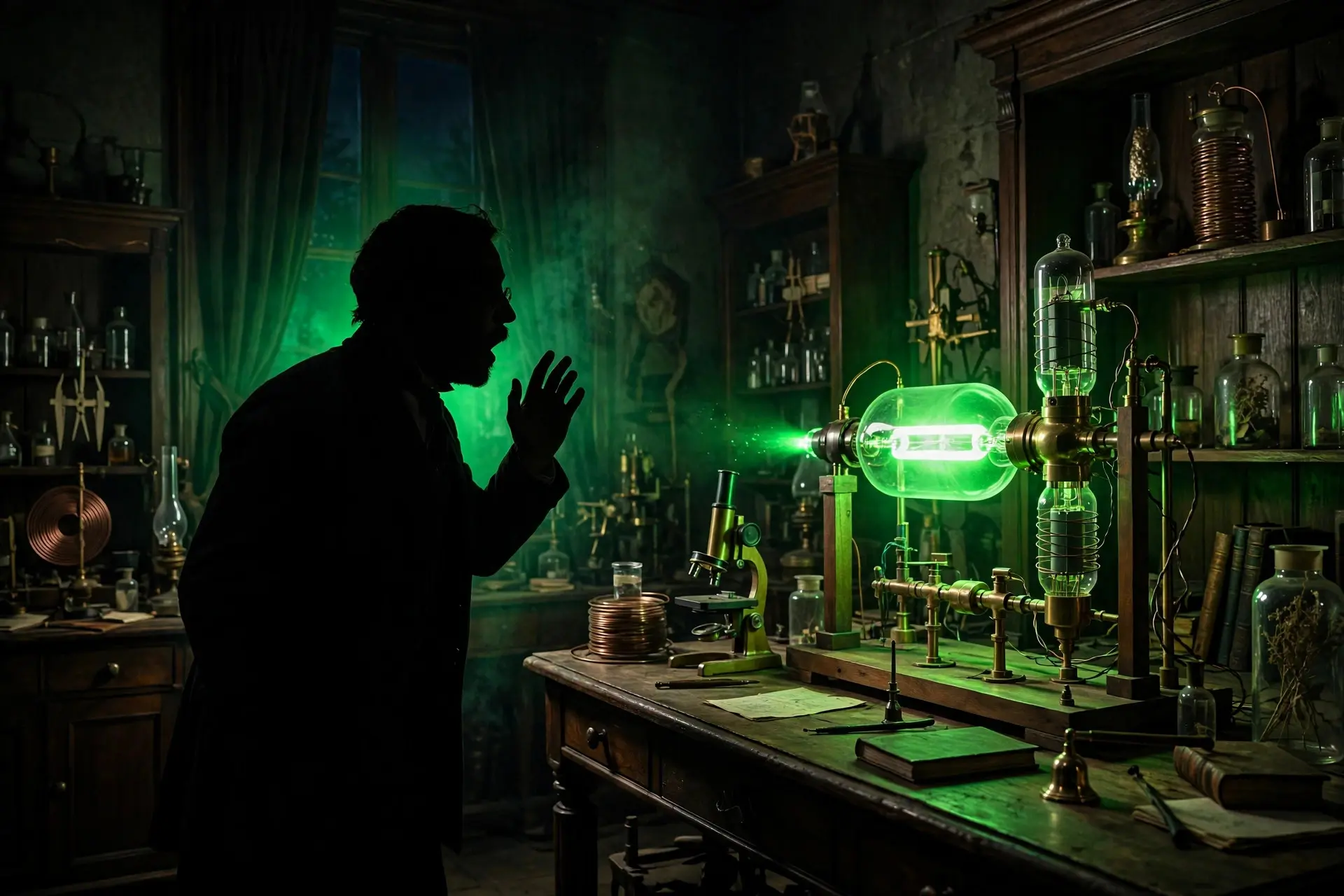
On the evening of November 8, 1895, in a darkened laboratory at the University of Würzburg, physics professor Wilhelm Conrad Röntgen saw something that should not have been happening: a screen coated in fluorescent chemicals was glowing from a bench across the room, even though the cathode-ray tube driving the experiment was sealed inside light-proof black cardboard. No visible light could escape that box — yet the screen kept shimmering. The invisible rays leaking from the tube were the first X-rays, and they were discovered not through a bold hypothesis, but because one man took a stray flicker seriously.
What actually happened that night in Würzburg?
Röntgen was not looking for a new form of radiation. He was studying cathode rays — streams of electrons in vacuum tubes — a fashionable research topic among European physicists of the 1890s. Earlier that autumn he had been repeating an experiment with a Lenard tube, in which a thin aluminium window allowed cathode rays to exit, and a cardboard cover shielded the window from strong electrostatic fields. The cardboard prevented light from escaping, yet he had observed that the invisible cathode rays caused a fluorescent effect on a small cardboard screen painted with barium platinocyanide held near the window. His thought was simple and testable: the Crookes–Hittorf tube, with its much thicker glass wall, might produce the same fluorescent effect. So on that November afternoon he built a black cardboard covering for the Crookes–Hittorf tube, attached the electrodes to an induction coil, and darkened the room to verify the cover was genuinely light-tight. He passed the discharge through the tube, confirmed that no light escaped the box — and then noticed the faint shimmer from a bench a few feet away. Skeptical, he repeated the discharge several times. The glow returned each time. Striking a match, he found it came from the barium platinocyanide screen he had intended to use next. The fluorescence was still visible when he moved the screen as far as two meters from the apparatus. Something was passing through the cardboard — and through the air — that no one had ever described. Röntgen told almost no one. For roughly six weeks he ate and slept in his laboratory, systematically investigating the mysterious radiation. This secrecy was not theatrical; he later admitted he feared colleagues would dismiss his findings. He was an exhaustive experimentalist — the kind of researcher who reviewed his results again and again before publishing — and he needed to be certain.
Why did everyone else miss it?
Here is the uncomfortable part of the story: Röntgen was not the first person to encounter X-rays. He was merely the first to refuse to shrug at them. A few years earlier, Arthur Goodspeed, a physicist at the University of Pennsylvania who also worked with cathode rays, developed some photographs and found disk-shaped shadows on them. Those shadows were cast by coins lying in the path of X-rays — but he never investigated further. William Crookes, inventor of the Crookes tube itself, had returned photographic plates to their manufacturers because they were fogged, not realizing the fogging was X-rays' signature. Only after Röntgen's announcement did Crookes understand what he had been seeing. This pattern — the anomaly photographed, filed away, and forgotten — is what makes the discovery worth retelling. It belongs to the same family as the mold spore that became penicillin and the accidental birth of Teflon: the accidental glow was only half the discovery. The other half was Röntgen's stubborn refusal to dismiss an observation he could not explain. When asked later what he thought at the moment of discovery, he answered with characteristic terseness: "I did not think, I investigated."
How did he prove the rays were real?
Over those six quiet weeks, Röntgen worked out the rays' basic behavior with remarkable speed. He found they passed through most substances — paper, wood, thin metals — while casting shadows of denser materials. Placing objects between the tube and the fluorescent screen, he saw their silhouettes; when he held a piece of lead in his hand, the shadow of his own bones appeared on the screen. On December 22, 1895, he made history's first medical image. He placed his wife Anna Bertha's left hand in front of a photographic plate and exposed it for fifteen minutes. The developed plate showed only the densest structures: the bones of her hand and the ring on her finger. Anna Bertha reportedly exclaimed, "I have seen my death!" — a reaction that captures how supernatural the image must have seemed to a world that had never seen inside a living body.
Röntgen published his findings on December 28, 1895, in a paper titled "On a New Kind of Rays" in the proceedings of the Würzburg Physical-Medical Society — a relatively obscure journal, but one with fast turnaround. Because he did not know what the rays were, he borrowed the mathematical symbol for the unknown and called them X-Strahlen: X-rays. Within weeks of publication, laboratories worldwide confirmed his results. Clinical applications appeared as early as February 1896 — X-ray photography moved from a physics curiosity to a medical tool in under three months. Not everyone was convinced at first. Lord Kelvin, arguably the most renowned physicist alive, initially pronounced the new rays a hoax. He was soon proven wrong, and the discovery earned Röntgen the very first Nobel Prize in Physics in 1901 — the citation referring to his "remarkable rays." An element would later be named in his honor.
Why did Röntgen refuse to profit from X-rays?
This is the part of the story that turns a great discovery into a remarkable character study. Despite urging from friends and colleagues, Röntgen never filed a patent. When he received the first Nobel Prize in Physics, he gave the entire monetary award — fifty thousand crowns, the equivalent of well over a million dollars today — to his university. He held, simply and firmly, that scientific discoveries are the property of all mankind. He also declined the fame that came with the eponym. When the physicist Albert von Kölliker, at a January 1896 demonstration, proposed naming the rays after their discoverer, Röntgen preferred to keep calling them X-rays — and the modest name stuck in most of the world. He rejected a noble title as well, and when his will was executed, his scientific correspondence was destroyed exactly as he had instructed, leaving historians only the published record of one of science's most careful minds. The refusal to patent had a price. During World War I, Röntgen donated his gold and medals to the war effort, and afterward the German inflation of the early 1920s devoured his savings. When he died in Munich on February 10, 1923, he was living in poverty — the discoverer of one of medicine's foundational technologies, having given away nearly all of its financial value to the world. The irony is that the free availability of X-ray technology is precisely why it spread so fast. By declining ownership, Röntgen let hospitals everywhere adopt radiography without licensing barriers — one reason X-ray imaging went from an unknown radiation in a Würzburg lab to a standard diagnostic tool within a decade. The radiation Röntgen described also pointed researchers toward the next frontier of physics: within months, scientists were using X-rays to probe radioactivity, launching a field that would reshape both medicine and physics. But accidents are cheap: Goodspeed and Crookes had the same accidents and learned nothing. What Röntgen added was the rarer thing — six weeks of solitary, meticulous work to turn a flicker of light into a law of nature, and then the rarest thing of all: giving it away for nothing. The X-rays were the accident. The legacy was a choice, made deliberately, in the dark.
Frequently asked questions
How were X-rays discovered by accident?
On November 8, 1895, physicist Wilhelm Röntgen was testing whether a cathode-ray tube was light-tight when he noticed a nearby fluorescent screen glowing in the dark room. He realized invisible rays were escaping the tube and passing through its cardboard covering, and he spent the next six weeks identifying their properties.
Why did Röntgen call them X-rays?
Borrowing from mathematics, where X stands for the unknown quantity, Röntgen named the mysterious radiation X-Strahlen — X-rays — because he could not yet identify what they were. He preferred this name even after others proposed calling them Röntgen rays.
Why did Röntgen refuse to patent his discovery?
He believed scientific discoveries were the property of all mankind, so he took out no patents and gave away the entire monetary portion of his 1901 Nobel Prize to his university. He also rejected a noble title, living modestly until his death in 1923.