How Radio Was Invented: Marconi and the Wireless Age
In 1895, 21-year-old Guglielmo Marconi turned Hertz's laboratory waves into the first practical wireless telegraph — then sent a signal across the Atlantic.

Key takeaways
- In 1895, 21-year-old Guglielmo Marconi sent wireless signals over about a mile and a half — the first practical system of wireless telegraphy.
- He built on Maxwell's theory and Hertz's experiments; the 1909 Nobel Prize for wireless telegraphy was shared with Karl Braun.
- His December 1901 signal crossed 2,100 miles of Atlantic, proving radio waves could span oceans despite the Earth's curvature.
- The 1907 transatlantic commercial service and the 1926 beam station turned an experiment into a worldwide industry.
Radio was invented in 1895 when 21-year-old Guglielmo Marconi sent wireless signals across more than a mile at his father's country estate in Italy. He did not discover radio waves — those had been predicted by James Clerk Maxwell and demonstrated in the laboratory by Heinrich Hertz. Marconi's genius was different: he took that physics and engineered it into the first practical system of wireless telegraphy.
Did Marconi really invent radio on his own?
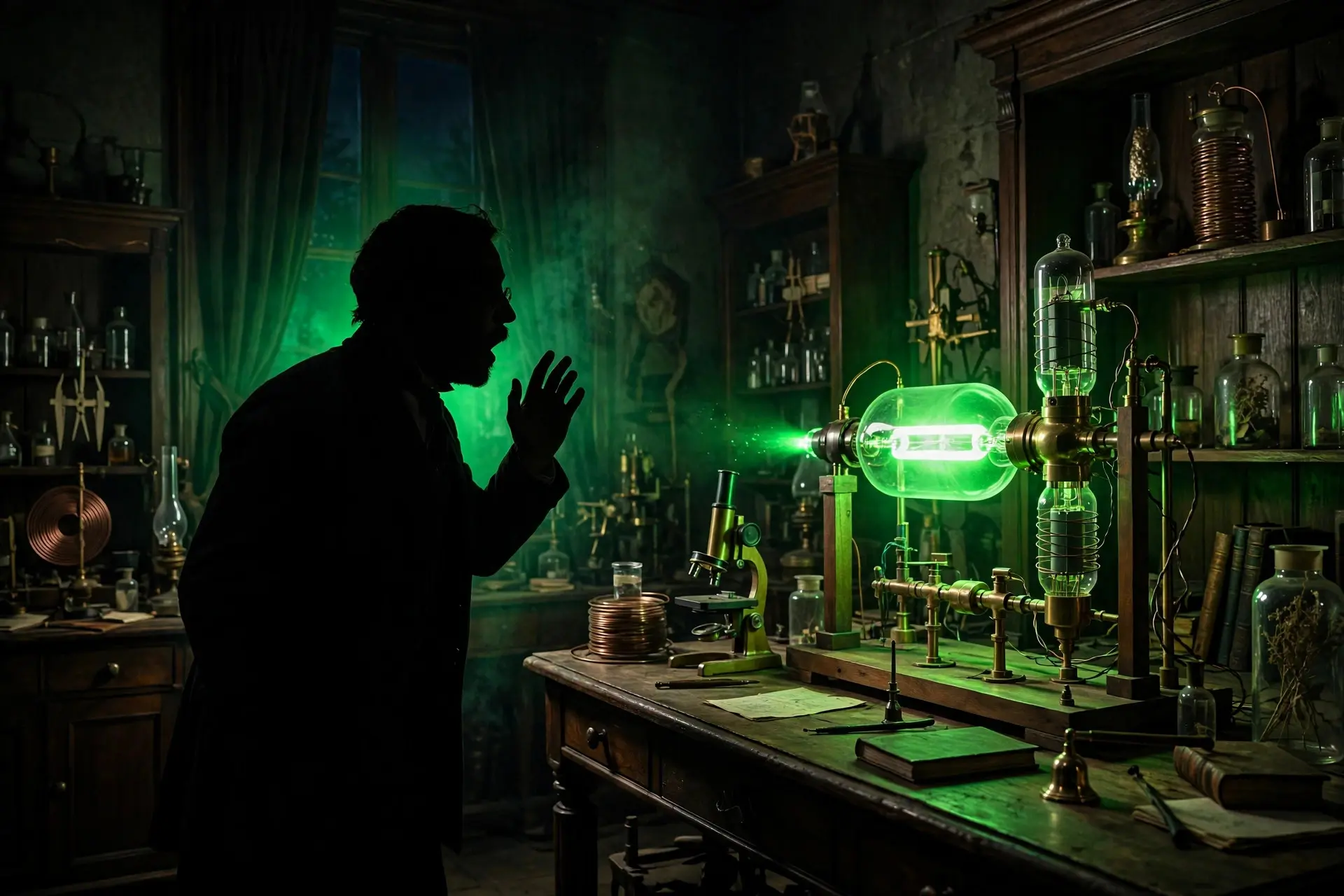
Strictly speaking, no — and the full story is more interesting than the lone-genius version. In the 1860s Maxwell had theorized that electromagnetic waves must exist, and in the late 1880s Hertz had proved them real, generating and detecting them across his laboratory. As a boy, Marconi devoured the works of Maxwell, Hertz, and other electrical scientists; his starting point was their science, not a blank page. What Marconi added was persistence and engineering judgment. While other researchers treated wireless signals as a laboratory curiosity, Marconi — experimenting at the family's Pontecchio estate near Bologna in 1895 — pushed for ever-greater range and reliability. The Nobel Foundation's own history notes that in 1895 he used radio waves to transmit signals over a distance of several kilometers, and that in subsequent years he developed the technology to achieve still greater range. The foundation for both wireless telegraphy and radio had been laid, it says — crediting Marconi as the founder of the application rather than the discoverer of the phenomenon. The Nobel Prize itself recognized this shared heritage: in 1909 it went jointly to Marconi and the German physicist Karl Ferdinand Braun, "in recognition of their contributions to the development of wireless telegraphy." Braun's improved transmitter circuits produced stronger, cleaner waves and reduced interference between stations — without which true long-distance wireless would have stayed a dream.
How did a backyard experiment become a worldwide system?
Marconi moved fast and thought in business terms from the start. In 1896 he took his apparatus to England, where he was introduced to William Preece, the engineer-in-chief of the Post Office. Later that year he received the world's first patent for a system of wireless telegraphy. He showed off the equipment at trials in London, over Salisbury Plain and across the Bristol Channel. To commercialize the invention he founded the Wireless Telegraph and Signal Company in July 1897 — the firm that became Marconi's Wireless Telegraph Company three years later. The distances kept climbing. That same year he demonstrated wireless to the Italian government at Spezia over twelve miles. In 1899 he established wireless communication across the English Channel, linking France and England, and built permanent stations at the Needles on the Isle of Wight, at Bournemouth and at Poole. In 1900 he patented his famous "tuned or syntonic telegraphy" system, patent number 7777, which let stations operate on different wavelengths without interfering with one another. Then came the gamble that made his name. Fascinated by the idea of sending a wireless signal across the Atlantic, Marconi built a transmitter at Poldhu on the southwestern tip of England that was about a hundred times more powerful than anything previously attempted, and set up a receiving station at St. John's, Newfoundland. In December 1901, signals from Cornwall were received across the ocean — 2,100 miles — proving to a skeptical scientific establishment that wireless waves were not stopped by the curvature of the Earth. The improvements kept coming: in 1902, during a voyage aboard the American liner Philadelphia, he demonstrated how daylight affected wireless communication, and that same year he patented his magnetic detector, which became the standard wireless receiver for years. By December 1902 he was transmitting complete messages to Poldhu from stations at Glace Bay in Nova Scotia and Cape Cod in Massachusetts; in 1905 he patented a horizontal directional aerial, and in 1912 a "timed spark" system for generating continuous waves. Marconi kept pushing into deeper waters: the first transatlantic commercial wireless service opened in 1907 between Glace Bay, Nova Scotia, and Clifden, Ireland, and in 1926 the first beam station linked England and Canada. A device that had once spanned a hillside now spanned an ocean.
Why did wireless catch on so quickly?
Because it solved problems that wires could not. Telegraph cables reached across land and under the sea, but ships were cut off the moment they left port. Wireless gave fleets, merchant vessels and navies a lifeline at sea — and navies in particular became eager customers. Every major navy of the era soon carried wireless equipment, and ocean-going steamers treated it as standard fittings within years of the transatlantic breakthrough. It also fed a frenzy of popular imagination. Newspapers reported Marconi's feats alongside Edison's light bulb and Bell's telephone as emblems of an electrified century. And just as X-rays revealed an invisible world inside the body in 1895 — the very year Marconi sent his first signals — wireless revealed an invisible world in the air itself. Within two decades Marconi's company had pioneered the technology behind the radio broadcasting boom of the 1920s.
What happened to radio after Marconi?
He never stopped. In 1932 he opened the world's first microwave radiotelephone link, connecting Vatican City with the Pope's summer residence at Castel Gandolfo, and in 1935 he publicly demonstrated the principles of radar — a technology he had first foretold in a 1922 lecture in New York. He died in Rome on July 20, 1937, at the age of 63, already a figure of worldwide fame. Radio waves turned out to be the same kind of radiation as light — simply with far greater wavelength, as the Nobel Foundation's prize history notes — and the technology that once carried Morse code across the Atlantic went on to carry voices, music and data. The wireless age he launched never ended; it just changed names. Broadcasting, radar, satellite links, and eventually Wi-Fi and mobile networks all descend from the spark-gap transmitter on that Italian hillside. Radio was not the work of one man — it took Maxwell's equations, Hertz's experiments, Braun's circuits and Marconi's relentless engineering to reach the ocean-spanning networks we inherit. But without the young Italian who believed a signal could cross the Atlantic, the wireless age might have waited decades for its champion.
Frequently asked questions
When was radio invented?
The first practical wireless telegraph system was built by Guglielmo Marconi in 1895 at his family's estate near Bologna, where he sent signals over about a mile and a half.
Did Marconi invent radio alone?
No — James Clerk Maxwell predicted electromagnetic waves and Heinrich Hertz proved them in the 1880s. Marconi's achievement was turning that physics into the first reliable, practical wireless communication system.
What was the first transatlantic radio signal?
In December 1901, Marconi's team transmitted signals from Poldhu, Cornwall, to St. John's, Newfoundland — 2,100 miles — proving wireless waves were not blocked by the Earth's curvature.
Who shared the 1909 Nobel Prize with Marconi?
German physicist Karl Ferdinand Braun, whose improved transmitter circuits made long-distance wireless telegraphy practical by reducing signal interference.